

Oh, swell, we’re beginning with a sexual assault already in progress with a side-order of multiple homicide as mad-dog killer Manuel Cass (Cole) threatens some poor girl with a meat cleaver while molesting her. Fortunately, but not timely enough for her parents, explaining that blood on the weapon, the police arrive, save the girl, and arrest Cass, who is subsequently found to be insane and will be indefinitely confined in a criminal mental facility. However, it isn’t long before Cass goes berserk, strangles an orderly and escapes -- rather easily, I might add, by simply walking out the front door. Wow.


Meanwhile, at the palatial abode of Dr. Roger Girard, his wife, Linda (Priest), is about to walk out on her reclusive husband, who locks himself inside his experimental laboratory for days and weeks on end -- a lab she is expressly forbidden from entering. This she confesses to mutual friend, Dr. Ken Anderson (Kasem), fearing her husband might be headed for another nervous breakdown, and hoping this threat will snap him out of his current spiral. Anderson promises to deliver her ultimatum when Roger grants him access to his lab, where he and his assistant, Max (Kroeger), have been hard at work, obsessively grafting a secondary head onto a menagerie of critters; most recently a monkey. The end goal of this? A full, and hopefully successful, human head transplant from one body to another. You know, for science.

Apparently, Girard was fired from the hospital he and Anderson used to work together over that breakdown when no one would recognize his genius. And while he doesn’t seem to be getting any better to me, Anderson is fascinated by these experiments, and after a brief ethical debate on where any test-subjects for this cranial transplant would come from, his friend seems content with the promise that Roger will re-engage with the wife now that this phase of his experimentation are complete.


Here, it should be noted that the perfect candidate for the receiving end of Girard’s experiment -- at least according to his dubious rationalizations, is already living on the grounds: Danny (Bloom), the son of the groundskeeper, is a giant man-child with extreme mental deficiencies. (Think Lenny from Of Mice and Men.) Seems when he was younger, Danny was a victim of a cave-in at an abandoned mine, where he was buried alive for an extended period; and when he was finally rescued, the boy had been starved of oxygen too long, resulting in permanent brain-damage.

Okay, then. Raise your hands if you all see where this is going? For everyone else, hang on as the fugitive Cass winds up at the Girard’s, where he spies Linda sunbathing by the pool and pounces. Her screams bring Roger and Danny’s father, Andrew (Vincent), to the rescue but Cass makes short work of them -- Andrew a little more permanently, and absconds with the girl. When Danny stumbles upon the scene, he collapses beside and cradles his father’s corpse and slowly weeps, begging him to wake up. Meantime, Roger and Max, armed with shotguns, run down Cass before he can rape Linda and fatally shoot him in the back. But instead of calling the Sheriff, these two pack Linda and the body into their car and haul them back to the house, where, at Max’s goading, Roger agrees they now have two perfect specimens to further their experiments.

It should also be noted that Max’s motivations are a tad mercenary, here, as his deformed hands make him another ideal candidate for a head transplant -- once it’s perfected, ‘natch. And so, with a nearly dead homicidal maniac and a near catatonic brain-damaged mongoloid with inhuman strength on their hands, with a little chloroform for Danny and a hefty dose of tranquilizers for Linda to keep her out of the way, Roger officially steps over the point of no return all mad-scientists eventually have to cross. And we all know how that always turns out, right? Right...

By 1970, American International Pictures sure wasn’t what it used to be. Things actually began to fall apart back in 1964, when co-founder Jim Nicholson started an affair with one of his starlets, which ended his marriage two years later in 1966, where his ex-wife received half of his shares in the company in the divorce settlement, meaning he and Sam Arkoff were no longer equal partners. Then in 1969, AIP went public and started having to answer to shareholders, essentially bringing an end to the Pop and Pop endeavor that had been churning out B-pictures since 1954. Now, these two industry stalwarts, who used to dream up titles first and then make a movie to fit the poster art, had been reduced to essentially greasing the wheels, and letting the hired help handle the day to day business of running the studio.

By 1972, Nicholson, never feeling comfortable after the settlement, would be gone, hiring on at 20th Century Fox as an independent producer, and by the end of the year he would fall victim to an undiagnosed brain tumor. “Once Jim left,” said Arkoff, “it changed AIP. And I didn’t really realize it for years. We had some very good people, you know, who were with us for a very long time but there was never a same relationship like there was with Jim. See, Jim and I were equals … It got a bit lonely.” Still, there was a concentrated effort to keep doing things the old fashioned way, sticking to the basic principles that had sustained the company for nearly two decades, which meant churning out genre pictures with gonzo titles like The Incredible Two-Headed Transplant (1971).

Apparently, the script, penned by James Gordon White, had been written some years prior to production, with Vincent Price penciled in for the lead if that’ll help you date it, but it was shelved when this kind of mad science picture fell out of vogue for outlaw bikers, psycho-killers and the living dead. Meantime, John Lawrence had produced the offbeat biker flick, The Glory Stompers (1967), for AIP and got this picture off the ground, which was crewed by all kinds of genre vets, with director Anthony Lanza coming from the fractured flickers of Arch Hall Sr. and Coleman Francis, with a cast and coordinators culled from Al Adamson’s Independent International stable (Cole, Bloom, Gary Kent, John “Bud" Cardos).


And while White had intended the film as kind of a spoof on these kind of Frankensteinian body-part-swap films, I fear something got lost in the translation a bit as Girard’s experiment is a success but then completely backfires when Cass is able to easily assert control over Danny, who commands the simpleton to break loose and he/they escape into the night, where the film takes a skeevy turn as poor Danny is forced to participate in Cass’ continued murder-spree, as he openly sobs while throttling a couple of smoochers they run across parked on Lover’s Lane, and then continues sobbing while beating and drowning a trio of bikers to death in a very one-sided rumble. Seriously, I haven’t seen this kind of gross negligence when it came to a character with mental disabilities since that autistic toddler gunned everyone down at the end of The Candy Snatchers (1973). *sheesh*

And while several eye-witnesses claim a two-headed giant was responsible, the Sheriff (Chester) doesn’t buy it. What he does buy are the large footprints found around the car; and since there’s only one galoot in the whole county who leaves that kinda shoe imprint, the Sheriff heads to the Girard’s, wanting to talk to Danny’s father, where Linda is beginning to suspect that poor Danny didn’t just run off. And as badly as the film treats Danny’s character, ever-suffering Linda isn’t too far behind as she finds herself trussed up and gagged in the lab, unable to alert the Sheriff to her husband’s lies. And she stays that way after he leaves as Roger and Max head out to try and find their runaway experiment before it's discovered by anyone else.

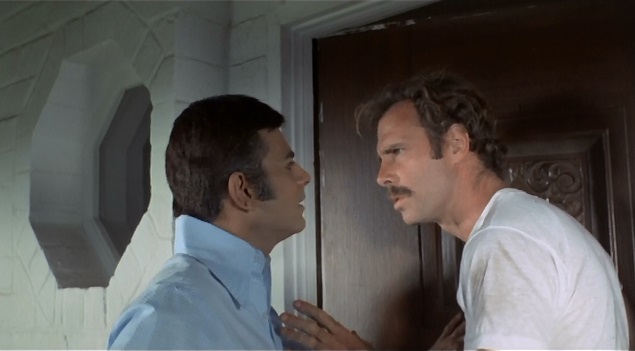

Meantime, Anderson is also given the brush-off by Roger but becomes suspicious by the radio reports of a two-headed giant on a murder rampage and returns to the house, where he rescues Linda. Alas, before they can escape, Roger and Max return. This time, Linda is locked in one of the specimen cages, leaving it to Anderson to talk some sense into Roger, saying all his grand experiment has resulted in is the death of five people. Though Roger seems to be coming around, he still insists his friend must see what he’s done firsthand before judging the end result. And so, Roger, Anderson and Max head out, unaware that Danny and Cass have circled back to the house and have once more run off with Linda. Once they suss this out, they try to beat the Sheriff’s posse to where Danny is most probably headed -- the old mine shaft where he was buried as a kid.

Sure enough, that’s where he and Cass are holed up with Linda. Finally realizing what he is wrought, Roger decides it would be best just to “put his experiment down” but Max won’t let him, wanting Danny’s body for himself. But this is all moot as Danny is done being experimented on and listening to what Cass says, first refusing to attack Linda, and second, by lashing out at those who did this to him. In the resulting melee, the weakened mine-shaft starts to collapse again, burying and killing Max, and pinning Roger, leaving it up to Anderson to get Linda to safety. Once they’re clear, Roger puts two slugs into Danny -- one which takes out Cass’ head, the other cripples Danny, leaving them both to die as the mine finally collapses completely, taking all of their secrets with them.


The Incredible Two-Headed Transplant was one of the last “exploitation” roles filled by Bruce Dern before he went legit. Again, the part was written for Vincent Price and Dern seems oddly out of place at first, aloof, but there is something smartly cold and detached with his take on the character. In his memoir, Things I’ve Said but Probably Shouldn’t Have, the actor admits he wasn’t thrilled with the role and took it solely for the money, $3,500 for two weeks work, planning to use the salary to bankroll his coming wedding. “Andrea and I got married off the money from [the film]. That was the end of my bona fide B days. That wasn’t a B. If you’re going to call The Wild Angels a B movie, this was a Z movie”. However, in a 1978 interview on the Tonight Show, Dern told host Johnny Carson he only got paid half of what he was promised as his second check for $1750 bounced. When he returned to the production offices to get his money, it had already been shut down and abandoned.

Co-star Casey Kasem was a famous Los Angeles radio DJ and cartoon voice actor for those of you under 30 out there (Shaggy Rogers, Robin the Boy Wonder). He had played one of the bikers in The Glory Stompers and The Cycle Savages (1969) with Dern, serving as a producer on both. The adorable Pat Priest was the second Marilyn on The Munsters TV series and, here, have this, uhm, picture of her for, uh, no reason whatsoever.

Lawrence and White would team-up again and would fare better with the follow up feature, The Thing with Two Heads (1972), a blaxploitation spin on the premise which netted a pretty good social satire, where a racist’s head is grafted onto the body of a black convict, with an assist from Lee Frost and Wes Bishop, who had managed to escape from Bob Cresse’s malignant sphere of influence, where they had pitched in on things ranging from nudie-cuties like House on Bare Mountain (1962), to the lurid roughies of Hot Spur (1968) and The Pick-Up (1968) and the Nazisploitation of Love Camp 7 (1969) for Olympic International.

Alas, there isn’t much social commentary in The Incredible Two-Headed Transplant aside from it’s slightly misplaced funk soundtrack, though the haunting, nicotine-scarred love theme “Incredible” by Bobbie Boyle is kind of a trip. No real endgame, either, just a rampaging monster movie; a rampage that doesn’t get going for about an hour. Also, not sure where Lanza picked up that subliminal seizure-inducing editing trick he was trying, with all the single frame inserts, but it didn’t work all that well either judging by the size of my migraine. Still, once the movie does get going I guess it succeeds, as Lanza keeps things humming along rather matter-of-factually. Maybe too matter-of-factually for its own good, though.

What is Hubrisween? This is Hubrisween. And now, Boils and Ghouls, be sure to follow this linkage to keep track of the whole conglomeration of reviews for Hubrisween right here. Or you can always follow we collective head of knuckle on Letterboxd. That's nine down with 17 to go!

The Incredible 2-Headed Transplant (1971) Harlequin Pictures :: Mutual General Corp. :: American International Pictures / EP: Nicholas Wowchuk / P: Volodymyr Kowal, John Lawrence, Ross Massbaum / AP: Alvin L. Fast, Arthur N. Gilbert / D: Anthony M. Lanza / W: James Gordon White, John Lawrence, Ross Massbaum / C: Glen Gano, Paul Hipp, Jack Steely / E: Anthony M. Lanza / M: John Barber / S: Bruce Dern, Pat Priest, Casey Kasem, Albert Cole, John Bloom, Berry Kroeger, Larry Vincent, Jack Lester


