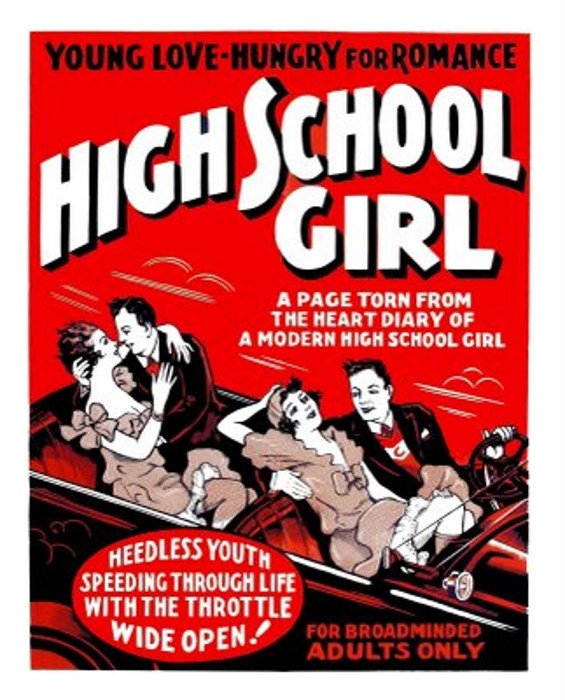
Born in 1906 in Lees Creek, Ohio, Howard W. "Kroger" Babb seemed destined for entertainment immortality -- of the oddball variety, that is. Before he was even twenty, Babb found himself in the "Believe it or Not" bible of Robert L. Ripley for his refereeing skills. And after a brief career as a sportswriter, Babb landed a job as a promoter and publicity director for a string of theaters in his native Ohio, where he honed his skills at cooking-up stunts and promotions to get more people into theaters for some of the less than stellar product on screen. Here, he hooked up with two more Howards, Cox and Underwood, a couple of old-school roadshow entrepreneurs, who were touring a moldy-oldy safe-sex screed, High School Girl (1934), punching it up with a new title, Dust to Dust, and inserting a reel featuring a live birthing sequence, and then capping it off with a lecture by a ringer on the pros of proper hygiene and the evils of sexual intolerance.

It was while heading one of these roadshow troupes that Babb first got the notion of making his own feature to exploit. Using his theater connections, Babb then raised $65000 for the project and arranged to have it shot at Monogram Studios. He even managed to get some clout behind the camera with William "One-Shot" Beaudine in the director's chair and Marcel Picard behind the camera. One week later, a sordid tale of a knocked-up high-school girl and her under-fire sex-ed teacher, complete with his graphic sex-ed inserts, was ready to roll. But first, Babb fine-tuned Mom and Dad (1945) to maximize attendance and minimize any trouble with the local censors and city fathers by pushing the standard moral boundaries of the era to the very precipice without toppling into the crevices of degeneracy below. Barely.

It seems back in those days you could get away with just about anything as long as it was presented as being educational -- and scored extra-points by railing against the ills of society, allowing the promoter to lay those ills bare for all to see as an end-run around the censors. And to get the ball rolling, like an old traveling snake-oil medicine show, Babb would send in an agent first to four-wall the town with promotional materials, handbills, and paid advertisements. Once total market saturation was achieved, the presenter moved in with the film and a bunch of other goodies in tow. See, to heighten things even further, Babb would include a lecture by the noted sexual hygiene commentator, Eliot Forbes, and would have nurses on hand to handle any emergencies if someone became overwhelmed by what they heard or saw on screen -- but what they were really there for was to make a sales pitch for the ancillary sex-ed pamphlets -- complete with diagrams and photos of several victims of varied venereal diseases, available at the concession stand:

___ ___ ___ ___ ___ ___ ___ ___ ___ ___ ___ ___ ___
"They cannot be obtained on newsstands or at booksellers, or anywhere else. No, these books are offered exclusively to the patrons of this presentation at a slight charge over the actual costs of printing and distribution. That price -- on dollar ... Now think of it: for less than the cost of a carton of cigarettes, you can have a set of the vitally important books to be read in the privacy of your won home, and I believe with all my heart that a set of these books belongs on the bedside table of every home in this great land..."
xxxxxxxxxxxxxxxxxxxxxxx -- Eliot Forbes
___ ___ ___ ___ ___ ___ ___ ___ ___ ___ ___ ___ ___
If you bought that load of crap, then you bought yourselves a copy of The Digest of Hygiene for Mother and Daughter or The Manual of Hygiene for Father and Son (-- penned by Babb's wife, and Mom and Dad co-screen-writer, Mildred Horn). Now, I have no idea if those editions were segregated like the audiences were (-- anybody else remember the day in High School Health class when the girls had to go watch a film in the library while the boys had to go and watch one in the cafeteria?). Either way, most of the information in these pamphlets was outdated before they were even printed, and the fact that Babb had 25 different touring companies roaming the country at the same time, each with their very own Eliot Forbes to stump for safe sex never discouraged sales all that much.


But even with the education angle, it's been estimated Babb was sued nearly 400 times over Mom and Dad, with no clear record on how he came out on those. However, after nearly a decade in circulation, Mom and Dad had grossed Babb and his Hygiene Productions an estimated $54 million -- and that's just in ticket sales, so I guess you could call that a definite win. Of course, with that kind of money to be made, several imitators soon followed and the whole Kinsey-addled country was soon inundated with sex-ed films. And, unable to compete with the allure of these features with their current product, those behind the burlesque films and stag loops started pushing the limits on what they could get away with, slowly evolving into the Nudies, then the Roughies, to, eventually, mainstream nudity and sexual content, leaving the battered remnants of the Hayes Code in their wake. All thanks to Kroger Babb, Mom and Dad, and all those Elliot Forbeses.

___ ___ ___ ___ ___ ___ ___ ___ ___ ___ ___ ___ ___
"Nothing's hopeless if it's advertised right."
xxxxxxxxxxxxxxxxxxxxxxxxxxxx -- Kroger Babb
___ ___ ___ ___ ___ ___ ___ ___ ___ ___ ___ ___ ___
Lightning never did strike again for Babb after Mom and Dad, though. His more famous follow ups include trying to cash in on actress Lila Leeds' drug bust (-- along with fellow actor, Robert Mitchum,) with She Shoulda Said No (1949); Karamojia (1954) -- kind of a proto-mondo movie about a blood-drinking tribe of Africans; The Prince of Peace, a truly atrocious religious film out of Oklahoma with the promise of a new Bible for every paying customer; he also chopped-up Ingmar Bergman's Summer with Monkia (1953) and re-packaged as the nudie-flick The Story of a Bad Girl; and last, and least, a badly dubbed Italian version of Uncle Tom's Cabin (1965).

Yeah, that was our boy's last hurrah as declining health and constant tax-troubles over the undeclared money made on all those pamphlets and Bibles caused Babb to bow out of the business, which he turned over to his protege (and one of those many Elliot Forbeses), David Friedmen, who was about to team up with Hershel Gordon Lewis and blaze his own trail of exploitation infamy. Babb's health continued to deteriorate over the next decade, and he eventually passed away in early 1980. As for Mom and Dad, when the old entrepreneur finally kicked the bucket, it was still making the rounds on the drive-in circuit, which I find both beautiful and fitting.
Other Points of interest:
Mom and Dad (1945) Hygienic Films :: Hallmark Productions EP: Barney A. Sarecky / P: Kroger Babb, J.S. Jossey / AP: Lewis G. Dow / D: William Beaudine / W: Kroger Babb, Mildred Horn / C: Marcel Le Picard / E: Richard C. Currier, Lloyd Friedgen / M: Dave Torbett / S: June Carlson, Hardie Albright, George Eldredge, Lois Austin


 The March, 1988, issue of Cinefantastique contains plenty of great articles, including an extensive chat with Dario Argento for a behind the scenes look at the making of Opera, and a review of some forthcoming "effects-laden, off-the-wall supernatural comedy" called Beetlejuice, which the author assures will make a name for some unknown director named Burton. Also featured are Frank Hennenlotter (Basket Case) , Wes Craven (Serpent and the Rainbow), and Stan Winston (Pumpkinhead), and quick-hits on Killer Klowns from Outer Space, The Hidden and Fatal Attraction. But, despite all of that, the reason this issue has been on my radar for such a long time was a pictorial retrospective by Stephen Rebello on "Selling Nightmares" -- or the lost art of movie poster design. And now, finally, I've managed to get my hands on a copy, and well worth the wait doesn't even scratch the surface on this one, folks.




 Catching the eye of several producers, the T-Bucket was in demand and for $50 a day you could rent it for your production -- most notably when Ed "Kookie" Burns got behind the wheel for 77 Sunset Strip, which earned the T-Bucket a new name: The Kookie Kar. As the legend goes, when the car was damaged during a shoot, Grabowski used it as leverage to get himself a job as a stunt-driver, which eventually led to a few bit parts in some Albert Zugsmith cautionary tales [High School Confidential, Girl's Town] and several of Walt Disney's live-action screwball comedies [The Gnome-Mobile, Blackbeard's Ghost]. He, and his easily recognizable mug and crew-cut, even got himself punched out by Elvis a couple of times in a career that netted him over 50 film and TV appearances.
 His glorified cameo in The Cannonball Run in 1981 officially marked the end of his film career, but Grabowski is still in the customizing business, unveiling the Kookie II in 1994, and his hand sculpted shifter-skulls are in high demand. Now in his '70s, Grabowski can still be found, 'rodding around the country and appearing at all kinds of car shows and rallies. And when a friend of mine, both of us huge fans of El Polacko, said he was heading to Wichita for Darryl Starbird's 53rd Annual Exotic Car Show, in which Grabowski would be in attendance, alas, my schedule wouldn't allow me to attend. But, acting as my proxy, my buddy agreed to get his autograph for me.


 I'll try, Norm. I'll try.
