Showing posts with label Antonio Margheriti. Show all posts

Tuesday, December 27, 2016

Happy Holidays :: The 11th Annual All-Night Chistmas Craptacular Movie Marathon Puts You Into Antonio Margheriti's Orbit!


As I noted last year, the problem with traditions is that they just won’t die no matter how many times you try to burn them to the ground and salt the ashes and debris with acid and lime. Thus and so, it was time for some loin-girding as another Annual All-Night Christmas Craptacular Movie Marathon was suddenly upon me, where I celebrate the one night a year the paper I work for doesn’t print, arm up with a turkey sub sammich, a pecan pie, and several bottles of root beer, and tackle a theme specific run of films to help chase away the Ghost of Seasonal Affective Disorder Blues Past, Present and Future.


Now, there was a slight hitch this year in that Christmas fell on Sunday, meaning it was decreed by Caesar that we would have to work Christmas Eve and get a weekend paper out for … reasons. However, we closed out early, HOORAY!, and I finally narrowed down the selection to either an evening facing galactic threats on Gamma-1 or fighting rampaging mechano-robots with the gang of knuckleheads at Special Vehicle Section 2, Division 2. Either way, I win. But I really didn’t decide until I after I put the paper to bed and headed home Saturday night, earlier than even I had anticipated -- a Christmas miracle, to be sure. And figuring three films in the Patlabor universe wasn’t going to cut it, I decided to board a rocket to Antonio Margheritiville and spend the night with some completely bonkers Italian sci-fi space yarns.


A reader of science fiction and comic books since he was a kid, Antonio Margheriti abandoned a collegiate career in engineering in 1956 and embraced his passion for cinema and turned it into a career in the movies. Using his background in building things he soon became a goto guy for miniatures, demolitions, and model-work and other assorted F/X as he also dabbled in screenwriting, which eventually led to his first directing gig, Assignment Outer Space (1960), which he co-scripted with Ennio De Concini, and concerned the efforts to stop a damaged, runaway spaceship (essentially a large nuclear bomb) from colliding with Earth and triggering an extinction level event. Margheriti followed that up with Battle in Outer Space (1961), which is kind of a snoozer, and a crapload of disposable peplum and a few horror films with Barbara Steele, including Castle of Blood (1963) and The Long Hair of Death (1964). All entertaining enough, but extremely derivative from what came before.


That is, his films were derivative, until 1965, when Margheriti put his own personal stamp on a group of films that have come to be known as The Gamma-1 Quadrilogy: The Wild Wild Planet (1965), War of the Planets (1965), War Between the Planets (1965), and The Snow Devils (1965). It always amazed my brain that Margheriti managed to churn out all four fairly ambitious films in less than a calendar year. And upon further digging, I was completely baffled and stupefied to find out the man co-produced, directed, co-wrote, and did the FX for all four films simultaneously, completing the whole sheebang in less than three months; three. Months! This is kinda confirmed as one explores the promotional materials for these films, with photos and scenes from one film showing up in stills and lobby cards for others. Or how the art for some of the foreign posters for one would wind up as the domestic art on the poster for the sequel. It is all very confusing.


Okay, back to the films. Seems after earning himself a reputation for working wonders with a very small budget, MGM came calling looking for some cheap SF product to sell off to television. And so, these films were financed by Hollywood and shot with an eye for American distribution, meaning don’t be confused by those Anthony Dawson credits; that’s just Margheriti’s American code-name. And his end results were pretty amazing and highly entertaining and, dare I say, a little ahead of its time, beating the likes of Star Trek to a few progressive punches. And the films proved so ambitious and better than expected, MGM switched gears and gave all four a theatrical release, starting with the Wild Wild Planet:


In the far-flung future, the United Democracies have conquered space, with outposts on nearly every habitable moon in the solar system, and several rockets and orbiting space stations patrolling around or monitoring the Earth for any signs of trouble. Aboard one of those chrome-donuts with the wobbly trajectory, better known as Gamma-1, Commander Mike Halstead (Tony Russell) has been putting up with some obnoxious corporate muckety-muck by the name of Nurmi (Massimo Serato), head honcho of Chem-Biomed, who specialize in the synthesizing and mass production of replacement parts for the human body -- organs, limbs, you name it, they can grow you a new one. But it soon becomes apparent that Nurmi has another, far more sinister agenda that is already in play that somehow involves Lt. Connie Gomez (Lisa Gastoni), the station’s karate expert, chief communications officer, and Halstead’s on and off again girlfriend. And right now, they’re kinda off; and so Gomez accepts Nurmi’s offer for an all expenses paid trip to some fancy spa that’s under one of Chem-Biomed’s many subsidiary umbrellas.


Meanwhile, down on Earth, people have been disappearing by the thousands under dubious circumstances. And by dubious circumstances I mean they were last seen in the vicinity of a knockout female in the hottest haute couture and some trench-coated, multi-armed creep, who shrink their victims down to doll-size and ship them off to parts unknown. (It’s Italian, just roll with it.) And with the U.D. completely stumped, Halstead is commissioned to take over the case, which breaks when one of these kidnappings goes awry and one of the intended victims only gets half-shrunk. But whenever they almost catch one of the culprits, they seem to disintegrate into thin air, leaving a very disturbing discovery to be made inside an abandoned briefcase.


Eventually, Halstead links the bio-engineered kidnappers back to Nurmi, currently holed up on the artificial planet Delphus, where that secret spa just happens to be located; and where Lt. Gomez has been put through a battery of invasive biological tests against her will in preparation for Nurmi’s endgame. Seems this mad scientist and his Chem-Biomed cronies have hit upon a mad plan to make a new race of perfect beings by splicing a man and a woman together. But these subjects must be a perfect match on some genetic level, explaining all the qualifying abductees. Connie is Nurmi’s perfect match, and they are scheduled to be the first union -- unless Halstead and his two bestest buds, Ken (Carlo Giustini) and Jake (Franco Nero), can cut through some stubborn bureaucratic red tape and rocket to Delphus in time with a rescue party.


Well, I don’t want to give the ending away but the whole gang returns for War of the Planets -- after a quick check on the IMDB proved that came before War Between the Planets. [And please, do NOT confuse this with the nigh interminable Cosmos: War of the Planets (1978).] Anyhoo, this round, seems all contact with Gamma-2 has been lost after reporting a huge spike in radiation readings; and then the investigative team sent to see what happened finds half the crew dead and the other frozen in suspended animation; and then and then the whole station and the rescue party up and disappear. Alas, this emergency kinda throws a wrench in Gamma-1’s New Year’s Eve bash -- and trust me, there ain’t no party like a Gamma-1 party -- even though Lt. Gomez can’t hold her liquor at all.


Meanwhile, down on earth, a Captain Dubois (Michel Lemoine) has been possessed by an alien race of non-corporeal green globs of psychic energy, who translates a message -- more of an ultimatum, to the U.D., offering a symbiotic partnership between Earth and the Diaphonoids for “the good of the whole.” And after the Diaphonoids essentially (and rather easily) render the entire U.D. fleet inoperable, the U.D. has no choice but to buy time, agreeing to the alien demands of sending an envoy to a mining colony on one of the moons of Mars, led by Halstead and his usual gang, where they witness firsthand this merging process, which only works on the most susceptible of human hosts.


Thus, those with sterner constitutions are summarily rejected and put to death. This, of course, will not stand. Thank heavens Halstead bucked orders on flying to Mars unarmed. Those already converted are lost, and Halstead only manages to save six souls and barely blasts off in time before the site is nuked from orbit. 


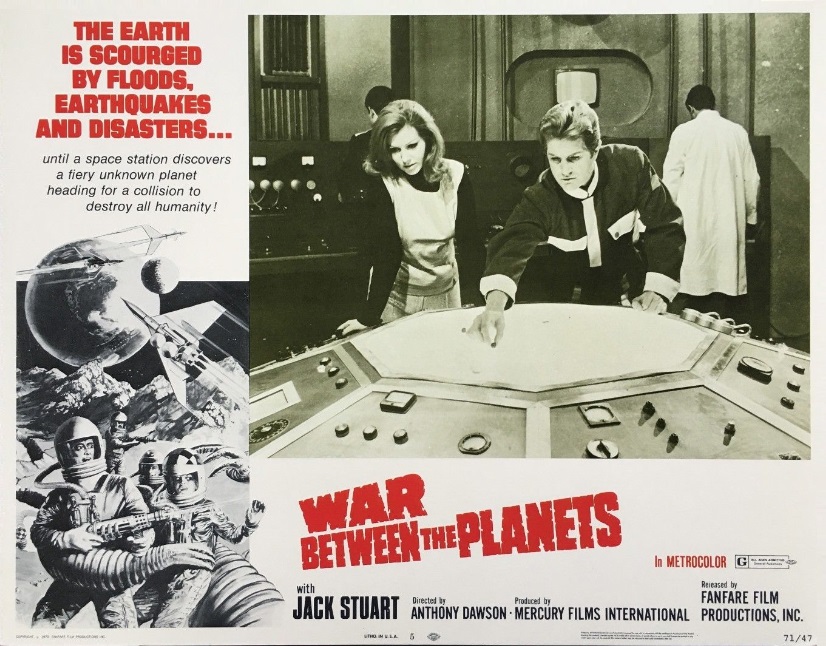
Halstead receives a medal for his actions on Mars, but he must also face a court martial for dereliction of duty and disobeying direct orders, which might explain away his absence in the next feature, War Between the Planets -- also known as the more appropriately titled, Planet on the Prowl. Titles aside, the action picks up with the crap already hitting the fan as the Earth is besieged by catastrophic earthquakes and bizarre weather patterns. The effect is eventually traced to a cause: a rogue runaway planet has entered the solar system and is on a current crash-course with Earth, and whose radiation bursts and magnetic discharges explain away all seismic destruction and apocalyptic weather.


And with the fleet devastated in the last installment, all that stands in the way of Earth’s total destruction is the crew of the Gamma-1, now under the command of Commander Rod Jackson (Giacomo Rossi Stuart -- who looks like the end result of Elvis Presley and George Reeves having a baby), who, along with his right hand man, Perkinson (Goffredo Unger), and his sort of girlfriend, Lt. Teri Sanchez (Ombretta Colli), launch an expedition to intercept the planet and destroy it. 


Upon arrival, while planting the antimatter explosives, it is discovered that the entire planet is one sentient being that tries to absorb our heroes after they crawl inside one of its sphincters for guesses that are as good as mine. And with the sacrifice of the few, and a few good whacks with an axe, the many are saved as the prowling planet is powdered permanently.


Alas, the weather is still acting screwy in The Snow Devils; only this time the cause is traced to a rise in global temperatures and the melting of the polar ice caps. The source of this disruption is traced to the Himalayas, where it just so happens a U.D. weather observatory has just been wiped out. Wiped out by what? Well, all physical evidence points to an attack by -- wait for it -- yetis. And not just any yetis but -- waaaaait for it -- ABOMINABLE SPACE YETIS! That’s right, Space Yetis are trying to conquer the Earth with Global Warming. All in an effort to cover the planet in water so they can then freeze it into one large planetary glacier before they can colonize.


Sniffing all of this out is Commander Jackson again, who leads an expedition into the mountains with his buddy, Perkinson, even though he sort of died in the last film. (Oh, no, wait. Same actor but he’s a different character now. And, wait, the gal who played Lt. Sanchez in the last one is now a different character, too. And her old character is played by her romantic rival from the last movie. Wait. What? *eyegitty* *eyegitty* *eyegitty*) And while Jackson gets the head Space Yeti to monologuing, revealing their grand plan, and manages to destroy their outpost on Earth, the polar ice is still melting and people are still drowning until they trace the cause to one of Jupiter’s moons, where the Space Yetis have another advance base. And so, Jackson, Not-Perkinson, and New-Sanchez ride a slow rocket to the gas giant and paste the moonbase from orbit without being drawn into any orifices, thus, saving the day.


And while that adventure closed out the Gamma-1 Quadrilogy, our marathon wasn’t quite over yet. For you see, a couple of producers and screenwriters on the series (Walter Marley and Ivan Reiner) essentially pulled up stakes from Italy and moved to Japan to team up with Kinji Fukasaku and one more space adventure with -- sing it with me -- The Green Slime (1968), which essentially takes place in the same whackadoodle universe; it just moves the action from Gamma-1 to Gamma-3 and then kinda mashes up all the plots of the first four films into one giant ball of awesome covered in awesome sauce. 
 

It begins with the detection of a rogue, extinction-sized asteroid barrelling toward the Earth. And so, Earth Space Command sends Commander Douche McAsshat (Robert Horton) to lead an expedition to blow it to smithereens. Internal conflict comes from an unresolved love triangle between McAsshat and Gamma-3’s current Commander, Vince Elliot (Richard Jaeckel), over the station’s chief medical officer, Dr. Lisa Benson (Luciana Paluzzi). (Hell, who wouldn’t fight over her?) 


Luckily, the Earth’s imminent demise allows these three to get along long enough to destroy the asteroid in time. Unfortunately, someone got some alien snot on his uniform. And once it gets back to Gamma-3, this glob of snot feeds on the radiation used to decontaminate the suit and morphs into a multi-tentacled, multi-eyed, and energy-bogarting monstrosity that also spores out whenever it is injured and so even more creatures spring from its blood!


And so, the station is soon overrun by horde of Green Slimers, leaving the other human occupants in a battle for their lives as they fight a delaying action, destroying half the satellite as they try to hold the creatures off long enough to get everyone else evacuated, leading to one bugnutz of a climax and final battle as that love triangle solves itself when Elliot sacrifices himself to save McAsshat, who is the last one out, setting the Gamma-3 on a crash-course with Earth’s ionosphere, where it and the monsters burn up in reentry. And then the movie plays us out with the reprise of the most kickingist theme song of ever!


Hole. Lee. Crap. But I do love these movies. Like a lot. I mean, A LOT, a lot. Sure, the films are grounded a bit and anchored by what the swinging 1960s thought the future would look -- from fashion, to furniture, to transportation, to architecture -- but to me, that’s half of the films' charm. And it feels like a breath of fresh air as we move past the projected dates of these films, where we fail to pass muster as far as I’m concerned and the planet is bled dry and our own parasitic pursuits only hasten along our own demise. So, yeah, give me this kind of prognosticative wackiness and retro-designs any day of the week, please and thank you.


It’s also kind of amazing how representative these films were. Sure, all the main players were your usual blundering and gung-ho white guys, but Gamma-3 was populated by many races and manned by both genders, with females serving as rocket pilots, technicians, and security personnel. And sadly, the total white-washing of The Green Slime really brings the inclusiveness of the other films into a very sharp focus.


Of the first four I would say they get progressively -- not worse, but less good as they go. Most of that, I think, is a personal preference for Tony Russell and Lisa Gastoni, and the comedy relief of Franco Nero, over Giacomo Rossi Stuart, his concrete pompadour -- that kept losing its structural integrity in a few spots, and his revolving cast-mates -- though I do have a soft spot for portly Goffredo Unger, who appears in all four films and kinda comes off as this franchise’s Patroni. And did I mention Lisa Gastoni? Because she is so adorable I can't even even.


I LOVE YOU, LT. GOMEZ!

Add it all up and these things are completely nuts in concept and execution with rousing battles followed by drinking and dancing in the space bar. They’re also delightfully gruesome in spots, as the body counts are quite staggering. And as I watched them play out again, I got to thinking at how sparse and economical these things are with fairly no frills, taking advantage of several futuristic looking locations for added production value. 

These things were made on the cheap, it shows, but Margheriti makes sure things moved fast enough that it doesn’t show too much. And the end result is a ton of fun to watch. But it did get me to thinking about what these things would’ve looked like if Margheriti had been given a little more time and a little more money. And the smile on my face while I contemplated this as I shut the TV off, put the DVDs away, and went to bed was large indeed.


And with that, I wish you all a Merry Christmas, Happy Holidays, and a Joyous New Year, one and all! Or, Bah! Humbug, where applicable. And see ya’ll next year for the 12th Annual All-Night Christmas Craptacular Movie Marathon. Until then, Boils and Ghouls, stay cool! 

Sunday, October 30, 2016

Hubrisween 2016 :: Y is for The Young, the Evil and the Savage (1968)


Taking a break from packing her unmentionables into a large steamer trunk, a woman fiddles with her radio, finds a station she likes, and then retreats into the bathroom, where her tub is almost full. When maximum bubble depth is reached, the woman strips and hops in. Meanwhile, someone with black-gloved hands is currently cranking up the volume on that radio. Why? To drown out the noise while this dastardly mystery guest sneaks into the bathroom and strangles the poor woman, holding her underwater for a spell, too, just to be sure she’s dead.


The killer then unceremoniously pulls the naked body from the tub and then roughly stuffs the corpse inside that trunk and seals it shut. From there, the trunk goes on a mini-Hitchcockian adventure as it keeps switching unwitting hands as it’s first loaded on-top of taxi, which takes it and the still unseen killer to the train station, where it barely has time to be loaded onto the luggage car before the train departs.


Upon reaching its destination, the trunk is soon lost in a jumble of similar containers; all tossed on the roof of a van, which is also carrying several potential suspects -- sorry, I mean, several teachers returning from an extended holiday break to St. Hilda’s Academy, an exclusive continental boarding school for girls -- well, except for Mrs. Clay (Lvova), who has just been hired on. Also along for the ride are Di Brazzi (Benedetto), the gym teacher and swimming instructor; Richard Barrett (Damon), the riding instructor; La Floret (Pogozzi), the head groundskeeper; and Miss Martin (Masing), who fills Clay in on the general workings of the school, and how most of the teachers and students are still on break, leaving only a handful of strays at the Academy. She also warns the new governess that the “Bug House” -- a small domed building, which houses the eccentric biology professor's menagerie of flora and fauna, is essentially the designated campus make-out spot. So if one of her charges goes missing, best to check there first.


Meanwhile, since this is a European girl’s school we find what few students remain lounging by the pool; about ten in total. Lucille (Brown) is very excited that Richard is returning so they may continue their illicit (and slightly skeevy) affair. Now, there is a bit of a jealous rivalry between her and Betty Ann (Trentini), Richard’s star pupil, for his affections, compounded by Lucille’s irrational fear of horses. And then there’s the ever perky and constantly wisecracking Jill (Smith), who is currently enamored with a new present from her father: a pair of walkie-talkies, which she intends to somehow incorporate into her mystery writings; the heroine of which is a master spy.


When the van arrives, they are greeted by the headmistress, Mrs. Transfield (Stapleton), who instructs Floret to just store all three (shockingly similar) trunks in the basement of the main building for now. She also reminds Richard that any *ahem* fraternizing with the students is strictly verboten, which essentially goes in one ear and out the other as he immediately meets up with Lucille in the Bug House, where we find out how much they really missed each other. (Hint: it was a lot, but she more than he -- he typed ominously.) 


Later, as things settle down, someone with a squeaky pair of shoes prowls around in the basement, whose unseen owner moves to make sure a certain trunk is still secure. But the killer is interrupted by Betty Ann. Apparently, one of those arriving trunks was hers, and in the low-light she accidentally tries to open the wrong one -- it's the last mistake she’ll ever make...


With The Girl Who Knew Too Much (1963 -- released in the States as The Evil Eye) and Blood and Black Lace (1964), Mario Bava not only established a genre but then successfully redefined it. Deriving its name from the yellow-tinted covers of the lurid paperbacks on which many of them were based, the giallo (yellow) is kind of hard to define and yet easy to differentiate from your standard and more conventional European thriller. The main difference is they tend to be more focused on the “how” instead of the “why” as their Rube Goldbergian plots start to unravel, with a protagonist seeing something they shouldn’t have, usually a murder, and then getting in over their heads as a seemingly unstoppable chain of events, usually made worse by the protagonist’s efforts to stop them, play out, again, usually leading to more bodies and more confusion, false leads and a metric ton of suspects.


And just when things seem to be coming into focus, nine times out of ten the investigation is focusing in the wrong direction, making it nearly impossible to decipher what’s really going on until the climactic reveal. And as the genre evolved, it became bloodier and more psycho-sexually motivated, meaning more graphic carnage and nudity wrapped up in a pretty pop-art, candy-colored shell.


Always the catalyst, perhaps Bava was trying to change the genre yet again when he teamed with British screenwriter, Tudor Gates, with whom he had recently collaborated with on Danger: Diabolik (1968), for Cry Nightmare, which was intended as comical spoof on the genre conventions he helped establish as a killer systematically works his way through the students and faculty at an all girl’s school. Unfortunately, the producers weren’t really looking for any kind of experimentation and just wanted the same old same old same old; and so, Bava was soon ousted and Antonio Margheriti was brought in, who reworked the script with Franco Bottari and Giovanni Simonelli and rechristened it, Nude... si Muore, which translates into Die Naked or Naked You Die (1968).


A journeyman director who went where the current box-office breeze blew him, be it science fiction, horror, musclemen and Styrofoam boulders, spies, or westerns, Margheriti -- usually credited as Anthony Dawson, seemed to finally find his true niche with delightfully gonzo space adventures of the crew of Gamma-1, beginning with The Wild, Wild Planet (1966), which was followed up with War of the Planets (1966), then War Between the Planets (1966), and finally, The Snow Devils (1966) -- and please note all four of those were shot and churned out in one calendar year. Wow. 


Anyhoo, considering its country of origin, the normal genre conventions, and salacious title, Naked You Die is a rather chaste and bloodless affair (-- even the opening murder only shows a little rear-end due to some strategic bubbles), as the killer’s choice of weapons is manual strangulation.


And who is it that’s doing the strangling? And why? Well, things begin to unravel as the search for the missing Betty Ann intensifies. Since she was last seen heading to retrieve her trunk, the over-imaginative Jill has already pegged Floret, the man in charge of such things, as a murderer. And while all the girls are confined to their rooms, Mrs. Transfield calls for one more search of a nearby park by the staff before calling in the police, leaving Mrs. Clay behind to make sure her charges stay put. 


Asking permission to take a shower, Lucille uses this as a ruse to cover her escape so she can meet up with Richard again. This she does, sneaking out the bathroom window, only he’s not in the Bug House and, instead, she finds Betty Ann’s body and screams. Running into Richard on the way out, she tries to show him the body but it's now gone. Of course, he doesn’t believe her.


Lucille's screams also alerted Mrs. Clay, and so, with his own hide on the line if they get caught, Richard runs interference, allowing Lucille to sneak back into the dorms the way she got in. To cover her tracks, she still needs to take that shower. Unfortunately, a loud noise from outside frightens her off. Turns out this was just that pervert, Floret, pulling a Belushi from a nearby tree, who got a little too excited at the free show and lost his balance. Meantime, Lucille left the water running, which draws in a curious Cynthia (Longo), who decides to not let the hot water go to waste. This, too, is the last mistake she’ll ever make. 


But this time the killer is unable to remove the body before it's discovered by Jill, who, again, thinks Floret is the killer, knowing full well he likes to hide in the trees and watch them bath. But Floret didn’t kill anybody; he did, however, see the real killer, which is why he is found later, when the police are finally called in, impaled on his own scythe.


While questioning Jill, Inspector Durand (Rennie) is shown a dress found at the crime scene. Jill recognizes it belongs to Lucille. She also asks to help out with the investigation, and when rebuffed decides to solve the case on her own, starting with planting one of her walkie-talkies in Durand’s makeshift command post as an ersatz listening device. Lucille, meanwhile, is convinced someone is after her and is packing to runaway with Richard. She’s supposed to meet him at the pool around 3am but when words comes Durand wants to question her next, she makes her friend Denise (Valturri) go in her stead to explain the delay to Richard. Again, he’s a no show but someone else is.


And yet this isn’t quite the last mistake Denise makes as the killer, decked out in some scuba gear, attacks and tries to drown her in the pool. See, luckily for Denise, a suspicious Jill was listening in on Lucille’s interrogation, heard about the pool rendezvous, and decided to check up on her. Diving in after them, Jill manages to fend off the killer, who flees into the woods, saving the other girl. Sweeping the park the police find Di Brazzi in half of a wet-suit, who claims it’s all part of his weight loss regimen; they also find Betty Ann’s body.


Okay, if it wasn’t obvious enough already, I think it’s safe to say Lucille is the killer’s real target. As to who and why, Durand thinks it’s financial, knowing Lucille is about to come into a large inheritance on her 18th birthday, which is currently being controlled by a distant cousin. But Lucille isn’t so sure, thinking maybe the ever-elusive Richard is getting a case of cold feet and wants to get rid of her and keep his cushy job. As to why would the killer bring that first body to the school? Well, the short answer is he needed it.


See, when the police find another body in a lime-pit near the school, the face is disfigured beyond recognition but her clothes and ID say it’s Mrs. Clay. They also find a shocking piece of evidence in her room: a written confession, saying she killed them all and then committed suicide in shame. 


Lucille, meanwhile, has decided to give Richard one more chance, sneaks off, and heads to a neighboring house where he’s hiding out. She spies him through a window and heads inside, only to discover he’s dead -- well, almost, and being puppeteered by her cousin, Pierre (Lvova again), who shoves the body down some steps, and then gives chase, looking to stab his niece to death, too.


Yeah, turns out that first victim was the real Mrs. Clay, with Pierre taking over her identity to get close to Lucille and kill her, then get away with it by framing the corpse for a murder-suicide, making him the sole beneficiary of all that money. Again, the inspector had this pegged from the get-go but Jill is the one who winds up saving everyone’s hash; once more spoiling the killer’s plans by going all Nancy Drew and trailing Lucille, putting herself in the right place at the right time to prevent another murder, never hesitating, putting herself in mortal danger, and saves the day long enough for Durand to wrap things up.


Co-financed by the Woolner Brothers, who had successfully imported Bava’s Blood and Black Lace, Naked You Die was released domestically by American International Pictures as The Young, the Evil and the Savage (1968), which I can only guess is a wild and shameless grope on the name recognition of The Good, the Bad and the Ugly (1966). It also saw a release under the alternative titles Schoolgirl Killer and The Mini-Skirt Murders. Anyhoo, AIP chopped nearly twenty minutes out of the original cut, which, having only seen the original Italian version, might’ve helped instead of hindered as the film does get kind of repetitive in spots and definitely could’ve used some tightening up.


As it plays out, Naked You Die (1968) honestly feels more like one of those hair-brained krimis that Constantin-Rialto were constantly churning out in Germany at the same time, which were based on the byzantine plots of author Edgar Wallace, where investigators tried to unravel the serpentine schemes of some master criminal to save some hapless heroine from either being cheated out of her rightful inheritance, being sold off to a white slavery ring, or getting her head chopped off by some guy dressed in a gorilla costume. Here, Pierre’s plot of carpet-bombing the school with bodies to obscure the real target would’ve fit right in, though in hindsight the character was obviously dubbed over by a man and played by a woman who was pretending to be a guy pretending to be a woman with mixed results as they try to give the whole game away in the first reel.


And while Bava was kicked off the production early you can still sense his presence and influence in the film when it comes to set-ups, shots and color schemes. The eerie location was maximized beautifully, and kudos to the costume and wardrobe department for all those wonderful and varied but still matching school girl uniforms. The film’s headache-inducing soundtrack by Carlo Savina also appears to be Neal Hefti’s Batman TV-suite with the serial numbers filed off -- only instead of horns it’s a harpsichord, meaning he probably owes Vic Mizzy an apology as well . And while the comedy-spoof angle was aborted, the film still comes off with a soft touch -- juvenile even, which will probably disappoint most genre fans, especially those drawn in by that salacious title.


So, yeah, when first encountered this flick wasn’t what I expected at all. But after some adjustment I did wind up liking it a whole lot. And I especially loved the wild card amateur sleuth angle that Jill represented, played beautifully by Sally Smith, who is so freaking adorable I can’t even even. Say what you will about her sticking her nose where it doesn’t belong, but I love how tenacious and proactive she is, diving into danger with only minimal hesitation. (Mostly so she can make a wisecrack at her own expense. The film later reveals this might all be due to family genetics as Jill’s 00-father proves to be an international spy who just happens to drive an Aston-Martin.) 


And credit to the police, too, who are on the ball from the get go; as it was at their insistence on elimination prints from the staff and finding the real Mrs. Clay so fast, which really screwed the pooch on the killer’s timetable, that allowed Jill’s window of opportunity to be the heroine -- with a little help from the not quite dead as we thought Richard, who, between you and me, was kind of a slap-happy creep.


I guess a departure from the norm best sums up Naked You Die / The Young, the Evil and the Savage. It’s also brings the mystery of “whodunit” back to the forefront, with lots of plausible suspects and motivations, which is usually lost in the blood, boobs and gore of its contemporaries and would become even more lost as the genre progressed / devolved into the 1970s. For while Bava always seemed more interested in the act of killing and the “angels in the wreckage” of the aftermath, Margheriti seemed more interested in motives and detection of what led to these terrible acts and preventing them, which kinda makes you wonder how awesome and actual bona fide collaboration between Bava and Margheriti would’ve turned out. Alas, this is as close as we’ll ever get.


What is Hubrisween? This is Hubrisween. And now, Boils and Ghouls, be sure to follow this linkage to keep track of the whole conglomeration of reviews for Hubrisween right here. Or you can always follow we collective head of knuckle on Letterboxd. That's 25 down with only one more to go! Can you believe? I sure can't!


The Young, the Evil and the Savage (1968) BGA :: Super International Pictures :: Woolner Brothers Pictures Inc. :: American International Pictures / P: Virgilio De Blasi, Lawrence Woolner / D: Antonio Margheriti / W: Antonio Margheriti, Giovanni Simonelli, Mario Bava, Franco Bottari / C: Fausto Zuccoli / E: Otello Colangeli / M: Carlo Savina / S: Mark Damon, Eleonora Brown, Michael Rennie, Sally Smith, Patrizia Valturri, Ludmila Lvova, Luciano Pigozzi, Vivian Stapleton, Ester Masing, Giovanni Di Benedetto, Malisa Longo, Caterina Trentini
Related Posts Plugin for WordPress, Blogger...