Showing posts with label Celluloid Zeroes. Show all posts

Sunday, April 2, 2017

The Celluloid Zeroes Proudly Present: Russell-Mania, Where We Go Trippin' with Ken Russell's Altered States (1980)


___  ___  ___  ___  ___  ___  ___  ___  ___  ___  ___  ___  ___  ___

“We’ve got millions of years stored up in that computer bank we call our mind. We’ve got trillions of dormant genes in us; our whole evolutionary past. Perhaps I’ve tapped into that."
___  ___  ___  ___  ___  ___  ___  ___  ___  ___  ___  ___  ___  ___

Truth told, as a character, Dr. Edward Jessup would fit right into the well-meaning but ultimately misguided mad scientist mold of the 1930s through the 1950s, whose cinematic pursuits into the unknown and target fixation found them tampering in Domains beyond their understanding, consequences and social obligations be damned as long as they see these damnable experiments through to the bitter end and find the answer to the question they seek. Here, Jessup (Hurt), an abnormal psych professor working with schizophrenics, latches onto a theory that our “other states of consciousness are as real as our waking states.” And to explore this further, Jessup, with the help of his assistant, Arthur Rosenberg (Balaban), starts experimenting with a sensory deprivation tank, hoping this isolation and resulting hallucinations will help him tap into the other side and make it manifest.


At this point it isn’t really clear what exactly Jessup’s endgame is but he soon becomes obsessed with the spiritual and religious overtones of the visions he has while free-floating in a salt solution in the dark. (Apparently, as a child, Jessup was prone to these type of hallucinatory spells, which intensified after the death of his father before eventually fading, and he’s been trying to tune back into these ever since.) Eventually, he at least tries to put into words what he is trying to achieve to a young and attentive anthropology student named Emily (Brown), an intellectual equal, who soon becomes smitten with the eccentric Jessup. And as a seemingly one-sided romantic spark ignites, topped off by some wild sexual encounters, this eventually finds the absent-minded professor, against his better judgment (-- he even warns Emily that he finds the concept of love frivolous in a 'this does not compute' sense and will never be able to connect with her in that way), abandoning his mission for a spell, committing to a marriage with Emily because there just seems to be an unquantifiable “somethin’ somethin’” about this woman.


Alas, this anchor isn’t enough to keep Jessup focused forever and his obsessions soon start to preoccupy him again; and despite raising two toddlers (-- the eldest around seven), a divorce appears to be imminent after a trial separation, where Emily will take the children with her to Africa for an extended study of primates while Jessup takes a trip to Mexico to witness an ancient ritual, where a certain indigenous tribe that dates back to the Toltecs partake of some potent magic mushrooms, which they call the First Flower, and experience a mass hallucination, where they all essentially experience the exact same visions. 


Once there, it doesn’t take much to convince the tribal elder to allow Jessup to actively participate in the ceremony, which includes adding his own blood to the potent peyote confection before consuming it. This, the elder claims, will allow the participant to get into touch with the Original Being.


What happens next is an elaborate, intense, and regressive assault of images as Jessup tunes into something else entirely. These images include all kinds of religious iconography, including nods to Adam (Jessup) and Eve (Emily) as they are returned to clay and slowly disintegrate into dust. But then things devolve even further, and the images grow more unstable, strange and violent. And when Jessup finally comes out from under the influence, he wakes up next to the rendered remains of a large lizard he apparently disemboweled and tried to consume with his bare hands and teeth. 


Freaked out, but determined to try and replicate this experience in a controlled environment, Jessup fine tunes his theory a bit, feeling with the right stimulants and surroundings, the body and mind, a collection of molecules and atoms that date back to the Big Bang and the birth of the universe, can regress and reconstitute back to this primordial state. And to prove this, he manages to secure a bottle of this magic elixir to take back to the States, where his deprivation tank and untold truths await to be tapped into an uncovered. And just like with all those other mad scientists of yore, this quest is destined to go awry with drastic consequences for Jessup and those closest to him...


Based on a novel written by Paddy Chayefsky, the production history of Altered States (1980) was nearly as sordid and feral as it’s main character’s violent hallucinations. Along with Rod Serling, Chayefsky was one of the most renown playwrights and screenwriters from the Golden Age of Television and was integral player in bringing “kitchen sink realism” to the small screen in the 1950s. This success also translated to the big screen when several of Chayefsky’s plays and teleplays were adapted into motion pictures, most notably Marty (1955), and he would go on to win two original screenplay Academy Awards for The Hospital (1971) and Network (1976).


Inspired by the work of John C. Lilly, a pioneer neuroscientist and researcher on the nature of consciousness while using a combination of psychotropic drugs and isolation tanks (-- a contraption of Lilly’s own invention), Chayefsky wrote his one and only novel, Altered States, which concerned one man's search for his primal self through these same means. The title refers to an altered state of consciousness, which is also referred to as an altered state of mind, which is any state that is significantly medically different to a normal waking state. This term was popularized around 1969 when Charles Tart used the expression to describe induced changes in a person's mental state.


Later, Lilly would claim a good chunk of Chayefsky's book was “borrowed” wholesale from his own novel, Dyadic Cyclone (1976), and a as of yet unpublished manuscript (-- later published as The Scientist in 1978), which described one of his ‘under the influence’ test-subjects regressing into an ape-like being, jumping up and down and hollering for twenty-five minutes. The subject in question would later testify that he “became a pre-hominid” and was in a tree, where a leopard was trying to get him, and so, he was trying to scare it away. Now, apparently, both Lilly and Chayefsky shared the same publisher (Bantam), and Chayefsky, through the publisher, asked permission to read Lilly's draft. Lilly agreed but only if the other author called and asked him personally. The call never came, but the evidence in both the book and the adapted film has convinced Lilly that Chayefsky most probably read his manuscript.


I’m not sure if Lilly was “the researcher” who sued Chayefsky over the book but someone sure did, and the stress of this on the author triggered a heart attack in 1977. But despite these health issues and legal hassles, the book was finally published in 1978 and was soon optioned by Columbia Pictures for a big screen adaptation. Chayefsky would adapt the screenplay himself, Daniel Melnick would produce, and it was originally slated to be directed by Arthur Penn (1967s' Bonnie and Clyde and 1970s' Little Big Man), who had worked with Chayefsky in New York during the live television era, with elaborate special effects provided by John Dykstra -- fresh off of Star Wars (1977) and Battlestar Galactica (1978), and special make-up appliances by none other than the legendary Dick Smith (-- with an uncredited assist from Rick Baker).


But as the proposed budget to pull the F/X off bloomed to over $15 million, coupled with a cantankerous falling out between Penn and Chayefsky, which ended with Penn quitting the production, Columbia got cold feet and pulled the plug. But Altered States didn’t stay in turnaround for very long, with Warner Bros. stepping up when Melnick and Chayefsky announced they had found a replacement for Penn: Ken Russell.


“I know my films upset people,” said notorious British film auteur Ken Russell. “I want to upset people." After serving a hitch in the Merchant Navy and the Royal Air Force, Russell’s initial career choice was to be a classical ballet dancer. When that didn’t pan out, he fell back on his childhood love of film and took his resume of short films to Huw Weldon at the BBC, who immediately hired him to replace John Schlessinger. Russell would work for the BBC for nearly 10 years, churning out 34 films. But even on the small screen, the director’s flamboyant propensity for brutality, the profane and the perverse, and taboo-breaking, sexually charged visuals found him in constant trouble with censors, viewers and the brass. And by Dance of the Seven Veils (1970), the public outcry was so great, even reaching the floor of Parliament, Russell would never work for the BBC again. “I’d rather gamble than play it safe,” said Russell in his own defense. “If I err it's by overstating, but I try to get it right."


But just as his TV career was drying up, Russell was starting to gain some traction on the big screen. His third feature and breakout hit was Women in Love (1969), based on D.H. Lawrence's novel about love, sex and the upper class in post World War I England, which would go on to be an international hit and garnered several Academy Award nominations. Russell followed that up with The Devils (1971), a tale of a witch-hunt and sexual repression at a Catholic convent in France, where several blasphemous nuns are up to no good. Never one to shy away at taking potshots at the church, Russell’s film received an X-rating but still managed to do good business in England but floundered everywhere else, which were relegated to severely edited cuts of the film. This also led to an infamous dust-up where Russell was interviewed with newspaper film critic Alexander Walker, who did not like the film; and their confrontation on live TV got so heated, it ended with Russell hitting Walker over the head with a rolled up copy of his own review.


Despite this gung-ho defense, after it was completed and released, Russell swore he would never make anything as disturbing as The Devils again. And so, true to his word, he spent the rest of the 1970s switching between some brazen and bizarre bio-pics on famed artists and composers like The Music Lovers (1970) and Lisztomania (1975) or outlandish musical adaptations with The Boyfriend (1971) and Tommy (1975). Soon dubbed England’s Orson Welles or the Fellini of the North, Russell soon had himself a reputation of visually stimulating films that didn’t translate very well at the box-office. Still, his elaborate visual style of expressing the nigh inexpressible seemed to make him tailor made to direct Altered States, which is dominated by the phantasmagorical hallucination sequences when Jessup is under the influence, which becomes more intense and terrifying after he returns from Mexico.


Rounding up the enthusiastic Rosenberg and the skeptical Mason Parrish (Haid), a friend and a doctor needed to monitor his vitals, Jessup doses himself and hops into the tank, where something amazing happens. For while he has visions of early hominids trying to eke out a living, and those monitoring the tank hear guttural gibberish coming from within, when he wakes up, bleeding profusely from the mouth, he demands Parrish x-ray him before the effect of the last trip wears off. He complies, and when they reveal parts of his body have transmogrified, taking on some of the characteristics of a simian, Jessup’s theory evolves even further -- now believing the combination of the drug and the tank will gain him access to the millions of years of evolution stored up in his own genome. A pathway, if you will, that he intends to follow all the way back to the very beginning of life itself.


Both Rosenberg and Parrish think he’s crazy -- especially Parrish, who thinks Jessup is suffering from toxic-exposure to the untested drug. (In truth, Jessup is actually starting to transform without the drugs and the tank.) Undaunted, to prove his theory to be correct and see it through, Jessup takes an unsupervised dose and dip, only this time, the devolution transformation is completed and an ape-man emerges from the tank, which attacks the lab's custodial staff and severely injures one of the guards before escaping into the night. The creature eventually finds itself in a zoo, where it kills and partially devours a sheep. But when the drug finally wears off, it is a naked Jessup that is found in the cage next to the rendered meal.


With the reports of a gorilla loose in the lab from several sources, coupled with the bizarre circumstances at the zoo, Rosenberg, Parrish and a returning Emily, faced with empirical evidence and a few cracked skulls that Jessup just might be onto something, agree to help him repeat this transformation under observation. Here it is revealed Emily’s feelings for Jessup have not eroded one iota but she isn’t sure she can stick around to watch the man destroy himself, and warns that perhaps some questions weren’t meant to be answered. But the stubborn Jessup presses on, only this time he doesn’t turn into a neanderthal. No, he transforms into something else entirely. 


Something so potent and unstable, the energy discharge from the blob of primordial protoplasm winds up destroying both the tank and the lab! Transformed into something akin to a cross between Belial from Basket Case (1982) and the Big Boss monster from Slither (2006), Jessup screams from the center of a mini-hurricane, where he appears to also be dissipating. Dire circumstances that Emily fights through to reach him, where her mere touch is enough of an anchor to zap Jessup back to normal.


Once the other two regain consciousness, they take the Jessups home to recover, where, after a brief debate on whether to continue to study this quantifiable phenomenon or just leave well enough alone, the couple are left by themselves. Here, Jessup admits he reached the “ultimate moment of terror that is the beginning of life." And, "It is nothing,” he says. “Simple, hideous nothing.” Thus, the final truth of all things is there is no Final Truth. It’s all transitory. And she saved him from that infernal pit. However, things then take an ominous turn when Jessup admits this “ultimate moment of terror” is still inside him, fighting to get out and he fears she may not be enough to keep it from devouring him.


And almost on queue, Jessup starts to violently transform again, and this time, when Emily reaches out to him, she is equally and painfully transformed into a being of pure pain. But seeing his wife suffering triggers something inside Jessup and he fights off the transformation as the two try to reach each other. Reverting to his human form, Jessup embraces energized Emily and the energy discharges, returning her to normal, too. The couple embrace as true love conquers all. 


(Wait. What? You mean this was a love story all along? Wow.)

Apparently, at the wrap party, both cast and crew were presented with t-shirts that proclaimed “I survived Altered States.” No small task as the tumultuous production was still in a state of constant upheaval even after switching out directors. Seems Russell couldn’t get along with Dykstra, and so he was soon out the door, too, replaced admirably by Bran Ferren, who overcompensated for a slashed budget with some truly remarkable F/X, including some early use of CGI during the climax to render the energy discharges between proto-Jessup and electro-Emily. Smith and Baker’s creature designs also fare well, and together, perfectly blended into Russell’s vision.


Things weren’t near so smooth between Russell and Chayefsky, however. The main bone of contention was with how Russell was treating his precious dialogue. “I don't think Paddy had ever been involved with a director who wasn't malleable,” said Russell. “He would make suggestions and I would listen courteously, and then disagree.” Russell wasn’t a fan of the script, calling it “ponderous, pretentious and labored”. But fearing legal action if he strayed from it, the film wound up being an extremely faithful adaptation of the source novel -- almost verbatim. But as film critic Richard Corliss noted, the characters are "endlessly reflective and articulate, spitting out litanies of adjectives, geysers of abstract nouns, chemical chains of relative clauses" which Russell had his cast deliver at a breakneck pace, overlapping the dialogue, usually with their mouths full of food. 


And that is what the author objected to; that Russell wasn’t showing the proper respect for his work or taking his dialogue seriously enough. Things eventually got so heated Russell had Chayefsky banned from the set. Chayefsky, in turn, tried to get Russell fired off the picture. But with one director already removed, and Russell being the 27th of 27 on the list of interviewed replacements (-- at least according to him), Warners backed the director, and so, Chayefsky would essentially disavow the film, removing his name from the credits and using a pseudonym, Sidney Aaron, instead. It would be his last project as he would be dead within the year.


Thus the film is ultimately Russell’s, who apparently took a ride on some magic mushrooms during the making of the film but had a bummer of a trip, and he brings the bizarre in buckets; but what really keeps the film from breaking under the ponderous weight of Chayefsky pretensions and Russell’s perversity is the cast, who bring such an earnest sincerity to the gobbledy-gook they are spewing one doesn’t seem to notice or care that the majority of it flies right over your head. Now, the vast majority of the players were already put in place by Arthur Penn, including William Hurt, making his big screen debut. And as good as he is as this ersatz Dr Jekyll and Mr. Faust, and as good as Balaban and Haid are as his neurotic foils, the rock on which the film is built is Blair Brown. 


After kicking around on television for nearly a decade, Altered States was Brown’s potential breakout role. She is smart, sensual and possesses an intellect that allows her to hold her own with the big boys. She owns it. And while I for one second do not buy the “true love of a good woman leads to salvation” hogwash this film was ultimately trying to peddle, with Brown, with that performance and portrayal of character, I >almost< buy it. (And if not buy, at least easily let it slide.) She had a solid career after Altered States, but it never reached the heights she truly deserved.


Ultimately, the troubled production wound up being a box-office failure. It didn’t bomb, necessarily, but it did disappoint, making around $21 million on a $15 million budget. Couple that with his behavior onset and his constant bickering with the producer and screenwriter meant Russell would never work for a major studio in Hollywood again. He did, however, find an outlet with Vestron, a home video distributor looking to get into theatrical production, who inked him to a four picture deal that netted us Gothic (1986) and the delightfuly demented Lair of the White Worm (1988).


As I noted earlier I’m not sure if I buy the ultimate conclusion of what Russell was selling by way of Chayefsky in Altered States (-- and they kinda gave this game away early, visually turning Emily into the riddle of the Sphinx in the Adam and Eve segment), but I will not deny that this movie is “a fiendishly constructed visual and verbal roller coaster, a movie deliberately intended to overwhelm its audiences with sensual excess" (-- Roger Ebert). Oh, yeah. There is a ton of noise and visual thunder to sift through and absorb, here; and it once more makes me depressed that they don't seem to make this kind of adult-oriented, hard-hitting, draw your own conclusions, R-rated sci-fi films anymore. And here's where things really get complicated. See, while I am glad to have survived the experience of this film intact, I’m not sure if I ever want to watch this again. On a technical level, it is kinda brilliant. And extremely well acted. On a philosophical level, well, I don’t want to think about it too hard for I fear the film will completely fall apart on me; and frankly, I don’t wanna ruin that initial, favorable impression of “What in the hell did I just watch?!”. Thus and so, did I like Altered States? Yeah. I did. Do I ‘get’ Altered States? I honestly have no idea. But right now, I’m okay with that.


This post is part of The Celluloid Zeroes Russell Mania roundtable. Check back in later for more links as the reviews go live: Web of the Big Damned Spider: The Boyfriend :: Cinemasochist Apocalypse: Gothic :: The Terrible Claw Reviews: Lair of the White Worm :: Checkpoint Telstar: The Devils


Altered States (1980) Warner Bros. / EP: Daniel Melnick / P: Howard Gottfried / AP: Stuart Baird / D: Ken Russell / W: Paddy Chayefsky / C: Jordan Cronenweth / E: Eric Jenkins, Jack Harnish / M: John Corigliano / S: William Hurt, Blair Brown, Bob Balaban, Charles Haid, Thaao Penghlis, Dori Brenner

Monday, January 9, 2017

The Celluloid Zeroes Proudly Present: A Franchise Kill :: This Time, It's Personal. Also, Very, Very Stupid as We Sink Deep into Joseph Sargent's JAWS: The Revenge (1987)


What we have here, Boils and Ghouls, is an experiment inflicted on my fellow Celluloid Zeroes. An experiment where we tackle a whole film franchise and take it down in one fell swoop -- a Franchise Kill, if you will, with each member responsible for one film in the series. And after some friendly debate and logistical analysis, it was decided that we'd tackle JAWS first and its trio of sequels and a few assorted knock-offs. And so, if you'd like to do this in the proper order, scroll down to the bottom of this post for the appropriate linkage as the reviews trickle in and we all scramble to meet the deadline. And while this experiment was voluntary, and everyone seemed eager, since this was all basically my idea, I got stuck with this one:


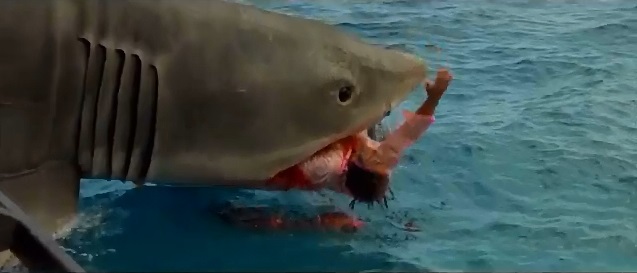
In the waters off Amity Island, as Christmas carols waft across the lapping waves, deputy Sean Brody (Anderson), youngest son of Martin and Ellen Brody, is puttering around the harbor in a patrol boat, responding to a call to remove some debris that’s threatening to topple an anchored channel marker. But as he works to remove the offending obstruction, a monstrous shark attacks from below, biting off the majority of Brody’s right arm. And as those same cacophonous carols drown out his desperate cries for help, the shark presses the attack, defying physics, plucking the wounded man off the stern floor, sinking the boat in the process, and then toys with the victim a bit as he flounders in the water, still screaming unheeded, until finishing him off. And judging by how the shark stalked his prey before pouncing, one could almost read or construe the sabotaged buoy was bait contrived by said shark to lure Sean Brody out onto the water in the first place -- especially when you consider the gnaw marks on said obstructing pylon!


At least that’s the conclusion his mother, Ellen (Gary), comes to as she views (what little is left of) her son’s recovered body. Convinced his battles with not one, but two monster sharks drove her husband, Martin, into an early grave via a heart attack, and while wallowing in the stages of grief, Ellen cannot come to grips with this massive mass of coincidences and is now convinced a lineage of sharks must have some kind of ersatz blood vendetta against her family, and are now out looking to even the score. Of course, her eldest son, Mike (Guest), thinks this is preposterous and, worrying about his mother’s mental health, convinces Ellen a change of scenery is just what she needs; and so, Ellen agrees to accompany Mike, his wife, Carla (Young), and daughter Thea (Barsi), to the Bahamas, where Mike is currently working in his capacity as a marine biologist, tracking the migratory patterns of sea snails.


Waitaminute, you say. Sea snails? The hell? What happened to Kathy Morgan? What happened to Not-Sea World? What happened to that job in Venezuela? Hang on, I say. All will be explained as the Brodys wing their way south. Well, sort of. Maybe. Explained, I mean. And believe me, before it’s over, this film will have a helluva lot of explaining to do. Anyhoo, back to the movie, where, unbeknownst to team Brody, sure enough, somewhere below and beneath the waves, a monstrous, 28-foot killer shark is also making its way from the cold waters of Amity to the warm currents of the Caribbean Sea. So maybe there is something to this preternatural vendetta after all…


There’s an apocryphal story that after Gremlins (1984) became an unexpected box-office hit, the studio quickly scrambled to come up with a sequel to cash in. Initially, original director Joe Dante turned it down, having an aversion to sequels in general and having had his fill of malfunctioning muppet movies. But eventually, he was coaxed back with the promise of free rein and carte blanche to do whatever he wanted to do. And with that caveat, Dante, whose own career sprung from this franchise with his inaugural effort, Piranha (1978), one of many knock-offs JAWS spawned, and then there's his association with the aborted spoof sequel, JAWS 3 People 0, which he abandoned to do The Howling (1981), for producer Michael Finnell, who both came back with their own personal pitch for Gremlins 2 (1990): make something that would absolutely guarantee there would never, ever be a Gremlins 3. And while that massive tonal shift and tale of self-sabotage was on purpose, here, with JAWS: The Revenge (1987), director Joseph Sargent and screenwriter Michael de Guzman basically did the same thing by churning out something so bad, something so nigh incomprehensible, something so rock-stupid, they inadvertently guaranteed there would never be a JAWS 5.


"Hey! Hey, you! Call my agent. I'm available. Cheap."
 
This debacle began in late September, 1986, when Sargent got a call from Sid Sheinberg, president of MCA-Universal, who offered him a chance to produce and direct a third JAWS sequel slated to be released in July the very next year. And though there wasn’t even a script written for it yet, Sheinberg gave the veteran director the hard sell, saying the picture would be put on a fast-track with a generous budget estimated between 23 and 30 million dollars (-- for comparison, Return of the Jedi was brought in for 32 million in 1983) and how he wanted a “quality picture about human beings.” In a shark attack movie. In less than six months. Right. And as red flags went up everywhere, Sargent, a noted TV director, but who had helmed the likes of Colossus: The Forbin Project (1970) and The Taking of Pelham One Two Three (1973) for the big screen felt the whole thing was “a ticking bomb waiting to go off” but accepted the offer anyway.


And Sheinberg was true to his word, getting the money and the production up to speed very quickly, but leaving it to Sargent and de Guzman to concoct another plausible encounter between a killer shark and the Brody clan. With the tagline, 'This Time, It’s Personal' -- and it’s never really clear if that is in reference to the shark’s or Ellen Brody’s perspective, or who is taking ‘The Revenge’ (-- it makes most sense if it’s the shark, honestly), the script started to come together. In an interview some twenty years later Sargent would claim plausibility was chucked out the window early in the writing process and as originally conceived the premise “was born out of a desperation to find something fresh to do with the shark. We thought that maybe if we took a mystical point of view, and go for a little bit of … magic, we might be able to find something interesting enough to sit through."


Now, we need to stress on the as “originally conceived” aspect of that quote as most of the mystical and magical elements he alluded to were later excised out except for Ellen Brody’s inexplicable and bizarre psychic link to the shark that is never explained in the finished film; and neither is the implied clairvoyant connection to her children and dead husband that allows her to recall or flashback to events she was not present for. Or how in the hell the shark even knew where they were going. However, a lot of these elements -- plus a whole lot more, showed up in Hank Searls novelization of JAWS: The Revenge. Searls had already done the novelization for JAWS 2, which reads as both a sequel to Steven Spielberg’s film adaptation of JAWS (1975) and Peter Benchley’s source novel, which alludes to a mafia subplot and the fallout of the affair between Ellen Brody and Matt Hooper.


From the very beginning of the production, Sargent seemed keen on ignoring the other two sequels completely, making his film a direct sequel to JAWS; and while elements from JAWS 2 (1978) are still present, the entirety of JAWS 3-D (1983) was ignored and essentially retconned out of existence, which is probably why this film was never referred to as JAWS 4. And so, Mike Brody never worked as an engineer at Not-SeaWorld and Sean never went to school in Colorado to get away from the PTSD-inducing ocean and instead stayed in Amity and followed his old man’s footsteps into law enforcement. Mike, meanwhile, according to Searls’ novelization, which one assumes was based on an early draft of the script, is now a marine biologist; a marine biologist who just so happened to piss off the wrong voodoo priest. That’s right, as originally conceived, JAWS: The Revenge, was about a shark being an unwitting pawn in a voodoo curse to get a little heathen payback.


See, in the novel, there’s a character named Papa Jacques, whom the superstitious islanders turn to for advice and guidance -- for a price. Despite the beliefs and protests of his local Rastafarian co-worker, Jake (Van Peebles), and his wife, Louisa (Whitfield), to leave well enough alone, Mike thinks Papa Jacques is nothing but a con-man and a fraud who is exploiting the people. A confrontation ensues, turns ugly, and Mike winds up breaking one of the witch doctor’s favorite magical gourds. And so, for this blasphemy, Papa Jacques summons the shark -- against its will, mind you, as evidenced by several chapters told from the enthralled shark’s point of view, possessing it, to do his bidding and take his revenge (aha!) on Mike Brody by proxy, setting the preternatural plot proper into motion.


And as the film progresses, Papa Jacques torments the Brodys further, cursing one of Thea’s toys (-- a bucket for building sand castles), putting the girl into a trance, to lure her into the ocean and the waiting jaws of the shark. And while that is thwarted at the last second, Louisa, who has a much larger role in the book, tries to make Mike believe in what he’s helped unleash; he still refuses to believe, but his mother does, setting up the climax, which, when the shark dies, rather ridiculously, the eldritch feedback is too much of Papa Jacques who also drops dead.


And while all of this sounds patently ridiculous, deliriously stoopid and positively schlock-tastic, alas, none of this made it into the finished film, leaving many a gaping plot-hole in its wake as no one bothered to go back and shore things up and just pushed ahead, hoping no one would notice how stupid the central premise now was without the mystical embellishment. So, nope, instead of a voodoo-fueled shark massacre, we get a middle-aged romantic island adventure between Ellen and Hoagie (Caine), a charter pilot who flew them to the islands.


Again, in the movie, Hoagie Newcombe is a bit of a cipher, but in the novel he is an undercover DEA agent out to get revenge (double aha!) on some cartel bigwig who supplied the cocaine his daughter OD’d on. These same drug-runners are also trying to kill Hoagie, with his new found friends getting caught in the crossfire. And this concurrent subplot runs head on into the voodoo shark thread during the climax, when Mike, Hoagie and Jake fly to Ellen’s rescue while fighting with the drug kingpin in midair, who falls out of the plane and is promptly eaten by the shark. Again, sadly, none of this made it into the feature film. *sigh*


You know what else never really made it into the feature film? The shark, as JAWS: The Revenge has the lowest kill count in the franchise with the grand and sad total of only three people getting eaten. (There were five victims in JAWS, seven in JAWS 2, and eight in JAWS 3-D). Well, more like two and half. (More on this in a second.) Again, Searls’ writing does the big fish due justice, revealing it was the sole surviving offspring of the pregnant shark in JAWS 2, who was born the moment his mother was fried while chomping on the electric cable in another wild dramatic liberty taken twist.


Here, on film, despite Mike’s assertions that Great Whites don’t like warm water, the shark shows up while he and Jake are tagging and releasing more sea snails on the ocean floor. And while Mike barely survives a close encounter with the shark, engineering his escape by turning his oxygen tank into a underwater rocket, he swears Jake to secrecy, not wanting his already paranoid mother to find out about it. Jake agrees, and also thinks they should abandon the snails and study the shark, managing to tag it with a tracking device. But all of this comes back to bite him in the ass -- see what I did there?, on the day of his sculptress wife’s big unveiling, when Thea skips the festivities and goes for a ride on an inflatable pontoon with her friends, which comes under attack by the shark, who misses his intended target and destroys some innocent bystander instead.


With that, Ellen is convinced the shark is definitely out to get her family and decides to take it upon herself to end this blood feud once and for all. And so, she steals Mike’s boat and heads out to sea. When Mike sniffs this out, he rounds up Jake and Hoagie and they fly to the rescue, making an emergency water landing so they can swim over to the boat. The shark attacks and tries to eat the plane because -- hell, I don’t know. And while it’s distracted, the others make it to the boat safely.


And all of that brings us to our whackadoodle climax. Both of them. See, as originally shot, Jake kit-bashes together some kind of ultrasonic contraption that emits a frequency that makes the shark go bonkers. Like, BONKERS bonkers. This contraption is essentially two flashlights that blink at each other. Now, this design kinda has a fatal flaw, though, in that one of them must be attached to the shark for reception purposes -- I think. And since it was his idea, poor Jake crawls out to the end of the boom and manages to jam the contraption into the shark’s gaping maw before he just, kinda, sorta, falls into the beast’s mouth to be shredded. Why? I don’t know.


Now, it should be noted that this film came out way before footage showing Great Whites rocketing out of the water as they hunt for prey on YouTube, so it is a lot more plausible now than it was back in '87 for it to “jump” out of the water -- but not quite to the extent and angle and mid-air suspension shown in the film. Also, pretty sure sharks have no lungs and, therefore, cannot roar like this thing does whenever Mike flashes his light at it. And as Mike keeps firing and the shark keeps angrily breaking the surface, Ellen steers the boat on a crash-course and rams the splintered boom like a spear into the airborne shark, which vomits up a copious amount of blood as it thrashes and dies. But this weight and stress is too much for the boat, which cracks in half and sinks, taking the harpooned corpse with it, leaving the surviving Brodys to live happily ever after.


After JAWS: The Revenge hit theaters to critical skewering, audience mortification, and poor box office -- with a lot of venom pointed at that asinine ending, which I think is actually pretty great for all the wrong reasons, Universal quickly scrambled to try and fix it for the pending international release. The only problem was this fix actually turned out to be even more dumb and nonsensical than the original take as the shark still flies, it still roars, and it still gets impaled on the boom but then inexplicably transforms into the saddest looking miniature you will ever see and then explodes, not once, not twice, not thrice, but four freakin’ times.


I suppose there’s an argument to be made that Ellen, with her new mental powers, blew the shark up with her mind, which makes just as much sense as anything else at this point. And then, for some reason, this European version was used for all broadcast and home video releases of the film (-- except, inexplicably, for AMC). And so, imagine my surprise when I caught it on TV, having seen this in the theater, waiting with baited breath to see the shark fly, roar, and puke up blood and get that other ending instead. Boo, movie. I said, BOO! It got to the point where I began to question my own memory of the theatrical ending, as no one would believe me, until clips of it started popping up on YouTube and I was vindicated. Hooray!


Apparently, an offer was made to Roy Scheider to reprise his role of Martin Brody, destined to be killed in the first reel instead of Sean. His answer was something just south of “Hell no.” There was also a cameo written for Richard Dreyfuss, but he declined as well. And so, the only link to the other films was Lorraine Gary, who, in the realm of threads, circles and coincidences, had worked with Sargent before on the made for TV movie, The Marcus-Nelson Murders (1973), which served as the pilot for Kojak (1973-1978); and apparently, Spielberg saw her in the telefilm, which went along way in her being cast in JAWS


Speaking of JAWS, one nice little touch I did notice was the presence of Lee Fierro at the Brody house in Amity after Sean is killed. If you remember, Fierro played Mrs. Kintner in the original film, whose son, Alex, was also killed by a shark. It’s a throwaway moment, mostly stunt casting, I’d wager, but I got a little more empathy out of that than the filmmaker had probably intended. It should also be noted that Gary was married to Sheinberg this whole time and this whole thing might be construed as a vanity project for his wife. If so, he kinda blew it. Gary is fine, but the script and plot holes do her no favors and her scenes with Caine kinda clunk and clunk pretty badly. 


As for the rest of the cast, the usually affable Lance Guest comes off as a bit of a crabby pants. But Mario Van Peebles appears to be having a lot of fun, and audiences appeared to have liked his character, as well; so much so one of the other big changes in the international cut was to have Jake miraculously survive the experience of being a shark’s chew toy. (And the call of ‘Oh,bullshit!’ on that one is mighty indeed.) 


Meh. I'm sure he'll be fine. 


Oh, hey, now, wouldjalookatthat. 


I also have to raise my hand in guilt for hoping the precocious Thea would also be eaten. And the guilt comes from digging into the tragic history of Judith Barsi, a young actress suffering from a congenital birth defect that stunted her growth and made the twelve year old appear to be five. Known mostly for commercials, she appeared ready to break out, especially in voice-over work in animation, where she voiced the character of Ducky in The Land Before Time (1988) and Anne-Marie in All Dogs Go to Heaven (1989). Sadly, both of these credits would be posthumous as after years of emotional and psychological abuse from her deranged father, Barsi fell victim to a murder-suicide when he shot and killed her, her mother and then burned the bodies before turning the gun on himself two days later.


And to brighten things up a bit after that downer, let us now turn our attention to Michael Caine, who famously quipped that he never saw JAWS: The Revenge, saying, “By all accounts it is terrible. However, I have seen the house that it built and it is terrific.” The actor was paid $1.5 million for seven days of work. Thus, his schedule was so tight he was unable to attend the Academy Awards that year where he won an Oscar for his supporting role in Hannah and Her Sisters (1986) due to those re-shoots to fix the ending. Still, Caine took in stride: “Won an Oscar, built a house, and had a great holiday. Not bad for a flop movie."


As for the shark F/X, like everything else, they fail miserably -- though I would say they are endearingly awful in concept and execution. There is one fairly decent sequence, where Mike must play cat and mouse (shark and chum?) with the alpha predator by taking refuge in a sunken, rusted out freighter on the seabed. It was fairly ambitious but was ultimately betrayed by the shortcomings of the prop shark. The current state of animatronics allowed for a more articulated mock-up, sure, but it has not aged well. And throughout the movie there are myriad examples of hoses and mechanical guts of the prop that are in plain view. It’s almost as if they gave up trying to hide them as things progressed and said to hell with it. Again, the prop and mock-ups are pretty dire but it wasn’t helped by what the script and Sargent called on them to do at all.


Thus, as schlock, JAWS: The Revenge excels most mightily when it's focusing on the shark but as I said the shark is remarkably absent for the majority of the picture and so it just cannot compensate for a plot that doesn’t hold water and makes no sense. “Sharks don’t take things personally, Mr. Brody,” said the marine biologist in JAWS 2 while examining the whale carcass, where the whole notion of this vendetta plot was probably born. And there it probably should have died, too, based on the empirical evidence: the fact that it is now some thirty years later and we still haven’t seen JAWS 5. Thus and so, JAWS: The Revenge has the dubious honor of not only being the worst film in the franchise, but also serves as the film that officially killed the franchise.


Welcome to the Celluloid Zeroes first ever Franchise Kill: 


And lets not forget the knock-offs:


JAWS: The Revenge (1987) Universal Pictures / P: Joseph Sargent / AP: Frank Baur / D: Joseph Sargent / W: Michael de Guzman, Peter Benchley / C: John McPherson / E: Michael Brown / M: Michael Small / S: Lorraine Gary, Lance Guest, Michael Caine, Mario Van Peebles, Karen Young, Judith Barsi, Lynn Whitfield, Mitchell Anderson
Related Posts Plugin for WordPress, Blogger...