Showing posts with label In Memoriam. Show all posts

Tuesday, February 12, 2019

In Memoriam :: Julia Adams :: Taming the Lonely Monster in All of Us.


When Julie Adams passed away a few weeks ago I struggled mightily as I tried to put into words what her iconic role and screen presence meant in Creature from the Black Lagoon (1954), and what it meant not only to me but to the whole congregation of my beloved B-Movie brethren out there. And then I realized what I wanted to say, and tried to write, had already been said, and written, and said and written much better than I ever could, by Drive-In movie guru, Joe Bob Briggs, in an essay he wrote on the film for his book, Profoundly Disturbing: Shocking Movies that Changed History (2003).


“Because Creature from the Black Lagoon was only 79-minutes long,” said Briggs, “the perfect length for TV syndication, it was a staple of late-night horror shows and afternoon ‘creature features’ well into the 1980s, and it was just all-American enough to escape the attention of the concerned moms who probably couldn’t figure out why their sons were so obsessed with it.


“What was the main attraction? Was it the Gill Man, the king of all rubber-suit monsters, who survives from the Devonian Age in an Amazon lagoon and preys on a ship full of scientific invaders? Or was it Julia Adams, the only female in the movie, whose curvy, leggy body and perky breasts are poured into a white, French-cut, crotch-enhancing swimsuit as she plunges into the lagoon, Esther Williams-style, and performs her seductive underwater dance


“It was both, of course. The one sequence that sticks in the mind long after the details of the film are forgotten shows the gill-faced creature swimming below the back-stroking fantasy woman, studying her, following her, yet never approaching as she performs her underwater spins and turns. The monster may or may not be falling in love -- the movie is short on exposition in this department -- but the fourteen year old boys in the audience definitely are.


"It doesn’t take a master psychologist to see how a prepubescent boy, struggling with feelings of being ugly, unloved, and half-formed, would not only identify with the creature (who has acne like protuberances on his face) but imagine a girl just like Julia Adams, who would finally come to rescue him from the lonely black lagoon called his room.


“This masterfully directed underwater sequence would later be copied by Steven Spielberg, almost shot for shot, in the opening sequence of JAWS (1975) -- but in that case the creature obviously has lunch, not love, on his mind. The beautiful thing about the original is that we somehow sense, in spite of the ominous music, that the girl is safe and in fact belongs here instead of in the arms of the man she thinks she loves."


I freely admit Julia Adams was one of my first cine-crushes. And this infatuation began with just photos in books and monster mags, as I didn’t get to even see the movie until VHS tapes became a thing in the 1980s when I was, you guessed it, 14, where this notion really cemented itself. When I had my brainstorm as I struggled to memorialize her passing, I re-read the essay (-- the whole book actually, which is wonderful, as is the author’s follow up book, Profoundly Erotic: Sexy Movies that Changed History), and then reached out to Briggs on Twitter and he responded most kindly:


Born in Waterloo, Iowa, as Betty May Adams, her family moved around a great deal when she was young. Her father was a cotton broker, and Betty May spent most of her school years in Blytheville, Arkansas.


And after a brief career as a secretary, at the age of 19, Adams was crowned “Miss Little Rock” and rode that sash and tiara to Hollywood to pursue an acting career.


She made her big screen debut with a bit-part in the barn-burning musical, Red, Hot and Blue (1949). And then, after starring in a string of poverty row westerns for Robert L. Lippert (-- six different films shot in five weeks), Adams got signed by Universal-International, who changed her name to Julia Adams (-- though she always preferred Julie), and she bounced around mostly between B-pictures and a few A-westerns, co-starring alongside Jimmy Stewart in Bend of the River (1952) and Rock Hudson in The Lawless Breed (1953). 


In the 1960s, after a brief retirement to raise her family, Adams starred opposite Elvis Presley in Tickle Me (1965), but spent most of the decade, and the rest of her career, really, taking roles on the small screen; most notably the infamous episode of Perry Mason, The Case of the Deadly Verdict, where her character was found guilty, marking the only time one of Mason’s clients was convicted in the show’s original nine year run. And speaking of mysteries, Adams would also have a recurring guest role on the TV series, Murder, She Wrote.


But as Adams herself put it, “No matter what you do, you can act your heart out, but people will always say, ‘Oh, Julie Adams -- Creature from the Black Lagoon.’" Adams really didn’t want the part of Kay Lawrence, the object of desire for a triumvirate of co-stars -- Richard Carlson, Richard Denning, and the two guys in the Gill-Man suit, Ricou Browning and Ben Chapman. In her eyes, it was just another run ‘n’ gun B-picture. She even tried to turn it down, but the studio wouldn’t let her. 


At least she would get to lose the western duds this time, and finally show off those legs Universal’s publicity department had been hyping up for years, claiming they were "the most perfectly symmetrical in the world" and had them insured for $125,000 by Lloyds of London. But I have no idea what her head was insured for, which got dinged pretty badly while filming, with the actress forced to do her own stunts due to the limited budget.


Aside from the minor head trauma, Adams noted the making of the film was an extremely pleasant process, and the cast and the crew, under the steady direction of Jack Arnold both above and below the surface, got along quite well. I don’t think she ever regretted making the film, tired of talking about it, maybe, but came to fully embrace it in her later years. And when asked why the film had so much impact and staying power, Adams thought compassion -- not pent up passion from the Devonian Age, is what drove the film. And how she always felt sympathetic toward the monster, saying, “I think maybe it touches something in ourselves, maybe the darker parts of ourselves, that longing to be loved and thinking they really can't ever be loved. It strikes a chord within us."


Which brings us back to the essay Brigg’s wrote about that iconic scene, which echo Adams’ sentiments, and what it underscored. Now hold on. I know, I know that you know, and I know, that you know that 90% of this scene where Kay goes for a swim wasn’t even Julie Adams in that swimsuit, observed from below by the Gill-Man, but her swimming double, Ginger Stanley, gracing the waters of Wakulla Springs in Florida while Julia never left the backlot in Hollywood, and those were Stanley's, less than symmetrical legs the Creature sheepishly paws at before he pulls a 360 and heads for his grotto.


Briggs was well aware of this, too, and even comments on this confusion. And he expands on this notion further when discussing the film’s climax: “What’s odd about the last scene is that there’s no moment in which we see what the monster’s intentions are. He doesn’t brush her hair away from her face or do anything except steal her, carry her, and dump her on a rock. In other words, we don’t know anymore about him than we did when he killed the guy in the camp in his first big scene. Then again, maybe a fourteen-year-old boy who suddenly had Julia Adams in his arms wouldn’t have known what to do either."


Here is where Briggs and I part ways as I don’t think there was anything sexual to this relationship with the creature (-- for that, we’d have to wait for 2017 and Guillermo del Toro’s consensual The Shape of Water). On the surface, sure. Her character is both beautiful and desirable and the end goal of a dick-fight between Carlson and Denning. But below the water I don’t think her iconic role is about being an ideal to be objectified, or possessed, or violated, but an idea. An idea that there is hope for us all to someday find love, compassion, sympathy, and understanding. And in that role, Julie Adams was a beacon that illuminated some very dark and lonely places and brought hundreds if not thousands into the light.


Julie (Julia) Adams
(1926-2019)
 xxxx

Saturday, December 22, 2018

Boob-Tube'n :: F-Troop :: For the Hero Who Sneezed: Lieutenant O'Rourke, Front and Center (1966).


It’s just another quiet day at Fort Courage (-- well, at least the watchtower hasn’t been blown up or collapsed yet, so we’ll call that a win), when a Major Duncan arrives carrying a whole saddlebag full of trouble. 

Seems the brass back at territorial headquarters haven’t been too impressed with the last few batches of graduates from Officer Candidate School; and so, Duncan (Gregory) has been charged to visit all army posts within his jurisdiction to seek out those of sterner officer material, conduct a battery of exercises to evaluate all enlisted personnel, and then award a few field commissions to those who pass muster.


Thinking this is a swell idea, the fort’s commanding officer, Captain Wilton Parmenter (Berry), reminds Duncan how he, himself, was awarded just such a battlefield commission toward the end of the Civil War (-- backed up by the TV show’s opening theme song). 

Well aware of the disastrous chain of events that led to the “legend” of the Scourge of the West, Duncan rim-shots they were well aware of this down at headquarters, but decided to go through with these tests anyway.


Thus, the screening will begin with a test of physical fitness; namely an imposing obstacle course, which is to be completed under simulated battlefield conditions with Duncan and Parmenter firing arrows over the men’s heads. 

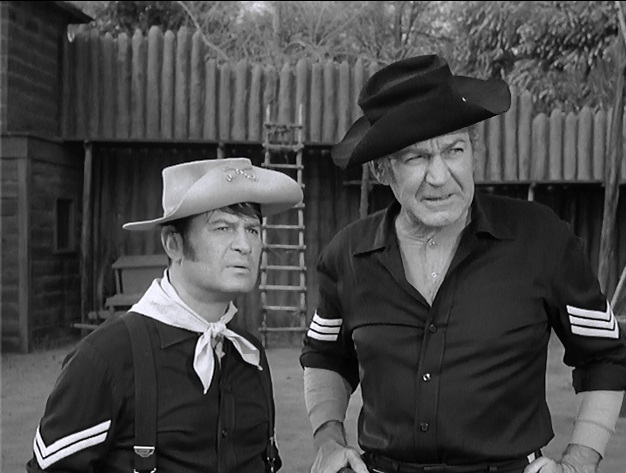
And after Sergeant Morgan O’Rourke (Tucker) goes over how the course is to be traversed, a line quickly forms on the left, wanting no part of this, starting with Dobbs (Hampton), who complains of dizzy spells from blowing his bugle too hard; trooper Duffy (Steele) cites an old leg wound he picked up at the Alamo fighting alongside Davy Crockett that's flaring up again AGAIN; the company's blind-as-a-bat lookout, trooper Vanderbilt (Brooks), can’t decide which elbow he threw-out pitching horseshoes; and Hoffenmueller (Mitchum), the fort’s Indian interpreter, who can speak Cheyenne, Apache, Hekawi, and Shug, but not a word of English, expresses how sein knöchel ist gebrochen in his native German.


Soon, the whole lot is protesting; and just when things appear to be getting completely out of hand, order is restored thanks to O’Rourke and Corporal Randolph Agarn (Storch) and the judicious use of his hat to beat the rabble back into some sense of order. 

And then, after a few last words of encouragement from their Captain, the exercise commences. And what happens next, well, why tell you when I can just show you:


Thus and so, when this exercise grinds itself to a complete halt, Duncan calls off the test over Parmenter’s protests, feeling his men weren’t given a fair shake -- even as Duncan stresses the U.S. Cavalry hasn’t suffered such a brutal and ignominious defeat like this since the Battle of Bull Run. 

And while Parmenter fears this means his men will miss out on a promotion, Duncan says not so fast. Seems he feels there is one man in this forsaken outfit worthy to lead and asks for a soon to be newly minted Lieutenant O’Rourke to step forward and accept his bars, which, believe me, is the last thing the scheming O’Rourke wants to do...


When William T. Orr was put in charge of Warner Bros.’ fledgling television division in 1958, one of the first things he did was to move the whole department from New York to Los Angeles. 

Now, before being placed in charge, Orr had forged a steady working relationship with the American Broadcasting Company (ABC), which had been languishing in third place in the ratings against the other big two (NBC, CBS) since they first found a place on the TV dial, with a series of highly successful westerns, starting with Cheyenne (1955-1962), which reinvented the genre for TV with its hour-long format, higher cinematic production values, and adult themes, which inspired the follow-ups, Colt .45 (1957-1960), Sugarfoot (1957-1961), and the wildly popular James Garner vehicle, Maverick (1957-1962).


After the move to California, Orr followed up with a few more westerns, Lawman (1958-1962), and Bronco (1958-1962), before branching out with a series of detective shows. And just like with his westerns, these series all belonged in the same “shared universe” beginning with 77 Sunset Strip (1958-1963), then Bourbon Street Beat (1959-1960), Hawaiian Eye (1959-1963), and Surfside 6 (1960-1962). And during the height of his run, Orr had no fewer than 9 prime-time programs on the air at one time. 

But by 1963, Orr had had his fill with the cheapness of his parent studio, which had cost them plenty of star-wattage over contract disputes and their staunch refusal to switch to color over cost concerns, which would come back to bite Warner’s in the ass when it came to later syndication packages for these storied programs. And with that, Orr left the company to join Frank Sinatra’s Essex Productions.

F-Troop (1965-1966) would be one of the last TV-series Orr would greenlight for producer Hy Averback. The brainchild of Richard Bluel, Seaman Jacobs, Ed James and Jim Barnett, this show would be a broad spoof and satire of westerns, relying on slapstick, sight-gags, and physical humor for most of its yuks, drawing inspiration from shows ranging from The Phil Silvers Show (Sgt. Bilko) (1955-1959), Mchale’s Navy (1962-1966), Get Smart (1965-1970), and even Gilligan’s Island (1964-1967).

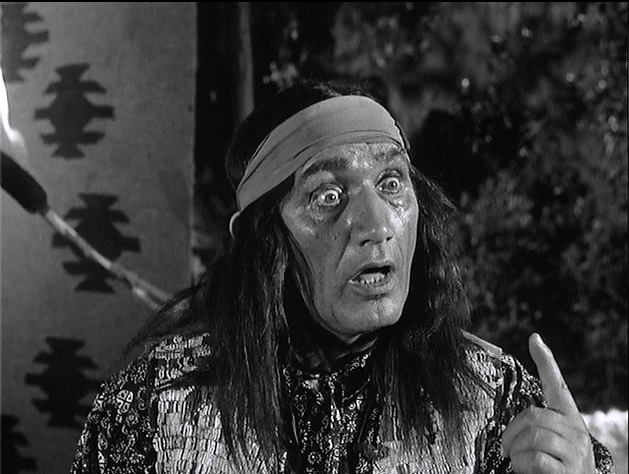
The series would revolve around two main characters, Sgt. O’Rourke and Cpl. Agarn, and their schemes to bilk as much money from the U.S. government as possible, drawing pay and rations for non-existent troopers, and then funnel that into O’Rourke Enterprises, which includes business dealings with the local Indian tribe, the Hekawis, led by their wily Chief, Wild Eagle, played by a constantly scene stealing Frank DeKova, who mass produce wild west trinkets and artifacts to be sold to tenderfoots back east. And when the bumbling Parmenter was assigned as their commander at Fort Courage, he was the perfect pigeon to dupe and distract to keep this cash-cow rolling along, leading to much wackiness per episode.


Of course, any kind of promotion would lead to a reassignment for O’Rourke, which would bring all of this profiteering to a screeching halt once he becomes an 'officer and a gentleman.' And that phrase, thinks O’Rourke, holds the key to his immediate demotion and soon hatches a scheme with Agarn, who finds Major Duncan in Captain Parmenter’s quarters. 

Duncan had just missed “Wrangler” Jane Thrift (Patterson), a resident of the nearby town, who dotes on Parmenter something fierce, including nocturnal visits to the post for a little petting, which is against regulations. And Parmenter is such a stickler for these regulations, and rodent control, a flabbergasted Duncan is about to seek lodging somewhere else when Agarn blunders in to say Sgt. O’Rourke has gone A.W.O.L. but won’t say where, opting to show Duncan instead, for it must be seen to be believed, leaving the fussbudget Parmenter behind to deal with his cheese and traps.


And when we do eventually see what Agarn was alluding to, I’m still not sure I believe it as he leads Duncan past the rock that looks like a bear and then turns left at the bear that looks like a rock to the Hekawi camp that’s been transformed into … Wait for it … The Playbrave Club, complete with Playbrave Squirrels, The Tomahawk Trio house band, and a go-go dancing floor-show:


Once their horses are turned over to the valet, they are greeted by the Maître D', Crazy Cat (Diamond), who took over for Roaring Chicken (Edward Everett Horton) as Wild Eagle’s second in command. 

And as Duncan soaks this all in, he comments how he’d like to help these “little squirrels” gather acorns for the winter. Hi-YO!


But Agarn pushes him on, staying on mission, to arrest Sgt. O’Rourke, whom they find in the company of Wild Eagle, who claims his good friend is a card carrying member of the Playbrave Club and has attended their soiree every night since they opened.


And as Agarn reads off the litany of charges against O’Rourke, who stands to take his punishment for conduct unbecoming of an officer to be, Duncan smiles, waves it all off, saying any man who can lead him to a place like this is just the kind of leadership he’s looking for. The army is looking for men like O’Rourke, not glorified housekeepers like Parmenter, you see.


The following morning, as Lt. O’Rourke and the newly minted Sgt. Agarn inspect the troops, including a promoted Cpl. Dobbs, who is holding auditions to replace him as bugler, O’Rourke bemoans he has less than 24-hours before he takes a 70% cut in pay -- unless he can convince Parmenter to let him remain at Fort Courage. 

But as they wait outside Parmenter's quarters, they overhear an argument between Duncan and their Captain. Seems Duncan has lost all patience with the fuddy Parmenter and plans to bunk with Lt. O’Rourke, who definitely won’t be greeting him in his nightcap and feather duster.


Thus, with salvation at hand, O’Rourke acts the part of Parmenter, rather deftly I might add, and runs Duncan off with those Lt. bars in tow, leaving us with the final coda, where Agarn, Dobbs and Hoffenmeuller are all relieved of their promotions, once again bringing the denizens of Fort Courage right back to where we started.

When F-Troop premiered on September 14, 1965, it was given a brutal time-slot on Tuesday nights opposite CBS’ nigh invincible, The Red Skelton Show (1951-1971). But positive critical response and a rapidly developed and loyal fanbase soon found the show cracking the Top 10 in the Nielsen ratings. 


As usual, Warners wouldn’t OK the show unless it was shot in black and white to save money. (The fort was built on the Warner Bros. backlot in Burbank, adjacent to one of its two western town streets.) And yet, despite this monochrome treatment, for the first three months of that inaugural TV-season, F-Troop was ABC's biggest new hit. 

But just when it seemed to be finding it’s comical legs and really breakout, the show would be quickly overshadowed by a mid-season replacement when the Adam West version of Batman (1966-1968) debuted on ABC in January of 1966 and Bat-Mania swept the country.


Still, F-Troop had solid ratings and was granted both a second season and an upgrade to color. And the show continued to hold its own through its sophomore run despite the loss of many of its writers and a third season appeared to be in the can. 

Unfortunately, the show was deemed too expensive for its allotted running time by the Warner execs, which was compounded by a merger with Seven Arts, who had no interest in continuing the show whatsoever, which officially shuttered-up Fort Courage for good after two seasons and 65 total episodes.


Like with Gilligan’s Island, once you embrace the absurdity of the premise the show is kind of brilliant -- and hysterical. The same goes for F-Troop as far as I’m concerned. It’s also strangely subversive, with a rousing soundtrack by William Lava, and is pretty damned funny in my book. 

I mean, think about it. The tower keeps falling over, sure, but you have to remember who it was who kept putting it back up, explaining why it always collapsed so easily and on such a regular basis. Think about it, won’t you? Thank you.


For the hero who sneezed...
Ken Berry
(1913-2018)


F-Troop (1965-1967) Warner Bros. Television :: American Broadcasting Company (ABC)/ EP: William T. Orr / P: Hy Averback, Herman S. Saunders, Richard M. Bluel / AP: Phil Rawlins / D: David Alexander / W: Arthur Julian / C: Robert Hoffman / E: James T. Heckert / M: William Lave / S: Forrest Tucker, Larry Storch, Ken Berry, Melody Patterson, Frank DeKova, James Hampton, Bob Steele, Don Diamond, Joe Brooks, John Mitchum, James Gregory
Related Posts Plugin for WordPress, Blogger...