In the jungle, the suspicious looking jungle, a desperate explorer flees from a horde of buxom amazonian women. And as the soundtrack farts and burps along, our Not So Naked Prey dodges a few spears before he is eventually run down and strung up over a giant stewpot. But when all hope seems lost and the man is about to become lunch, someone yells “Cut!” from offscreen and the scene quickly breaks as the mincing male actor turns into a raging queen and goes bitchy bananas, calling the director, Lucy “Luce” Habit (Lenska), a “female chauvinist cow” before he quits and storms off the set.


Good riddance to worthless rubbish, says Habit, who gets even more bad news from her talent agent. With her reputation as a sadist preceding her, seems that bloke was her last shot as no other actor in his right mind will ever hire on to do the director’s next picture, set to shoot in the deepest darkest corners of Africa, and whose subject matter Habit is keeping under wraps.


And so -- and stop me if you’ve heard this before, Habit vows that if audiences want a male love interest in her feminist pictures, and no professional actor is tough enough for the job, then she’ll just have to go out and find an unprofessional one on her own. Hitting the streets of London, Habit soon becomes smitten with a blonde-haired vagabond as he tries and fails to steal a toffeed apple; and then she bemusedly lurks as he tries to pull another con on a pawn-shop owner, where he fakes an injury so he can steal an original King Kong poster. This leads to a merry chase of Habit chasing the shop owner who chases the blonde down the crowded street complete with faux Benny Hill muzak.


And once he’s caught, Habit steps in, pays for the poster, and offers to buy the blonde a drink, who introduces himself as -- wait for it -- Ray Fay (Askwith). And while he tries to bum some reefer off a fellow hipster twit, Habit spikes his drink and then bundles the unconscious Ray onto her boat, the Liberated Lady, where her all girl crew ... ah crap, I had completely forgotten this was also a musical ... break into a haphazard song as the ship weighs anchor and sails for Africa -- destination, the land of Lazinga Where They Do the Konga -- and would someone, anyone, just shoot me now, please and thank you?


And when the ceremony reaches its climax, they raise a giant cake, inside of which is leavened the ‘Husband of Kong’ but this sacrifice comes to a screeching halt as blah blah blah, the chieftess (Leon) wants to sacrifice Ray instead, Habit won’t let her, blah blah blah return to the boat, the natives nab Ray, stuff him inside a cake, and, oh, for dumb, bang the Kong Gong while bogarting some Conga Cola, summoning a great She-Ape -- well, more of a walking carpet sample with hardshell knockers, from the other side of the wall, who snatches up Ray and retreats before Habit can rescue him. Undaunted, Habit rallies her crew and leads the charge into the jungle to save Ray, where giant horny apes, cheeky plants, rubber dinosaurs, and even more asinine musical numbers and atrocious puns lurk...


I’m not so sure that Dino de Laurentiis didn’t do the whole world a huge favor by bringing a lawsuit against the producers of Queen Kong (1976), which prevented its release for several decades. A film conceived and executed to ride and cash-in on the ginormous publicity wave generated by Big Dino De’s much ballyhooed remake -- however, unlike the legendary Italian producer, not-so-legendary producer Keith Cavele and his Dexter Films Ltd. failed to get permission from RKO for the use of their copyrighted characters and property, which it, forgive me, apes mercilessly.

A German, Italian and British co-production, Queen Kong was intended as a bawdy gender-switched spoof of the Big Ape, with the ball-breaking Habit replacing Carl Denham and meat-head Ray replacing Fay Wray -- stress on the intended. Frankly, I think the biggest mistake Cavele made was trying to beat the King Kong (1976) remake into theaters, especially when you consider all the international cash-ins that followed that never got sued like Hong Kong’s The Mighty Peking Man (1977) and Korea’s A*P*E (1976). Or maybe, just maybe, Cavele’s film was just that bad, and no matter how skewed it still hewed a little too close to the original and could therefore actually be construed as detrimental and damaging to the legitimate remake’s release.

At least that’s how the plaintiffs (RKO General Inc. and Dino de Laurentiis Productions) laid it out in their complaint, saying they found the script to be “so appalling” it couldn’t do anything but “repercuss poorly on their client's’ reputation” if it was ever thought Queen Kong was associated with King Kong; and further investigation showed “in plot, events, and characters there was a close resemblance between the two films, and an analyzed sample of the screenplay showed a resemblance in details.”

And so, they asked the judge to ban the distribution of Queen Kong based on potential damages and copyright infringement. The defendant (Dexter Films) countered, arguing there was no infringement of copyright, saying “King Kong was a horror movie concerning a male gorilla while their film was purely light-hearted and about a female ape, and that any similarities derived from the fact that Queen Kong was an affectionate pastiche or light-hearted satire."


However, the defendants did not deny that the timing of the film was chosen to take advantage of the big expenditure incurred by the Paramount’s publicity department for the King Kong remake but contended this was smart business to do so. And while the judge agreed that the film was different enough they still did not have permission to use the copyrighted material. And so, judgement came down in favor of the plaintiffs and Queen Kong was banned from being released in Britain and the United States. It did see a limited release in Italy and West Germany, and proved to be a big hit in Japan. The film eventually saw the light of day on DVD back in 2003 to cash-in on yet another announced remake, Peter Jackson’s King Kong (2005), which is where I first encountered it. A decision I still regret to this day.


As you watch this shit-hemorrhage of a movie, what strikes you the most, what with the soft-focus, oversaturated lighting, it’s star (-- more on this in a sec), and the loaded title twist, is how much Queen Kong comes off as the world’s worst/most incompetent pornographic movie -- because there’s no naughty bits to be found. (Lots of jiggling, and racial insensitivity, but no naughty bits.)

No, what director Frank Agrama and co-screenwriter Ronald Dobrin were actually shooting for, I think, was a bawdy disco-era and feminist spin on tin-pan-alley burlesque -- again, without the benefit of any stripteases, leaving the audience with nothing but a series of broad comedic sketches, where everybody’s a ham, spewing gallons of creamed corniness, and filled to the brim with innuendo, double entendres and those atrocious puns I mentioned earlier -- all that was missing after each whiffed punchline was someone chiming in with “I’ll say she is.” Picture Carry On, Kaiju, and there ya go.


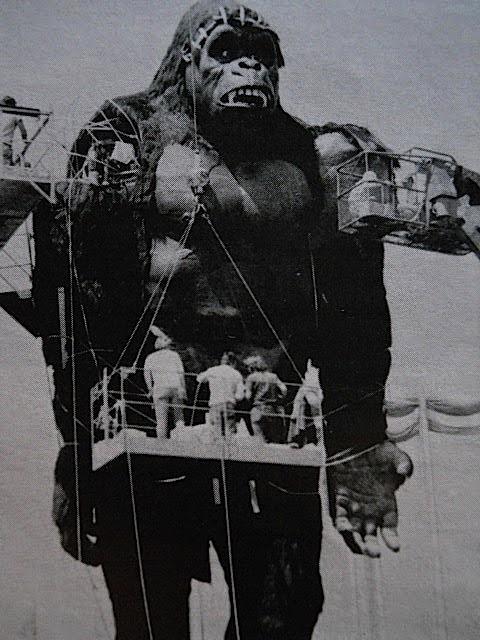
Is there anything worse than watching a comedy where all involved are so committed and feel so sure that what they’re doing is hilarious only it isn’t? -- quite the exact opposite actually. And as it played out, it is kind of amazing how closely the film stuck to the original version, getting sidetracked on a couple of occasions to take even broader potshots at JAWS and the Airport franchise. Granted, the one area that Queen Kong actually improves on Kong ‘76 is the dinosaur combat in the jungles of Lazinga. The gorilla suit is pretty awful, yes, and the efforts to chroma-key her into the action is even gawdawfuler, but that rubberized T-Rex and Pterodactyl were honestly pretty great and could’ve used more screen time.


Alas, we’re mostly stuck with the human element, and once Ray is rescued and the ape is captured, it’s off to London where she will be put on display -- only the slimy promoter won’t let them do it until they cover the lady ape’s bare boobies for reasons of standards and practices. By now, Ray has had a change of heart and has fallen for the old girl; and so, when Queen Kong inevitably escapes, shreds her bra, and manages to track him down after the requisite property damage, he realizes everyone hates her only because this Kong is a woman, and then rallies the women of London to come to their rescue, resulting in a riot of female liberation and eventual deportation of the lady Kong back to Lazinga.


A pox on this whole enterprise, says I. And I’m not alone. According to his memoir, star Robin Askwith said he and co-star Rula Lenska were also “aghast” at how bad the finished film turned out and were thankful for the lawsuit, hoping it would never see the light of day. A veteran of the Confessions… series, poor man’s Mick Jagger Askwith was no stranger to this kind of sexual farce, having done it as a window cleaner, a pop performer, a summer camp counselor, and now, a dudette in distress.


Feeling like one big inside joke that everyone is in on except you, as I struggle for anything nice to say about Queen Kong I will leave you with my theory on anti-comedy: You might not think there is anything worse than a bad comedy but there is such a thing as anti-comedy, which is essentially a volatile humor vacuum of biblical proportions. And like with matter and antimatter, if the two substances ever came into contact with each other, and if there is enough of each, we’re talking an extinction level explosive discharge. I think the same thing is theoretically possible if any actual comedy ever came into contact with anti-comedy. Thankfully, Queen Kong was consistently up to the task, leaving this hypotheses in the realm of the hypothetical. So, yay, for that.

What is Hubrisween? This is Hubrisween. And now, Boils and Ghouls, be sure to follow this linkage to keep track of the whole conglomeration of reviews for Hubrisween right here. Or you can always follow we collective head of knuckle on Letterboxd. That's 17 down, and the absolute worst film in the line-up in the can, with only nine more to go!

Queen Kong (1976) Cine-Art München :: Dexter Film London / EP: Keith Cavele / P: Virgilio De Blasi / D: Frank Agrama / W: Frank Agrama, Ronald Dobrin, Fabio Piccioni / C: Ian Wilson / E: David Campling / M: Pepper / S: Robin Askwith, Rula Lenska, Valerie Leon, Roger Hammond, John Clive, Carol Drinkwater