

___ ___ ___ ___ ___ ___ ___ ___ ___ ___ ___ ___ ___ ___
“The year, 1994. From out of space, comes a runaway planet, hurtling between the Earth and the moon, unleashing cosmic destruction. Man's civilization is cast in ruin. Two thousand years later, Earth is reborn. A strange new world rises from the old. A world of savagery, super-science, and sorcery. But one man bursts his bonds to fight for justice. With his companions, Ookla the Mok and Princess Ariel, he pits his strength, his courage, and his fabulous Sunsword, against the forces of evil. He is Thundarr, the Barbarian!”
___ ___ ___ ___ ___ ___ ___ ___ ___ ___ ___ ___ ___ ___
While writing up the fate of the Kong robot from King Kong '76 a few posts back, I ultimately left out a couple of paragraphs talking about how the faulty contraption played a pivotal role in one of my all-time favorite episodes of Thundarr the Barbarian:


It opens with our heroes, Thundarr, Ariel and Ookla stumbling upon some mutant ape creatures digging for something in the aptly named Death Canyon. Led by Simius, who never met a human he didn’t want to vanquish, these talking apes unearth a giant dismembered gorilla paw with a bunch of mechanical guts sticking out the exposed end. Apparently, this is part of something Simius refers to as “The Mighty One” and it doesn’t take Ariel long to realize what these apes are up to.


E’yup, them apes are currently scouring the countryside, looking for all the scattered animatronic limbs of, essentially, Big Dino De’s Robo-Kong, and hauling them back to a long abandoned movie lot, where Simius is in the process of putting The Mighty One back together so he can use it to wipe out a nearby village of human midgets. And as our heroes move to stop them, a fight which includes an authentic barroom brawl, they’re too late as The Mighty One is reactivated and goes on a rampage.


Well, it took almost 2000 years but, finally, Carlo Rambaldi and Glen Robinson were vindicated somewhat as the damnable thing finally worked as intended -- albeit on an animated kids show. In the end, taking a page from the movie, Ariel uses her magics to animate an old fighter plane to get Thundarr nose to nose with the robot, who splits it from clavicle to the crotch with his magic sword, ending Simius reign of terror for good.


After writing and deleting those paragraphs from the original review, thinking I might use it later for another post on its own, I broke out my Thundarr complete series boxset and watched the episode, and then a couple of more, and a delightful making of featurette that got me to thinking about the origin of the series, which stirred up a few more memories of some magazine articles written about the show when it first came out, which I managed to dig out, mold and all, and gave them a re-read. Thus and so, what started as a few simple throwaway paragraphs about a single episode of one my favorite cartoons quickly exploded into another full kitchen-sink review. Does this kinda crap happen to anybody else? Asking for a friend. Anyhoo…

After a flurry of copyright lawsuits and blown deadlines, legendary comic-scribe Steve Gerber (Howard the Duck, The Defenders, Man-Thing) was fired by Marvel Comics in early 1978 and was looking for work. Through a connection with fellow comic writer turned cartoon guru, Mark Evanier, Gerber had been moonlighting for years under an assumed name for Hanna-Barbera, which brought him into contact with Joe Ruby and Ken Spears. Ruby and Spears had been working at the H-B studios since the 1960s, where the duo created the smash hit, Scooby-Doo, Where Are You? (1969-1970), along with some of their trippy sci-fi output like Space Ghost (1966-1968) and The Herculoids (1967), as well as a ton of one season fodder cash-ins like Jabberjaw (1976).

As the 1970s progressed, elevating production costs saw a huge drop in quality of the Hanna-Barbera product onscreen, and feeling they weren’t appreciated enough or being compensated enough, Ruby and Spears left the studio to go work for Fred Silverman at CBS to supervise the network’s Saturday morning lineup, and then the duo followed Silverman when he moved to ABC to do the same thing, teaming up with Sid and Marty Kroft for the likes of Electra Woman and Dynagirl (1977), Wonderbug (1977) and Bigfoot and Wildboy (1977), all part of the anthology series, The Kroft SuperShow (1977) that only I and about five other people seem to remember. (Kaptain Kool and the Kongs? C’mon, people! Work with me here!)

It was around this same time Silverman decided ABC needed its own pipeline of animated content; and so, Ruby-Spears Productions was born, which quickly became Hanna-Barbera’s chief rival for Saturday Morning supremacy as many H-B employees defected over to the other side, including Gerber. Like their old bosses, the two men would split responsibilities, with Ruby taking care of the business end of production while Spears would handle the creative side of things. But that’s not to say Ruby didn’t ever have any ideas of his own.


Now, as the legend goes, Joe Ruby loved dogs but his parents never let him have one as a kid; and the running joke over this childhood trauma was an end result where Ruby would try to stick a dog into anything and everything he pitched (-- cemented by the success of Scooby-Doo), which is why Gerber and Ruby found themselves in Silverman’s office pitching him a show where Marvel’s Avengers each had their own character-specific canine sidekick and went on wacky animated adventures together. (Blue Falcon and Dynomutt hangover? You be the judge!) This, obviously, went nowhere fast. Scrambling for something else, Gerber and Ruby regrouped and tried again with a proposed series inspired by the fantasy art of Frank Frazetta, the sword and sorcery novels of Robert E. Howard, and the recent sci-fi explosion due to the detonation of Star Wars (1977). Silverman was slightly confused by the pitch for Thundarr, where a fugitive barbarian fought wizards and robots in the post-apocalyptic future, but loved the idea of “Tarzan in space”, which equally confused Gerber and Spears but who felt the Burroughs character was a “close enough” in the analogy department to get them the green-light from the boss and funding to put the series into production. And as the series solidified, many more influences would come to the front, ranging from The Omega Man (1971), to Logan’s Run (1976), and even Planet of the Apes (1968) -- especially the TV series, which, funnily enough, Ruby and Spears both worked on.


According to the show’s bible, Thundarr (Ridgley) would serve as the series’ protagonist in this futuristic age of super-science and sorcery. A hot-headed barbarian who was once the slave of a powerful techno-wizard named Sabian, Thundarr and his friend Ookla (Corden), a Mok (-- essentially an ill-tempered gorilla that was bitten by a radioactive lion, who was also a network-dictated addition to give the hero an easily identifiable Wookie-like bestest bud), are freed by Sabian’s rebellious step-daughter, Ariel (Bellflower), a sorceress whose vast knowledge of history allows her to be the guide, the (usually unheeded) voice of reason, and audience identification, who could also hold her own in a fight. During their rebellion, Ariel gave Thundarr one of Sabian’s greatest weapons, the Sunsword (-- essentially a lightsaber with the serial numbers filed off), and together this trio roam a post-apocalyptic world, writing wrongs and fighting wizardly oppression wherever they find it.


Now, none of this backstory really came out during the series. The fantastic opening credits allude to some of it, but not all. And while the R-S team were shooting for a more mature audience, they also made it as kid friendly as possible without losing that harder edge. Note how the catalyst for the apocalypse is essentially a natural disaster and non-nuclear. (Children had enough to worry about in the 1980s on that front, believe me. My research also uncovered an abandoned plot which said the comet that broke the moon was actually the Sunsword falling to earth, lost in some cosmic battle like the Iron Giant.) “Children don’t look down, they look up,” said Spears, who would go on to explain how the series would consistently have some element that children could easily identify be it a famous landmark, vehicle or prop.


The production design on the show was just incredible. For the pitch, veterans Doug Wildey (Jonny Quest) and Alex Toth (Space Ghost) did some basic character sketches and design work but when they both proved unavailable during the actual production phase, at the suggestion of Gerber and Evanier, comic-book legend Jack Kirby was brought in to flesh things out, whose signature style -- from character designs, to tech, to backgrounds, to general cosmic whizbangerry -- is stamped all over the series with authority. And it wasn’t just the drawings either, as Kirby would sit in on production meetings and awe the assembled writers by taking some half-baked ideas, turn them around, and spin some gold. Even the good ideas, according to contributing writer, Steve Pasko, were made better by Kirby’s embellishment.

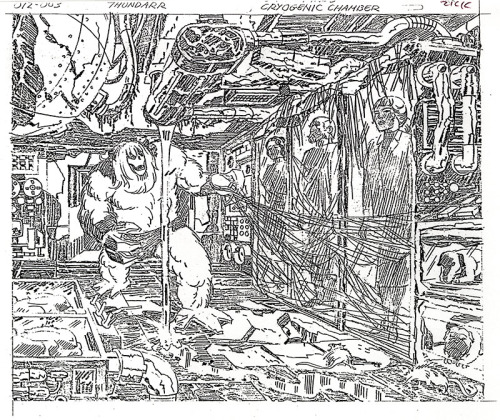


The writing team also included fellow comic expatriates Evanier, Roy Thomas, and Gerry Conway, and together they produced two seasons and a grand total of 21 episodes that aired between October, 1980, and September, 1982, before it was pulled off the air. Now, Thundarr the Barbarian was not cancelled over ratings. Nope, despite its late time-slot and constant preemption by the game of the week, it was a substantial hit. Thus, the reason for its cancellation was over the show's violent content.

While completing the first season it was a constant battle with the network censors over the emulative clause, which stated cartoons couldn’t involve violent content a child could mimic. (Even Thundarr’s weapon had to be a non-metal sword as any kind of blade or knife were strictly verboten.) And for a show designed to push the boundaries of adventure, suspense, and even dabbling in the macabre, it was a steep hill to climb from the get-go. (As designed and executed, considering when it came out, I’m still surprised this thing ever made it to air.) “We [had] a number of severe limitations,” said Gerber in an interview for Fantastic magazine back in 1980. “With all of the mayhem that goes on in our show, [they] will still not allow our main character to throw a punch or hit anybody. He can do all kinds of acrobatic things but he can’t even trip anyone … If, on the other hand, Thundarr picks up a boulder and throws it in the path of some werewolves to trip them up that’s not emulable and we’re allowed to do that. The funny thing is that the violence is actually scaled up and not down."


Thus, to combat this the production team actually kicked it up several notches and overdid things, hoping at least some of the original bite of the show would remain intact. And when it was renewed for a second season, the network warned it was going to come down even harder. Here, Pasko claims to have written an episode for the season premiere that was so over the top standards and practices used it for years as an example of what not to do. But again, this was all part of an elaborate design. “Ruby fretted over this since he felt we’d already watered the show down to the point where it was barely exciting,” said Pasko. “Steve suggested making it so violent that even after the network got through with it, we’d have enough left that in all future arguments over violence, we could point to that episode and say, ‘You let us do that, why not this?’"

While the design was great and the characters a ton of fun and their adventures always engaging, the show was marred by the bane of many cartoons of the era: repetitive and recycled animation, using the same cels and sequences over and over again. Then again, the show went through the trouble of rotoscoping all the equestrian sequences, an expense almost unheard of for a Saturday morning show. (To be fair, these sequences received the most use and abuse.) To me, this is easily overlooked and over-compensated for by the amazing details stuffed into every square inch of your TV screen, and some superb voice talent and vocal chemistry between our heroes. Ridgley’s gung-ho performance and war-hoops are a riot, as are Corden’s vocalizations of the mercurial Ookla, and Bellflower is pitch perfect as the snarky Ariel. Mention should also be made for the rousing score and pants-on-fire musical cues concocted by Dean Elliot, Mark Green and Denise O’Hara. And, holy crap, not since the Ballad of Gilligan’s Island has a title-sequence been so well-executed to give you everything you need to know in less than a minute. Ten year old me was addicted, and kinda freaked out at times, and wished for more. But while looking back and researching this write-up, maybe it’s a good thing the plug got pulled when it did.

On one hand, you had Gerber toying with the idea of a full season arc where Thundarr goes to war against a council of wizards, the Seven Citadels, to free all of those they’d enslaved over the years. (This was also the pitch for a proposed Thundarr movie that, alas, went nowhere.) On the other, Ruby wanted season three to be about Thundarr’s kids. Apparently, he and Ariel were to be married and have twin children (-- it flies, as I know this series was my first exposure to "sexual tension"); one “a tomboy barbarian daughter and a son who follows his mother’s magical inclinations.” I don’t know about you all, but that has all the earmarks of a Scrappy-Doo level of ruination to me. So maybe cancellation making that the end of that idea wasn’t such a bad thing after all.

What’s really tragic about Thundarr the Barbarian was bad timing in that it just missed out on the explosion of syndicated cartoons and the easing federal restrictions on content and merchandising, ushering in the age of the glorified commercials of G.I. Joe and The Transformers, and the mass-casualties of Japanese imports like Robotech, which officially marked the death knell of the dreaded emulative clause.


What I found most amusing with this latest revisit to the year 2446 was how much Thundarr the Barbarian fit so perfectly where Conan and Star Wars meet on the graph -- and how hilariously it felt like some weird Italian knock-off of both. It’s been playing on my TV as I write this up, the whole time, which is why this has taken forever to finish. Sorry, but I have nothing really to apologize for, there. Now if you’ll excuse me, I gotta go. Ookla is losing his shit again and he just used a stuffed whale to clobber a space vampire. Damn I love this cartoon.

Thundarr the Barbarian (1980-1982) Ruby-Spears Productions :: ABC / EP: Joe Ruby, Ken Spears / P: Jerry Eisenberg / D: Rudy Larriva, John Kimball / W: Steve Gerber, Buzz Dixon, Mark Evanier, Martin Pasko, Ted Pedersen, Christopher Vane, Roy Thomas / E: Mary Nelson-Duerrstein, Chip Yaras, Lenore Nelson / M: Dean Elliott, Mark Green, Denise O'Hara / S: Robert Ridgely, Nellie Bellflower, Henry Corden, Dick Tufeld


