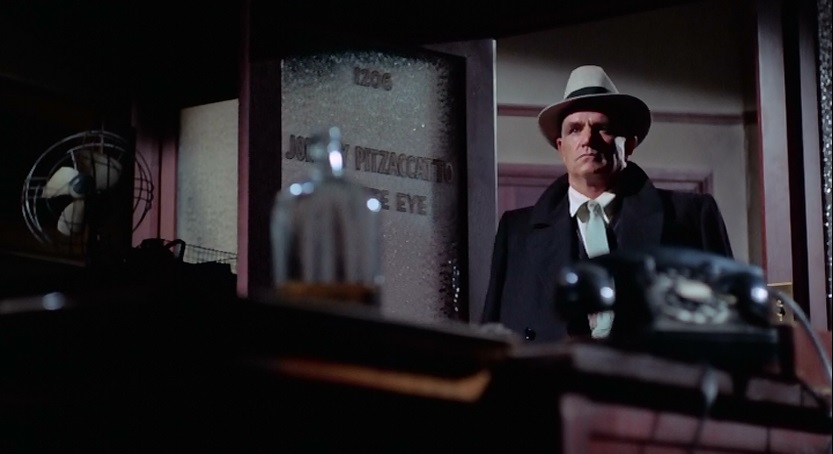
After scoring several pop hits, the husband and wife singing duo, Sonny and Cher (Bono, Sarkisian), are suddenly red-hot commodities in Hollywood circles as several studios trip over themselves in order to strike while things are molten and get them onto the big screen first despite the couple’s grand indifference on such things. Well, turns out Sonny is a little less indifferent than Cher, and he signs on when a mega-producer named Mordicus (Sanders), who won’t take no for an answer, makes an offer they can’t refuse, giving the potential stars carte blanche to write the script for their own movie in any genre they choose. But now, with a deadline looming, and shooting scheduled to begin in just a couple of days, the procrastinating Sonny’s imagination soon gets the better of him as he runs several movie scenarios past his partner to see if something, anything, finally sticks...


A high school dropout with dreams of being a songwriter, Sonny Bono worked several odd jobs while trying to break into the music business in Los Angeles, including a waiter, construction worker, truck driver, and a butcher's delivery man, which left a lasting impression on several music execs when he would constantly drop by while making deliveries, to submit new songs, still wearing his bloodstained apron. He finally caught on at Speciality Records, where Sam Cooke recorded one of his compositions, "The Things You Do to Me.” Bono then went to work for Phil Spector in 1962, where he co-wrote “Needles and Pins” with Jack Nitzsche for The Searchers. And it was around this same time Bono hired himself a new housekeeper he’d met in a coffee shop by the name of Cherilyn “Cher” Sarkisian.

Like Bono, Cher had also dropped out of high school and moved to Los Angeles when she was just 16, where she worked as a dancer in several clubs along the fabled Sunset Strip, using these venues to introduce herself to managers and agents, looking for an “in.” She found one in November, 1962, when she met Bono, who introduced her to Spector, who in turn used her as a backup vocalist for the Wall of Sound on several pop hits, including the Ronettes' "Be My Baby" and the Righteous Brothers' "You've Lost That Lovin' Feelin.” Liking the way she sounded, Spector produced her first single, “Ringo, I Love You,” recorded under the name of Bonnie Jo Mason, which completely fizzled.

Meantime, a romantic relationship soon blossomed between Bono and Cher, culminating in an “unofficial” wedding ceremony in Tijuana, Mexico, in late 1964. All the while, Sonny kept pushing Cher as a solo act but she kept begging for him to perform with her due to some crippling stage fright. And as the duo began harmonizing together onstage as Caesar and Cleo, Cher would focus on Bono to relax, later claiming she always sang to the people through him. Still, as single after single continued to fizzle, the couple hadn’t quite found their sonic signature yet.

But that all changed in 1965 with the three-punch combo of a name change to Sonny and Cher, the release of the Bono penned “I Got You Babe,” and an incident in England when they were both evicted from the London Hilton over the way they were dressed in fur vests and striped bell-bottoms, making them instant counter-culture sensations overnight; and by the end of the year, after the release of their first album, Look at Us, the couple had five songs in the Billboard Top 20.

Musically speaking, with Sonny’s high and nasally voice mixed with Cher’s rich contralto, this shouldn’t have worked at all and yet it did; two highly mismatched puzzle pieces that somehow clicked and locked together. Amazingly so. And all the while, Sonny kept pushing Cher to the front, writing “Bang Bang (My Baby Shot Me Down)” and “You Better Sit Down Kids” for her solo album, The Sonny Side of Cher, which also went through the roof. Then, in 1967, with the release of the follow up Sonny and Cher album, In Case You’re in Love, anchored by the hit single, “The Beat Goes On,” and their popularity at an all-time high, Bono approached his agent, Abe Lastfogel, about the possibility of making a Sonny and Cher movie.

Lastfogel then introduced Bono to a fellow William Morris Agency client, William Friedkin -- a young documentary filmmaker, who was ready to break into features. The two hit it off and started looking for a script. At some point, they got a spec letter from Nicholas Hyams, which suggested they go meta and make a movie about Sonny and Cher making a movie. They both loved the idea and Friedkin hired the novice screenwriter to flesh out his idea. But, this collaboration did not last very long because, according to a later interview with Friedkin, “Hyams was condescending to Sonny and disdainful of me." Thus, the script was eventually hammered out by Friedkin and Bono and then polished up by Tony Barrett.

Meanwhile, Lastfogel secured financing through Steve Broidy and his newly minted Motion Pictures International. Broidy had been in the movie business since the 1920s, bouncing around between Universal and Warner Bros. He then hired on at Monogram Pictures in 1933, and steadily moved up the management chain until he was named director of operations in 1945 and steered them through the Poverty Row studios’ massive upgrade to Allied Artists in 1953, where he remained president until 1965 when he left to form his own company.

Apparently, Broidy had wanted to call the film I Got You Babe to cash in on the hit single but Bono preferred Good Times (1967), based on a newly penned song he wanted to incorporate into the film. And while the production itself was a bit of a runaway, with the budget ballooning from $500,000 to $800,000 as Friedkin went a little nuts, Broidy would sell the completed film to an eager Columbia for $1.2 million, making himself a tidy profit. Columbia, however, took a bath, as the film floundered at the box-office and failed to find an audience -- any audience. And the reason for that is twofold:

One, the film isn’t particularly all that good. The whole thing comes off as a pastiche of a half-dozen, half-baked scenarios haphazardly thrown together that both look and read like rejected coconut-cranial-trauma-induced dream sequences from the old Gilligan’s Island TV show as Sonny gets to star and be the hero in a musical western, a hard boiled murder mystery, and a jungle adventure, with Cher playing a different character in each, and George Sanders and his goons playing the villains, while Bono tries and fails to drum up some enthusiasm in his partner, who really doesn’t want any part in this nonsense. And then Sonny decides he really doesn’t either. And that’s about it.
If one wanted to be generous, you could call Good Times a farce, I guess. Props to Friedkin for giving us a few interesting things to look at, but his burgeoning style constantly clashes with cinematographer Robert Wyckoff’s ingrained TV sensibilities that keeps the film way, way, way too grounded as it struggles to be hip and kooky. Apparently, Friedkin shot half the film with a different cinematographer and a three man, non-union crew, guerilla style, and it's very easy to tell one half from the other. Alas, this clashing of styles only adds to the film's problems. Which brings us to the second reason the film flopped.

By the time Good Times came out in May, 1967, the kind of mellow folk music Sonny and Cher were peddling was being pushed off the charts by the likes of Jefferson Airplane and Led Zeppelin. The times, as the song goes, were a changing. And following Bono’s conservative lead, they refused to adapt to these changing times. Now couple that with the duo’s well-publicized stance against the notion of “free love” and being staunchly anti-drug, Sonny and Cher were flaming out and on a fast train to Squaresville. Bono had hoped the film would shore things up, but this, of course, backfired.

However, these same stances made the duo very standards and practices friendly, explaining why these “safe hippies” spent almost the entirety of the 1970s on TV in some form of variety show, which appealed to a more geriatric audience, starting with The Sonny and Cher Comedy Hour (1971-1974), which got a lot of mileage out of Sonny’s self-depreciation and Cher’s bold fashion statements. And as the couple’s marriage fell apart, so did their act, leading to their own separate series, The Sonny Comedy Revue (1974) and Cher (1975-1976) before they reunited one last time for The Sonny and Cher Show (1976-1977), which always ended with their signature song, “I Got You Babe."


As Bono moved into the 1980s and Cher left him in the dust never to look back, he sort of became his own punchline. And while he still showed up in a few movies and TV serials from time to time, he apparently started shying away from showbusiness after a guest stint on Fantasy Island where he witnessed Hervé Villechaize have a complete meltdown over some slight affront and washed his hands of the whole business.
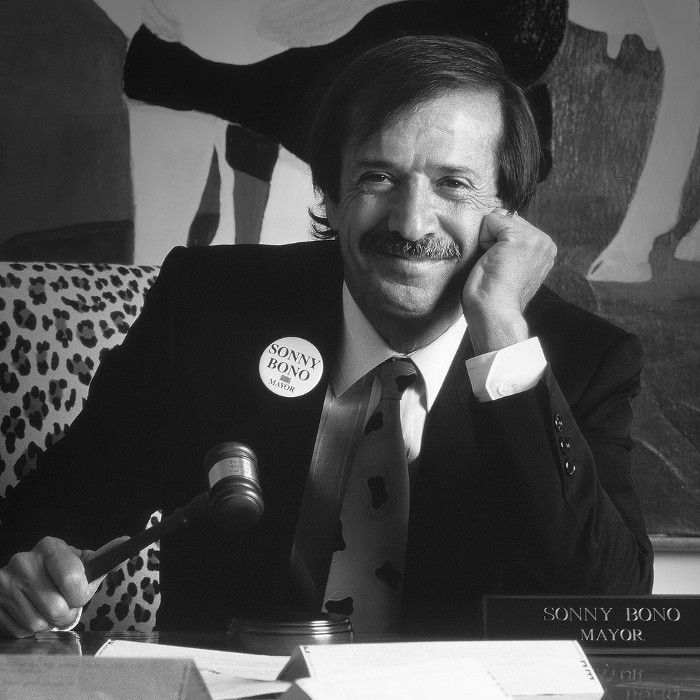
But in the end, he just left one media circus for another when he got into politics, getting himself elected mayor of Palm Springs in 1988 -- basically so he could change a city code so he could put up a bigger sign up on his restaurant. He was then elected to the U.S. House of Representatives as a Republican on his second try in 1994, and served in that capacity until his untimely death in 1998 due to a skiing accident. Cher would deliver his eulogy, and his headstone reads, “And the Beat Goes On."
Thus, Bono left behind a very strange and unique legacy. And that might be the best way to sum up Good Times, too. Strange, and unique. Also, pretty forgettable, which is too bad. I’ve always liked the duo, dug their music, and their schtick. In that same interview referenced earlier, Friedkin stated "I've made better films than Good Times but I've never had so much fun." For me, I just wish a little more of that fun had made it into the actual film.
Good Times (1967) Motion Pictures International :: American Broadcasting Company (ABC) :: Columbia Pictures / EP: Steve Broidy / P: Lindsley Parsons / D: William Friedkin / W: Tony Barrett, Nicholas Hyams / C: Robert Wyckoff / E: Melvin Shapiro / M: Sonny Bono / S: Sonny Bono, Cher, George Sanders, Norman Alden, Larry Duran, Hank Worden
While there will be almost 250 passengers and crew destined to board Flight 502, non-stop from New York to London (-- though I'm pretty sure that's LAX), our film will narrow its focus to the flight crew, the twenty or so first class passengers, and the two stewardesses tasked to serve them as the last few stragglers scramble to secure their boarding passes. Meanwhile, in the first class lounge, we’re introduced to several of those passengers as they check in:


First up is the Garwoods, Dane and Laraine (Clark, Day), a married couple running away from the grieving process over the death of an estranged daughter due to a drug overdose of dubious circumstances; next is Mona Briarly (Bergen), a bitchy, best-selling mystery author who is too scared to fly unless she’s fully crocked (-- and she’s halfway there already); and then there's Jack Marshall (Bono), a washed-up pop singer looking to make a comeback in a spaghetti western; and also Ida Goldman (Picon), an elderly yenta, who strikes up an instant relationship with fellow octogenarian, Charlie Parkins (Pidgeon); and a young turk named Millard Kensington (Bonaduce); and then there’s two doctors, one medical, Kenyon Walker (Bellamy), and one academic, Otto Gruenwaldt (Bikel); and finally we have International man of mystery, Paul Barons (Llamas), who barely gets checked in on time before the final boarding call.


Meantime, Captain Larkin (Stack) is already on board the 747, where he checks in with head stewardess, Karen White (Fawcett -- here billed as Fawcett-Majors), who, having been liberated long enough, she says, is on her last flight before retiring to a life of wedded bliss, and then watches as the disaster prone Vera Franklin (Adams), the other first class attendant, trips and falls, dislodging the contents of her overnight bag. And while the two women scramble to clean up the mess before the passengers board, Larkin finds one of them got on early, lurking near the cockpit.
But this man introduces himself as Detective Daniel Myerson of the NYPD (O’Brian), on his way for special training with Scotland Yard, and he’s there to check in with Larkin, hoping to get permission to carry his firearm during the flight since he “feels naked” without it. But cop or not, rules are rules and Larkin confiscates the service revolver, promising to return it once they land in London.


And once everyone is aboard and secures a seat, with several of those mentioned passengers sitting beside each other, this triggers myriad subplots and clandestine animosities between several parties, which start bubbling to the surface as the plane taxis down the runway and prepares for take-off. Then, once the plane is in the air, back on the ground an attendant finds a gift someone from first class left behind -- a gift that is apparently ticking! But after the bomb squad is called in and starts tinkering with it, the package harmlessly detonates in a puff of smoke. A fast check of the passenger list by Robert Davenport (Maharis), the airport’s chief of security, quickly narrows down the most likely culprit to that punk, Kensington, who has pulled several similar pranks on this particular airline at airports around the country (-- for reasons and guesses that are as good as mine). And while this one proved relatively harmless, what the attendant brings to Davenport’s attention next is anything but: a letter, addressed to him, left in the first class lounge that he normally wouldn’t have received until the next day; a letter whose anonymous author apologizes for the murders they’re about to commit on Flight 502...


The made for TV movie thriller, Murder on Flight 502 (1975), is one of those features that is chock full of, and dependent on, and hoping the audience will swallow, an absurd amount of improbabilities and coincidences to make its plot work. For, here, we have a plane with a pre-confessed murderer on it, that is past the point of no return, with all other airports socked in by inclement weather (-- I’ll assume that to be all of Canada, Greenland and Iceland), meaning the flight must continue on to London. And on top of that, every passenger in first class seemingly holds a homicidal grudge against someone else who also just happens to be on the exact same flight.


See, against all odds of credulity, Dr. Walker just happens to be the surgeon who couldn’t be reached in time to save Gruenwaldt’s wife, leading to several grief-fueled death threats. And not only that, guess whose house the Garwood’s groupie daughter overdosed in? That’s right; not only did she O.D. in Marshall’s house, she died in his bed. And though he was cleared of any wrongdoing, the singer wasn’t even home at the time, Dane Garwood still holds him personally responsible and intends to seize this proximity for a little payback, especially when Marshall starts hitting on the pretty young girl sitting next to him.


Now, all of this background info is uncovered by Davenport, who relays it onto Larkin, who lets Detective Myerson in on death threat and gives his gun back. But by then, after determining it is not prank (-- ruling Kensington out), it’s already irrelevant as Gruenwaldt suffers a massive coronary, with Walker being his only hope of pulling through. And as Walker treats him, the two men make peace as the victim pulls through, eliminating the both of them, in Myerson's estimation, as suspects. (The author of the note promised multiple murders, so the math doesn’t work out here.)


Meanwhile, Garwood violently attacks Marshall in the lounge with a serving fork he stole from the galley. (This, thankfully, interrupts a very painful musical interlude between Marshall and his brand new groupie played by Stack’s daughter, Elizabeth.) This fight is broken up before any damage can be done, and Marshall is in a forgiving mood once he finds out who his attacker really is. And while the mother has come to grips with what kind of a person their daughter had become, the father still holds her up on a ivory pedestal. And together, Laraine and Marshall talk Garwood into finally coming to terms with her death by, essentially, lying to him to keep his delusions safe because denial IS just a river in Egypt, apparently.
Again, the math on the Garwood / Marshall feud doesn’t jive with the plural murder letter so another probable suspect is eliminated, sending this ersatz investigation back to square one. Then, as Myerson eliminates the crew as suspects, another couple of leads come courtesy of Briarly, who is convinced Barons is the mastermind behind a brazen bank robbery several years back that left one guard and one accomplice dead, which netted the two remaining thieves over seven million dollars. Barons, obviously, vehemently denies this. Sure the cops pulled him in for questioning, he admits, but they had no evidence and let him go.


Undaunted, the tenacious and slightly intoxicated author keeps probing, wondering how he managed to smuggle that much money out of the country? Again, Barons denies everything and is really regretting his choice of seatmates right now. And then, the ever observant and always suspicious Briarly might also have pegged Barons’ living accomplice, pointing out the odd behavior of a priest to Larkin, who, one, didn’t budge when Gruenwaldt had his heart attack, and two, What kind of priest would ever wear nail polish? (I know that’s me shrugging right now.)


When word comes from Davenport that the ‘priest’ currently occupying seat 14-B actually died the year prior and his identity was assumed by a three-time loser named Hoffman, Larkin relays this to Myerson. But when he goes to confront the suspect he finds his seat empty. Now, we already know Hoffman was clandestinely attacked and most probably killed by an unseen assailant near the restrooms while Briarly was making her case to Larkin upstairs in the lounge. And this is confirmed when Myerson and Kathy eventually find the body, stuffed in the galley elevator, triggering a scream from the girl.


When Dr. Walker determines the man was strangled to death, meaning a murderer is on board the plane, the cat is officially out of the bag. And so, to calm the panicked passengers, Larkin and Myerson fully disclose the contents of the letter with everyone. The captain also reveals the killer is most likely a first class passenger, and he/she promised more than one other passenger would die. (And this is supposed to calm everyone down how?!) Deciding on the best course of action, since there’s less than an hour before they land, Larkin orders everyone to remain in their seats under the watch of Myerson until they touch down. With that, Larkin returns to the cockpit to update Davenport. And while he radios in, Briarly, now really intoxicated, continues to put the screws to Barons, who is becoming visibly upset and belligerent with her line of questioning.
Meantime, down in the storage area below the galley, someone is rifling through the stewardesses’ luggage and finds a crapload of money stashed in Vera’s bag. (But wait, you say? Hang on, I say.) And one could probably safely assume this same person a short time later snatches an unaware Vera into the lounge bathroom where she is subsequently strangled to death. Then, when her body is discovered by the co-pilot (Baggetta), this finally pushes Barons over the edge. Convinced he is next on the killer’s hit-list, he demands protection from Myerson. When asked why, Barons lets slip he was responsible for the bank robbery and Hoffman was his accomplice. This, was all Myerson wanted to hear and Barons’ confession proves the last puzzle piece in a three year pursuit of vengeance that is about to reach final fruition.


You know, an airborne jumbo jet has a lot of potential as an excellent setting for a locked room murder mystery. And while that certainly is the central premise for Murder on Flight 502, an excellent locked room murder mystery it really isn’t. The first murder doesn’t occur until an hour in, and it really doesn’t find any traction until there’s about ten minutes left when the killer is finally revealed and engages his endgame. Before that, all we got is a ton of padding revolving around those amazing coincidences I mentioned earlier as the film tries to throw you off the trail of the real intended victims and the killer, making Murder on Flight 502 a bit of a slog.


Obviously, from the cast of dozens, to the near miss airline disaster, to the geriatric romantic interlude, to the PTSD marriage counseling, Airport (1970) and the resulting franchise had a huge influence on this production, though the film’s true cinematic surrogate is most probably Skyjacked (1972), where someone leaves an anonymous note on the ground that someone on board has a bomb, with the plane eventually hijacked to Russia by a crazed Vietnam veteran.

Translating all this melodrama and intrigue to the small screen were producers Aaron Spelling and Leonard Goldberg. These two had established Spelling-Goldberg productions in 1972, which unleashed the prime-time 1970s staples, Starsky and Hutch, S.W.A.T., Fantasy Island and Charlie’s Angels. The two would also churn out a ton of made for TV movies, ranging from sagebrush to the supernatural, beginning with The Daughters of Joshua Cabe (1972) and the delightful, star-studded tale of family skeletons, Home for the Holidays (1972). My personal favorite was the totally creepifying, A Cold Night’s Death (1973), where a couple of arctic researchers finally realize who’s been trying to kill them too late.

And then there was the totally wonky Satan’s School for Girls (1973) and Death Cruise (1974), the twisty Death Sentence (1974), and the ghostly Death at Love House (1976). (Sensing a pattern here?) And then the two men would amicably dissolve the company in June of 1977, but not before finishing things off with The Boy in the Plastic Bubble (1976) and Little Ladies of the Night (1977), which would kind of lay the groundwork for the social dramas Spelling would later produce in the 1990s.


Again, Murder on Flight 502 isn’t Spelling and Goldberg at their finest, and most of that falls on David Harmon’s script and the train-wreck of coincidences and padding found therein, and the fact that the killer had to have free run of the ship, narrowing down the probabilities to one passenger, Myerson. (It might’ve been helped with a shorter time slot because there just isn’t enough here to fill two hours.) And this terminal script isn’t helped all that much by George McCowan’s lackluster direction, who doesn’t do a whole lot with his minimal settings, which makes the film feel very repetitive.

The veteran cast plugged into these stock characters are solid but aren’t given a whole lot to do. The only real standouts are Polly Bergen and Hugh O’Brian. (The doomed romance between Picon and Pidgeon was endearing but belonged in a different movie.) Everyone else is walking through this as fast as humanly possible. In fact, the film might’ve been improved by moving Bergen’s character to the forefront and make her the main character instead of the pilot and let her unravel the mystery ala Jessica Fletcher. They wouldn’t even have to sober her up as this was an interesting character trait. I mean, she basically uncovered the conspiracy plot on her own already -- a little too conveniently, I might add, as her whole case was based on her sorta, maybe, recognizing Barons, who only sat by Briarly so he could hit on her, which quickly gets him cut off at the knees.


O’Brian, meanwhile, comes to the forefront at the end when it’s revealed he was the killer all along and starts to crack-up, taking several passengers hostage in the lounge, where he lays Barons’ sins bare, including the revelation the guard he killed was Myerson’s brother. Seems he figured Barons and Hoffman were guilty, and finally sussed out they were using a stewardess to smuggle the stolen money out of the country in small increments, which is why he killed Vera after finding that money in her suitcase. And once he’s laid out his case, he intends to execute Barons in front of these witnesses. Things get a little hairy when Larkin’s plan to disrupt this, dropping the oxygen masks from the ceiling, kinda backfires as Barons still gets plugged and several ricochets ignite the enriched oxygen. Thus, the lounge is soon a blazing inferno.


And while all the other passengers manage to escape, except for Myerson, who is severely burned, Larkin gets the plane landed safely for the awaiting emergency crews, leaving us with one final twist in the plot that needs to be tied off. Remember at the beginning of the film when Vera’s bag spilled all over the cabin? Well, Larkin sure does, and he doesn’t remember seeing any money, meaning Kathy was the real accomplice all along, who panicked when Hoffman was killed, moved the money into Vera’s bag, framing and getting her friend killed to save her own hash while she essentially hid in the cockpit.
With that, Kathy and Myerson are taken into custody, the two old farts decide to share a hotel room -- wink, wink, nudge, nudge and pass the Geritol already, and Briarly is already taking steps to get signed releases from all the passengers with every intention of making this little murderous misadventure the plot for her next mystery novel.


Murder on Flight 502 made its debut on November 21, 1975, as the ABC Friday Night Movie. I don’t think it ever had a release on VHS but a quick check shows there’s been a ton of legitimate and not so legitimate releases on DVD. The film is also readily available for streaming on several YouTube channels. I can’t really recommend a watch because the film really isn’t all that great or engaging and is a rather dull and lackluster affair -- well, it was until the last ten minutes where it goes completely bonkers; but like with Davenport’s last radio message, revealing Myerson is no longer a cop after suffering a nervous breakdown, after the plane had landed, this was too little too late. But such is the life of a Made for TV Movie obsessive-compulsive. As always, your frequent flyer miles may vary but I honestly recommend trying to find some friendlier skies to fly.

Murder on Flight 502 (1975) Spelling-Goldberg Productions :: American Broadcasting Company (ABC) / EP: Aaron Spelling, Leonard Goldberg / P: David Chasman / AP: Bret Garwood / D: George McCowan / W: David P. Harmon / C: Archie R. Dalzell / E: Allan Jacobs / M: Laurence Rosenthal / S: Robert Stack, Farrah Fawcett, Hugh O'Brian, Polly Bergen, Sonny Bono, Ralph Bellamy, Theodore Bikel, Dane Clark, Laraine Day, Fernando Lamas, George Maharis, Molly Picon, Walter Pidgeon, Brooke Adams, Danny Bonaduce