Monday, May 12, 2014

Blogathons Ahoy! We're Gonna Whip 'Em. Whip 'Em Good.


Following several enticing bread crumbs, I now find myself happily participating in Silver Screenings and The Rosebud Cinema's 1967 Blogathon. (Of course, I just wrote up In the Heat of the Night. *sigh*). And while I contemplated venturing into the lunatic sleaze-noir of Michael and Roberta Findlay's The Touch of Her Flesh, I decided to tackle something just as demented instead:


a/k/a The College Girl Murders, one of Rialto film's most whackadoodle Edgar Wallace adaptations. And if I manage to survive that, I've also got a few thought on The Born Losers I'm dying to share.


I'm participating. Are you?

And coming up in July, I've also wrangled a spot in Krell Labs and Bemused and Nonplussed's John Ford Blogathon. And for that, well, since I just wrote up Fort Apache (*double sigh*), I guess I'll just have to settle on this one. Anybody heard of it?


I'd been noodling a write-up on this film ever since finally reading Alan Le May's novel last year and picking it up the BluRay, where I finally noticed something -- something you'll have to wait and read to find out what. And now, at last, proper motivation to actually get it done. (And if I get my crap together, I'll also take a run at Donovan's Reef.)


Stay tuned, Boils and Ghouls.

Thursday, May 8, 2014

STOP! Don't Trip Over that Ending :: A Beer-Gut Reaction to Michael Anderson's The Naked Edge (1961)


Six years after her husband's crucial testimony sent a co-worker to prison for murdering their boss, the wife (Kerr) stumbles upon a conspiracy to blackmail the star witness. Seems the blackmailer claims it was the husband (Cooper) who actually committed the murder, who then framed an innocent man for it.


Now, there's a lot of tangential and circumstantial evidence to back up this claim, too, which puts, quite obviously, some major strains on their marriage. And the deeper she digs, the more guilty her ever-evasive spouse looks, putting herself in mortal danger in the process. And all of this leads to a pretzel'd climax that will leave you guessing over who is really guilty till the bitter end.


From the scriptwriter (Joseph Stefano) to it's plot (which mirrors Suspicion quite fiercely), The Naked Edge owes a lot to Alfred Hitchcock. This would be Cooper's last film, who was apparently so sick he required frequent breaks for an oxygen assist between takes -- you can definitely see the toll it was taking on him.


Sadly, Cooper passed away before the film was released and it subsequently crashed and burned at the box-office, which I find odd because it wasn't all that bad. Sure, Kerr kinda overplays the overwrought, passive/aggressive wife; and the plot is a little too lather, rinse, repeat as it unfolds -- with each piece of new evidence uncovered leading to a confrontation between our couple, resulting in the same accusations and the same fishy denials followed by a temporary truce until the next piece of evidence is found.


Still, double-extra bonus points from me for a cameo by Peter Cushing as the prosecuting attorney. And I won't spoil who really done it, because despite these harrowing hiccups the last thirteen minutes definitely flash-fires this thing into the win column for me. 


The Naked Edge (1961) Pennebaker-Baroda Productions :: United Artists / EP: Marlon Brando Sr. / P: George Glass, Walter Seltzer / D: Michael Anderson / W: Joseph Stefano, Max Ehrlich (novel) / C: Erwin Hillier / E: Gordon Pilkington / M: William Alwyn / S: Gary Cooper, Deborah Kerr, Eric Portman, Hermione Gingold, Peter Cushing

Thursday, May 1, 2014

Good Reads :: A 250 Page Mission to Boldly Go Where No Zombie Has Gone Before!

So. Just finished up Kevin David Anderson and Sam Stall's Night of the Living Trekkies, a novel which concerns the staff at a Houston hotel as they brace themselves for the onslaught of a weekend Star Trek convention only to be overrun by something far more sinister -- and hungry. 

Here, our story focuses on a certain bellhop named -- wait for it -- Jim Pike, a former Trekker whose enthusiasm for the fantastic has been scuttled by an IED reality check and two tours in Afghanistan. 

But once the shit hits the fan, this disgruntled vet, along with his Andorian sister, a hired cosplayer decked out as Slave Leia, a Klingon from Atlanta who builds replica sci-fi melee weapons, an overweight computer programmer who still lives with his mom, a keynote speaker on Xenobiology from Harvard, and a Red Shirt named William 'Willie' Makeitt, must fight their way from room to room and floor to floor, trying to escape before they're all assimilated into the zombie horde. Well, technically, they're not really zombies, but more of a Van Vogt-tian space parasite infection.

Anyhoo, filled with about a gabillion inside jokes, several of which had me barking out with laughter, the dual-authors really know their Trek lore; and though their end result is completely disposable once the last page is finished, the novel is well worth a read.

Sure, the plot and characters are all unrepentantly silly, but it's in a 'having fun with the cliches' as opposed to 'making fun of them' if that makes any sense. I mean, What is a Zombie Apocalypse but a total Kobayashi Maru?

Now, the only real disappointment I had with Night of the Living Trekkies was it barely scratched the surface on the whole notion of Gene Roddenberry's optimism butting heads with George Romero's pessimism -- an idea I felt deserved to be explored further. 

But! What we got was good enough and manages to actually exceed its novelty trappings while embracing them at the same time as the novel finally answers the eternal question: What will it take to make a cross-fandom relationship work? Alien Zombiegeddon.

Beyond that? Only 250 pages and a quick read. Track it down and engage as soon as possible, Boils and Ghouls. 

Saturday, April 26, 2014

Wish We Could All Be There.


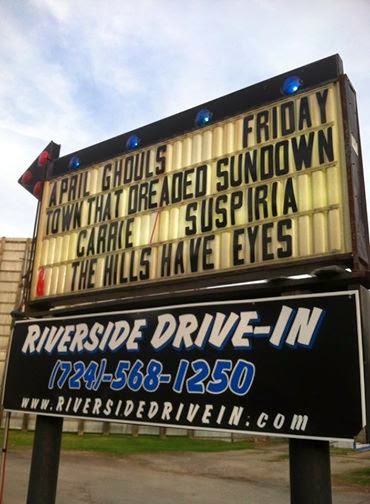
For those attending the April Ghoul's Monster Rama at the Riverside Drive-In this weekend, I salute you! Sorry I couldn't make it. Have a blast, Boils and Ghouls, but, remember...


Do NOT drink the Brown Sprite.

Thursday, April 24, 2014

Quite the Trip Indeed :: A Beer-Gut Reaction to Finally 'Getting' Stanley Kubrick's 2001: A Space Odyssey (1968)


Last week, you may recall, I mentioned seeing John Ford's Fort Apache on the big screen at a Saturday matinee. What I didn't tell you was, on the same day, there was also an opportunity to see Stanley Kubrick's 2001: A Space Oddessy at the World Theater in Kearney, a sister burgh, where I had already seen the likes of JAWS, Swiss Family Robinson, and Young Frankenstein as they were meant to be seen. Alas, this was also bill paying day; and no matter how hard I crunched the numbers I just couldn't creatively finance or justify the scratch for the tank of gas needed for this screening. And so, I settled for the next best thing and finally broke open my BlueRay copy of 2001, which I had rescued from a $5 bin the day I bought the player nearly two years ago. (I rescued a copy of The Outlaw Josey Wales from the same bin. Haven't watched that one yet either. *sigh*) 


And so and so, I finally saw 2001: A Space Oddessy, digitally remastered, and in the right aspect ratio, and my mind was blown all over again in the comfort of my recliner. Not the same by any stretch, but it would do.


Now, the first time I tried to watch this movie ended in disaster. I was probably seven or eight years old when 2001 made its broadcast TV debut and I nearly gave up on it during the opening 'Dawn of Man' sequence but decided to stick it out -- for about another ten minutes, when I officially gave up during the interminable space-docking waltz and started cranking through the other channels. Both of them, and settled on something else. Most probably a Dukes of Hazard rerun.


I revisited it again in my late teens on video, but still didn't really get it, taking the film at face value -- or the value of the face that I saw: a pretentious sci-fi movie / cold-war parable about a man's hubris and a villainous super-computer turned homicidal that took an odd and exhaustive route to get there and then got really full of itself for the last ten minutes or so. Then, about a decade later, returning home one Friday night from the bar, bombed out of my skull, I found 2001 playing on one of the SuperStations and watched it for a third time, mesmerized, and the quarter finally dropped and I finally 'got it.' I think. Maybe. The long and the short of it: I just wasn't thinking big enough.


To me, 2001: A Space Odyssey is not about space exploration or a paranoid sentient computer in need of some Clozapine. (Teenage me thought the alien monoliths turned HAL homicidal.) No. Those are just means to an end. Nope. It's about the evolutionary progress of man -- more to the point, the moments which trigger or cause advances up the scale of such things. We begin at the beginning, with the use of basic tools and then warp ahead to show how far we've evolved and taken this technology: to the point where it is on the verge of surpassing us -- if it hasn't already; and also to the point where the tools we invented that allowed us to kill to survive and dominate is now capable of killing us to do the same. I've also felt that this was to somehow show that we, as a species had gone as far as technology could take us. The completion of a first step, if you will. We've built these amazing machines, but are still fallible. Thus, the question is: Are we ready for the next step? Whatever the hell that may be.


Of course, according to the film and the books it was based on by Arthur C. Clarke (The Sentinel), these steps have been prodded along by some higher power, who left benchmarks (the Monoliths) to spark and mark our progress as a species, which signal to the Big Unknown whenever an objective is reached. (From the Earth to the moon, and now, to Jupiter.) And when we are finally able to reach that last threshold, the Big Unknown deems us advanced enough and worthy of a closer look, which leads to the infamous stargate sequence, where Bowman's pod is reduced to a sperm-like speck as it warps into another place and another time, destined to be reborn, where he is observed further in the 'cosmic zoo', where everything happens at once like a theoretical tangled ball of cosmic string. (The second step.) And, in the end, we are judged to be worthy. (I think.) And the 'Star Child' is returned to Earth to mark a new beginning and trigger the third step. 


What that third step is, well, that's up to each viewer. Mine is probably a little too optimistic, but, it was at this moment, with this interpretation, right or wrong, when I officially fell in love with the movie and never looked back. It's also one of the reasons I'm torn over the sequel, 2010: The Year We Make Contact, which I enjoyed but kinda blows this theory all to hell since it basically says that we weren't worthy after all and the Big Unknown was starting over on Europa.


All of this seems fairly obvious in hindsight. I freely admit it. But! The best part is, there is no 'right answer' when talking about opinions -- and none, no matter how much we trumpet them, are never definite. Philosophical debates and different interpretations aside, the film is a true technical marvel and a visual feast in its production design and execution -- which is a whole 'nother conversation for another day altogether. 


2001: A Space Odyssey (1968) Stanley Kubrick Productions :: Metro-Goldwyn-Mayer (MGM) / P: Stanley Kubrick / AP: Victor Lyndon / D: Stanley Kubrick / W: Stanley Kubrick, Arthur C. Clarke (novel) / C: Geoffrey Unsworth / E: Ray Lovejoy / M: Patrick Moore / S: Keir Dullea, Gary Lockwood, William Sylvester, Leonard Rossiter, Margaret Tyzack
Related Posts Plugin for WordPress, Blogger...