Saturday, June 21, 2014

The 1967 in Film Blogathon :: Whodunit? Who Cares! It's All Edgar Wallace's Fault in Alfred Vohrer's The College Girl Murders (1967)

___  ___  ___  ___  ___  ___  ___  ___  ___  ___  ___  ___  ___

"Your plan is perfect. Who would look for a murderer in prison?" 
___  ___  ___  ___  ___  ___  ___  ___  ___  ___  ___  ___  ___

Our Teutonic film of masked killers, daring (and somewhat dopey) detectives, damsels in distress, mayhem, and mass murder at a girl's boarding school begins, quite inexplicably, in the secret lair of a couple of wütender wissenschaftlers, who feverishly work to put their new odorless, forensically undetectable, and fast-acting poison gas through one last test on a vat of rats. When this experiment proves a rousing success, the elder scientist decides to field test the poison's dubious delivery device on his clueless assistant, too, who dies almost instantly upon opening a ledger as instructed and the resulting puff of aerosol spray from the ensconced-doodad hits him in the face.


Cut to a cemetery, where a sinister looking masked monk armed with a bullwhip stealthily lurks amongst the tombstones. (Well, as stealthily as you can in that scarlet get-up.) Nearby, the mad scientist delivers the poison gas and the gadget to deliver it, now secreted inside a bible, to the client who commissioned it. Keeping to the shadows, we never see The Client's face during this exchange. When asked for payment, he tells the scientist to remain right where he is and he'll get what's coming to him. And after he leaves, the Scarlet Monk reveals himself and goes all Indiana Jones on the scientist, snapping his neck with that rawhide whip.


Cut to a prison, where Frank Keeny (Rauch), a small time hood who would do almost anything for a $1000, gets roped into a scheme by a fellow inmate wanting to test that theory. With that, a baffled Keeny is swiftly (and rather easily) secreted out of the prison and delivered to a palatial estate, where he's escorted into a secluded chamber / aquarium / secret lair / yes, it even has a pit of alligators / no I'm not kidding / and meets The Client, who gives the fugitive an offer he can't refuse. (Author's note: The Client is still being shy, seated with his back to Keeny, who angrily barks out instructions to his new henchman without ever turning around.) Shown a picture of a teenaged girl, Keeny is ordered to give a certain bible to her by any means necessary. And if he does exactly as told, The Client promises his reward will be great. But if he fails, well, yeah. *thwack* Anyhoo...


Cut to a church, where a gaggle of school girls file in for mass, including the girl in the picture, Pam Walsbury (Strömberg). Working quickly, Keeny manages to bump into her and deftly switches out bibles. And as the invocation kicks up, Pam opens the deadly tome to read along, gets a face-full of gas, convulses violently, and keels over into the aisle, much to the distress of her fellow classmates, who didn't notice that gas attack. (Pam dropped the bible instantly and kicked it under a pew.) And as her best friend, Ann Portland (Glas), and the school's headmistress (Lauenstein) move to help, they're already too late. The girl was dead before she even hit the floor. Watching all of this, and quickly realizing he's gotten into something way, way, way over his head, Keeny flees the scene as fast as his feet will carry him.


And that, believe it or not, is basically just the preamble, folks; and Der Mönch mit der Peitsche a/k/a The College Girl Murders (1967) is only getting warmed up, destined to get even more screwier from here... 


Born the illegitimate son of a stage actor and a chorus girl in April, 1875, author Edgar Wallace had ditched school by the age of twelve to hock newspapers in London's Ludgate Circus, washed out as a printer's apprentice the next year, and then spent the next six years bouncing around, bilking, and getting fired from several menial jobs until enlisting in the army on his 18th birthday, where he served in South Africa during the Boer War of 1896 as part of the Royal West Kent Regiment. Sticking with the theme, Wallace wasn't too enamored with army life and wrangled a transfer to a medical outfit. This proved even worse, which soon had him on the move again until he apparently finally found what he was looking for in the military press corps. 


A voracious reader of military history and the ripping yarns of Rudyard Kipling, Wallace used these influences as inspiration for his stories and poems. According to legend, Wallace's dispatches so impressed Kipling that he arranged to meet the fledgling author (most reports place this meeting in Capetown, South Africa, in 1898) and encouraged him to keep writing once his enlistment was up. And with the sale of his first book of ballads, The Mission that Failed, Wallace sped up this process by using the profits to buy his way out of the army, got married, started a family, and moved back to England, determined to make writing a full time career. 
___  ___  ___  ___  ___  ___  ___  ___  ___  ___  ___  ___

"Such is the insanity of the age that do not doubt 
for one moment the success of my venture."

                                     -- Edgar Wallace 
___  ___  ___  ___  ___  ___  ___  ___  ___  ___  ___  ___

While still working as a reporter for the London Daily Mail, Wallace completed The Four Just Men, his first mystery novel concerning a quartet of proto-Batman-esque vigilantes, which he had to publish himself in 1905. To help boost sales, Wallace concocted an ill-conceived publicity blitz with his employers, serializing parts of the novel in the paper, promising 500 pounds to any reader -- stress on the "any" and not "the first" -- who solved how the crimes were committed before the author's official solution was published. This was accompanied by a four-walling advertising campaign throughout the Empire -- all done on credit. And as more and more correct guesses were mailed in, after the last chapter was published and no contest winners were announced, the lawsuits started flying. Legally obligated to pay off all the winners, the paper's publishers stepped in to bail him out. Couple that catastrophe with several lingering libel lawsuits, and Wallace found himself fired. However, even though it cost him his job and bankrupted him, The Four Just Men did become a best seller. However, one should note that this kind of enthusiastic self-sabotage would serve as a microcosm for Wallace's entire career. 


With his journalistic reputation in tatters and the rights to his novel sold off for a pittance to satisfy some of his creditors, Wallace headed back to Africa at the behest of the publisher of the Weekly Tale-Teller, a sensationalist penny magazine, for which he chronicled the terrible atrocities the Belgians were inflicting on the Congolese native laborers at their rubber plantations. He was also encouraged to write fictionalized accounts of his adventures in the jungle, which added a healthy dose of foreign exotica and taboo rituals into his stories. And along with his adventure tales, private dicks and amateur sleuths, Wallace also pioneered the police procedural by forgoing the middleman and making the detectives his protagonists. 


As his popularity grew, so did his proficiency (-- according to legend, he cranked out The Ringer in just 14 hours.) Again, this staggeringly massive output was by necessity to stave off his creditors and bookies. Seems Wallace had a weakness for the ponies and throwing extravagant parties for the culturally elite but couldn't really afford either, but which never stopped him from partaking in both. And so, by now, the author had developed a formula that sold: "crime, blood and three murders the chapter" and adopted "if it ain't broke, don't fix it" mentality as he pounded them out, published them, and immediately started on the next project.


Sustaining himself on copious amounts of tea and cartons of cigarettes, Wallace would go on to write 18 stage plays, 957 short stories and over 170 novels (12 of them in 1929 alone). It's been said during his reign (1910-1932) that one in four books being read in England were written by Wallace. And though contemporary authors found him both crude and lacking, and the critics thought his work was distasteful and without any merit, the reading public devoured his output to an estimated tune of 50 million copies sold. Outside of Britain, a quarter of a million books were sold in America, but where his writing proved most popular internationally was in Germany -- both in print and at the movies.


Wallace's salaciously violent and violently salacious stories were a decadently perfect fit for pre-Nazi Germany. When films first evolved as an art form, the story was the most important element and the director, cinematographer, and actors were mere technicians, tasked to translate them into moving pictures. (The Germans referred to this as autorenfilm.) And so, the more prestigious the source material usually meant more box-office receipts. Again, Wallace seemed a perfect fit. And happy to find another source of quick cash, Wallace quickly signed off on Der große Unbekannte a/k/a The Unknown (1927) and Der rote Kreis a/k/a The Crimson Circle (1929). About a half-dozen adaptations followed, ending in 1934 with E.W. Emo's Der Doppelgänger, when the rise of Hitler and National Socialism made this type of foreign materiel strictly verboten.


When the German money dried up, Wallace turned to America, hoping to find the same success in Hollywood. He signed on with RKO, where he famously helped Merian C. Cooper flesh out a certain "gorilla movie". Maybe you've heard of it? Alas, barely three months into his contract, Wallace tragically died in February, 1932, due to sudden and acute complications from an undiagnosed case of diabetes, bringing a premature end to his writing and filmmaking career. But this is not the end of our tale. No. This is just the beginning. (Well, more like the middle.) For it seems the Germans weren't quite done with the author yet.


At the dawn of the 1950s there was a sudden resurgence in popularity for these kinds of seedy crime thrillers and two-fisted adventure pulps in Europe, especially in Italy and West Germany. And while the Italians had their gialli (yellow) paperbacks, the Germans had the taschenkrimis -- "pocket-sized crime novels". With their theaters also flooded with American films in the same vein, the distributors of the Frankfurt based Constantin Film decided to try and do something similar domestically. Looking to cash in on these pulp influences, they sent out feelers to several studios, hoping to get someone interested in adapting the westerns of Karl May, the espionage tales of Jerry Cotten, or the criminal capers of Edgar Wallace but found no takers until the Dutch-based Rialto films agreed to take a gamble with them.


Remember, filmmaking in post-war Germany still hadn't really found its legs yet or established any kind of signature identity like it had in the heyday of Fritz Lang and Paul Wegener. But that was about to change when this risky endeavor quickly paid off with Der Frosch mit der Maske (1959), based on Wallace's The Fellowship of the Frog, where a masked super-criminal and his gang of thugs terrorize and loot London while staying one step ahead of Scotland Yard. And it proved so successful it quickly spawned a franchise that earned its own genre -- the kriminalfilm or krimi for short.


Under the guiding hand of producers Preben Phillipsen and Horst Wendlandt, and directors Harald Reinl and Alfred Vohrer, these krimis flourished throughout the 1960s, where "femme fatales, gamblers, and other denizens of the underworld -- stooges, squealers, informers and the like -- shared screen time with heirs and heiresses, insane relatives, mad scientists, psychos, criminal masterminds and (other) worse (elements of horror) in the blurred borders of a corrupt society."
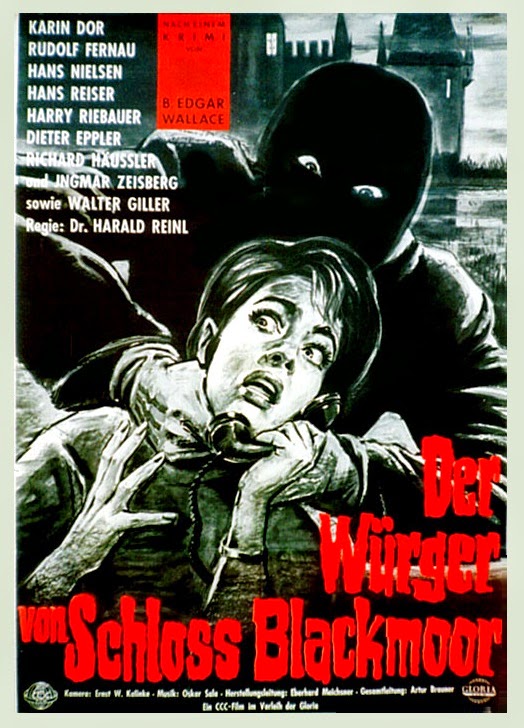

From 1959 thru 1972, with 32 films in-between, Constantin-Rialto seldom strayed from this formula. They were always set in England; the bad guys were always opposed by a rotating gallery of detectives from Scotland Yard and their odious comedy relief; all under the watchful eye of the bumbling chief inspector, Sir John (Schürenberg, who played this same character in 13 of these things), and his ever-revolving pool of perky secretaries. And these investigators would then try to unravel the serpentine schemes of the master villain to save some hapless heroine from being cheated out of her rightful inheritance, being sold off to a white slavery ring, or getting her head chopped off by some guy dressed in a gorilla costume. Combine all of that with an international cast, mindless violence, some eye-popping production design, a swingin' horn heavy soundtrack, more mindless violence, deep shadows, wild camera angles, and a staggering body count by film's end, once you're exposed to this insanity, there is no turning back.


Spawning dozens of imitators, each tried hard to emulate this formula but they always lacked the true delirium of the Rialto series. And though Rialto acquired the rights to exclusively adapt Wallace's books, and they all still bore the signature Wallace stamp of the pre-credit sequence, where the screen would be riddled with bullets and a ghostly voice would announce "This is Edgar Wallace speaking...", barely five films in, it quickly became apparent they were based on the source material in the same way Roger Corman's The House of Usher was based on the poem of Edgar Allan Poe. And as the series progressed, things got even more violent, more decadent, and also a whole lot goofier, which brings us back to The College Girl Murders.


Like the rest of the series, The College Girl Murders plays out like an old Republic serial, mixed with the absurdity of a Gilligan's Island dream sequence, with the overall look and feel and vibe of the old Batman TV show. If you watched all of these films chronologically, by 1967, it's fairly obvious Rialto's formula was on the verge of collapsing under the weight of its own, ever-increasingly convoluted plots. And if things weren't convoluted enough already, the plot proper kicks in when that perfect poison turns out to be not as undetectable as advertised.


With another bizarre homicide on his hands, Sir John assigns Inspector Higgins (Fuchsberger, another series regular) to assist him in the investigation. As a fan of the series, I like Sir John enough, but I like the old goofball in small doses and he spends way too much time out from behind his office desk in this film, which is sorely lacking the true comedy relief of Eddi Arent, another regular, who, alas, doesn't appear in this entry.


Neither the faculty or the students are all that thrilled to have the police sniffing around the school for suspects and leads for Pam's murder, as everyone seems to be harboring a secret or having an illicit affair. Only Ann is willing to talk to Higgins, who earnestly but erroneously sends him sniffing down several false trails. And as these red herrings keep piling up, The Client arms Keeny with another deadly device (which resembles a ray-gun that shoots lethal cotton-candy) and keeps sending him back to the school to bump off more girls. And while Keeny reduces the student body, the Scarlet Monk starts wiping out the faculty before they can talk to the police.


The thing you have to remember is the majority of the players are acting squirrelly due to their own private skeletons that have nothing to do with main murder thread. They act guilty because they are guilty, just not of murder. Thus, due to this behavior, nearly everyone winds up a suspect in this thing. And as Higgins focuses in on them, their life-expectancy can be measured in mere minutes as the true culprits bump them off to sow confusion or, more than likely, just employing a scorched-earth policy to eliminate any possible leaks.


With all these false leads and false witness baring, then, there is no way in hell Higgins or the audience could ever solve the mystery of who is really behind this mad scheme; just a lot of loose dot-connecting, a five-car-twist-pile-up during the climax, and a last minute revelation that nearly explains away everything. Here, The Client was basically carpet-bombing the school to create a pile of bodies big enough that no one would realize who the real target was and trace it back to him. How does the Scarlet Monk fit into all of this? Well, I've watched this film four times now and, You know what? I'm still not sure how they wound up in league together. That's me shrugging right now -- but he sure looked cool!


And even though the whackadoodle plot leads in you thirty different directions at once, there are some interesting twists if you can manage to glom onto them as they rocket by. I like how the setting is another one of those European boarding schools where the only class appears to be lounging around the pool. But I especially dug The Client using prisoners as his lackeys, causing much confusion when several witnesses identify Keeny, who is always snuck back into his cell before the police arrive. Fortunately, Keeny gets a little too greedy and pays the price. And this mistake finally provides a pivotal clue for Higgins, who sniffs out the revolving door to the prison in time to save Pam from that alligator pit. Credit also to Vohrer, who directed nearly half of the Rialto krimis, and cinematographer Karl Löb because, if nothing else, the film is a visual feast, over-compensating for the lack of cohesion everywhere else.


Before I wrap this up, it should be noted that these Rialto krimis were also a huge hit in Italy, where their influence on the body count films of Mario Bava and Dario Argento cannot be discounted. But as the Italian bred giallo evolved, and by the time The College Girl Murders was made, influences were definitely starting to cross-pollinate as the high contrast color schemes, eerie settings, and voluptuous eye-candy of Vohrer's film definitely has Mario Bava's Blood and Black Lace fingerprints all over it. And as the series moved out of the 1960s and into the 1970s, with the likes of Lenzi's Seven Blood-Stained Orchids (1972) and Sallamano's What Have You Done to Solange (1972), you could barely tell the difference between the genres anymore. And then the whole thing finally collapsed the same year, along with half the European film industry, ending one of the greatest, goofiest, brain-bending series in cinematic history.


Now, if you've made it this far, you may have inferred from my reservations about the cock-eyed plot that The College Girl Murders is a complete, intractable mess that might not be worth the time to endure. This, was not my intention and I hope it doesn't scare you off from checking it out -- or any other film from the Rialto series, for that matter. It's more of a friendly warning to brace yourselves, there's gonna be a lot chucked at you for the next hour and a half, but, oh, Boils and Ghouls, is it ever worth it to find out no matter whodunit.


This review is part of Silver Screenings and The Rosebud Cinema's 1967 in film Blogathon. And a big Hooray! to them for throwing out such a wide net for participants and landing Yours Truly. Please follow the linkage and check out all the other fantastic entries, won't you? Thank you. I also must relay the bad news that even though I promised a second write-up for this roundtable of The Born Losers and the birth of Billy Jack, alas, a last minute shift change and a three day weekend that suddenly wasn't have officially scuttled this notion. Boo! Apologies to one and all.


The College Girl Murders a/k/a Der Mönch mit der Peitsche (1967) Rialto Film :: Constantin Film / P: Horst Wendlandt / D: Alfred Vohrer / W: Herbert Reinecker, Edgar Wallace (novel) / C: Karl Löb / E: Jutta Hering / M: Martin Böttcher / S: Joachim Fuchsberger, Uschi Glas, Grit Boettcher, Siegfried Schürenberg, Tilly Lauenstei, Ewa Strömberg

Sunday, June 15, 2014

Netflix'd :: Clearing Out the Instant Que :: A Boy, a Tiger, and Comical Symmetry :: Joel Allen Schroeder's Dear Mr. Watterson (2013)


Well, turns out Dear Mr. Watterson (2013), a documentary on the creator of the much beloved Calvin & Hobbes comic strip, was not the worthless fan-lip-service-circle-jerk that I both feared and was led to believe.


No, the notoriously elusive and reclusive cartoonist does not participate, but documentarian Joel Allen Schroeder does the next best thing by compiling a ton of interviews with the artist's contemporaries, his syndicators, cultural historians, comic art curators, and yes, fans, who discuss the cultural impact of the strip, the history of the medium, the dire straits of newspaper comics today, and speculate on Watterson's cantankerous merchandising decisions, meaning the complete lack of any, and why he pulled the plug nearly twenty -- yes, TWENTY -- years ago after a ten year run of brilliance and basically disappeared.


Even the framing device of the filmmaker's navel-gazing reminiscing works as he digs into Watterson's history, skirting the line between stalking and fact-finding, as he relates his own relationship to the strip (I chuckled how his mother admits she wouldn't let him read it at first due to Calvin's destructive tendencies) and visits the creator's hometown of Chagrin Falls, Ohio, and digs up some of his early high school and college work, and later unearths several of his editorial cartoons from when he briefly worked at the Cincinnati Post, which all show the evolution of his craft. But Schroeder takes it no further than that, respecting his subject's decision to be left alone.


Calvin & Hobbes ended before I started working at a small micropolitan newspaper back 1996. And as my job evolved over the years since then, one of the responsibilities I've inherited is building the daily and Sunday comic sections, which isn't nearly as romantic or cool as you'd think in this digital age of drag and drop. Folks still care care about them (-- judging by the phone calls received if I mess something up), but they ain't what they used to be as papers shrink and strips shrivel like Shrinky-Dinks to save money. I seldom read the dailies, but the Sunday section is still as vibrant as ever. (If you're not following Zits, you should.)


And if you will allow me one more relevant personal note, of all the vintage toys, boxes of comics, books and vids cluttering up my house, my most prized possessions is an autographed copy of Watterson's last Sunday strip, given to me by the managing editor for some editorial cartoons I did for him.


Admittedly, Dear Mr. Watterson works best when it's not dealing with the fan-gush, with people basically regurgitating up their favorite strip but seldom slowing down enough to say why. (My favorite is pictured above.) But I think that gets to the heart of why Watterson refused any offer to merchandise his creation. Without this dilution of product, the strip remained small and personal and left to each individual interpretation. Not some ad executives'. Not some voice-over actors' from a non-existent cartoon. And definitely not from dropping trou' and relieving yourself on some corporate logo.


If nothing else, this documentary prodded me to dig out my old and worn out C&H compendiums, their spines long cracked and broken, but untouched for -- wow, since I last moved nearly 15 years ago. Polished off Calvin & Hobbes and got about half-way through Something Under the Bed is Drooling before I realized that all of Watterson's shrewd marketing decisions were not the actions of a control freak but an attempt to keep things pure and simple. As pure and simple as ink on paper and where your own imagination takes you from there.


And so, if you were a fan of the strip, and I've yet to meet anyone familiar who wasn't, give this doc a whirl. And with that, I let the The Beatlesøns play us out. Feel free use the lyrics provided below to sing along.


Video courtesy of Sello Million.


Dear Mr. Watterson (2013) Gravitas Ventures / P: Joel Allen Schroeder, Christopher Browne, Matt McUsic, Joel Allen Schroeder, Jennifer Clymer / D: Joel Allen Schroeder / C: Andrew Waruszewski / E: Joel Allen Schroeder / M: Mike Boggs / S: Joel Allen Schroeder, Berkeley Breathed, Jef Mallett, Stephan Pastis, Jean Schulz

Wednesday, June 11, 2014

Boob Tube'n :: Crude Britannia Rules! :: The Young Ones (1982-1984)


I clearly remember as a kid spending my late Sunday nights watching reruns of Monty Python's Flying Circus on PBS with my older brothers back in the mid-1970s. At the time, I was little too young to truly appreciate everything that was going on but there was enough general silliness and fish-slapping there to keep me entertained. Yeah, this infamous sketch comedy showcase was a Sunday night staple until our dear sweet mother walked in on us one fateful evening, just in time to see Terry Jones playing the piano in the buff. Whoops. Thus and so, the TV was immediately turned off, the hammer came down, and my education on the finer points of Monty Python would have to wait nearly a decade before it resumed on home video.


And it wasn't until even later, when Comedy Central started airing another British import in the mid-1990s, that I was introduced to The Young Ones: a nasty, raunchy, and downright hilarious two-fingered flip at Margaret Thatcher-era conservatism. (Apparently, it had a run on MTV in the 1980s, but, alas, we had no cable in the sticks.) The series originally ran from 1982 through 1984, with only a dozen precious episodes and one fairly hilarious music video tie-in to leave its mark, but, oh, what a (skid)mark it left. And with the recent depressing news on the passing of series co-creator, RIk Mayall, had me itching to revisit the series again.


The Young One's origin begins at Manchester College, where Mayall attended with co-star, and life-long friend, Adrian Edmondsun, and series writer, Ben Elton. Mayall and Edmondsun developed a comedy act, The Dangerous Brothers, and found work at the Comedy Store, where they shared the stage with Alexi Sayle and Nigel Planer, who was part of The Outer Limits with Peter Richardson. As their popularity grew, this motley collection of yuksters, along with fellow comedians Jennifer Saunders and Dawn French, went into business for themselves, opening their own venue, The Comic Strip, which quickly became the hottest spot in London, prompting two rival TV networks into negotiations for their services. And while the BBC lost out on The Comic Strip Presents, their consolation prize was the aburdist anarchy of The Young Ones.


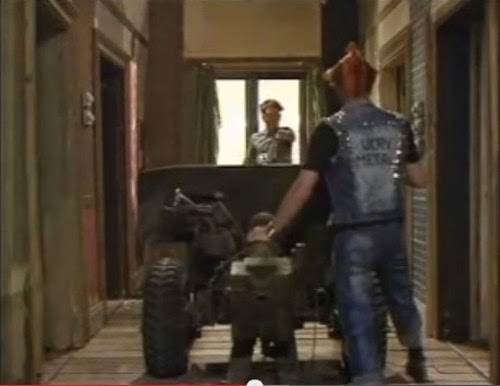
Set in north London, the show focused on four disparate and desperate Scumbag College students, who all lived under the same roof: Vyvian (Edmundson), a pre-med, metal-studded, hyper-violent punk; Rick (Mayall), a self-proclaimed anarchist, who would lack the courage of his convictions if he could ever settle on any; Neal (Planer), a peace-nik hippie, who hates all machines (-- he feels they're all conspiring against him), and has a thing for lentils; and Mike (Ryan, the only non-stand-up comedian in the group) a clueless hipster and designated leader.


This quartet was ably supported by plenty of reoccurring characters; most notably the Balowski family, led by Jerzei Balowski (Sayle), their landlord, and other assorted brain-damaged brothers and clueless cousins (all played by Sayle). And honestly, the house itself should also be considered a character, too -- if it was lucky enough to still be standing at the end of each episode. Pictures and furniture came to life quite regularly; and, when no one's looking, the food usually put on a song and dance number in the fridge or sink; sentient appliances hassle them constantly, especially Neal, who has a running feud with the toilet, and are given lines to advance the plot; not to mention the giant wardrobe in the hall that leads Vyvian into Narnia in one episode and another where he finds the three witches from Hamlet sequestered inside.


The series was also littered with many soon to be famous faces be it actor or comedian in throwaway bits: Robbie Coltraine, Mel Smith, Griff Rhys Jones, Emma Thompson, Hugh Laurie, Stephen Fry, Jennifer Saunders, and nearly every (non-American) comedian you can remember from the original Whose Line Is It Anyway? all show up in the darndest of places. The series also served as a ersatz musical showcase, running the range from Madness to Dexy's Midnight Runners to Amazulu to Motörhead.


Speaking of music, when those reruns on MTV proved so popular in 1985, the fledgling Fox network commissioned an American version, which imported Planer from England and nothing else. Tentatively titled Oh No! Not Them!, produced by David Mirkin (The Simpsons), and co-starring Jackie Earle Haley, the pilot, by all accounts, was pretty dreadful and the series was not picked up. According to legend, Planer hated everything about the experience and happily went back to England when it didn't sell.


Anyways, as I type up this retrospective, several scenarios and situations easily come to mind. Like in Sick, where everyone has the plague and Neal's nose erupts like a volcano full of snot. *ewww* Encased in a garbage sack that *double ewww* is slowly filling up, Vyvian tries to cure him with an acupuncture treatment. (And since he doesn't have any needles, he uses 8-penny nails -- just this side of a railroad spike, folks, instead.) All the while, a vicious riot rages outside the flat and, worst of all, Neal's parents drop by for a visit.


Time opens with a brilliant parody of Dallas, a dream sequence, with Neal as J.R. Ewing. Elsewhere, Rick wakes up and finds a female mass-murderer (Saunders) sleeping next to him and claims they had sex. When it comes to light that he actually didn't, Vyvian chases him around the house with his trusty howitzer until Rick admits he's still a virgin. Nasty finds the boys trying out a new fangled VCR they’ve rented to watch a 'video nasty' (-- a notorious list of films banned by Great Britain over violent or erotic content). Flood finds the house underwater. And in Interesting, they throw a party, mixing the punks, hippies, and anarchists all in one-place, where the expected volatile reaction of these elements has Neal winding up on the moon.


And then there's Bambi, which begins with Neal desperately trying to get back to the house. Inside, gathered around the kitchen table, Rick is trying and failing to relate a joke to Mike and Vyvian until Neal barges in with some breaking news. News the others won't let him reveal until he makes them dinner, which he does by emptying a trashcan onto the table and declaring it 'leftovers.' And while Vyv happily gnaws away at a dead rat, the pathologically insecure Rick calls for an immediate vote on whether the others really like him or not. When a show of hands answers nay, they don't, Rick decides to martyr himself with a suicidal overdose of pills -- pills he doesn't realize are laxatives.


Unsure if some can actually die from crapping themselves to death, Vyvian is delighted for the opportunity to watch and find out. This all, indirectly, leads to a discussion on personal hygiene, which reveals none of them have been to a laundromat in nearly four years. And just as those laxatives kick in, things take a surreal turn as we suddenly find ourselves looking at the guys through a microscopic lens. Turns out that instrument is in a Victorian era study, where a scientist (Coltraine) comments on the disgusting events playing out amongst the amoeba-sized people living in his petri dish. This interlude ends when the maid brings in a tray of snack and he places a sticky bun precariously over the equipment containing our known universe.


Back amongst the amoeba-people, terror grips the flat as one of Vyvian’s dirty socks has escaped and gone on the warpath. Cornering the smoking abomination, Vyv beats it into submission with a frying pan. With that, it's decided to hit the laundromat first thing in the morning before heading upstairs to bed. Two seconds later, the cock crows and they all come back down again. 


Assembling in the living room, a brilliant bit commences with each actor taking on a different character. Then, it's off to the laundrette, where the antagonistically temperamental machines refuse to cooperate and regurgitate their loads until Vyvian convinces one of the contraptions that he has some of Felicity Kendall’s underwear. 

For those playing at home, Felicity Kendal was the adorably perky co-star of a contemporary comedy of a more agrarian nature, The Good Life, that was the antithesis of what The Young One's was all about. She also serves as one of Rick's psychotic crushes.
When the washer lustily opens wide, they force all their clothes in and hold the lid shut while Mike reads the instructions on how to operate the duped machine -- until he gets to part about inserting coins to make it work, so they quickly call the whole thing off and head back to the flat, where they vow never to wash their clothes again. Expressing that won't be much of a challenge, Mike's observation triggers a patented Neal freak-out. Seems he finally remembers the news he had to share from the beginning of the episode: this fearsome foursome is to represent Scumbag College on the quiz show, University Challenge, and they only have two minutes left to reach the train station!


One Motörhead feuled montage later, they make the station on time. But once the train starts moving, the group panics because collectively knowing nothing, at all, is extremely counter-productive when appearing on a quiz bowl. They do know some worthless trivia, like who owns the record for the most marshmallows stuffed up one’s own nose, and who made the stickiest booger. (The answer to both is obviously the same man; Toxeth O’Grady.) Meanwhile, Vyvian ignores a posted warning and sticks his head out a window, and gets it lopped off by another passing train. And when his body finally finds its head, in true stomper fashion, he merrily kicks it down the tracks.


Eventually, they do actually make it the TV station but are denied entrance due to Vyvian's pet pig, Bacon Sandwich, until the guard (Smith) is convinced it's really a ferret. A brief greeting with Bambi (Jones), the quiz-master, follows, where Neal breaks down, sobbing, thinking he's the orphan from the Disney movie. Asked if they have any chance of winning, Bambi scoffs, saying, no, Footlights will win because the posh kids always do. With that, the show starts, and Bambi introduces the challengers: a quartet of inbred and drunken sots, played by some of those familiar faces I was talking about:


And then comes Scumbag's introductions. And please note someone scribbled in a 'P' on Rick's placard, making him a...


The studio audience clearly favors Footlights, with Scumbag’s only supporter being Vyvian’s psychotic pet gopher, SPG (Special Patrol Group). When Bambi asks the first question, Neal buzzes in -- but he doesn’t have the answer, he just needs to go to the bathroom. Alas, Bambi won’t let him and the question goes to Footlights. They don’t have an answer either, but with a quick bribe to the judges it isn’t long before Scumbag is getting buried on the scoreboard.


Huddling up to strategize, seems Neal really, really, REALLY has to go to the bathroom now. Finally losing his temper, Vyvian uses a grenade to take out Footlights, and then demands some easier questions from Bambi, whose next query rings familiar: it deals with marshmallows, noses, and sticky boogers, which Mike answers, starting Scumbag’s rally. His next question, Who let the world’s worst fart, causes Neal to chime in and answer that it was Rick (under the influence of that laxative overdose), which proves correct. And finally, the last question comes: Who has been tampering with Bambi's cards? Caught up in the moment, for the win, Rick triumphantly answers that he switched out the cards. This disqualifying deception triggers a salvo of refuse from the audience, which increases in intensity until a giant sticky-bun falls from on high and crushes all of them.


We switch back to the Victorian scientist, who peels the glass slide off the sticky bun, and then feeds it to a handy elephant as the credits roll.


Now, with all of that evidence, an argument could be made that The Young Ones and its players were the originators of modern toilet humor. And we've barely scratched the surface here because about 60% of the jokes are visual. Therefore, it's really hard to do the series justice with the written word. It was total anarchy, had slapstick violence coming out of every pore, and was decadently, almost repulsively gross. But leavened into all of that noise and chaos, like the best Looney Tunes and Merrie Melodies of yore, was a deft hand at farce and satire mixed in with all the farting, head trauma, and poop jokes. It works. Just don't ask me how.


The Young Ones (1982-1984) British Broadcasting Corporation (BBC) / P: Paul Jackson / AP: Geoff Posner / D: Paul Jackson, Geoff Posner / W: Ben Elton, Rik Mayall, Lise Mayer, Alexei Sayle / E: Ed Wooden, Graham Hutchings / M: Roy C. Bennett, Sid Tepper / S: Rik Mayall, Adrian Edmondson, Nigel Planer, Christopher Ryan, Alexei Sayle

Saturday, June 7, 2014

Favorites :: Behind the Scenes :: Two of a Kind Publicity Photo from Ghost Catchers (1944)


I just love the sheepish, inner-8-year-old channeling by Andy Devine and Lon Chaney Jr. in this publicity photo. After finally tracking down and enjoying the hell out of Hellzapoppin' (1941), alas, all efforts to track down this other Ole Olsen and Chic Johnson vehicle have come up bupkus. Thus, the search continues....


Tuesday, June 3, 2014

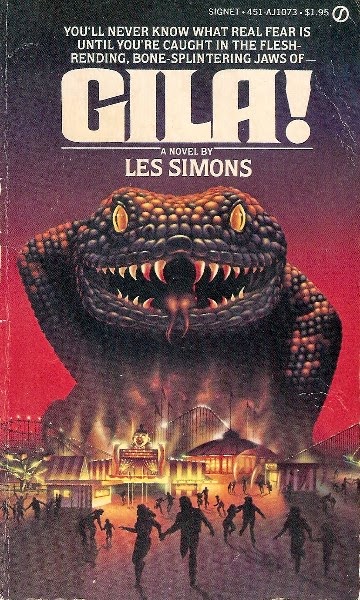
Good Reads :: You'll Never Know What Real Fear is Until You're Caught in the Flesh-Rending, Bone-Splintering Jaws of this Book!


Dr. Kate Dwyer, lead herpetologist at the University of Albuquerque, has no idea why she's been summoned to a clandestine meeting with the governor of New Mexico. But Dwyer gets an explanation quick enough when she's shown the charred remnants of what appears to be a lizard's tail; most likely from a gila monster. 

But why all the hush-hush hubub? Well, this dismembered appendage makes no sense, biologically speaking, due to its abnormal size. For, if you extrapolate from what's left, the rest of the critter would be some fifteen to twenty feet long. Which is impossible, right? Wrong. Dead wrong.

For even though Dr. Dwyer doesn't know what's really going on as she plunges into this nigh inexplicable mystery, the reader sure does. Do we ever! See, some thirty years after all those nuclear bomb tests over in Nevada, all that released radiation seeped across the border and spawned something both ridiculously deadly and deadly ridiculous: a strain of giant Gila monster. 

And not just one, but a whole herd (knot? gaggle?) of these deadly beasts that are currently laying waste to a good chunk of southern New Mexico, leaving no survivors at a wrecked diner and a mysterious bus accident (-- from which the tail was pulled), just carnage and half-eaten body parts, which only deepens the mystery. 

Thus, will Dr. Dwyer discover the truth and formulate a plan to stop these rampaging lizards before it's too late? Well, that all kinda depends on whether or not she can stop having sex with an old flame long enough to be bothered with finding a solution. No. Really.

Born in Omaha, Nebraska, but raised in Albuquerque, Gila! was author Kathryn Ptacek's first novel -- published under the pseudonym of Les Simons, and it really and truly is amazing. Ludicrously so. 

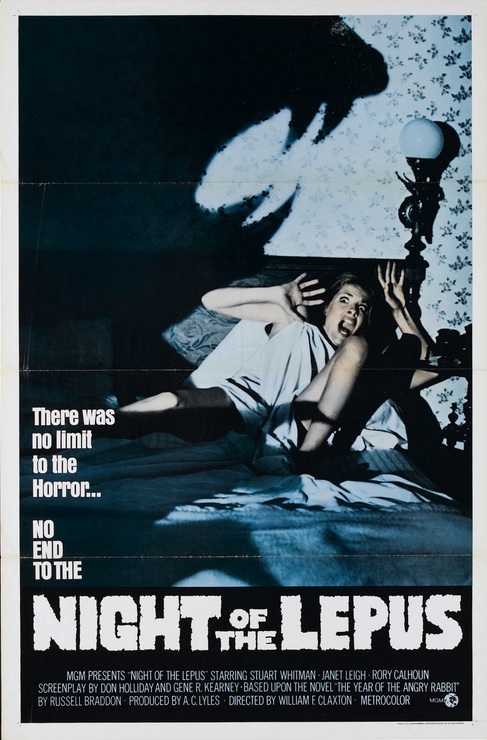
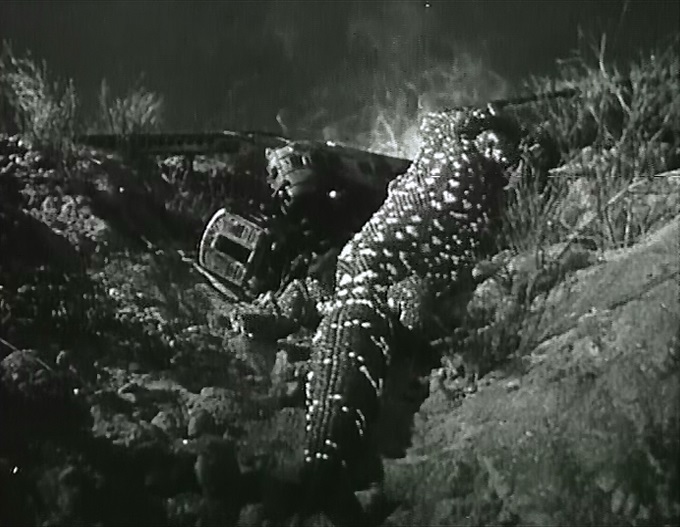
Honestly less The Giant Gila Monster (1959) and more THEM! (1953) or Night of the Lepus (1972), this tale is nothing more than a good old fashioned Monster Movie; and taken on those terms, this thing is an absolute riot. To me, the author just has an uncanny knack for sketching out disposable characters, with just enough flesh on them, only to tear each and every one of them asunder as they're ground-up and dismembered by the rampaging Gila's' powerful jaws, shredded by their poisonous fangs, or just flattened underneath their feet and massive tails. 

I'm telling ya, Ptacek gleefully paints the mayhem and it's aftermath with all the restraint of a Mars Attacks trading card. And I, for one, relished each descriptive paragraph of people being relentlessly and methodically masticated to mulch. 

Unfortunately, in between lizard attacks, the author stumbles and trips over a fairly asinine concurrent plot to stop them that isn't helped by the "Dear Playgirl Magazine, I didn't think this could ever happen to me, but, I was a lonely herpetology professor at a small New Mexico college" subplot of Dwyer hooking up with old flame Chato, a native American. I shit you not, this thing was bluer than those old Monarch adaptions of Konga (1961), Gorgo (1961) and Reptillicus (1961). 

Seriously. There'd be a lizard attack somewhere; they'd get there too late; they'd survey the carnage; they'd go back to the hotel; they'd say, Wow, that was really terrible; shrug; and then hop into bed and knock some plaster off the adobe walls. I wish I was exaggerating. But not even a little, am I, as this scenario is then repeated almost verbatim again. And again. And again. Aaaaaaand again -- with each encounter more absurdly inappropriate than the last. (I kept envisioning Ken Tobey sucking on Mara Corday's nipples during these scenes. This, did not compute.)

Thankfully, the incongruity between the carnage and the carnal only adds another layer of a delirium to the whole thing. And honestly, it pales when stacked up against the mounting stupidity of the conspiracy surrounding the governor's slow reaction to this crisis. And like with The Giant Claw (1957), the author gets kinda stuck on one solitary metaphor to announce the Gila monster's impending attack: a leaking tire. (Though the one time the hissing actually was just a flat was kinda funny.) 

Now, I also have very little patience with phonetic spelling to convey a yokel's accents, with Governor Bubba being the absolute worst offender. Still, my only real beef with the book was due to the fictionalized incompetence of the New Mexico National Guard, which denied me, and you, a battle between a flock of giant Gila monsters and a column of tanks. Fie and Phooey on that, I say! 

Aerial bombings with napalm prove just as ineffective due to the lizards burrowing ability. And after laying waste to the New Mexico State Fair (my favorite part) and flattening an Air Force base, the giant lizards continue their relentless march north, drawing a bead on Albuquerque itself. 

And with conventional weapons failing on all fronts (-- though those tanks should have been given a second chance, and I would've loved to see what a bazooka round would do against the lizard's hide), our heroine comes up with a possible solution -- if anyone is still listening to her. And just like with many B-movies of old, just when you think it's all over, it isn't. 

*thhhhhppppppttthhhhhhh*

Look. All I know is when I got to the last chapter of this book, I didn't want to read it. I simply did not want this insanity to end. Nay. I wanted this rampage to continue on indefinitely. And I sort of got my wish, as the last page is a perfect set-up for a sequel that, alas, hasn't happened yet. 

At a brisk 160 pages, this was a quick read that had me barking out loud with laughter with nearly every page turned. The Simons Signet paperback is long out of print and has gotten terribly expensive since I got mine -- if you can even find a hard copy. The good news is, you can now purchase a digital copy listed under the author's real name. Whichever version you choose, get to reading Gila! as soon as possible for a gruesomely good time. 

Sunday, May 25, 2014

YouTube Finds :: Vintage Radio :: When There's No More Room In Hell, the Dead will Go to Peoria.


Fell down an apocalyptic YouTube hole last night and stumbled upon this, The Peoria Plague, a War of the Worlds-esque radio dramatization of a zombie outbreak broadcast by WUHN, Peoria, back in 1972. Like it's Orson Wellesian inspiration, the story unfolds via news reports as things quickly escalate from bad to worse to catastrophic. The audio is a bit shaky in spots (I fear we're in a dub of a dub of a dub territory), but the whole thing is really well executed and fairly brutal and gruesome with, I assume, actual station personnel playing themselves. (My favorite bit is a live report from a besieged hospital, where what we hear in the background may be sirens or may be people screaming and dying as they're beaten to death and consumed. Also, the Montovani muzak breaks at the beginning are hilarious.)

   
With several references to Trick-or-Treating and children in costume (most of whom die rather horribly), it makes one wonder if this was a special Halloween program. I also wonder if any citizens fell for it? Sadly, I wish I could tell you more, but any info on the actual broadcast has proved stubbornly elusive as I spelunk into the Google. Regardless, The Peoria Plague is a fascinating relic of vintage radio and an absolute delight. Give it a spin, Boils and Ghouls. I guarantee you're gonna love it 

 
 Video courtesy of Post-Apocalyptic.com
Related Posts Plugin for WordPress, Blogger...