Showing posts with label Pulp Comics. Show all posts

Sunday, June 15, 2014

Netflix'd :: Clearing Out the Instant Que :: A Boy, a Tiger, and Comical Symmetry :: Joel Allen Schroeder's Dear Mr. Watterson (2013)


Well, turns out Dear Mr. Watterson (2013), a documentary on the creator of the much beloved Calvin & Hobbes comic strip, was not the worthless fan-lip-service-circle-jerk that I both feared and was led to believe.


No, the notoriously elusive and reclusive cartoonist does not participate, but documentarian Joel Allen Schroeder does the next best thing by compiling a ton of interviews with the artist's contemporaries, his syndicators, cultural historians, comic art curators, and yes, fans, who discuss the cultural impact of the strip, the history of the medium, the dire straits of newspaper comics today, and speculate on Watterson's cantankerous merchandising decisions, meaning the complete lack of any, and why he pulled the plug nearly twenty -- yes, TWENTY -- years ago after a ten year run of brilliance and basically disappeared.


Even the framing device of the filmmaker's navel-gazing reminiscing works as he digs into Watterson's history, skirting the line between stalking and fact-finding, as he relates his own relationship to the strip (I chuckled how his mother admits she wouldn't let him read it at first due to Calvin's destructive tendencies) and visits the creator's hometown of Chagrin Falls, Ohio, and digs up some of his early high school and college work, and later unearths several of his editorial cartoons from when he briefly worked at the Cincinnati Post, which all show the evolution of his craft. But Schroeder takes it no further than that, respecting his subject's decision to be left alone.


Calvin & Hobbes ended before I started working at a small micropolitan newspaper back 1996. And as my job evolved over the years since then, one of the responsibilities I've inherited is building the daily and Sunday comic sections, which isn't nearly as romantic or cool as you'd think in this digital age of drag and drop. Folks still care care about them (-- judging by the phone calls received if I mess something up), but they ain't what they used to be as papers shrink and strips shrivel like Shrinky-Dinks to save money. I seldom read the dailies, but the Sunday section is still as vibrant as ever. (If you're not following Zits, you should.)


And if you will allow me one more relevant personal note, of all the vintage toys, boxes of comics, books and vids cluttering up my house, my most prized possessions is an autographed copy of Watterson's last Sunday strip, given to me by the managing editor for some editorial cartoons I did for him.


Admittedly, Dear Mr. Watterson works best when it's not dealing with the fan-gush, with people basically regurgitating up their favorite strip but seldom slowing down enough to say why. (My favorite is pictured above.) But I think that gets to the heart of why Watterson refused any offer to merchandise his creation. Without this dilution of product, the strip remained small and personal and left to each individual interpretation. Not some ad executives'. Not some voice-over actors' from a non-existent cartoon. And definitely not from dropping trou' and relieving yourself on some corporate logo.


If nothing else, this documentary prodded me to dig out my old and worn out C&H compendiums, their spines long cracked and broken, but untouched for -- wow, since I last moved nearly 15 years ago. Polished off Calvin & Hobbes and got about half-way through Something Under the Bed is Drooling before I realized that all of Watterson's shrewd marketing decisions were not the actions of a control freak but an attempt to keep things pure and simple. As pure and simple as ink on paper and where your own imagination takes you from there.


And so, if you were a fan of the strip, and I've yet to meet anyone familiar who wasn't, give this doc a whirl. And with that, I let the The Beatlesøns play us out. Feel free use the lyrics provided below to sing along.


Video courtesy of Sello Million.


Dear Mr. Watterson (2013) Gravitas Ventures / P: Joel Allen Schroeder, Christopher Browne, Matt McUsic, Joel Allen Schroeder, Jennifer Clymer / D: Joel Allen Schroeder / C: Andrew Waruszewski / E: Joel Allen Schroeder / M: Mike Boggs / S: Joel Allen Schroeder, Berkeley Breathed, Jef Mallett, Stephan Pastis, Jean Schulz

Wednesday, July 10, 2013

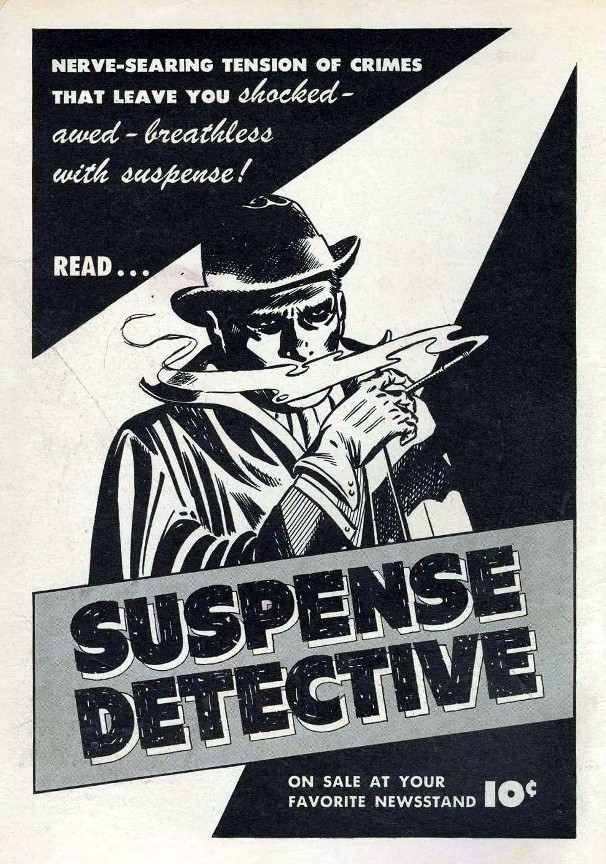
Favorites :: Comic Book Covers :: Death Poised to Strike on Every Tension-Fraught Page!


Suspense Detective was a bimonthly publication produced by Fawcett Comics that featured the usual crime, violence and mayhem as told by a mysterious balladeer, with a gift for black 'n' blue prose, decked out in a fedora, gloves, and a cloak, with most of his features constantly obscured by the smoke from an ever present cigarette:


Cover Artist: Bernard Baily


Cover Artist: Bernard Baily


 Cover Artist: Bernard Baily


Cover Artist: Mike Sekowsky


 Cover Artist: Mike Sekowsky

Suspense Detective debuted in June, 1952, and lasted until March, 1953, managing only five issues before the publisher pulled the plug -- and not just on this series, but ALL of their comics. Now, Fawcett Comics, a subsidiary of Fawcett Publications, is probably best known for its Captain Marvel line and its various spin-offs, but it was also home to several other pulp heroes, adventure, western, sci-fi, crime, and horror titles. Beginning as far back as 1919, Fawcett Publications had enjoyed a highly successful run through the 1930s, 40s, and even into the 1950s until the lingering, bitterly contested litigation with a rival company over copyright infringement (-- DC Comics felt Captain Marvel hewed a little too close to their own Superman), combined with waning interest and plummeting profits, forced Fawcett to get out of the comic book business altogether. 


Friday, July 27, 2012

Operation: 00-OddBalls :: Getting to the Root of the Diabolical Dilema Over My Dastardly Dislike of Danger: Diabolik!


Written by the sibling tandem of Angela and Luciana Giussoni and initially drawn by Gino Marchesi, the Diabolik fumetti (-- the Italian term for comic books) was first published in November, 1962. As the legend goes, sister Angela lived near a busy train station in their native Milan and noticed how much reading the passengers did on their lengthy commutes, especially the paperbacks. Now, Angela had a brief career as a model before marrying Gino Sansoni, who then took a position in Sansoni's publishing firm. And while observing all those commuters, Angela hit upon the notion of creating a new fumetti using the same, smaller dimensions for the reader's convenience. As for what it should be about, depending on which story you believe, Angela either polled the commuters on what they liked to read most, with violent mysteries and steamy adventures winning out or she found an abandoned Fantômas novel on a train and took it as a sign of inspiration.


Angela and Luciana Giussoni

Fantômas was a devious master-criminal co-created by French writers Marcel Allain and Pierre Souverstre. And in typical grand guignol fashion, Allain and Souvestre's protagonist was one sadistic S.O.B. with definite sociopathic tendencies. He was a master of disguise, completely ruthless, and killed without qualm or mercy to achieve his own ends in 43 published adventures.


Despite this grisly modus operandi, Fantômas proved quite popular throughout Europe and inspired many imitators. And with another copycat character set, forming her own company, Astorina, Angela Giussoni bet the bank on this new publishing venture, beginning with the first issue, Ill Re del Terrore (The King of Terror). History proves that Giussoni's gamble paid off, big time, as the public voraciously ate up the intricate plots, protracted violence, and sizzling sensuality of Diabolik and kept coming back for more. E'yup, the series had legs and proved so popular famed Italian producer Dino de Laurentiis soon came calling about the possibility of a feature film adaptation. To direct, de Laurentiis picked Mario Bava, one of my favorite filmmakers of all time -- and I'm sure Bava crapped his pants when the producer gave him a budget of over three million dollars after making gold out of the few copper pennies spent on his previous features.


Teaming up with four other writers on the script, according to several sources, Bava's film version stays fairly true to the comic, too, with, let's face it, a moronically implausible plot of improbable and daring escapades, followed by even more impossible escapes that honestly work better in the panels of a comic -- or a spy movie, 'natch. But, honestly, the plot, characters, and character motivations are just a means to an end. The end being one of the most fantastical feasts of stunning visuals and incredible action set-pieces that almost carry the film into the win column for me. Almost. But not quite.


To find out why, check out our full film review of Danger: Diabolik over to 3B Theater for a complete debriefing on the second installment of our Five part Operation: 00-OddBalls spy-spoof retrospective. The rest of which we will be rolling out over the next few weeks. Stay tuned!


Alas, all efforts to find any print ads for this feature failed.

Wednesday, May 6, 2009

Good Reads :: Godzilla versus the Marvel Universe


___  ___  ___  ___  ___  ___  ___  ___  ___  ___  ___  ___  ___

"For two years Japan's greatest export was one of Marvel's biggest stars, and the King of the Monsters upheld his title against some of the best and the worst the House of Ideas had to offer." 
___  ___  ___  ___  ___  ___  ___  ___  ___  ___  ___  ___  ___

People might look at you a little cock-eyed when asked if they can remember the time when Godzilla fought the Fantastic Four -- right before he butted heads with the Mighty Avengers. But it did happen. Or how about that time he took on Bigfoot? Yes, that really happened, too -- and they all occurred within the certifiably insane pages of Marvel Comics 24-issue run of Godzilla: King of the Monsters.


The late 1970's saw a surge of toy-based comic books and I'm not sure if Marvel back-doored into the rights for the character through Mattel, who also produced the American line of Shogun Warriors (-- also adapted into a comic), which contained an awesome Godzilla toy with a spring-loaded fist that I spent many an afternoon using to knock Evel Knievel off of his Stunt Cycle. Regardless, it was a good run, and now, thanks to Marvel's Essential line -- phone book style B&W reprints -- they've all been collected together at a very reasonable price for you to enjoy for the first time or, like me, all over again!


Wasting little time, writer Doug Moench gets the ball rolling when Godzilla surfaces and stomps into Alaska (-- making this his second visit to American soil; the first, 'natch, being when he pulverized the U.N. Building in Destroy All Monsters). And from there, the monster heads south, southeast, making an erratic course for New York, leaving cities like Seattle, San Francisco and Las Vegas in ruin behind him. And to bring all of that to life, editor Archie Goodwin turned to the hard and bold lines of artist Herb Trimpe -- who was definitely getting his King Kirby on in this thing with his layouts and forced perspective shots to establish the monster's size. Known mostly for his work drawing Marvel's other, rampaging green-skinned monster (-- and when inked by Jon Severin, was the best rendition of old Jade-Jaws ever!), Trimpe's distinctively blunt style and constantly morphing main monster might turn some folks off, but I think its great and his creature designs on the myriad of otherworldly monsters our hero gets to fight are something to behold and celebrated.


Also, one of the book's strongest assets was that not only did it allow Godzilla to fight his way through the Marvel Universe's gallery of super-heroes, including those already mentioned plus the likes of The Champions and Devil Dinosaur, it was also a showcase for the long dormant Agents of S.H.I.E.L.D.


Charged with bringing the monster down, the hi-tech counter-terrorism unit definitely have their hands full and Trimpe's designs for all their advanced tech, atomic-gizmos, and hardware are spiffy-cool, including the giant robot, Red Ronin, built specifically to stop Godzilla. (But one has to wonder how in the hell Dum Dum Dugan keeps that ever present stogie in his constantly yapping mouth.)


Admittedly, the book is more than a little grounded in the decade that spawned it, but if you can get past that, and one really annoying Kenny character, the book is one helluva demented good time. And while were speaking of toys adapted into comics, am I the only one who thinks Marvel really needs to get Rom: Spaceknight and The Micronauts an Essentials run, too? 


Related Posts Plugin for WordPress, Blogger...