___ ___ ___ ___ ___ ___ ___ ___ ___ ___ ___ ___ ___ ___
"What's wrong with this town of yours, Miss Wirth? It just seems to me that there aren't many towns like [Black Rock] in America. But one town like it is enough because I think something kinda bad happened here. Something I can't quite seem to find the handle to.
___ ___ ___ ___ ___ ___ ___ ___ ___ ___ ___ ___ ___ ___
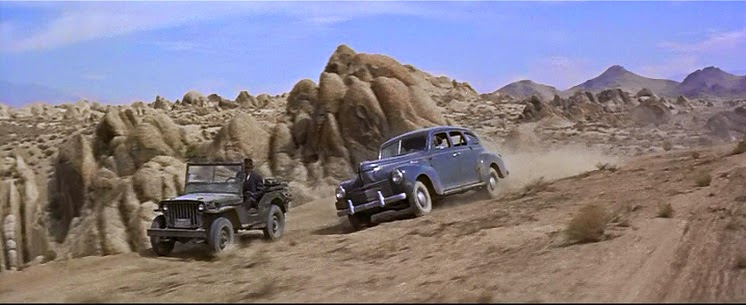
My old creative writing instructor always harped "Show, don't tell", and since this is The CinemaScope Blogathon, it seems only appropriate to show first and then tell. And frankly, the images that follow could stand up on there own -- but that won't stop me from gushing about this film later. Nope. Not a chance.




Our story begins in 1946 when Howard Breslin wrote the short story "Bad Time at Hondo". Seems that during World War II, the armed services made it a practice of hiring private detectives to track down an enlisted person's family to present any posthumous medals earned to the surviving family. And this sets the stage for Breslin's morality tale as a stranger wanders into a small isolated desert town, looking for a displaced Japanese-American man named Komoko, and soon finds himself immersed in a conspiratorial web of silence, xenophobia, prejudice, and murder, putting himself in mortal danger. The story was published in the January, 1947, issue of "The American Magazine", which brought it to the attention of Don McGuire and, thinking it would make a crackerjack film, he optioned the story out of his own pocket and hashed out a screenplay.

McGuire had been in the business since the 1940s, first as an actor, then a press agent, before taking up scriptwriting full time. He managed to successfully pitch the movie to MGM's production chief, Dore Schary, but Schary essentially chucked McGuire's screenplay and commissioned Millard Kaufman to take another crack at it and tabbed Richard Brooks to direct. The executive was also dead-set on getting Spencer Tracy signed to star as the story's protagonist, John J. Macreedy. But just as the pre-production was gaining momentum, it ran into some massive bumps on the road to Black Rock.
___ ___ ___ ___ ___ ___ ___ ___ ___ ___ ___ ___ ___ ___
"Four years ago something terrible happened here. We did nothing about it. Nothing. The whole town fell into a sort of settled melancholy and all the people in it closed their eyes, and held their tongues, and... failed the test with a whimper. And now something terrible's gonna happen again -- and in a way we're lucky, because we've been given a second chance."
___ ___ ___ ___ ___ ___ ___ ___ ___ ___ ___ ___ ___ ___
For, while Schary could barely contain his enthusiasm over the picture, his boss at MGM, Nicholas Schenk, nearly pulled the plug -- on several occasions. Seems Schenk felt the storyline was too subversive, using racism and bigotry as an allegorical smokescreen to take potshots at the bullying tactics of Senator Joe McCarthy and the House Un-American Activities Committee's Commie witch-hunt, which had left Hollywood quietly submitting and cowardly reeling from the fallout of the Blacklist. (Kaufman had fronted for Dalton Trumbo on the film Gun Crazy, giving these accusations some credence.) Also, dug-in on the opposite ends of the political spectrum, Schenk and Schary really didn't like each other all that much. Schary had had an off and on again relationship with MGM since 1933. The man seemed to have the magic touch when it came to productions, but on the rare occasions when he didn't get his way, he'd either quit or get himself fired. He spent most of the 1940s with RKO, which produced a strong string of hits (The Spiral Staircase, The Farmer's Daughter, Mr. Blandings Builds His Dream House), but, again, he was growing frustrated with the brass there -- in particular, Howard Hughes, whose eccentricities would eventually destroy the once proud studio.
Meanwhile, MGM, still clinging to its pre-war glory days, had not adapted well for the post-war market. And after a string of high profile flops as the 1940s drew to a close, with money hemorrhaging out, and needing to right the ship, Schenk sent out feelers to an eager Schary, who left RKO in 1948 and brought a personal pet-project Hughes had nixed with him to MGM; a war movie everyone in Hollywood, including Schenk, thought he was crazy for making. But Battleground (1949) proved a rare, hard-nosed hit for the floundering studio, giving Schary a lot of leverage. I find it interesting that many years later people would point to Spielberg's JAWS (1975) as the first B-picture with an A-Budget, marking a paradigm shift for the modern blockbuster. I heartily disagree, there, because it was this very same notion that Schary used to get a moribund MGM back on its feet as the 1950s began. And so he used that leverage, threatening to quit again if Bad Day at Black Rock, one of those B-pictures with a A-budget, was cancelled.
With that, Schenk backed off but continued to hound the picture, mostly on a technical level. You see, Bad Day at Black Rock was set to be one of MGM's first films shot in CinemaScope. But Schenk wasn't sold on the new process, fearing it was both a fad destined to fizzle like 3-D and feeling the story itself lacked the grandeur and casts of thousands of the historical epics that seemed tailor made for the new widescreen process -- like Knights of the Round Table (1953), another feature concurrently in production for MGM in England. These concerns were alleviated when Schary agreed to simultaneously film the production in both the old standard square format and the new widescreen aspect ratio. (The square format was never released theatrically.) But even though he now had Schenk appeased, for the moment, it appears that no one else involved was really all that keen to make it, either.
According to legend, Richard Brooks was not happy with the assignment at all, wanting to work on his own pet project, Blackboard Jungle, instead. While working on the script with Kaufman, as the legend continues, Brooks phoned Spencer Tracy and told him the project was "a piece of sh*t". Tracy, who still hadn't committed to the film, immediately called Schary and ripped him a new one for overselling the role. With that, Brooks was out and the search was on for a replacement. Richard Fleischer was Schary's next choice, but he was committed to finishing up 20,000 Leagues Under the Sea for Disney. And though Don Siegel lobbied hard for the job, John Sturges eventually wound up in the director's chair, who had previously worked with Tracy on the raucous political romp, The People vs. O'Hara (1951).
%2B1955.jpg)
Schary and Tracy also went way back, collaborating on the likes of Boystown (1938), which earned both of them an Oscar. At the time of the production of Bad Day at Black Rock, Tracy felt he was too old for the part. (And honestly, he kinda was. In the end it didn't matter.) He was also losing his battle with alcohol addiction, which only added to his reluctance about taking the role, which he felt lacked depth. (This is Hollywoodspeak for the role was beneath him.) Thus, Macreedy's character went through a massive overhaul. And as Kaufman, Schary and Sturges bounced ideas of each other, they came up with the notion that the protagonist was a disabled war veteran, who had served as an officer in the 442nd Regimental Combat team; the famed all Nisei (Japanese-American) regiment, culled from the notorious internment camps, who served in Italy and became the most decorated outfit of the war. (I say all Nisei except for the officers, who were all white.) Schary had already made a film about their exploits with Go For Broke! (1951), a fine follow-up to Battleground (-- which I think is the greatest war movie ever made.) When injured in battle, a young G.I. named Joe Komoko was killed trying to save Macreedy. Now damaged both physically (he's lost the use of an arm) and mentally (PTSD and survivor's guilt), Macreedy undertakes one last mission before he officially resigns from the human race: deliver a medal to the father of the boy who died saving him, whom he tracks down to some backwater sh*thole named Black Rock.


___ ___ ___ ___ ___ ___ ___ ___ ___ ___ ___ ___ ___ ___
"Yeah. Smith, Coley, Sam, Hector, and me -- we were all drunk. Patriotic drunk. We wanted to go out to scare the Jap a little and have a little fun. Well, when we got there, he heard us comin' and he locked the door. And then Smith started a fire. And the Jap -- he came running out. His clothes were all burning. And then Smith shot him. I didn't even know he had a gun."
___ ___ ___ ___ ___ ___ ___ ___ ___ ___ ___ ___ ___ ___
Tracy loved the changes, but he still wouldn't give a definite answer. And as the legend reaches its climax, Schary tried one last trick, telling the temperamental actor to go ahead and back out if he wanted to, saying Alan Ladd had also been given the script and was anxious to do the picture. It was all a lie, but this, this finally did it. Rounding out the players landed the production one of the greatest ensemble casts ever assembled -- most of them (were or destined to become) Academy Award winners: Tracy, Walter Brennan, Ernest Borgnine, Lee Marvin, and Dean Jagger. (In the out of print laser disc commentary track for the film, director Stuges comments how Brennan would rile up Tracy by flashing three fingers at him before each take, in reference to his three Oscars to his co-stars two.) Robert Ryan was nominated once but never won, though he deserved several. (Ryan was so good at playing vile and bigoted villains, but in real life he was the complete antithesis of this. If you haven't ever read up on the guy, I highly recommend it.) This was also Anne Francis' big breakout role, and she would be heading to outer-space next in another one of those MGM big-budget Bs, Forbidden Planet (1956).

Overflowing with talent, the story they're all plugged into is refreshingly terse and very economical that takes place in one 24-hour period with an invisible clock ticking down the whole time. The tension is palpable. An amazing mash-up of both western and film noir sensibilities, I honestly see a lot of Hammett in this story, and feel Macreedy isn't much of a leap from the nameless Continental Op of Red Harvest, making him a surrogate for Kurosawa's Yojimbo (Yojimbo) or Leone's Man with No Name (The Dollars Trilogy), who all wandered into town and blew up the status quo. (And blew it up real good. There's also a tangential link to Will Kane in Zimmerman's High Noon.) You'd think this story would be diluted over time, cash-ins, rip-offs, and every episode you've seen of your favorite TV drama where the hero or heroine arrive at a small town and are inexplicably met with hostility and paranoia before exposing some dastardly cover-up, but the film hasn't lost one iota of impact.
%2B1955_5.jpg)
And while Shrenk was leery of CinemaScope, Sturges embraced it, adopting a less is more strategy. I love how the ramshackle town of Black Rock itself clings low to the desert; dug in like a tick, leeching off the artery of the rail-line that has long since ignored it. (Kudos to production designers Malcolm Brown and Cedric Gibbons and their crews who built Black Rock from scratch, and then tore it all down once production was completed.) I also love how Sturges uses it and the beautiful, looming mountain vistas of Lone Pine to make something that open and spacious feel terribly closed-in and claustrophobic. Sturges himself nixed the use of extras, amplifying the abandoned -- make that decaying motif of the town. And the contrast of Macreedy, dressed in black, easily spotted in all that bright sunshine, moving like a specter through these ghostly environs is powerful stuff, indeed.
%2B1955_6.JPG)
The unresolved murder of the elder Komoko, while not irrelevant, isn't much of a mystery, more of a means to an end: to expose the silent acceptance of the many for the racist muckraking of the few and vaporize it. Still, I love how the unraveling of what happened to cause this kind of mass suppression -- what Reno Smith (Ryan) is bullying them into suppressing -- plays out so deliberately, with Macreedy finding all the clues: the burnt-out homestead, the well, and the small patch of wildflowers, giving us the who, what, where and the how, leaving Macreedy to stitch together why. This he finds out with some deft word games and Jedi mind-tricks with the anxious townsfolk, who are either terrified, too ashamed, or guarded to blab and yet still seem psychological driven to confess in their own way. However, it already may be too late, as Reno slowly tightens the noose, moving his pieces, Hector and Coley and Hastings, in this deadly game of cat and mouse. He just doesn't realize Macreedy is playing, too. (The one on one tête-à-têtes between Tracy and Ryan are worth the price of admission alone. They just don't make 'em like that anymore, folks.) Notice the way Reno keeps asking all the questions but Macreedy always winds up with all the answers.
+1955_19.jpg)
As a friend of mine pointed out, he loved the way "the hero was such a grownup and had seen so many harrowing things in his wartime service that these tinpot dipsh*ts in this little town utterly fail to impress him." Macreedy plays it cool, alright, which stems mostly, I think, from his own anxiety-based need to just not engage with anyone. At least in the beginning. When this imbroglio begins, Macreedy feels he is broken, half a man, a worthless freak, who doesn't belong anywhere, making this excursion also about Macreedy's own personal redemption. It's interesting to note if Reno's goon squad (Borgnine, Marvin) and toadies (Jagger, the drunken sheriff, Ericson, the hotel clerk, and Collins, the spastic telegraph operator) hadn't acted so squirrelly upon his arrival, there's a good chance Macreedy might've believed Reno's eager and friendly pitch that Komoko never returned after being relocated after Pearl Harbor and simply moved on. However, when you put the two odd behaviors of too hostile and too friendly together, in that setting, well, Macreedy is no fool, and it becomes less about not engaging because he doesn't want to and more about being surrounded and hopelessly outnumbered.
___ ___ ___ ___ ___ ___ ___ ___ ___ ___ ___ ___ ___ ___
x
"Well, I know this much: the rule of law has left
here and the gorillas have taken over."
"They're gonna kill you with no hard feelings."
___ ___ ___ ___ ___ ___ ___ ___ ___ ___ ___ ___ ___ ___
And yet, when escape proves untenable, and all that poking and prodding and potshots finally reach critical mass, even with one hand, Macreedy proves superior to these clowns and bullies. And once he figures that out, the tide of this battle has clearly turned and Reno's reign of terror is over, he just doesn't know it yet. Here, a reinvigorated Macreedy finally goes on the offensive. He knows he's a de facto murder witness that must be eliminated, but he starts sewing seeds of doubt with Reno's underlings, too, saying he's not the only witness; and after he's gone, they're most likely next. A point of fact Liz Wirth (Francis) pays for dearly during the climax. Originally, Reno was to survive Macreedy's desperation Molotov cocktail, and be strapped across the hood of the car and brought into town like the deer the villain had shot in the opening scene. Sturges was having none of that, fired off a cable to Schary, saying "that sonofabitch had to die." Schary's reply: "Do it."
%2B1955_ART-1.jpg)
___ ___ ___ ___ ___ ___ ___ ___ ___ ___ ___ ___ ___ ___
"This town is wrecked, just as though it was bombed out.
Maybe it can come back?"
"Some towns do and some towns don't.
It depends on the people."
___ ___ ___ ___ ___ ___ ___ ___ ___ ___ ___ ___ ___ ___
According to his autobiography, it was Borgnine, an ex-Navy man, who suggested the judo for the fight in the cafe, which finally turned the tide. Borgnine did his own stunts but Tracy left it to a double. This stemmed from an incident while filming a fight scene for Boom Town (1940), where Tracy accidentally connected his fist to Clark Gable's mouth, knocking out his front teeth. After that, he left it to the professionals. And that's a good way to sum up Bad Day at Black Rock: professional. Professionally produced, professionally written (the dialogue just crackles), professionally directed, and professionally acted. Is it any wonder it turned out so good? Even though it almost didn't.
Sources: Bad Day at Black Rock and the Overcoming of Evil by Richard Raskin, part of Sharon Packer and Jody Pennington's A History of Evil in Pop Culture (2014); Ernie: the Autobiography (2008) by Ernest Borgnine; 500 Great Films (1987) by Daniel and Susan Cohen.
Other Points of Interest:
The post is part of ClassicBecky’s Brain Food and Wide Screen World’s CinemaScope Blogathon. Be sure click on over and check out all the other wonderful entries.
Bad Day at Black Rock (1955) Metro-Goldwyn-Mayer (MGM) / P: Dore
Schary / AP: Herman Hoffman / D: John Sturges / W: Millard Kaufman, Don
McGuire, Howard Breslin (story) / C: William C. Mellor / E: Newell P.
Kimlin / M: André Previn / S: Spencer Tracy, Robert Ryan, Anne Francis,
John Ericson, Walter Brennan, Ernest Borgnine, Lee Marvin, Dean Jagger

%2B1976.jpeg)


%2B1976.jpg)


%2B1940.jpg)
%2B1940.jpg)
%2B1940_2.jpg)


%2B1940.jpg)
%2B1955.jpg)
%2B1955_11.jpg)
%2B1955_6.jpg)

%2B1955_71.JPG)
%2B1955_19.jpg)


%2B1955_1.jpg)

