Our latest tale of surreal lunacy begins in the deep-end of the Omigod What the Hell is Going On Here? Pool, where a grumpy old man waxes cryptically about the events which are destined to unfold from … well, someplace else. And while the credits refer to this man as The Scientist, we’ll be referring to him as The Puppet Master (Lugosi) due to his constant metaphysical string-pulling on our cast of characters.
And as the audience struggles to follow his circular logic on this tale of the human condition, and humanity's constant search into the unknown, which has brought “startling new things to light,” but then immediately admits these new discoveries were actually old discoveries all along and just “the signs of the ages,” or whatever, we cut to a city street, and our omniscient Puppet Master starts channeling Sarte as he describes all these individuals living in their own individual worlds. Then, we hear the cries of a newborn, and then the wail of an ambulance siren. For, “One is a sign that a new life has begun, the other that a life has ended."


Cut to a small apartment, where police investigators process the crime scene of what turns out to be a suicide. And as an Inspector Warren (Talbot) reads the suicide note, turns out the victim was not a woman at all but a cross-dresser named Patrick, who preferred life as Patricia. Seems Patricia had been arrested four times for cross-dressing in public and served several jail sentences for this so-called crime. And due to this lack of understanding and persecution, Patricia decided there was no hope for her future and killed herself, ending the note with a request to be buried as Patricia, declaring, "Let my body rest in death forever, in the things I cannot wear in life."
Puzzled by all of this, and worried about a sudden spike in cross-dresser suicides, Warren checks in with a psychiatrist, Dr. Alton, for some answers. Alton (Farrell) then takes over narrator duties as he relates the tale of Glen (Wood -- though credited as Daniel Davis), whom we meet as the man dressed as a woman lingers at a shop window filled with the latest female fashions. We then flashback to Glen’s youth, where he asks to wear his sister Sheila’s dress to a Halloween party, which his mother allows over his father’s protests. But then Glen, liking how they made him feel, continued to wear his sister’s clothing on the sly until he got caught in drag by Sheila (Wood), who has shunned him ever since.


Here, Alton explains to the dubious Warren that, no, Glen was not a homosexual but a transvestite, which he explains is a male who prefers to dress in women’s clothing. Getting back to the narrative shows Glen has been hiding this secret life from his fiancee, Barbara (Fuller), fearing she will reject him outright if she ever found out about Glenda, Glen’s other self, and how he fetishizes and covets some of her clothes -- especially her Angora sweaters. Knowing full well something has been eating at him lately that he refuses to talk about, Barbara fears their suddenly strained relationship might be due to some infidelity on Glen’s part and another woman has come between them.


Of course Barbara is right but just not in the way she thinks since the “other woman” is Glenda. Here, the Puppet Master chimes back in, encouraging everybody to “Pull the string!” as a herd of superimposed buffalo stampede through the scene. (Magic 8-Ball? What was that all about?! Magic 8-Ball says, “@#%* if I know! You’re on your own, dude.” ) Anyhoo, after the Puppet Master and the bison exit, stage left, Alton continues, saying how much Glen is torn over whether to reveal his secret life to Barbara before or after their wedding. Seems the wife of his friend, John (Crafts), a fellow transvestite, left him after catching him wearing some of her clothes, which only adds even more anxiety.


Thus and so, to shed some of that anxiety, Glen goes out for a decompressing stroll as Glenda. But when she returns home, a clap of thunder causes her to collapse to the floor unconscious. Cut back to the Puppet Master, currently off his meds (-- and considering Lugosi was a narcotic addict at the time, I now realize how tasteless that joke is, sorry, everybody), as he unleashes a salvo of non-sequiturs, telling everyone to "Beware! Beware! Beware of the big, green dragon that sits on your doorstep! He eats little boys, puppy dog tails, and big, fat snails! Take care! Beware!” And what we’re to be wary of is Glen’s subconscious as this rant leads to a phantasmagorical dream sequence, where Barbara discovers his secret. This, does not go well.

Then, Barbara is trapped under a fallen tree; a tree which Glenda fails to move but Glen removes with ease. Once she’s free, we shift to their wedding day, where Glen’s best man appears to be the Devil himself (DeZita). And while the Puppet Master keeps ranting on and on about the eating habits of the dragon green, I think what Glen is really trying to show us here is how he’s damned if he does and damned if he don’t as far as Barbara is concerned when it comes to the truth about Glenda...
Far from the volatile man-mountain as portrayed in Tim Burton's bio-pic, Ed Wood (1994), by most accounts, film producer George Weiss was an unassuming and affable guy, small and stooped in stature, who had a thing for kinky titillation and domineering women. (You can actually spot him in this movie, a brief cameo, as the building super who let the police into the apartment of the decedent.)
George Weiss.
A student of the Kroger Babb school of road-showing and square-up reels, where you could get away with just about anything as long as you presented things as being educational, Weiss and his Screen Classic Productions had already made themselves quite the reputation with a tell-all look at artificial insemination in Test Tube Babies (1948), the horrors of narcotics with The Devil's Sleep (1949), a harsh lesson of female wrestlers duped into a money-laundering scheme in Racket Girls (1951), and dirty flesh-peddlers doing dirty things in Dance Hall Racket (1953), which included an appearance by the legendary Lenny Bruce, where Weiss broke in another fledgling director by the name of Phil Tucker, who would go on to carve out his own gorilla-shaped hunk of sci-fi infamy with the awesome whackadoodlery of Robot Monster (1953).

Weiss had also churned out a couple of stag loops and feature length Nudies with the burlesque show-fueled Too Hot to Handle (1950) and Paris After Midnight (1951), where a couple of American GIs on leave in Paris wind up in a jail and spend the night recounting all the debauchery encountered in the Place Pigalle ("Pig Alley") that landed them in the clink.
And as originally intended, Weiss had wanted his next feature, I Changed My Sex, to be in the same clinical vein. But when noted transexual, Christine Jorgensen, formerly George Jorgensen Jr., whose recent, headline-grabbing sex-change operation the proposed feature was not-so-loosely based on, both refused all overtures to appear as the lead and wouldn’t sign off on any kind of publicity tour because she didn’t want to sensationalize the procedure while her parents were still alive, Weiss was forced to re-calibrate and rethink things.
Enter Edward D. Wood Jr., a writer, a wannabe film director, and a transvestite himself. As far as I know, the exact circumstances that led to Wood crossing
paths with Weiss has yet to surface. But cross paths
they did, leading to one of the strangest exploitation classics of all
time. And with a content-reluctant Bela Lugosi tucked in Wood's back-pocket, who became far less reluctant when his then wife, Lillian, negotiated a doubling of his salary from $500 to a $1000, the tone of the project changed from a shocking exposé to full-blown melodrama about Wood’s own proclivities, which went through several title changes, ranging from I Led Two Lives, to He or She, to The Transvestite as it ran through the States Rights circus, before finally settling on its best known title, Glen or Glenda (1953).

As filming commenced for a grand total of four whole days, Weiss was soon faced with three monumental problems. First, thanks to Wood's deficit-style budgeting, the producer was forced to pre-sell the film in order to generate enough money to complete the picture. Now, what always turned out to be Wood's Achilles Heel was financing (-- and his drinking didn’t help, either); and what separated the successful independent film entrepreneur from the other one-lungers, was a business model where a majority of the profits from the distribution deal on a completed film was then used to help finance their next feature. With Wood, he was usually so far in the hole from over-selling shares and grossly underestimating costs, that whatever money was made went to paying off the last feature, leaving him nothing for the next. Lather. Rinse. Repeat. And then skip out when the bills come due.


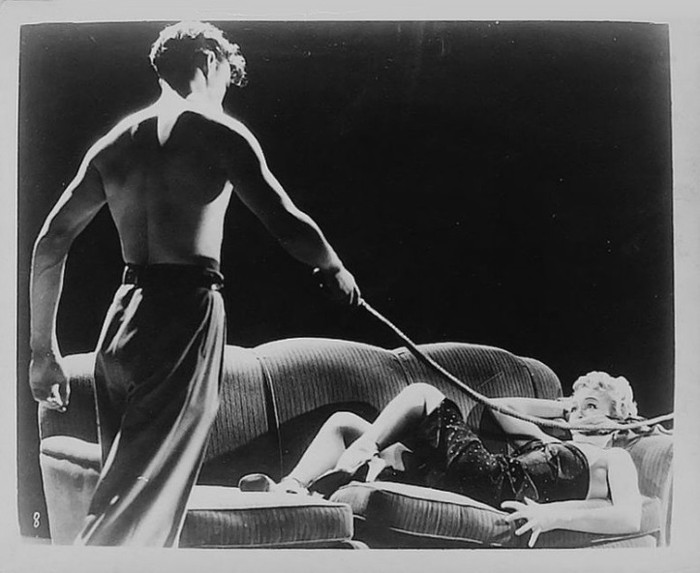
The second obstacle Weiss faced was Wood's finished film came in well short of the required 70 minutes. To fix this, the producer stuck in about fifteen minutes worth of additional, nonsensical footage into the dream sequence, salvaged from an unfinished film of one of Weiss's other associates, W. Merle Connell -- Untamed Women (1952), The Flesh Merchant (1956). And when you watch the end results, it isn't all that difficult to see where Wood's weirdness ends and Weiss's naughtiness begins:
Looking like snippets from one of Weiss’s vintage stag reels, or one of those old Irving Klaw bondage loops, these inserts, inter-cut with reaction shots from Wood’s character and Lugosi’s, only add to the overall delirium of Glen or Glenda that supercharges the schlock into something truly unique.
And as the dream sequence finally ends after Glen and Glenda go through the torments of hell, represented by the preening devil and mocking visages, who slander his perceived deviant behavior relentlessly, and ends with the wholesale rejection from Barbara. When Glenda wakes up, she faces herself in the mirror and removes the wig.
With that, Glen decides to tell Barbara the truth. And while she initially struggles with this revelation, Barbara decides to stand by him, removing her sweater and offering it to him as a symbolic gesture of acceptance and a promise that, together, they will work things out.
When the scene shifts back to Dr. Alton’s office, with the story essentially over, we come to Weiss’s third monumental problem with the film. Seems he had promised his distributors an exploitation film about a sex-change operation, which Wood had neglected to include. Thus and so, we get a tacked on ending, where Alton also relates the tale of Alan (Haynes), whose mother had wanted a girl so badly she decided to raise him as Anne, leading to a life of ridicule and rejection.


When Alan was drafted into World War II, he maintained his secret life as Anne, echoing both Jorgensen and Wood’s own experiences in the service; Wood as a paratrooper, who claimed he once made a combat jump wearing a brassiere and panties under his GI togs. As for Alan, wounded during combat, he first hears about the possibility of a sex-change operation while recuperating at the hospital. And once recovered and mustered out, Alan decides to go through with the trials and tribulations of the operation and finally embraces who he was supposed to be all along.

In the end, despite all those title changes and added bonus content, Glen or Glenda just never could find an audience. Too bizarre for mainstream theaters but not bizarre enough for the roadshows, Weiss couldn't get anybody to show the damnable thing and took a bath. But unlike most of his other backers, Weiss held no real animosity toward Wood over their film's box-office failure, and has nothing but nice things to say about the director in Rudolph Grey's anecdotal biography, A Nightmare of Ecstasy, but it should be noted the two never worked together again -- except when Wood bought out Weiss' unfinished film, Hellborn, and eventually turned it into The Sinister Urge (1960).

By the time Glen or Glenda was completed, with the draconian Hayes Code starting to show a few cracks in its cinematic foundation, Weiss soon chucked the educational angle and square-up reels and shifted his focus to straight-on Burlesque revues and helped pioneer the Nudies in the late 1950s. However, Weiss is probably more famous, and rightfully so, for establishing The Roughie with the lovely Audrey Campbell as Mistress Olga in White Slaves of Chinatown (1964), and the equally demented Olga's House of Shame (1964), and Olga's Girls (1964).

And, with Weiss's encouragement, this also ushered in the commando sleaze-noir of Michael and Roberta Findlay -- Take Me Naked (1966), The Touch of Her Flesh (1967), The Ultimate Degenerate (1969) and the Amero brothers -- Diary of a Swinger (1967), Lusting Hours (1967), and The Corporate Queen (1969), which helped turn those cracks in the Nation's moral codes into a full-blown breach. Add it all up, and fans of weird and offbeat and exploitative cinema everywhere owe Georgie Weiss a huge debt of gratitude, and he needs to be known more for that than just another guy Ed Wood bamboozled and left in his drunken wake.
Glen or Glenda (1953) Screen Classics / P: George Weiss / D: Edward D. Wood Jr. / W: Edward D. Wood Jr. / C: William C. Thompson / E: 'Bud' Schelling / M: Sanford H. Dickinson / S: Edward D. Wood Jr., Dolores Fuller, Bela Lugosi, Lyle Talbot, Timothy Farrell,Captain DeZita, Evelyn Wood, Tommy Haynes
We begin with an opening preamble from the notorious prognosticator, the Amazing Criswell, who rises from his coffin and does his best to address the audience and not his cue cards as he pontificates about the terror tale we are about to see: a tale of the “threshold people” so astounding some of us may faint from just the exposure! A sanguinary story of those lost in the twilight time; those who were once human, now monsters, living in a void between the living and the dead! Creatures to be pitied, and despised! A night of ghouls reborn from the innermost depths of the underworld! So, brace yourselves, I guess?


Anyhoo, cut to a convertible Corvair winding around a deserted mountain road at night and at a treacherous speed. Behind the wheel is Bob (Bates), in the passenger seat leaning into him is his girl, Shirley (Barrington), and the couple are bickering about their destination. Seems Bob is a writer of horror and is currently looking for an old cemetery to draw some inspiration for his latest tale. When asked why he writes about such terrible things, Bob admits he tried other genres first but couldn’t sell a single word of it. But his monsters have been good to him and afforded him a healthy living. Still, Shirley’s “puritanical” upbringing won’t let her acknowledge these things are real despite Bob claiming he derived all of his tales on facts and legends of old. And so, he tries to settle things with a kiss, but that does little to calm Shirley down, who is getting spooked by all the monster talk and begs him to just turn around and head home. Bob finally relents, but his brakes apparently picked this most inopportune moment to fail as he tries to make a quick u-turn and rolls the car off a steep embankment.


Meantime, in the very derelict cemetery Bob was looking for, a mysterious cloaked figure emerges from the fog enshrouded tombstones. This is the Emperor of the Night (Criswell again), who takes a seat on the marble steps of a mausoleum before summoning his consort, the Black Ghoul (Silver) -- sort of the missing link between Vampira and Elvira, who also emerges from the fog and bows before him. Seems this Ghoul is in charge of the evening’s entertainment; and the boss warns if the performers fail to please him, he will banish all their souls to eternal damnation.


Now, it prolly should be noted upfront the “entertainment” scheduled for this all-night graveyard jamboree is of the *ahem* ‘exotic’ variety. And as the full moon shines above, the ebony Ghoul summons the first dancer; a woman decked out in Native American gear -- but not for long. Trust me. For, as our emcee explains how this woman (Bunny Glaser) loved fire, and how she and her lover died in flames, the dancer strips down to almost nothing as she circles around an eldritch pyre until she jumps into it. And once that fire goes out, the Ghoul then brings out the next dancer for her master; a former street walker (Colleen O’Brien), who gets to bumpin’ and grindin’.


Meanwhile, in another part of the cemetery, it appears those wayward travelers, Bob and Shirley, survived the wreck as both were apparently thrown clear and are just coming around. Battered and bruised but still functioning, they hear the music and trace the noise to its source just as the Emperor himself summons the third dancer; a woman who worshiped gold above all else. And as the Golden Woman (Barrington again) completes her ritual, the Emperor summons two beefy man servants and orders them to reward her with the desired gold. And while this reward begins with a shower of coins, it ends with the girl being dipped into a cauldron of molten gold, turning her into a golden statue (-- think Shirley Eaton in Goldfinger, ‘natch), which is then deposited in a nearby crypt.


Clandestinely observing all of this from the shrubbery, the naive Shirley suspects they’re watching some kind of collegiate initiation ritual but Bob thinks otherwise -- in a supernatural stag film sense. And this is confirmed when the two are captured by a werewolf (Andrews) and a mummy (Ojena) and are then forcibly brought before the Emperor. But before he passes final judgement on these mortals for interrupting this profane burlesque show of the damned, he orders the captives bound to two stone pillars so they may watch the rest of the ritual (and suffer along with everyone else in the audience) before he turns them over to the Ghoul for proper disposal -- but only after she plays around with Shirley for a bit, first, he typed salaciously -- I mean, he typed ominously...

If you’re a true Edward D. Wood Jr. aficionado, like me, Criswell’s opening monologue might sound a little familiar to you. And it should, because it’s the EXACT same monologue he gave to open Wood’s lost film, Night of the Ghouls (1959). Yeah, Wood cannibalized this speech for Orgy of the Dead (1965) because at the time Night of the Ghouls hadn’t been released yet because the always cash-strapped filmmaker didn’t have the money to pay for the lab fees. And so, the unprocessed film sat on a shelf for nearly three decades and was feared lost until Wade Williams found it in 1984, paid the delinquent bill, and finally released Night of the Ghouls on home video.

As for the man who delivered that speech, born Jerome King Criswell in Princeton, Indiana, circa 1907, according to his own legend, from a very early age Criswell was a keen observer of the human condition and paid close attention to the goings on in his hometown, and then translated these observations into a series of sordid predictions about what would most likely happen to these citizens in a self-published article entitled Short History of the Future, which his father subsequently burned out of existence. His family also owned a mortuary business, explaining away his life-long predilection for sleeping and having sex in a coffin.

After high school, Criswell attended the University of Cincinnati to study music. After college, he went to work for several newspapers, where he’d translate horoscopes and make bold and highly errant predictions about the future. In 1930, Criswell married Burlesque star Halo Meadows (Myrtle Louise Stonesifer), who proved just as eccentric as he was. (She was convinced her pet poodle was the reincarnation of her dead cousin.) Throughout the 1940s Criswell kept up with the predictions and tried his hand at being a radio announcer and a news broadcaster, where he honed his sonorous voice into a finely tuned instrument with the volume set at 11.

The kooky couple migrated to Hollywood in the early 1950s, where, in 1953, Criswell bought some airtime on station KLAC-TV to hawk his latest quackery, Criswell Family Vitamins. And to help fill up the time, Criswell, decked out in his customary sequined tuxedo, started making wild prognostications under the banner of Criswell Predicts and soon became a bit of a notorious local celebrity, started making the rounds at Hollywood parties, and became the personal psychic for Mae West after he predicted she would become President of the United States in 1960 as part of an article he wrote for the February, 1955, issue of Spaceway Science Fiction Magazine, which cemented a friendship that lasted until the starlet’s death in 1980.

Part Nostradamus and part Liberace, then, as Criswell Predicts grew more popular and started to be syndicated to other stations, Criswell’s notoriety continued to grow and spread, leading to a nationally syndicated column, where his predictions became even more outlandish. As the old joke goes, "87% of Criswell's predictions that he reminds you of have come true!" The accuracy on those that he didn’t mention? Well, not so much. For even though he accurately predicted Ronald Reagan would become the governor of California, he also predicted Denver, Colorado, “Would be struck by a ray from space that would cause all metal to adopt the qualities of rubber, leading to horrific accidents at amusement parks.” He also claimed the world would end in August of 1999. Luckily, he blew that one, too.


During his TV run, Criswell ran through many directors and production assistants -- many of them familiar to the B-Movie Brethren, including Lee Sholen -- Catalina Caper (1967), The Doomsday Machine (1972), William “One Shot” Beaudine -- Bela Lugosi Meets a Brooklyn Gorilla (1952), Billy the Kid vs. Dracula (1966), and a young upstart by the name of, you guessed it, Ed Wood.

By this time Wood had several productions under his belt -- Glen or Glenda (1953), Jailbait (1954), and Bride of the Monster (1955), and was in the process of trying to raise funds for his latest epic, Grave Robbers from Outer Space. Aside from the Baptists, I have a feeling one of those investors was Criswell, who agreed to bookend the film with some amazing gobbledygook about future events in the future. And I’ve often wondered if it was Criswell who landed Vampira for her role in the film; what with them both being local L.A. TV celebrities and all. Again, what was to become Plan 9 from Outer Space was shot in 1956 but didn’t find a distributor until 1959, which means it at least fared a little better than Night of the Ghouls made out.

By the 1960s, The Amazing Criswell’s popularity only continued to grow, netting him appearances on national talk shows hosted by Mike Douglas, Merv Griffin and Jack Paar, where he made his most infamous prediction that actually came true, claiming President Kennedy would not run for re-election in 1964 due to something that would happen to him in November, 1963. Later, Criswell would become a regular and a household name on The Tonight Show with Johnny Carson, who would later lampoon his guest as Carswell and, later still, as Karnak. And despite being the butt of Carson’s jokes, all of this free publicity allowed Criswell to cash-in with a series of books -- From Now to the Year 2000, Your Next Ten Years, and Forbidden Predictions, and an LP, The Legendary Criswell Predicts Your Incredible Future.


Strangely enough, Criswell would often plug Orgy of the Dead during his appearances on The Tonight Show, which makes you wonder if he’d invested some money in that production, too. And while a lot of people associate the movie with Wood, who did write the screenplay, it was produced and directed by A.C. Stephen a/k/a the sadly unsung Stephen C. Apostolof. And as you dig into the personal history of Apostolof it is the stuff that would make a great B-movie -- and it sort of did in the semi-autobiographical feature, Journey to Freedom (1957), starring Wood regular, Tor Johnson.

Having fled from Bulgaria after serving as a freedom fighter against the newly installed Communist regime, and after serving out a sentence in a Turkish prison due to accusations of being a spy, and after completing a stint in the French Foreign Legion, Apostolof migrated to Canada in 1950, and then moved to California in 1952, where he worked as a bank clerk and an accountant for 20th Century Fox. Then, in 1955, he decided to get into independent filmmaking, forming SCA Productions with Robert Dertano and William Thompson -- no strangers to the exploitation film racket. Their first feature was Journey to Freedom, which was distributed by Republic Pictures. But it was with the release of Russ Meyer’s Nudie-Cutie, The Immoral Mr. Teas (1959), where Apostolof suddenly had an epiphany, saying, "I saw what was happening in the market -- I couldn't possibly compete with the major companies, but I saw a niche there for us, the independent guys. I saw those sexy type of pictures that were becoming popular. I went and saw them, and I wanted to see how far you could go with nudity."

See, once the courts decided nudity on its own had no erotic content, and therefore, was not obscene, the Nudie-Cutie was the next logical evolutionary step for this kind of exploitation picture, making it sort of a nine-months later end-result of a drunken prom date between the full frontal Nudist Camp pictures and the comical stage-bound Burlesque Films that preceded them. As filmmaker and sleaze historian Frank Henenlotter put it so eloquently, “It was a sex film without any sex … and they were undoubtedly the stupidest films on the face of the earth." Voyeurism was still the key: lot's of looking, but no touching -- from the audience, or any characters on screen; just a parade of topless beauties, a lot of teasing, and no muff, punctuated by a lot of bawdy punchlines.

And oddly enough, when this cycle started petering out, monsters started showing up, giving the genre one last gasp with the likes of Bob Cresse’s House on Bare Mountain (1962) and Harry Novak’s completely demented Kiss Me Quick (1964), before the real monsters and psychos started showing up in the next iteration: the Roughie. But Apostolof never really went down that road and stayed the course, producing and directing seventeen sexploitation pictures over the next decade until the release of Deep Throat (1972) legitimized harcore porn with the masses and officially killed the draw for this kind of, well, good-natured naughtiness in the likes of Suburbia Confidential (1966), The Bachelor’s Dreams (1967), Lady Godiva Rides (1969) and The Snow Bunnies (1972). But back in 1965 there was definitely a market for this kind of picture. “I believe in something,” said Apostolof. “If I'm in the restaurant business, I'll give you good food and good drink; if I'm in the movie business, then I'll give you good girls with big bazookas. I call them ‘ticket sellers.’"

So how did this all come to be? Well, the cinematographer on Journey to Freedom was William Thompson, who had shot nearly all of Ed Wood’s films from Glen or Glenda to The Sinister Urge (1961). And it was Thompson who later introduced Apostolof to Wood at the Brown Derby restaurant, who was in full drag but still wore his trademark pencil-thin mustache. Regardless, these two hit it off and decided to make a movie together. Thus, Orgy of the Dead began life as an 18-page spec-script previously written by Wood under the title, Nudie Ghoulies, and would be Apostolof’s first go as a producer and a director. Also lurking in the credits as an A.D. was future sleaze-merchant, Ted V. Mikels -- The Astro-Zombies (1968), The Corpse Grinders (1971), also making his debut.


To help flesh out the script -- heh, see what I did there? Sorry. Anyhoo, to give the customers what they paid for, what little plot there was would be wrapped around ten striptease performers and topless dancers of various themes and motifs. According to Wood’s synopsis, these performers were dancing for the fate of their very souls before the Master of the Dead and his consort. But that thread kinda gets lost in all the blustering of Criswell, who got promoted from Master to Emperor, and his constant demands of “Torture, torture! It pleasures me!” or his running commentary of “A pussycat is born to be whipped."


So, yeah, like with all Nudie-Cuties, the plot of Orgy of the Dead is both rock stupid and essentially irrelevant as these performers resume their dance of the dead with a Cat Woman (Texas Starr), decked out in topless leopard skin leotard, who gets chased around with a bullwhip; this sadomasochistic turn continues with the Slave Girl (Nadejda Dobrev), who also gets whipped, much to the Emperor's delight, until she breaks free and starts dancing. All the while, the Black Ghoul can’t keep her hands off the captive Shirley, scratching and pawing at her. And even draws a knife to do more damage but is called off by her master, saying it’s not their time to join them -- yet.


And you know what? I am spending way too much time expounding on all this filler. And so, to sum up, after the Mexican dancer with a thing for skulls (Stephanie Jones), the Polynesian dancer with a thing for snakes (Mickey Jines), the widowed Newlywed dances with the skeleton of her husband she just killed (Barbara Nordin), the Emperor and the Black Ghoul resume their fight over Shirley; the Ghoul saying they’d better do something quick before the sun comes up and they return from whence they came. But he’s the boss, applesauce, and so, the dancing continues with a Zombie (Dene Starnes), and then concludes with a woman who died for “feathers, fur, and fluff (Rene De Beau), which she proceeds to shed and molt if you know what I mean and I think you do. And just when it appears Shirley and Bob have run out of time, lo, these maledictions tarried to long, dawn breaks, and they all fade away, leaving nothing but skeletal remains behind. But! Turns out this was all just a dream as the couple awaken again to tending paramedics. Bob is still unconscious but Shirley is near hysterics, wondering what happened to the ghouls as she’s loaded into an ambulance. But was it all a concussed dream? Only the Night People can say.


Despite what we see on screen, which appears fairly professional despite the subject matter, Orgy of the Dead was a bit of a chaotic shoot and beset with all kinds of problems behind the scenes for Apostolof. And his biggest headaches were Wood, Criswell, and actress Pat Barrington. Barrington was a professional stripper, who pulled double-duty in the film as the protagonist and one of the dancers, who thought she was gonna be a star, acted accordingly, and was tagged with being troublesome, which could mean she was troublesome or Barrington had refused to sleep with someone.

As for Wood, well, one of the things I found most disingenuous about Tim Burton’s biopic, Ed Wood (1994), was how the enamored filmmaker completely glossed over the fact his subject matter was a chisler, a con-man, and what horrific drunks both Wood and his wife, Kathy, were, as not to ruin his 'gee-whiz no-talent boob makes good' aesthetic. And by 1965 Wood was no longer a functioning alcoholic. At all. Officially, he served as the writer, production manager, casting agent, and a few rumors say he shot second unit on a couple of scenes. The problem was he kept showing up to work intoxicated. And on the rare occasion when he did show up sober, he only stayed sober long enough to con someone out of some money, then disappear, only to come back later bombed out of his skull. And things got so bad Apostolof wound up firing and rehiring the pitiable and pathetic Wood several times as the tumultuous production dragged on.

And I think one of the reasons Apostolof put up with that nonsense was Wood was the only one who could deal with Criswell and his traveling entourage, who was cast because of his notoriety and personal relationship with Wood. And on a side note, apparently, the role of the Black Ghoul was specifically written with Vampira (Maila Nurmi) in mind but Wood and Criswell couldn’t get her onboard this time; and so, she was played by Fawn Silver in a black bouffant wig; and frankly, she appears to be the only decent actor in the bunch. Also of note, the cape worn by Criswell is the same cape worn by Bela Lugosi in Abbott and Costello Meet Frankenstein (1948).

But wardrobe wasn’t the problem. Nope. Criswell’s problems were he could never remember his lines, blowing them for take after take. And if you look at any photos from the production you can see Wood holding several cue cards for his friend and it’s painfully obvious Criswell is reading from them in the finished footage. The psychic also had a bad habit of disappearing between setups to take a nap in the coffin he always brought along with him.

When filming finally wrapped, no one was sold on Nudie Ghoulies as a title. And so, several others were kicked around, including Ghouls and Dolls according to Mikels. It was Criswell who offered up Orgy of the Damned, which Apostolof tamed down to Orgy of the Dead. And taking pity on Wood, who was always destitute, the producer threw him a bone and gave him $600 to write a loose novelization of the film. (Last check a copy of it was going for a high three figures on eBay.) After Orgy of the Dead, Wood would write seven more screenplays for Apostolof before he drank himself to death in 1978. Criswell failed to predict his own passing in 1982. And after his second attempt at a legitimate feature, Hot Ice (1977), crashed and burned, Apostolof retired from filmmaking. He died in 2005.


It’s hard to judge a film like Orgy of the Dead. It is what it is, and exactly what it set out to be. It’s a total goof but grows very tedious due to its repetitive nature. Lots of eye candy, and corny jokes by the mummy and the werewolf, two late additions to bring some levity. In the end, the film is like the clinical definition of the Nudie-Cutie genre it represents and should be too stupid to even exist. And yet, there it is. Watch and boggle, Boils and Ghouls. It’s all you can do.
What is Hubrisween? This is Hubrisween. And now, Boils and Ghouls, be sure to follow this linkage to keep track of the whole conglomeration of reviews for Hubrisween right here. Or you can always follow the collective head of knuckle on Letterboxd. That's 15 reviews down with 11 to go! Up Next: An invitation to terror from a very unlikely source.
Orgy of the Dead (1965) Astra Productions :: Atomic Productions Inc. :: F.O.G. Distributors :: Crown International Pictures / P: Stephen C. Apostolof / AP: William Bates, L.S. Jensen, Neil B. Stein / D: Stephen Apostolof / W: Edward D. Wood Jr. / C: Robert Caramico / E: Donald A. Davis / M: Jaime Mendoza-Nava / S: Criswell, Fawn Silver, Pat Barrington, William Bates, Louis Ojena, John Andrews