With one of the cleverest uses of the old spinning newspaper headline gag, our latest feature gets a huge chunk of its backstory out of the way early through a vintage photo montage from the mining boomtown of Silver City, Colorado, intermixed with headlines from the local paper, which begins with news of a massive silver strike in the area back in the spring of 1888, the resulting rush of prospectors, hitting the mother-lode, and the prosperity this wrought over the next two decades until things took a sinister turn as more headlines appear touting a pox of deadly cave-ins, safety inspectors due, and culminating with the biggest disaster to date when 27 men get trapped in the mine by the worst cave-in yet. And as the days and editions pass, with rescue efforts proving futile, and reports of mysterious attacks by something unknown from the lone survivor who managed to escape, the rescue is called off, the miners are declared dead, and this cursed mine is closed and officially sealed off for good in late 1912, where it sat undisturbed -- until now.


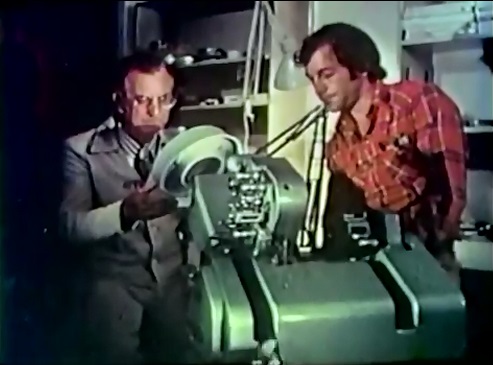
Here, the movie picks up some seventy years later, where a couple of men working for Syndicated Mines Inc. are charged with opening up the old derelict Silver City mine, assess the condition, collect rock samples to see what precious minerals are present, and determine if it’s worth exploiting any further with a full crew. And so, for now, it’s just Brian Deering (Crawford) and Dan Ostroff (Flory), a couple of grizzled company men who’ve explored hundreds of abandoned mines just like this one. Joining these two men are a couple of fresh-faced transplants from Pennsylvania mining country, Roger Lowrie (Harlan) and Mark Kinner (McCarren). And after breaching the entrance, the older men get to inspecting the timbers in the main shaft, which are in pretty sad shape, leaving the shit-work to the two newbies, who schlep the heavy equipment around and string wire to hang lights as they move deeper into the tunnel.


Meantime, a Martha Chapman (Dangerfield) is not having a very good day. The landlord of the property Lowrie and Kinner will take possession of tomorrow when Lowrie’s girlfriend, Jessica Ford (Martin), arrives, Martha is on the way to light the pilots of the furnace and hot-water heater for her new tenants when she runs her car off the road to avoid a deer. Then, after walking the rest of the way to the secluded house in the bitter cold, over snow and ice -- all under the lurking surveillance of the same creepy old man (Lormer) who was spying on those at the mine earlier that day, Martha finishes the prep work and makes a few futile calls for help, saying she will just spend the night at the house and beg a ride back into town tomorrow. But her stay is short-lived as she’s soon drawn back into the basement by some mysterious noises, which appear to be emanating from behind a shabbily boarded-up hole in the wall near the bottom of the steps, where the woman is violently attacked and drug off into the hole, kicking and screaming, by some unseen horror.


Back at the mine, work comes to a halt when they find evidence of a branching tunnel that doesn’t appear on any of their maps, blocked off by rubble from one of those long-ago cave-ins. Curious to see what’s on the other side, Deering and Ostroff use controlled blasts to remove the obstruction. And what they find is a huge natural cavern dominated by an underground lake. Scattered around the shore they also find huge piles of bones; the skeletal remains of all those lost miners, they figure.

Now, there are three huge clues our four explorers miss, here: One, it seemed awful easy to get into the chamber where those missing bodies were found, making one wonder why they weren’t just as easily rescued back in 1912. And I think the answer to that is the second clue: the condition of those skeletons, and how the bones are a jumbled mess and not somewhat intact and still clothed in the remnants as you’d expect if 27 trapped men laid down and asphyxiated -- more like stripped clean and discarded. So maybe there was something to those hush-upped reports of an attack in the mine. And thirdly, if you’re still not convinced something strange is going on, there’s some kinda something lurking in the water just below the surface that’s obviously stalking our obtuse protagonists, who’d best start paying more attention and put all of this together soon before they all wind up as just another pile of bones, too...


Ever since I began raking my knuckles over the keyboard and started posting the resulting nonsense on the wild world of the web some twenty years ago, I have been singing the praises for one of my personal patron saints of schlock cinema, Charles E. Sellier Jr.. But that was usually focused on his barrage of cryptozoological, strange phenomenon, and eccentric historical docudramas he unleashed for Sunn Classic Pictures back in the 1970s, where Sellier found kindred spirits of unknown phenomenon with filmmakers, Robert Guenette and James Conway.

And for a glorious period between 1975 and 1981 these three would conspire in the producing, directing, and writing of The Mysterious Monsters (1975), The Amazing World of Psychic Phenomena (1976), The Unexplained: The UFO Connection (1976), In Search of Noah's Ark (1976), The Lincoln Conspiracy (1977), Beyond and Back (1977), The Bermuda Triangle (1979), Encounter with Disaster (1979), Beyond Death’s Door (1979), and The Man Who Saw Tomorrow (1981) in some capacity, where the likes of Brad Crandall, Peter Graves, or Orson Welles would guide us on a personal tour of the inexplicably unexplained, throw a lot of conjecture at the screen, make dubious assumptions and hypothesis, and then tout their cock-eyed conclusions as fact, much to audiences’ delight.

But today we’re gonna explore the period when Sellier started working outside his faux doc comfort zone, which would ultimately result in the near Christmas ruination with the release of Silent Night, Deadly Night (1984), which Sellier had only directed as a favor, and whose resultant backlash over the marketing campaign and blasphemous content of a homicidal Santa Claus marked a decisive end to the first wave of the slasher boom of the early 1980s as studios quickly ran for cover and distanced themselves from all the blood and boobs. Before that, however, Sellier and Sunn were looking for the next hot trend at the dawn of the ‘80s, when the market for their quaint documentaries and matinee friendly family fare started drying up. And there was nothing hotter at the time than independently produced horror films with high body counts.

Charles E. Sellier Jr.
Based out of Salt Lake City, Utah, Sunn Classics, a subsidiary of Schick Enterprises, was purchased by Taft International Pictures in 1980, who would take over production and distribution of their films to help combat Hollywood’s efforts to squeeze-out old school roadshowers and four-wallers like Sunn. And so it was Taft who greenlit Sellier’s first R-rated feature, The Boogens (1981). Sellier would produce the film, while his old friend, and lifelong horror nut, Conway, would direct from a story concocted by Tom Chapman and David O’Malley, which was later hammered into a shooting script by O’Malley and Bob Hunt.

And while this script shares several of the newly minted and rapidly solidifying slasher movie tropes -- horny youths, horny youths dying first, old coots lurking and warning of imminent danger and curses, which go unheeded, rogue POV shots representing whoever is doing the killing, red herrings, pet stranger danger, prolonged stalking, gory deaths, all in service of the systematic reduction of the cast, The Boogens is, at its heart, despite some clumsy misdirection, nothing more than a good old-fashioned monster movie as it quickly becomes apparent that something inhuman attacked and most likely killed the landlord, and was also responsible for all those bones. And worse yet, it’s still hungry as Jessica arrives at the rental house with her old college friend, Trish Michaels (Balding), in tow.

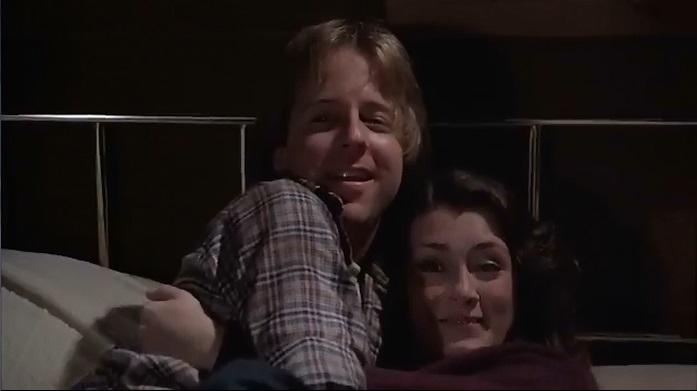

Seems Jessica and her boyfriend, Roger, have been scheming to bring their mutual friends, Trish and Mark, together for awhile now, feeling they’d be perfect for each other. But this was the worst kept secret and both victims of these machinations are having cold feet; but their inevitable meet-cute shows a definite romance in their future, which is confirmed when this relationship is consummated later. Meantime, Jessica and Roger’s debaucherous reunion in the sack is brought to a screeching halt not once, but twice. First, when a Deputy Greenwalt (Wilkinson) shows up looking for the missing Martha Chapman, whom none of them have seen. And second, when Roger draws the short-straw and gets “nominated” to drive into Denver long before the sun comes up to secure an upgraded map of the mine. And so, Roger leaves Jessica and the others in Silver City -- which also pretty much died when the mine shut down from what we see, with Deering and Ostroff at the local saloon so he can go catch a few hours sleep without the temptation of sex before heading out, only to promptly get attacked in the garage by some horrible, tentacled thing that slashes his throat open with the deadly barbed end of this appendage once it takes his legs out.

The following morning, thinking Roger is on his way to Denver, not realizing his truck and the bloody evidence of his demise is still in the closed up garage, Jessica starts tackling a few domestic chores while Trish, a cub reporter for the Denver Post, heads into town to check out the local paper and do some research on the old mine disaster, hoping a story will come out of it. And as she digs through the morgue, Trish becomes intrigued by several accounts about the lone survivor; a man named Blanchard, who claimed the mine was occupied by something evil. There’s hints this man caused the cave-in on purpose to stop this phantom menace from spreading and the other miners were already dead; but this line of inquiry peters out with an article stating Greenwalt was deemed crazy and committed to an asylum. Is this the old man that’s been lurking about? Maybe. What we do know for sure is what most likely happened in the mine back in 1912:


When the cavern was first discovered, the miners found something deadly waiting inside, which attacked them. Blanchard managed to get away and resealed the entrance to the cavern with dynamite. And in an effort to hush this up and prevent several lawsuits, the lone survivor was blamed for the disaster, declared insane, and committed. Now, of course, this cavern has once more been broken into, giving the monster (or monsters) free access to a maze of ventilation shafts that surface all over the town -- including one in the basement of the rental house our protagonists are occupying.

But Trish doesn’t quite have all of these clues put together yet as she heads back to the house. Meanwhile, realizing her dog, Tiger, has been missing all morning, Jessica discovers Roger’s truck is still there and calls the mine-works to alert Mark, who calls the Denver office. And though he should’ve been there hours ago, Roger never showed up. Mike calls Jessica back, saying he doesn’t know where their friend is but not to worry -- not realizing Deering and Ostroff just found Roger’s torn up body floating in that underground lake. Then, after Mark joins them as they pull the body to shore, the old coot shows up with a sack full of dynamite, who rants at them for letting the evil loose. Seems this man is Blanchard’s son. And unlike everyone else, he believed his old man’s tale of the Boogens and took it upon himself to keep watch on the mine and the ventilation shafts around town to make sure they never got out. And as he threatens to blow up the entrance, one of the creatures strikes from the water and kills Olstroff, causing a panicked Blanchard to seal himself and Deering inside the cavern with the massing creatures.


Mark, realizing the girls were in danger, had already fled before the explosion to get Jessica and Trish out of the house. But he’s already too late as Trish returns first, finds signs of a struggle and the shower still running, but can’t get a response from her friend. Here, she retraces Jessica’s terrified flight from one of the creatures, who attacked while she was in the shower. And after a harrowing chase, Jessica was trapped in the pantry and killed. Following the smeared blood evidence down to the basement, Trish finds Jessica’s mutilated body. Turns out the monster was still down there, too, and we finally get a good look at this misshapen mutant amphibian from hell as it attacks her, too. Luckily, Mark and the deputy, whom he called after giving up trying to reach the girls on the phone, arrive in time.


Greenwalt empties his revolver into the monster, which seemingly falls dead. The deputy then makes a tragic mistake by going in for a closer look only to have the critter spring to life and bite his face off. In the ensuing melee with Mark and Trish, the fuel line for the heater is severed, flooding the basement with kerosene. Mark puts a match to this, hoping to kill the creature. And while that mission was accomplished, the resulting inferno soon engulfs the stairs, trapping them in the burning basement with the only way out being the mine-shaft. So in it they go, where after a few suspenseful turns they run into Olstroff, whose bloodied but still breathing. Blanchard? Not so much. But as Olstrroff points the way to the surface, he is attacked and killed by another creature -- but not before he gives Mark the rest of Blanchard’s dynamite and orders him to get out and seal the mine for good. And this Mark and Trish do, barely staying ahead of what sounds like a whole horde of these creepy crawlies. And despite the last second suspense of a stubborn lighter, the fuse it lit, the dynamite goes boom, the shaft is sealed, and the day is saved but not without great cost.


Like those Sunn docs of old, the slow and deliberate pace director Conway and company deliver in The Boogens might be too much for some horror fans to overcome. The story structure is pretty clumsy, too, and pretty loose with no coherent timeline, meaning it probably would’ve been better served to open with the death of the landlord instead of taking that night-time sequence and shoe-horning it into the middle of the initial opening of the mine sequence, which all takes place during the day. This same script also relies way too heavily on Jessica’s dog for both comedy relief and for the entirety of the suspense for the whole middle third of the movie as the cantankerous canine is stalked by the unseen menace constantly, and is presumed dead a couple of times, before the Boogens finally get him. Kudos to the two pups who played Tiger and their trainers. Always in the scene, and, yeah, kinda carries the movie in spots.


Still, despite these glaring mistakes, I think this hybridization of monster and slasher movie works overall thanks in most part to a likeable cast, well-defined and likeable characters, that taps into a nice blue collar vibe. These are the same working stiffs we saw in My Bloody Valentine (1981), which I feel is the best slasher movie ever made, and helps ground the film considerably. Anchored by solid character actors, John Crawford and Med Flory, who definitely add some weight and humor (“How ‘bout we jog?”), the cast was rounded out by a couple of genre vets with Anne-Marie Martin and Rebecca Balding. Martin didn’t survive Prom Night (1980), while Balding was the final girl in Silent Scream (1980). Balding also fulfilled her contractual obligation to go nude while Martin did not. I always thought Balding was adorable in Lou Grant before she got fired off the TV show after only six episodes because the producers suddenly felt she wasn’t right for the part, which freed her up to be in Silent Scream and The Boogens. Director Conway agreed with me, apparently, as the two fell hard for each other during this production and would be married four weeks after the film wrapped.

While set in Colorado the movie was shot in and around Park City, Utah, utilizing several abandoned mines and an unused grocery store, where the cavern and lake interiors were constructed. And apparently, while filming the climax, the explosions got out of hand and the whole building and all the standing sets inside went up in flames, forcing cast and crew into one of those real mines to finish shooting the ending. Also of production note, seems there was a reason why we never got a really good look at the monsters in The Boogens. Seems despite the best efforts of William Munns and Ken Horn, veteran make-up and prosthetic makers for The Hills Have Eyes (1977), Swamp Thing (1982), and Return of the Living Dead (1985), who both built the animatronic monster and provided the bloody wounds the fanged and tentacled amphibians inflicted, the monster’s rubbery origins didn’t pass muster with Conway, who wound up taking the less-is-more Spielberg route and relied heavily on his POV-cam and the sound-design of Jeffrey Sandler, who took a recording of a dog and cat fighting, looped it backwards, and then slowed it down to realize the monster's hideous roar, to make it appear there were hundreds of Boogens in the mine and not just the one working prop they had, to maintain the dread.

After its limited theatrical release in 1981 -- and I have a vague, vague recollection of seeing this as a second feature at the drive-in on a dark and stormy night, The Boogens became a bit of an enigma because no one was able to see the damned thing for the longest time as the film essentially disappeared off the face of the earth, propagated by vague memories and a favorable review by Stephen King in the July, 1982, edition of The Twilight Zone magazine. And the film stayed lost for nearly twenty years until a very limited and very shitty pan ‘n’ scan VHS release in 1998 through Republic Pictures Home Video just as the format was dying out to make way for DVDs. And just when it appeared ready to disappear back into obscurity, Olive Films secured the rights and released The Boogens on DVD and Bluray in all its glory in 2012 to satiate many a curious fan. Myself included. Was it worth the wait? Well, expectations be a bitch and all that, but I found The Boogens’ novelties refreshing enough to easily overlook any of its shortcomings, though many they were.

What is Hubrisween? This is Hubrisween. And now, Boils and Ghouls, be sure to follow this linkage to keep track of the whole conglomeration of reviews for Hubrisween right here. Or you can always follow the collective head of knuckle on Letterboxd. That's two reviews down with 24 to go! Up Next: The Exorcist by way of a highway safety film! Buckle up, buttercups!

The Boogens (1981) Taft International Pictures :: Jensen Farley Pictures / P: Charles E. Sellier Jr. / AP: Bill Cornford, Carole Fontana, Cliff Osmond / D: James L. Conway / W: Thomas C. Chapman, David O'Malley, Jim Kouf / C: Paul Hipp / E: Michael Spence / M: Bob Summers / S: Rebecca Balding, Fred McCarren, Anne-Marie Martin, Jeff Harlan, John Crawford, Med Flory, Scott Wilkinson, Marcia Dangerfield, Jon Lormer