Showing posts with label Sunn Classics. Show all posts

Tuesday, October 18, 2016

Hubrisween 2016 :: M is for The Mysterious Monsters (1976)


While the first documented evidence of Bigfoot dates back to 1811, found within the journals of noted explorer and surveyor David Thompson, who came upon some strange footprints in the snow in what was to become Alberta, Canada, that he nor his Indian guides could identify, the idea that some monstrous biped was roaming the backwoods of North America really didn’t get any traction until 1955, when William Roe hiked up Mica Mountain in British Columbia and came back with a whopper of a tale. Apparently, Roe had an encounter with "a creature between six and seven feet tall that was hairy all over, had large breasts, a Negroid-shaped head, and walked on two legs."


This was the first widely reported domestic sighting of a large hairy cryptid since the world became Abominable Snowman-addled when Sir Edmund Hillary brought tales of the Himalayan Yeti back with him after he conquered Mount Everest in 1953. And as these things made headlines, Albert Ostman came forward and detailed an encounter he had with the creatures back in 1924, where he claimed to have been kidnapped and held captive by a family of Bigfoot (Bigfeet?) for nearly a week before he engineered an escape. That same year also unearthed the Ape Canyon attack, which also took place in 1924, where several miners allegedly killed one of the creatures and then spent a harrowing night in a cabin near Mount St. Helens, Washington, while several other creatures hurled rocks at them and tried to break in to avenge the dead.


But it wasn't until about two years later in 1958, when several tracks of large, humanoid footprints were found in the soft loam along the logging trails around Bluff Creek, California, that the notion of “Bigfoot” as we’ve come to know it was really born. And it was these very same tracks that later brought Roger Patterson and Bob Gimlin to the area in 1967, where they managed to capture what is probably the most infamous 16 seconds of footage ever committed to film; and with that footage, the legend of Bigfoot absolutely exploded in the national consciousness, creating a voracious appetite for more evidence of the creature that a lot of folks were happy to provide -- some more reputable than others.


One of the quieter patron saints of schlock cinema, Charles E. Sellier Jr. is probably best known to the masses for the ruination of Christmas with his controversial but, in the end, harmless holiday slasher, Silent Night, Deadly Night (1984), but we children of the 1970s remember him more for a rash of crypto-zoological, strange phenomenon, and eccentric historical docudramas he produced for the Salt Lake City based Sunn Classic Pictures, where Sellier Jr. found a kindred spirit with filmmaker Robert Guenette, who is credited for introducing a distinctive “newsreel style” to the documentary format. And for a glorious period between 1975 and 1981 these two would conspire in the making of The Amazing World of Psychic Phenomena (1976), The Unexplained: The UFO Connection (1976), In Search of Noah's Ark (1976), The Lincoln Conspiracy (1977)’, Beyond and Back (1977), The Bermuda Triangle (1979), Encounter with Disaster (1979), Beyond Death’s Door (1979) and The Man Who Saw Tomorrow (1981), where the likes of Brad Crandall or Orson Welles would guide us on a tour of the inexplicably unexplained. But this whole journey into the unknown began with a little pseudo documentary called The Mysterious Monsters (1975), which, perhaps inspired by the success of Charles B. Pierce’s The Legend of Boggy Creek (1972), purported to present evidence that proved the existence of Bigfoot.


To set the proper studious mood, our delightful little cryptid doc opens with the Graves known as Peter going mano a mano with the audience, ensuring all the facts about to be presented were true based on gathered evidence and sworn testimony, and the conclusions reached astounding, making this the most startling picture the audience will ever see. And after the credits proper conclude, played over our first re-created sighting of a Bigfoot, Graves, our designated narrator and guide, admits he was skeptical at first but tantalized by the body of evidence of the mythical creature’s hotly contested existence; and so, acting as our surrogate, he will sift through all the exhibits and then draw a conclusion once all the evidence is in.


Since the dawn of creation, man has created monsters to explain away or embellish the unknown. But if the Bigfoot is just a figment of our collective imagination, Graves argues, why are all the eyewitness accounts, from all over the country, essentially the same: tall, hairy, ape-like, with an unholy stench. Perhaps the elusive creatures just haven’t been properly catalogued yet, like the gorilla, giant panda, or komodo dragons, who all use to be essentially myths until western eyes saw them. Is it some form of anthropoid, an offshoot of the gigantopithecus? Or is it some form of primitive man, a relative of the Yeti, who crossed over the Bering land bridge and managed to survive in seclusion until these modern times?


Here, the film takes a hilarious left turn for a bit, focusing on tales of the Abominable Snowman and, believe it or not, an extended take on the Loch Ness Monster; and using the same dubious evidence that doesn’t pass muster when talking about proof of Bigfoot and applying them to its mythical brethren, Graves concludes that both the Yeti and Nessie definitely exist; and therefore, since they exist, Bigfoot must exist as well; a mind-blowing circle of self-citation and fractured logic of ipso facto what the hell-o that will assuredly leave you giggling.


So what is this much ballyhooed evidence? Well, the film lays out its haphazard exhibits from A through H, skipping a few letters here and there and circling back to a few others, starting with all those eyewitness reports. But the experts believe these to be unreliable and demand concrete proof, asking why has no one ever found the remains of a Bigfoot. Counter-arguments involve the whole circle of life thing, saying nature serves as its own disposal service. There is even some arguments that Bigfoot bury their dead. 


Exhibit B does concern such physical evidence, such as all the giant footprints, hairs that defy scientific analysis, and the huge piles of scat-of-unknown-origin collected over the years. Again, this runs into the problem of overzealous monster hunters and hoaxers, which is countered by famed cryptozoologist, Grover Krantz, who shows off the notorious Bossburg print, which he claims shows some form of arthritic deformity that no hoaxer could ever concoct.


Exhibit C is more physical evidence, namely a recording of a Bigfoot howling in the wild. Graves takes this to be analyzed at the same vocal lab from that one episode of 3-2-1 Contact, where it’s run through a computer, which determines the subject lacks a certain “articulatory flexibility” and, judging by its vocal tract, it must be 50% larger than your average human being.


I honestly don’t know what happened to exhibit D, but exhibit E involves the tale of Jacko, a juvenile Bigfoot caught in British Columbia back in 1884; sourced from a single newspaper clipping unearthed by a reporter digging into the history of Bigfoot sightings back in the 1950s. And then there’s the notorious Minnesota Iceman, where carnival huckster Frank Hansen claimed to have a corpse of a Siberian Bigfoot trapped in a block of ice. An exhibit that mysteriously disappeared in 1968 when calls to defrost it for study got too loud, bringing into question the validity of exhibit E. 


Exhibit F takes us on another detour and a psychic consultation with famed psychometrist, Peter Hurkos, a consultant on the Boston Strangler case, who divines a picture of a large hairy creature, half man, half ape, based on unseen evidence locked in a briefcase.


Exhibit G ups the ante with multiple corroborative witnesses when a town was besieged with a rash of Bigfoot sightings over the course of three weeks, with several of those eyewitnesses passing polygraph tests or volunteering to go through hypnosis to bring out more details of these encounters (-- which, speaking honestly, comes off as more creepy and sad than factual).


Which finally brings us to exhibit H, photographic evidence, which also brings us full circle back to the Patterson film, which leads to a hilarious exchange between true-believer Krantz and the highly skeptical Dr. Geoffrey Bourne, who get into a heated point, counterpoint discussion over the validity of the footage -- an argument I think Krantz wins because, really, who really does know what the breast of a Bigfoot ought to look like?
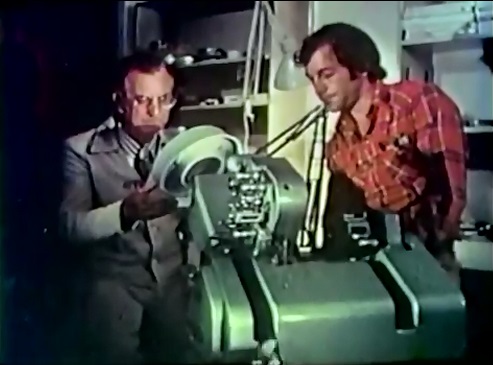


And so, with all the evidence presented, the documentary wraps up with Graves coming to the conclusion that, without a doubt, Bigfoot does indeed exist. And now that that’s settled, he direly intones as we try to decide what exactly a Bigfoot is we must be careful not to destroy what we seek to understand.


Now, those of you who’ve followed my ramblings on the web over the years are probably keenly aware of my irrational fear of Bigfoot. And this doc, right here, is the root cause of my psyche-trauma: at the ripe old age of six, Peter Graves took me by the hand and asked me if I liked to watch gladiator movies. No. Wait … That’s not right. Wait. Got it. He asked me if I believed in the Loch Ness Monster, Yetis and peeping tom Bigfoot (Bigfoots? Bigfeet?), and then showed me all the proof I needed that there was something sinister lurking in the large shelter-belt of Evergreen trees just outside our house like my elder brothers always said -- the jerks. And then there was that pothole near my grandma’s house that inexplicably looked just like a huge footprint sunk in the asphalt. I shit you not. Yep. Bigfoot was a very real thing back then. Hell, I even remember being disappointed when I found out Chewbacca was just a Wookie and not a Sasquatch when Star Wars (1977) hit a couple of years later.


Like a lot of cryptid docs the backbone of The Mysterious Monsters are the dramatic reenactments, re-created from first hand accounts as the witnesses are interviewed on camera. Some of these are hilariously laughable, like the Boy Scout’s encounter, while others are startlingly effective, namely the scene where a Bigfoot stalks outside a house while a woman watches TV, unaware as a huge hairy shadow falls across the curtain of the picture window behind her -- a picture window not unlike the one in my house, by the Evergreens, which only reinforced my case of the induced drizzles and confirmed my older brothers were a couple of assholes. She hears a noise outside but takes a look out the wrong window as the creature crashes in from another; chaos ensues as her screams brings her husband running, armed with a rifle, and when he opens the front door comes face to face with the monster and, end of scene. GAH!


I don’t know what it is about these things that puts such a damned hypno-whammy on me, making me believe these things are not only possible but plausible. Guenette's mix of talking head experts, stock footage, and cagey staging of the sightings are bizarrely effective. 


Helping to sell all of this is some pretty spiffy work by The Burman Studio, who provided all the Bigfoot costumes that hold up well even in the light of day; and these technicians would go on to provide creatures and aliens for feature films ranging from Close Encounters of the Third Kind (1977), Prophecy (1978), The Adventures of Buckaroo Banzai Across the 8th Dimension (1984), Waterworld (1995) and six seasons of Buffy the Vampire Slayer. And Ruby Raskin’s soundtrack runs the range from silent film melodrama and organ stings to the grandiose bombast of an industrial travelogue that constantly lulls you into things only to whack you upside the head to keep your eyes and ears open for what’s lurking in those bushes.


Personally, I like to believe more in the possibility of Bigfoot than its actual existence. Remember those footprints found around Bluff Creek that started all the initial Bigfoot hysteria back in the 1950s? Well, turns out those were all faked. This hoax was revealed with the death of Ray Wallace in 2002, who “found” these prints and, in accordance with his final wishes, Wallace’s family came forward with the molds and rubber casts used to make all of the fake prints. And if we follow the fruit of this poisoned tree, that probably means the much contested Patterson footage, shot in the same area, and corroborated by several footprints that bear a striking similarity to Wallace's forgeries, is cast into even further doubt. Say it ain’t so, Pete. Say it ain’t so. 

Other Points of Interest:


What is Hubrisween? This is Hubrisween. And now, Boils and Ghouls, be sure to follow this linkage to keep track of the whole conglomeration of reviews for Hubrisween right here. Or you can always follow we collective head of knuckle on Letterboxd. That's 13 down with 13 to go! Halfway! Woohoo!


The Mysterious Monsters (1976) Schick Sunn Classic Pictures / EP: David L. Wolper, Raylan D. Jensen / P: Charles E. Sellier Jr., Robert Guenette / AP: James L. Conway, Frances Guenette / D: Robert Guenette / W: Robert Guenette / C: Tony Coggans, Erik Daarstad, David MyersFrances Guenette / E: Earle Herdan, Robert K. Lambert / M: Ruby Raksin / S: Peter Graves

Sunday, July 26, 2015

The Celluloid Zeroes Present: It's All True! (Except for the Bullshit.) :: Getting Lost 4VR with Charles Berlitz and Friends in Richard Friedenberg's The Bermuda Triangle (1979)


Way, way back in Fourteen Hundred and Ninety-Two, when Columbus sailed the ocean blue, history shows he steered the Nina, the Pinta and the Santa Maria into what would come to be known as the Sargasso Sea. Named for the sargassum -- a dense, floating blot of aquatic vegetation -- that marks its boundaries, this nebulous body of water has earned itself a rather insidious reputation over the centuries since Columbus first mistook these masses of seaweed as a good omen that land must be near. Prone to deadly calms that left sailing ships stranded indefinitely, the Sargasso soon earned itself several nicknames, including The Sea of Lost Ships, as several salty tales of massive graveyards of vessels, swamped in the muck, their holds full of gold, with their skeletonized crews still waiting for a wind that would never come just waiting to be plundered, began to surface.


And as wind power gave way to steam, ships still managed to venture into these waters only to never be heard from again. It didn't help matters that this area was also prone to magnetic disturbances known to send compasses a'spinning or pointing to true north instead of magnetic north; and dead spots where all radio communications are disrupted or neutered, which led to another nickname, The Sea of Fear, as the troublesome concentration of these maritime disasters began to define itself a little more clearly; an area that was roughly demarcated by a line drawn from the southern tip of Florida, to the island of Bermuda, to Puerto Rico, and then back to Florida.


Even as man took to the sky this new means of travel brought no immunity as several airplanes met the same unknown fate as their water borne brethren somewhere over the Sargasso. However, most of these instances were isolated with plenty of plausible explanations for the abrupt disappearances. But then, on December 5, 1945, five TBM Avenger torpedo bombers left the naval air-station at Ft. Lauderdale, Florida, on what was supposed to be a routine two-hour training flight. Designated Flight 19, it was under the command of Lt. Charles Taylor, a combat veteran of the Pacific campaign, serving on the carrier USS Hancock; and while the rest of the pilots and crew were trainees they were far from their first flights. In fact, this was to be their last training mission before graduating. And after a slight delay, the flight departed; and as the planes formed up the weather was clear and favorable, the sea moderate to rough. Again, this practice bombing run was nothing any of these pilots hadn't done before. And once they cleared the runway, another batch of trainees would launch to run the exact same exercise, just as another group was ahead of them and already well on their way to Chicken Shoals.


But once Flight 19's bombing run was successfully completed, something strange happened. It began with a pilot to pilot radio transmission, asking for a compass heading. This chatter continued, growing more agitated as it became apparent Flight 19 was off course. More radio calls inferred that the entire flight's compasses were malfunctioning, and no one could get a proper bearing or heading. More confused transmissions followed, desperately trying to get fix on their location, one thinking they might be over the Florida Keys, another fearful that they were now somewhere over the Gulf of Mexico. On the ground, all efforts to triangulate the flight's location failed. Radio contact with the flight was spotty and intermittent and as the crisis dragged on it suddenly stopped. Still, the plane to plane chatter continued, arguing over which direction to head as Taylor kept them circling eastward, while the others begged him to head west. At one point, several land-based radio stations were able to fix Flight 19's location as nowhere near Florida but north of the Bahamas. But before this could be confirmed, contact was lost as the weather started to deteriorate. And as the sun started to set and the planes ran dangerously low on fuel, a distraught Taylor radioed how the sea didn't look right, and being awash in a strange light. Then, the last transmission from Flight 19 was received: "All planes close up tight ... We'll have to ditch unless landfall ... When the first plane drops below 10 gallons, we all go down together."


Despite a massive air and sea search covering nearly 250,000 square miles, no traces of Flight 19 or the 14 men who manned the five planes was found. No debris. No oil slicks. Nothing. They simply vanished. The flight was one man short, since a Corporal Allan Kosnar was excused from the flight because, according to legend, he had had a "strong premonition of doom" and begged off sick. A Naval board of inquiry listed the reason for the disappearance as "cause unknown." Seventy years later, they still don't know what happened for sure. But back in 1945, the Sargasso had earned itself another new name: The Bermuda Triangle.


The first allegations that something screwy was going on in the waters southwest of Florida first saw print in 1950, when an article by reporter Edward Jones was picked up by the AP, which tied several maritime disasters, including Flight 19, to the area. In 1952, Fate Magazine published an article by George Sand, "Sea Mystery At Our Back Door", which was the first to note the (now standard) triangular shape of the troubled area and the first to suggest a supernatural element as the cause to all these strange disappearances. A decade later, Vincent Gaddis' "The Deadly Bermuda Triangle" saw print in the February, 1964, edition of Argosy, which further expanded on the pattern and causes of these disappearances. And though Gaddis would later publish his theories in a book, Invisible Horizons (1969), The Bermuda Triangle didn't really strike a chord with the masses until Charles Berlitz came along.


As the legend goes, gonzo author and noted linguist Charles Berlitz first became interested in the Triangle phenomenon at a travel agency in the late 1960s, when he became intrigued by several customers who adamantly refused any mode of travel through the dreaded area. That, however, is not quite true. Born in New York City in 1913, Berlitz, fluent in four languages before the age of three, after graduating magna cum laude at Yale, where he pushed that number to over 32, got into the family business, teaching at the famed Berlitz School of Languages, founded by his grandfather, Maximilian, in 1878.


With America's entry into World War II, Berlitz enlisted and found his way into the Army's counter-intelligence corps. Once the war ended, Berlitz stayed in the military for nearly 13 years as a reservist. He also returned to teaching, eventually taking over the stewardship of several branches of the Berlitz school, where he pioneered the use of records and tapes in learning a second (or third or fourth or 33rd) language, and then took over Berlitz Publications until it was sold to a rival publishing house in 1967. From there, Berlitz abandoned linguistics and went full bore into the world of ancient civilizations, underwater archeology and the paranormal; more specifically, locating and proving the existence of the lost continent of Atlantis and, later, getting to the bottom of the deadly occurrences inside the Bermuda Triangle.


A firm believer in Ancient Astronauts and alien visitations since the dawn of man, Berlitz's first two books, The Mystery of Atlantis (1969) and Mysteries from Forgotten Worlds (1972), delved into these theories and the possible effect these *ahem* visitors had on some infamous "lost civilizations", echoing the work of Erich von Däniken's Chariots of the Gods? (1968). Around this time Berlitz also had his alleged encounter at the unknown travel agency, which determined the topic of his next book. But most of this interest, however, seems to stem from his time as a reservist, where he served as an investigative officer for the Army Air-Corps when Flight 19 disappeared. And after compiling all of his research, Berlitz believed that "the people and planes and ships that have reportedly disappeared in the Bermuda Triangle have been victims of some sort of electromagnetic disturbances that cause them to disintegrate and fall into the sea." And his speculative exposé on this theory, The Bermuda Triangle (1974), sold more than 14 million copies worldwide, feeding the voracious appetite of the crypto-mania-addled public of the 1970s, who had gone completely bonkers over UFOs, Bigfoot, ghosts, and psychic whammies, and almost single-handedly made the notorious area of water a household name and caused a massive dip in Bermuda's tourist trade.


At some point, Berlitz hitched himself on to noted prognosticator and self-proclaimed mystic Edgar Cayce's bandwagon and tied his two obsessions together, claiming Atlantis was located inside the Bermuda Triangle, even claiming to have found a massive pyramid on the ocean floor near Bimini. But a reviewer for TIME Magazine countered that the author "takes off from established facts, then proceeds to lace its theses with a hodgepodge of half-truths, unsubstantiated reports and unsubstantial science." And Naval historian, Eliot Morison, called Berlitz's book "a load of hoey", adding most of the documented disappearances didn't actually happen in the Triangle or could easily be explained by more normal causes.


Even as the Washington Times tagged him as "the de facto expert on weird phenomena", Berlitz was just getting started. Flooded with more eye-witness testimonials after his first book hit big, he immediately published another on the Triangle, Without a Trace (1977), followed by another exposé on some deadly Naval exercises that took place in the very same waters, The Philadelphia Experiment (1979), which alleges the US Navy tested some Top-Secret high-powered generators to make a "magnetic field" powerful enough to render a destroyer invisible that went completely awry, causing the boat to shift between dimensions, leaving several crewman dead, melded into the hull, while others kept blinking in out of this known existence. And as the 1970s came to a close, Berlitz was one of the first to claim the government was covering up the existence of aliens with The Roswell Incident (1980).


Meantime, producer and director Charles E. Sellier Jr., probably best known to the masses for the ruination of Christmas with his controversial but, in the end, harmless holiday slasher, Silent Night, Deadly Night (1984), was quietly becoming one of the patron saints for a certain niche of shlock cinema. For we children of the 1970s remember him more for the rash of faux docs on cryptids and other strange phenomenon like The Mysterious Monsters (1975) -- which gave five year old me thee worst case of the drizzles, The Amazing World of Psychic Phenomena (1976), and Beyond and Back (1978) that he unleashed on the public along with his eccentric historical docudramas, In Search of Noah's Ark (1976) and The Lincoln Conspiracy (1977). Half of these I remember seeing in the theater. The others used to be late night staples on the Supestations before they all chucked them for more mainstream programming. Altogether now, BOO!, Superstations. We said, BOO!


So to say Sellier Jr. was a bit obsessive on the mysterious and unexplained would be a bit of an understatement; but he found a kindred spirit with fellow filmmakers Rober Guenette (The Man Who Saw Tomorrow / 1981) and James Conway (Hangar 18 / 1980), who all found distribution through Sunn Classic Pictures, a subsidiary of Schick Enterprises, who had expanded beyond disposable razors. Based out of Salt Lake City, Sunn Classic was kind of a throwback to the old barnstorming and road-show days of Dwain Esper and Kroger Babb, moving from city to city, with over-saturation advertising campaigns to lure people into the theaters, where it would have a limited run to add even more urgency before moving on and starting the process all over again.


As 1978 rolled around, Sellier Jr. and Conway managed to get the film rights for Berlitz's book and set out to adapt it to film in their usual docu-drama style. Now, what I always loved about these kinda movies and books on this type of whackadoodle subject matter is they all tended to follow a fairly familiar pattern. First comes an introduction to what mystery we're investigating, then comes the dramatic recreations of infamous incidents and true testimonials, followed by a token attempt to show all possible rational explanations for these strange phenomenon before we get to the best parts, where the crackpot theories roam free and wild.


In The Bermuda Triangle (1979), director Richard Friedenberg and scriptwriter Stephen Lord stick to this gonzoid approach, playing rather loosely with the facts for ... uhm, dramatic purposes, and throw in everything but Bigfoot and the Loch Ness Monster. And while Flight 19 is a centerpiece (embellished with a few more supernatural twists and turns, 'natch), it begins with Christopher Columbus' encounter with a series of strange "fireballs" in the sky near Bimini; then a ghostly encounter with the Mary Celeste and the Flying Dutchman; then the disappearance of the U.S.S. Cyclops. These along with about a dozen more encounters in the Triangle, by sea and air, related by those who survived and speculation over what happened to those who did not round the film out. Highlights include:


A rather unintentionally hilarious segment about a dimensionally-displaced barge; a plane passenger's harrowing close encounter with a space-time vortex; an airliner that ceased to exist for 12 minutes; a rather creepy tale about a plane and its two passengers, apparently caught in a time-bubble, circling Grand Turk Island, unable to land because whenever / wherever they are / were the airport hadn't been established yet, as the confused radio-operator in the tower below can hear them circling overhead until they disappear into the clouds and are never heard from again. Things even get a little sinister when some of these surviving eye-witnesses die under dubious circumstances for, dare I say, knowing too much.


As far as the theories go, well, once pilot-error, underwater earthquakes, water-spouts, and leftover mines are written off due to the lack of physical evidence, followed by some heated conjecture between several oceanographers with out-RAY-geous French accents over (sacré) blue holes (essentially giant whirlpools), the film starts thinking outside the box -- and these ideas are all bone-headedly magnificent. One of my favorites is the claim that it all boils down to Atlantis -- namely a powerful crystal that, when not harnessed properly, is prone to violent discharges of energy that not only destroyed and sunk the ancient civilization it is still popping-off from the ocean-floor to this very day like some ersatz death-ray -- represented by pilfered and spliced-in footage from George Pal's Atlantis: The Lost Continent (1961).


Dimensional rifts caused by all that magnetic interference is also given some play, as is a wild reenactment of the "failed" Philadelphia Experiment, where the USS Eldridge is super-charged for naught and all her sailors turned into ghostly, intangible lab-rats. But the film's own favorite pet theory is a UFO connection (-- which I'm sure had nothing to do with the release of Close Encounters of the Third Kind (1977) the year before), claiming there's a secret underwater alien base near Puerto Rico, who have been picking off ships and planes to keep it a secret since the 1800s. 


This notion even leeches into the Flight 19 segment, with additional radio chatter about a silver object and strange lights before all communications are lost. (Again, Flight 19 plays a role in Spielberg's film, as well. Coincidence? I think not. Nope. Nosiree.) In fact, the last third of the movie is dedicated to these Unidentified Flying -- no, wait, sorry, Underwater Floating Objects, even going so far afield for another hilarious dramatization of Captain Thomas Mantell's fatal encounter with a UFO over Fort Knox, Kentucky, in 1948, which, according to my map, is nowhere near Bermuda. We also learn that these aquatic alien invaders have an aversion to salsa music. Go figure.


Tying all of these spooky and kooky tales together is Brad Crandall, who serves as our omnipresent moderator and guide. Crandall's career began as a proto-shock jock for WNBC, New York, in the 1960s. In the 1970s he sort of became a freelance narrator for films like this one, making his deep and authoritative voice as familiar to me as Percy Rodriquez, Ernie Anderson or Don LaFontaine. The rest of the acting by the cast of unknowns in the reenactments is serviceable enough, as is Friedenberg's direction of the same. Often overlooked in these things, but John Cameron's score kinda quietly glues the film together; making the eerie and ominous even creepier, the rousing more bombastic, or capturing the strange mix of dire danger and gob-smacked awe of the impossible things being seen and heard by all the alleged witnesses. As for what we saw they said they saw, the F/X (credited to Doug Hubbard) is grounded in the decade that spawned it but is actually quite good once you consider the budget, though thinking on it about three-quarters of his job was adding a green-filter to the camera lens. Still, the miniatures and pyrotechnics were top-notch.


Obviously, Berlitz's book is part truth wrapped in a ton of bullshit. But I do believe it was sincere bullshit. Sellier's film adaptation, of course, is pure exploitation, beating the evidence and the sincerity around the head and neck with the three Fs: faulty, fraudulent and fabricated. "Science does not have to answer questions about the [Bermuda] Triangle because those questions are not valid in the first place," said Dr. Buzzkill in an episode of NOVA (June 2006) dedicated to debunking this particular myth. "Ships and planes behave in the Triangle the same way they behave everywhere else in the world."


Yeah. It's been said that if you took a global map and drew a triangle with the same dimensions as the Bermuda Triangle and placed it anywhere else that was blue it would show that just as many ships and planes disappeared in the new triangle as the old, making it no more or less dangerous than anywhere else -- even though anywhere else never got its own home version board game from Milton Bradley. (Take that, Dr. Buzzkill.)


And while I don't necessarily believe in things like The Bermuda Triangle, I like the idea of it existing (and Bigfoot, lake monsters, UFOs and ghosts) if that makes any sense. And I love books and documentaries based on them even more, with this one being a particular riveting favorite both in print and film. Yes, even though the majority of it is bullshit -- I know it and you know it, I love this flick because sometimes ... sometimes you simply just don't care and just simply run with it and see where the B.S. takes you because the B.S. is the best part. And if that doesn't compute for you, well, I'm sorry. Truly sorry. And one more thing before I set sail to parts unknown, while a lot of these old paranormal and cryptid docs managed to eke a VHS release they have yet to make the digital leap and I would hope that someone, anyone, would rectify that as soon as possible.


This post is part of The Celluloid Zeroes latest roundtable: It's All True (Except for the Bullshit). And be sure to please 'o please check out my noble compadre's Stranger than Fiction entries since I'm the one who talked them all into this seemed like a great idea at the time topic in the first place as they pop up over the next few days, please and thank you.

Checkpoint Telstar: Without Warning, Cloverfield, Punishment Park, The Bay, [REC].


Cinemasochist Apocolypse: Legend of the Chupacabra.

The Terrible Claw Reviews: Chariots of the Gods.


The Bermuda Triangle (1979) Schick Sunn Classics / P: Charles E. Sellier Jr., James L. Conway / D: Richard Friedenberg / W: Stephen Lord, Charles Berlitz (book) / C: Henning Schellerup / E: John F. Link / M: John Cameron / S: Brad Crandall, Vince Davis, Anne Galvan, Robert Magruder, Tom Matts
Related Posts Plugin for WordPress, Blogger...