Showing posts with label Film Reviews. Show all posts

Thursday, August 15, 2024

Hello, All! Been a While, Hasn’t It? Sit Down, Grab a Brew, and I'll Tell You What We've Been Up to Lately.

Greetings, Boils and Ghouls, long time no see. Well, I guess we can count this one as a Shameless Plug to help those who wound up here and herd them over to our more recent online endeavors at Confirmed, Alan_01. (Yes. That's a TRON reference.)

Anyhoo, we just completed an exhaustive two part series on Rene Daalder's Massacre at Central High (1976), where we explained the circumstances of how a Dutch filmmaker, an independent distributor out of Chicago, and Russ Meyer of all people came together for one strange little bugaboo of a movie; then try to unravel how a film that was specifically commissioned to be as equally grisly as The Texas Chain Saw Massacre (1973), with a near double-digit body count, wound up instead an odd and offbeat lesson in civics and an all-out political allegory on the rise and fall of the Third Reich; and then decide if it works and ultimately unravel the film's treacherous path from obscurity to Cult Filmdom. 

We also just completed a retrospective / memorial on the early film career of Roger Corman, with completely overhauled and updated reviews on The Gunfighter (1950), The Beast with a Million Eyes (1950), It Conquered the World (1956), Rock All Night (1957), Creature from the Haunted Sea (1961), X! The Man with the X-Ray Eyes (1963), and a brand new review of The Terror (1963), where we skewer the myth that the production tales of Corman's movies always proved more interesting / entertaining than the film they made. Sort of. We also did a massive update on our old 3B Theater review of Corman's Teenage Caveman (1958)

Here's a list of what we've published so far, including a two-part look at Phil Karlson's Framed (1975) and the rise and fall of Joe Don Baker. And I encourage you, Gentle Readers, that even if you've already read my take on these movies before, each entry has been extensively rewritten and updated -- like these reviews of Ghost in the Invisible Bikini (1966), Beginning of the End (1957) and Under the Rainbow (1981) -- with an emphasis on proper attribution on a lot of those phantom quotes that have plagued my writing for years. (My bad. Working on it. And now with at least 30% less grammatical atrocities.) 

Of course, I'm posting this right before I take off on the usual September Sabbatical, but that also means we'll return in October with something I refer to as Not Quite Hubrisween, where we do a marathon of specific and seasonally appropriate genre films. (Not 26 films though. I'm way too old for that anymore. Wow. How I managed to pull that off for so long is beyond me.) Also of note, we've resurrected The Morgue and the Poster Archive as well.

The end game / goal is to get all of my online writings finally in one place -- with even a few brand new reviews sprinkled in. (All of the old content will remain as is where it is.) And I wouldn't even call these things reviews anymore. Essays maybe? Term papers? Sermons? Treatise? Mindless Ramblings with an Occasional Anecdote? Desperate cries for help? That's me shrugging right now. Either way, thanks for reading and I hope you enjoy!

Tuesday, April 23, 2019

Ghosts in the Tall Grass :: A Beer-Gut Reaction to Kaneto Shindô's Onibaba (1964)


As the Battle of Minatogawa rages nearby, which triggered a long and bloody period of civil war and strife in 14th century feudal Japan that would last for over fifty years, two soldiers flee from the wholesale carnage but are pursued by several others on horseback. Now, whether these men are fleeing from the enemy or are deserters no one can say for sure as they try to lose themselves in a dense patch of grass. And as they struggle through the deepening marsh and overwhelmingly dense vegetation, as the wind whips the elongated chutes into a blinding frenzy, both men are suddenly run through by spears held by unseen hands, gored, and killed rather gruesomely.


It is then revealed those spears were held by two women, who quickly strip the victims bare of their weapons, armaments, and clothing before unceremoniously dragging and dumping the bodies into a large and ominous pit secluded deep in the marsh. All of this is done with such a ruthless efficiency, it becomes quite obvious these two have pulled off this kind of ambush before. And not only have they done this before, but they’ve turned it into a cottage industry as these desperate and destitute women leave their ramshackle hut and take this latest batch of loot to a black market peddlar named Ushi (Tonoyama) and trades them for more rations of rice.


Seems times are tough in this province, what with the feuding factions having stripped the land bare of anything edible and shanghaiing all able-bodied men into service (-- and women, too, for other reasons), leaving no one to regrow the next batch of crops, leaving those left behind to eke out an existence by any means necessary or face death by starvation. And since it’s rare to have a dog wonder into camp and onto the menu, the old woman (Otowa) and the girl, her daughter-in-law (Yoshimura), decided to get proactive. In fairness, they haven’t chosen a side in this conflict and are equal opportunity killers and looters. And once the latest negotiations are complete, the lecherous Ushi offers up an extra ration if either woman will have sex with him. The older woman refuses. Bluntly.


When they return to the hut, the women are startled to find someone there, hiding out, waiting for them. Hachi (Satō) is another deserter, but he was also a neighbor and friend of Kichi, son and husband to these two scavengers, who got conscripted into the conflict at the same time, explaining why he wasn’t immediately set upon or wound up in the pit -- at least not yet, as Hachi brings bad news, revealing Kichi also tried to desert with him from the ongoing battle but was killed while trying to steal supplies from a group of farmers on the way home. Convinced the cowardly Hachi let her son die, the woman tosses him out and forbids the girl from ever interacting with him.


But things tend to get mighty lonely in the tall grass and, soon enough, Hachi is able to not-so-clandestinely seduce the girl and they go at it, hot and heavy, night after night. Soon realizing she is about to lose the girl to this interloper, and knowing full well she will never survive on her own without her partner, the woman, perhaps a little jealous, and definitely equally sexually frustrated, confronts Hachi, pleads with him to leave the girl alone, and offers herself up instead to satisfy his carnal needs only to be laughed off as an old hag he wouldn't touch with a ten foot pole. Thus, despite the fact Hachi was awful handy in killing two dueling samurai caught in the flooded paddy, whose superior weapons brought them more rice, the old woman concludes he needs to go in the hole with all the others.


But before she can set this in motion, while the other two are once more off fornicating, making her distracted and off her game, yet another samurai -- a general (Uno), clad in a hideous demon mask, stumbles upon the hut unmolested. Seems the general, who refuses to remove the mask, saying it protects his beautiful face, has gotten lost after the latest battle and wants the woman to guide him out of this infernal marsh. And after a brief philosophical debate on Japan’s patriarchal caste system, the woman agrees to these demands only to the lead the man into a trap, when he is herded toward the unseen pit and falls to his death.


Then, when the woman lowers herself into the hole, she finally manages to wrest the stubborn mask off, which reveals the man was hideously scarred underneath. And as she strips the rest of him and makes fun of his looks, the woman suddenly hits upon a blasphemous notion that will solve all of her problems and explains why the samurai’s robes and demon mask were noticeably absent when she sells the rest off to Ushi. And while this does solve one problem for the old woman, it curses her with yet another, more deadly one...


An erotically charged, strange, but deceptively simple little bugaboo of a movie, Kaneto Shindo’s Onibaba (1964) was based on an old Shin Buddhist parable, Yome-odoshi-no men (-- translated as bride-scaring mask), whose moral lesson of piety and divine consequences the director kinda acknowledged but then turned on its ear. In the story, a mother feels her daughter-in-law spends too much time going to temple and praying to Buddha, feeling her day would be better spent on her chores and tending to her husband’s needs. And so, to rectify this, the mother waits in ambush on the path to the temple, hiding in a patch of tall grass. And when the daughter-in-law approaches, she jumps out in front of her, wearing a hideous demon mask, shrieking and gesticulating, scaring the girl into an immediate u-turn.


But this stunt backfires when the wrathful Buddha puts a curse on her for this deception, which left the mask permanently welded to her face once it gets wet in a rainstorm. And only after she prays for mercy did the mask finally come off, but it took half of her face with it as a reminder that while Buddha can be merciful and forgiving, there will still be consequences to deal with for your blasphemy.


Shindo would later recount how his mother told him this story in his youth to reinforce the notion to always be honest and forthcoming and the dangers of hypocrisy and deception, and it apparently stuck. And while the central theme is still there and drives the third act, both Shindo and Onibaba had a lot more to say. Not since Isao Takahata’s Grave of the Fireflies (1993) have I seen a film hold this much contempt for those who wage war, which is then reflected in how the film wallows in the desperation, degradation, and poverty of those caught up in this no man’s land as they try to survive not day to day nor hour to hour but minute to minute.


From the opening scene of Onibaba -- which literally translates as “demon hag,” the cynical Shindo makes it perfectly clear he has no patience for the current corrupt social order of his native country, which led Japan to war two decades earlier, and strips bare the samurai’s bushido code by having his protagonists literally desecrate and strip every samurai carcass they come across. (This is all reinforced later in the scenes with the general both mortem and postmortem.) It is the stuff of nonsense, says Shindo, that only leads to loss and ruin for those caught in the wash, who suffer the real consequences of this kind of blind faith, leaving you with few choices: a terrible death by violence, or a horrible death by starvation.


But it’s not just food they’re all hungry for. There’s a very strong libidinous component to Onibaba as well. This is a lusty, sweaty, and primal movie. And if one looked at the evolutionary chart of such things, the film feels like a common genre ancestor for both the Pinky Violence and Roman Porno films that were about to come into vogue in the late 1960s. 


Unlike everyone else in this movie, the old woman is sexually frustrated. She’s extremely jealous when Hachi rejects her. And there’s even a few less than subtle hints of sapphic desire for her daughter-in-law, making things even more twisted as she waits in ambush as the girl once more sneaks out of the hut for another moonlight rendezvous with Hachi.


With Operation: Scare the Piss Out of Little Miss Horny Pants a complete success, the following morning, the old woman presses things even further, convincing the naive girl the demon was most assuredly real and divine punishment for her infidelity. And it will be back if she tries it again, she warns. These scare tactics work for a little while, but lust is a harsh mistress never satisfied. And so, as a thunderstorm rages, the old woman dresses up again and sets another ambush, which totally backfires this time. Seems Hachi was tired of waiting for the girl, sets out to find her, only to have the "demon" chase her right into his arms. And as he quiets her down and they go at it, the old woman, realizing she has failed and lost the girl for good this time, watches on dejectedly.


Once the deed is done, Hachi returns to his hut, where he catches another deserter stealing his food and is promptly killed by his startled guest. Meantime, the old woman has discovered she can no longer remove the soggy demon mask. When the younger girl returns, and is rightfully frightened by the sight of the demon in their hut, the old woman reveals it was her all along, begs forgiveness, and promises to no longer interfere in her love-life with Hachi if she will help get the infernal mask off. A mighty struggle ensues and, in the end, the girl winds up having to break the mask off with a hammer. Once gleefully removed, it’s revealed the mask took most of the woman’s skin with it.


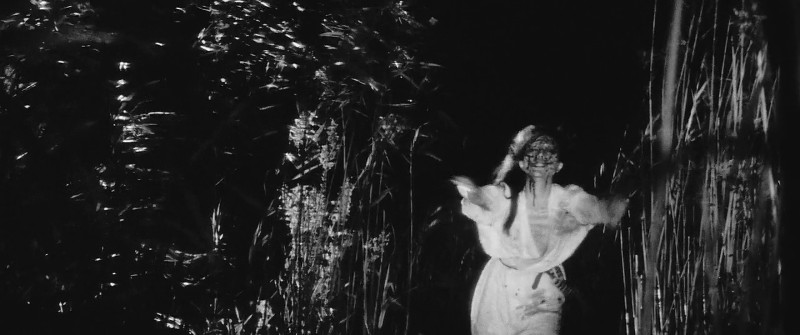
Taking one look at this hideous visage convinces the girl this really was a demon all along; she screams, and then flees into the night. The old woman chases after her, swearing she is not a demon. This erratic chase leads them to the pit, which the girl jumps over. Right behind her, the older woman also makes the leap as the film abruptly ends, leaving it up to the audience on whether she made it across or not. Me? I’m leaning toward not, but it all kinda depends on your own metered severity of the ‘hell of your own making’ in what you just watched.


To fulfill his vision, Shindo wanted to make the entire film in a dense field of susuki grass; an invasive perennial that ranges from three to seven feet tall. And after a lot of searching, he finally found what he was looking for along a riverbank in Chiba near Inba-Numa, where they put up prefabricated buildings to house the minimal cast and crew for the scheduled three month shoot. The crew got a little mutinous as things dragged on due to the incessant rains and flooding that plagued the shoot, which bred hordes of insects and stirred up the local crayfish population; but stuck it out when told they wouldn’t get paid at all unless the contractual obligation was met.


Despite these hardships, Shindo, his cast, and his cinematographer, Kiyomi Kuroda, really captured some magic here. A film with more visual texture than Onibaba I’m hard pressed to name. Poetic even, when you add in the haunting vocals of Hayahi Hikaru’s intense, percussion heavy score. And I think the film works better if you take it at face value with the visuals, which -- from the opening sequence to the finale, where the old woman's scarred face brings to mind the radiation burns of Hiroshima and Nagasaki, are stunning, since the plot is kinda leaking water; and the less you try to ponder on the schism of an old folktale on right and wrong and a twisted carnal yarn of gaslighting and survival the better in the long run.


Onibaba (1964) Kindai Eiga Kyokai :: Tokyo Eiga Co Ltd. :: Toho :: P: Hisao Itoya, Kazuo Kuwahara, Tamotsu Minato, Setsuo Noto / D: Kaneto Shindô / W: Kaneto Shindô / C: Kiyomi Kuroda / E: Toshio Enoki / M: Hikaru Hayashi / S: Nobuko Otowa, Jitsuko Yoshimura, Kei Satô, Jûkichi Uno, Taiji Tonoyama

Monday, January 21, 2019

Recommendations :: What I've Been Watching, and So Should You! At Your Own Risk. Maybe. Or Not. You've Been Warned!


To be frank, I was kinda terrified I was dealing with An Occurrence at Owl Creek  Bridge scenario in The Girl Who Leapt Through Time (2006) as this delightful though, in the end, melancholic anime about a precocious teenage girl, who finds herself able to leap back in time after a near death experience involving some failed bicycle brakes and a moving train, played out. Turns out my fears were mostly unfounded as the girl, Makoto, uses her new found abilities for silly selfish reasons at first before graduating into trying to fix things and play matchmaker for her friends while she tries to sort out her own confused feelings with a boy named Chiaki. However, Makoto is soon to learn the more you mess around with history to try and fix things, the more chaotic and dangerous the past can get. And through her best intended machinations, she puts one of her best friends in mortal danger just as Makoto finds out too late she only had a finite amount of time leaps. Loved this one. Loved it. The animation is breathtaking, and the voice acting fits perfectly with a special shout-out to Riisa Naka as Makato, who just captures the spirited character's awkward gung-ho-ness effortlessly. See, to make the time jumps work Makato has to actually make a physical jump, and the further she jumps the further back in time she goes leading to some pretty hysterical aerobatics and crash-landings for our girl. Cannot recommend this one enough, folks.


A funny yet bittersweet docudrama, A Futile and Stupid Gesture (2018) covers the life and death of Doug Kenney; one of the founding fathers along with Henry Beard of the National Lampoon magazine, radio show, the Lemmings, and co-writer of such comedy blockbusters as Animal House (1978) and Caddyshack (1980). Will Forte is fantastic as Kenney, as is Domhnall Gleeson as Beard (-- spent the whole movie trying to recognize who that was underneath the beard and was shocked when the end credits rolled). In fact, the whole cast really makes this thing cook as we get an inside look at the inner-workings of the Lampoon as Kenney tries to work through some "daddy never loved me issues,” which serves as the root cause for his downward spiral of self-destruction and drug addiction and his eventual death that was either an accident or a suicide, depending on who you ask, at the bottom of a cliff in Hawaii. (As Harold Ramis so famously quipped, Doug probably fell while looking for a place to jump.) How much is true? How much of it is bullshit? Well, it hewed pretty close to Drunk Stoned Brilliant Dead: The Story of the National Lampoon (2015), a straight up doc on the Lampoon so ... maybe? Regardless, highly entertaining and highly recommended.


A delightfully bonkers Allied Artist programmer, Death in Small Doses (1957) sees an undercover federal agent (Peter Graves) infiltrate a trucking company to smash an amphetamine ring due to a sudden spike in traffic fatalities because too many long haul drivers have been "riding with Benny" with dire consequences. Sure, it's the usual preaching and finger wagging, but the lingo is a hoot; and while Graves is fine, the film gets a definite boost from a free-wheeling Chuck Connors as a pill-popping and jive-talking trucker (-- whose eventual meltdown is one for the ages). You'll probably spot the true "Mr. Big" a mile away but, eh, this ride is definitely worth it.


An interesting little Cold War potboiler, Beyond the Curtain (1960) begins when a commercial airliner veers off course and into Russian occupied Germany's airspace and is forced to land. And after a lengthy vetting process, when the plane is finally allowed to leave, several passengers of interest are left behind, including a stewardess (Eva Bartok), a former East German resident, who escaped to the West, and whose dissident brother remained behind to cause more havoc. And so, the Stasi hold the girl hostage in plain sight thinking it will lure the brother out of hiding so they can pounce and make him "disappear" for good. This, of course, does not sit well with our heroine's fiance, a square-jawed British pilot (RIchard Greene), who doesn't buy the KGB story saying she willingly stayed behind. From there it's a lot of intrigue and spy shenanigans as our hero heads to the other side of the Iron Curtain under false credentials and efforts to match wits with the secret police and rescue his girl -- if she even wants to come back, that is. This movie started really strong, but was kinda running on fumes by the end until it was salvaged, somewhat, by a crackling finale taking place in the bombed out ruins of the Reichstag. Also nice to see Andree Melly (one of those Hammer Brides of Dracula) in a supporting role.


Upon completion, perhaps this Pim de la Parra oddball ode to Hitchcock and Michael Powell should've been called Perversions instead of Obsessions (1969). Judge for yourselves as a medical student discovers a peephole into his neighbor's apartment, who then watches as this neighbor keeps a string of women doped to the gills on horse-tranquilizers and bound to the tub or bed. And does our hero call the police? Nope. The pervert keeps on peeping, steals the landlord's keys, and goes snooping around said apartment. (To his credit, he does release and sober up one of these ladies. The others? Meh. He's gotta have something to watch, amIright?.) Anyhoo, all of this winds up tying into a murder mystery his reporter girlfriend is trying to resolve, which leads them down a rabbit hole of drug-pushers and stolen identity. And all of that leads to one of the greatest, "No shit? Well, he totally had THAT coming" endings I've seen in a good long while. One should probably note this movie was co-written by Martin Scorsese of all people, and the rollicking score was provided by Bernard Herrmann. (The film is also dedicated to Republic Pictures for some reason.) Yeah, this one's a weird duck, folks, that won't make a lick of sense until the last five minutes of the film, when one character finally decides to take a massive plot dump. Is it worth the effort? If you're into this kind of Eurosleaze you could do worse for your 90-minute investment. To me, the ultimate ending was cathartic enough to let everything else slide. Currently streaming on Amazon Prime via a horrible dub with some hot hot audio, so prepare to turn your volume way down if you dare follow.


You know? I'm starting to sense a pattern in horror movies lately. And what that pattern seems to be is a Rashamon (1950) effect, where we are presented one story, and then, about half way through, the film kinda starts over and we see the same story again from a different angle to show how everything we've seen so far and were led to believe were wrong if not an outright lie. All well and good if you feel like watching the same movie twice. SPOILER WARNING! In Fractured (2018), a couple are gonna spend a weekend at an isolated country cottage. Someone is obviously stalking them, and they soon get the sense they're not alone. Things escalate, then murder, and then, the reset button, where we find out these victims kinda had it coming all along. The film is barely 80-minutes, and it's basically the same 40-minutes twice. Clever on the surface, a cheat everywhere else. But it's well made, good suspense, with clues scattered about that something isn't quite right, here. In the end, I didn't much care for it but, as always, your mileage may vary.


Well, what we have here is another gonzo entry in Constantin Film's series of krimi. And while not officially an Edgar Wallace mystery, The Carpet of Horror (1962) still bears all the earmarks of one of those whackadoodle tales of spies, criminals, deathtraps, damsels in distress and Scotland Yard's finest trying to untie an impossible knot of intrigue -- it's even directed by Harald Reinl and stars krimi regulars, Joachim Fuchsberger and Karin Dor! Anyhoo, when a gang of criminals start bumping each other off with those mothballs from hell ... And do I really need to go any further than that? What really struck me with this one was how gorgeous the film looked thanks to Reinl and cinematographer, Godofredo Pacheco, who milk these black and white images for all they were worth -- rivaling the noirish flair of The Third Man (1949) IMHO. As usual, this eye-candy enhances (and overcompensates for) a plot that constantly pretzles itself over and over again. Thus, the mystery and resolution didn't make much sense; then again, they NEVER made much sense in these things. So, who cares! Watch and boggle. Just be wary of those mothballs.


A strange transition piece for Walt Disney via their Wonderful World of Color anthology TV series, The Sky Trap (1979) really feels like the studio dipping it's toe and testing the PG-rated waters, making it a bridge between The North Avenue Irregulars (1979) and Midnight Madness (1980). Here, a couple of teens get mixed up in a drug smuggling operation near the Mexican border, where one of them is forced into becoming a mule by using his glider to transport drugs over said border. Marc Mclure and Katherine Moffat make for a cute couple as our spunky protagonists, but the film can't quite shake the Very Special Episode of Spin and Marty feel of this thing as whole, spoiling some otherwise beautiful aerial footage and some pretty spiffy hand-held camera-work during the myriad chase scenes.


Now. I found The Nesting (1981) to be a fairly interesting ghost tale that is almost undone by some reaaaaaaally bad acting from the supporting cast. Almost, but not quite, as a recovering agoraphobic writer of Gothic fiction takes a chance, moves to the country, and occupies an old mansion that, turns out, is full of belligerent ghosts looking to take revenge on those who committed the massacre that resulted in them being ghosts in the first place. These ghosts then kinda channel themselves through the author, who isn't sure if this is real or all in her head as people around her start dying under dubious circumstances and the truth starts to unravel around her. If you're familiar with this type of genre, you'll probably know exactly where this is all going but I think this film did a pretty decent job of getting us there. Robin Groves is pretty great as our protagonist, making up for all the drips around her; and it's always fun to see John Carradine lurking about; and double-extra points for Gloria Grahame as the madame of the brothel that used to occupy the mansion and the ringleader of our vengeful spirits. I really dug this, but your ectoplasm readings may vary. 


And lastly, I recently plowed through and enjoyed the hell out of the first two seasons of HBO's The Deuce (2017-2018), which is a case study of the fragile ecosystem of the pimps, the prostitutes, the dive bars, corrupt cops, the smut peddlers, the dirty movies and their makers, and the creeping parasitic influence of the mob on all of the above in dirty old NYC of the 1970s as they all caught the fever of crumbling moral standards and siren call of porno chic. Recommended, absolutely, but fair warning: it is ridiculously eXXXplicit when delving into the subject matter. I know I will never look at potato soup the same way ever again. 


Related Posts Plugin for WordPress, Blogger...