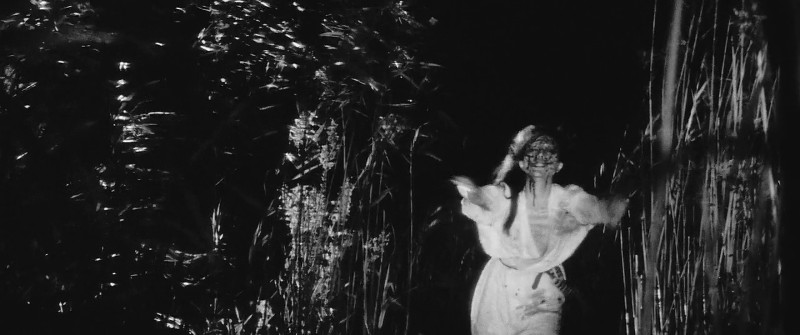
As the Battle of Minatogawa rages nearby, which triggered a long and bloody period of civil war and strife in 14th century feudal Japan that would last for over fifty years, two soldiers flee from the wholesale carnage but are pursued by several others on horseback. Now, whether these men are fleeing from the enemy or are deserters no one can say for sure as they try to lose themselves in a dense patch of grass. And as they struggle through the deepening marsh and overwhelmingly dense vegetation, as the wind whips the elongated chutes into a blinding frenzy, both men are suddenly run through by spears held by unseen hands, gored, and killed rather gruesomely.
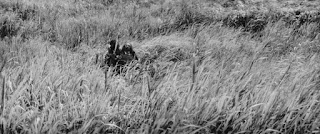


It is then revealed those spears were held by two women, who quickly strip the victims bare of their weapons, armaments, and clothing before unceremoniously dragging and dumping the bodies into a large and ominous pit secluded deep in the marsh. All of this is done with such a ruthless efficiency, it becomes quite obvious these two have pulled off this kind of ambush before. And not only have they done this before, but they’ve turned it into a cottage industry as these desperate and destitute women leave their ramshackle hut and take this latest batch of loot to a black market peddlar named Ushi (Tonoyama) and trades them for more rations of rice.


Seems times are tough in this province, what with the feuding factions having stripped the land bare of anything edible and shanghaiing all able-bodied men into service (-- and women, too, for other reasons), leaving no one to regrow the next batch of crops, leaving those left behind to eke out an existence by any means necessary or face death by starvation. And since it’s rare to have a dog wonder into camp and onto the menu, the old woman (Otowa) and the girl, her daughter-in-law (Yoshimura), decided to get proactive. In fairness, they haven’t chosen a side in this conflict and are equal opportunity killers and looters. And once the latest negotiations are complete, the lecherous Ushi offers up an extra ration if either woman will have sex with him. The older woman refuses. Bluntly.


When they return to the hut, the women are startled to find someone there, hiding out, waiting for them. Hachi (Satō) is another deserter, but he was also a neighbor and friend of Kichi, son and husband to these two scavengers, who got conscripted into the conflict at the same time, explaining why he wasn’t immediately set upon or wound up in the pit -- at least not yet, as Hachi brings bad news, revealing Kichi also tried to desert with him from the ongoing battle but was killed while trying to steal supplies from a group of farmers on the way home. Convinced the cowardly Hachi let her son die, the woman tosses him out and forbids the girl from ever interacting with him.


But things tend to get mighty lonely in the tall grass and, soon enough, Hachi is able to not-so-clandestinely seduce the girl and they go at it, hot and heavy, night after night. Soon realizing she is about to lose the girl to this interloper, and knowing full well she will never survive on her own without her partner, the woman, perhaps a little jealous, and definitely equally sexually frustrated, confronts Hachi, pleads with him to leave the girl alone, and offers herself up instead to satisfy his carnal needs only to be laughed off as an old hag he wouldn't touch with a ten foot pole. Thus, despite the fact Hachi was awful handy in killing two dueling samurai caught in the flooded paddy, whose superior weapons brought them more rice, the old woman concludes he needs to go in the hole with all the others.


But before she can set this in motion, while the other two are once more off fornicating, making her distracted and off her game, yet another samurai -- a general (Uno), clad in a hideous demon mask, stumbles upon the hut unmolested. Seems the general, who refuses to remove the mask, saying it protects his beautiful face, has gotten lost after the latest battle and wants the woman to guide him out of this infernal marsh. And after a brief philosophical debate on Japan’s patriarchal caste system, the woman agrees to these demands only to the lead the man into a trap, when he is herded toward the unseen pit and falls to his death.


Then, when the woman lowers herself into the hole, she finally manages to wrest the stubborn mask off, which reveals the man was hideously scarred underneath. And as she strips the rest of him and makes fun of his looks, the woman suddenly hits upon a blasphemous notion that will solve all of her problems and explains why the samurai’s robes and demon mask were noticeably absent when she sells the rest off to Ushi. And while this does solve one problem for the old woman, it curses her with yet another, more deadly one...

An erotically charged, strange, but deceptively simple little bugaboo of a movie, Kaneto Shindo’s Onibaba (1964) was based on an old Shin Buddhist parable, Yome-odoshi-no men (-- translated as bride-scaring mask), whose moral lesson of piety and divine consequences the director kinda acknowledged but then turned on its ear. In the story, a mother feels her daughter-in-law spends too much time going to temple and praying to Buddha, feeling her day would be better spent on her chores and tending to her husband’s needs. And so, to rectify this, the mother waits in ambush on the path to the temple, hiding in a patch of tall grass. And when the daughter-in-law approaches, she jumps out in front of her, wearing a hideous demon mask, shrieking and gesticulating, scaring the girl into an immediate u-turn.

But this stunt backfires when the wrathful Buddha puts a curse on her for this deception, which left the mask permanently welded to her face once it gets wet in a rainstorm. And only after she prays for mercy did the mask finally come off, but it took half of her face with it as a reminder that while Buddha can be merciful and forgiving, there will still be consequences to deal with for your blasphemy.

Shindo would later recount how his mother told him this story in his youth to reinforce the notion to always be honest and forthcoming and the dangers of hypocrisy and deception, and it apparently stuck. And while the central theme is still there and drives the third act, both Shindo and Onibaba had a lot more to say. Not since Isao Takahata’s Grave of the Fireflies (1993) have I seen a film hold this much contempt for those who wage war, which is then reflected in how the film wallows in the desperation, degradation, and poverty of those caught up in this no man’s land as they try to survive not day to day nor hour to hour but minute to minute.

From the opening scene of Onibaba -- which literally translates as “demon hag,” the cynical Shindo makes it perfectly clear he has no patience for the current corrupt social order of his native country, which led Japan to war two decades earlier, and strips bare the samurai’s bushido code by having his protagonists literally desecrate and strip every samurai carcass they come across. (This is all reinforced later in the scenes with the general both mortem and postmortem.) It is the stuff of nonsense, says Shindo, that only leads to loss and ruin for those caught in the wash, who suffer the real consequences of this kind of blind faith, leaving you with few choices: a terrible death by violence, or a horrible death by starvation.

But it’s not just food they’re all hungry for. There’s a very strong libidinous component to Onibaba as well. This is a lusty, sweaty, and primal movie. And if one looked at the evolutionary chart of such things, the film feels like a common genre ancestor for both the Pinky Violence and Roman Porno films that were about to come into vogue in the late 1960s.
Unlike everyone else in this movie, the old woman is sexually frustrated. She’s extremely jealous when Hachi rejects her. And there’s even a few less than subtle hints of sapphic desire for her daughter-in-law, making things even more twisted as she waits in ambush as the girl once more sneaks out of the hut for another moonlight rendezvous with Hachi.


With Operation: Scare the Piss Out of Little Miss Horny Pants a complete success, the following morning, the old woman presses things even further, convincing the naive girl the demon was most assuredly real and divine punishment for her infidelity. And it will be back if she tries it again, she warns. These scare tactics work for a little while, but lust is a harsh mistress never satisfied. And so, as a thunderstorm rages, the old woman dresses up again and sets another ambush, which totally backfires this time. Seems Hachi was tired of waiting for the girl, sets out to find her, only to have the "demon" chase her right into his arms. And as he quiets her down and they go at it, the old woman, realizing she has failed and lost the girl for good this time, watches on dejectedly.


Once the deed is done, Hachi returns to his hut, where he catches another deserter stealing his food and is promptly killed by his startled guest. Meantime, the old woman has discovered she can no longer remove the soggy demon mask. When the younger girl returns, and is rightfully frightened by the sight of the demon in their hut, the old woman reveals it was her all along, begs forgiveness, and promises to no longer interfere in her love-life with Hachi if she will help get the infernal mask off. A mighty struggle ensues and, in the end, the girl winds up having to break the mask off with a hammer. Once gleefully removed, it’s revealed the mask took most of the woman’s skin with it.


Taking one look at this hideous visage convinces the girl this really was a demon all along; she screams, and then flees into the night. The old woman chases after her, swearing she is not a demon. This erratic chase leads them to the pit, which the girl jumps over. Right behind her, the older woman also makes the leap as the film abruptly ends, leaving it up to the audience on whether she made it across or not. Me? I’m leaning toward not, but it all kinda depends on your own metered severity of the ‘hell of your own making’ in what you just watched.


To fulfill his vision, Shindo wanted to make the entire film in a dense field of susuki grass; an invasive perennial that ranges from three to seven feet tall. And after a lot of searching, he finally found what he was looking for along a riverbank in Chiba near Inba-Numa, where they put up prefabricated buildings to house the minimal cast and crew for the scheduled three month shoot. The crew got a little mutinous as things dragged on due to the incessant rains and flooding that plagued the shoot, which bred hordes of insects and stirred up the local crayfish population; but stuck it out when told they wouldn’t get paid at all unless the contractual obligation was met.

Despite these hardships, Shindo, his cast, and his cinematographer, Kiyomi Kuroda, really captured some magic here. A film with more visual texture than Onibaba I’m hard pressed to name. Poetic even, when you add in the haunting vocals of Hayahi Hikaru’s intense, percussion heavy score. And I think the film works better if you take it at face value with the visuals, which -- from the opening sequence to the finale, where the old woman's scarred face brings to mind the radiation burns of Hiroshima and Nagasaki, are stunning, since the plot is kinda leaking water; and the less you try to ponder on the schism of an old folktale on right and wrong and a twisted carnal yarn of gaslighting and survival the better in the long run.

Onibaba (1964) Kindai Eiga Kyokai :: Tokyo Eiga Co Ltd. :: Toho :: P: Hisao Itoya, Kazuo Kuwahara, Tamotsu Minato, Setsuo Noto / D: Kaneto Shindô / W: Kaneto Shindô / C: Kiyomi Kuroda / E: Toshio Enoki / M: Hikaru Hayashi / S: Nobuko Otowa, Jitsuko Yoshimura, Kei Satô, Jûkichi Uno, Taiji Tonoyama
We open in the thick of it as a bloody revolt erupts in and around the castle of Lord Ogata (Hayashi); the benevolent ruler of the feudal Japanese kingdom of Oumi. Well, at least he was until his top general, Yuki-daijo (Amatsu), reveals himself to be a traitor and the instigator of this violent uprising. who then puts a sword through his former master, killing him. And as Ogata's wife tries to escape, she is also killed by Orochimaru (Otomo); the ruthless leader of a band of mercenary ninjas, whom the corrupt Yuki-daijo hired as muscle to back this hostile takeover. Apparently a success, Orochimaru reports all other loyalists to Ogata have been liquidated, leaving only one loose end to wrap-up and snuff-out before Yuki-daijo officially takes over: Ogata’s young son and rightful heir, Ikazuki.


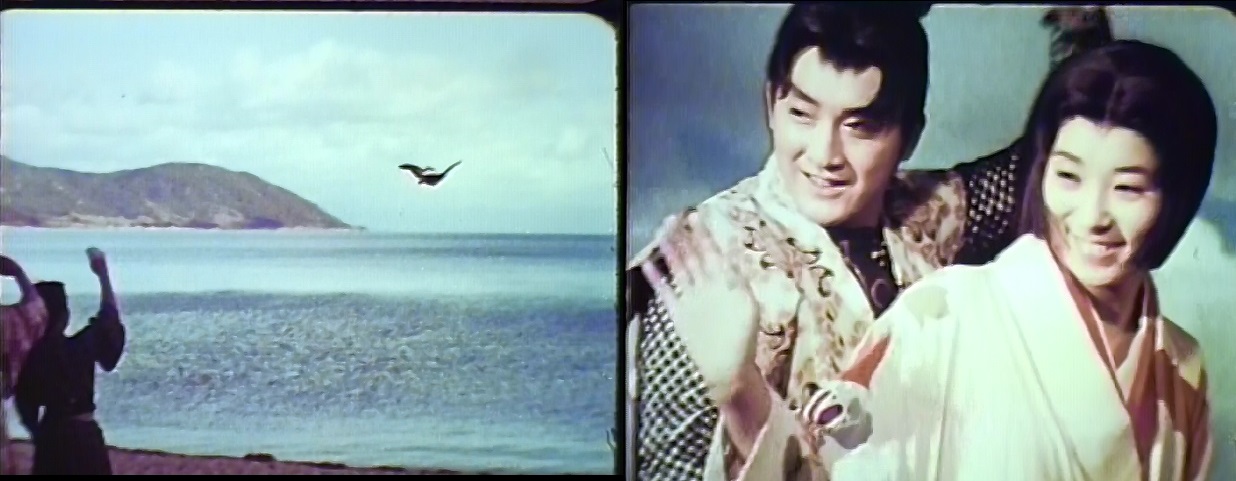
Luckily, a few of Ogata’s men managed to escape the slaughter and the castle with the toddler prince in tow. But while they try to flee in a small boat, Orochimaru proves to also be a master of magic as he transmogrifies himself into a nifty, kaiju-sized dragon, which promptly swamps the boat and shreds all of the men trying to protect Ikazuki. And those it doesn’t eat, the dragon drowns. And just as he’s about to turn the boy into a tasty morsel, salvation comes from the heavens when a large eagle swoops in and maims the dragon, taking out an eye, complete with some righteous arterial spray. And before the dragon can recover, the bird swings around and snags the child and flies him away to safety, leaving an enraged Orochimaru behind. *whew*


But this is only the beginning of our tale, as we jump ahead several years and find a now much older Ikazuki (Matsukata) training hard in the art of ninjutsu and magics under the tutelage of a wizened old hermit named Dojin-Kiki (Kaneko), who had sent the eagle to save him. And after successfully completing the latest battery of hazardous tests and surviving the obstacle course from hell, Ikazuki is informed his training is now complete and it’s time to return to the outside world and embrace his destiny to do good for all of mankind, unlike Dojin-Kiki’s last pupil.


But the revelation of who that was and what his destiny will be will have to wait until after dinner. Sent out to find some suitable veggies for the pot, Ikazuki is attacked by a pack of wily, preternatural ninjas. And while it appears this fight doesn’t go well for our hero, what with him getting decapitated and all, turns out losing his head put his opponents right where Ikazuki wanted them. (No, I am not making this up.) Soon vanquished, the last remaining ninja suicides-out before revealing who sent them.


Once he gets his head back on, Ikazuki also flushes out Sonate (Ogawa), thinking the young maiden is another attacker (-- well, at least he did until accidentally cupping a feel and realizing she's a girl after tackling her and going for a downhill roll in the weeds). Turns out she was just lost in the woods, searching for her equally long lost father since her mother recently died. Thinking his master may be able to help find him, since she claims her father came to this area to study with a wizard, a smitten Ikazuki convinces the girl to come with him. Meanwhile, Orochimaru drops in on Dojin-Kiki. (Obviously those ninja assassins were his, out and about trying to find and kill the missing prince.) Turns out there’s a long and sordid history between these two. And, yep, Orochimaru was the former (and now disgraced) pupil of the old wizard, who stole several magic scrolls, including the one with the instructions on how to morph into a dragon. Seems Orochimaru finally realized it must have been his old master who saved Ikazuki; the delay was due to his thinking the old wizard was long dead, since the villain thought he had killed him while stealing those scrolls.


A fight soon erupts, but through magical treachery most foul, Dojin-Kiki is poisoned by a deadly snake -- an illusion he mistakes for the recovered dragon scroll. However, the tough old bird manages to stay alive long enough to reveal Ikazuki’s true heritage and beseeches our hero to take back the throne of his father and kill both Yuki-daijo and Orochimaru. He also recognizes Sonate, but expires before he can reveal the identity of her father, which, believe you me, is a rather an important cog in the tale to come -- and, it is someone we’ve already met...


You know, it’s not very often in a film where your hero gets his own head lopped off but still manages to win the fight against a horde of killer ninjas anyway. Ladies and Gentlemen, Boils and Ghouls, welcome to the pure bonkers-bedlam of Tetsuya Yamauchi’s The Magic Serpent (1966). Gleaned from Japanese folklore, the film was based on the legend of Jiraiya (-- later changed to Ikazuchi-Maru), a master ninja who controls “giant toad magic," where he rides around on some over-sized amphibians, fighting evil, and can even turn into a kaiju-croaker whenever the situation calls for it. And in his serialized adventures he falls in love with Sonate, a beautiful maiden, who is a master of “slug magic," and has a running fight with his dreaded arch-enemy, Orochimaru, a former pupil who controls “giant serpent magic." The first recordings of these stories can be dated back to 1806. From there it was expanded to 43 installments between 1839 and 1868, with the first ten chapters adapted by Mokuami Kawatake into stage production, Jiraiya Gōketsu Monogatari [“The Tale of the Gallant Jiraiya”] around 1852.

And it was Kawatake’s version producer Shigeru Okada and Toei Studios adapted into Kairyū Daikessen [“The Mystic Dragons’ Decisive Battle”] nearly a century later. Founded in 1938, Toei most notably dealt with product for television aimed at children; and whether it be animated (Mazinger Z, Voltron, Dragon Ball Z and Sailor Moon) or live action (Johnny Sokko and His Flying Robot, Kamen Rider, the completely demented Supaidāman, and then there’s the Power Rangers and their assorted knock-offs, Big Bad Beetleborgs and Masked Rider), one cannot underestimate the cultural impact their product had on both sides of the Pacific. Hell, globally. Essentially, if it had a kid and a giant robot, or a bunch of kids forming a giant robot, beating the snot out of a horde of goofy-assed monsters, it probably had Toei’s fingerprints on it.

Thus, Toei wasn’t averse to making tokusatsu [“special filming”], a catch-all Japanese term for anything featuring live-action and the considerable use of special effects -- even on the big screen. It began when they cobbled together several episodes of their Planet Prince series into a feature, which was then exported to the States as Prince of Space in 1962. This was followed up by Invasion of the Neptune Men (1961), and another Sonny Chiba vehicle directed by Kinji Fukasaku, The Terror Beneath the Sea (1966), a wild mash-up of spy-shenanigans and mad science. Fukasaku would also helm The Green Slime (1968), which Toei co-produced with MGM, that I really need to get around to reviewing one of these days because it is that awesome and then some; and let us not forget Toei’s Star Wars cash-in, Message From Space (1978), which, sticking with the theme, is totally nucking futz that I go into much more detail here for those who want to get their hands on their very own magical space walnut.

Anyways, circling back to The Magic Serpent, it, too, was imported to the States by American International Pictures but it didn’t get a theatrical release. Instead, it was packaged-off as part of AIP’s syndicated TV line-up with other Japanese imports like Toho’s Dogora (1964), The X From Outer Space (1967), Yongary (1967) and Daiei’s Daimajin trilogy and nearly all of their Gamera films. Here, the film was given a new and extremely nonsensical title, was extensively re-cut, re-scored, and dubbed over by the always commendable Titan Studios, who also dubbed Speed Racer and Ultraman among many other imports ranging from Gamera to Gamma-3. Even the monsters were dubbed, with the familiar roars of Godzilla (the dragon), Rodan (the toad), and Mothra (the eagle) all subbing in for an assortment of creatures. But even with all that tinkering, nothing can or ever will quash the pure and unadulterated fun The Magic Serpent brings from start to finish.

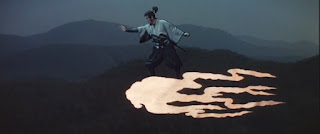

Even as it settles into a melodramatic groove, chock full of budding romance, double-crosses, damsels in distress, and a staggering amount of mayhem, death and destruction, The Magic Serpent has a certain indelible charm, and it is wonderful to behold and a pleasure to endure as the insanity slowly escalates from scene to scene and showdown to showdown as Yuki-daijo and Orochimaru switch tactics, no longer hunting for Ikazuki, but will wait for the young hero to come to them on his quest for vengeance. Seems Orochimaru has a (somewhat convoluted) plan involving Zenbei (Hara) and his seven specially trained super-assassins to take out Ikazuki so he can pretend to be Ikazuki so he can take over the kingdom. (Why he doesn’t just kill his boss and takeover and be done with it? Well, ya got me there.)


Meanwhile, Yuki-daijo leads a contingent of troops to the local market where Ikazuki has been spotted helping a crusty old farmer and his two children. A wild brawl erupts, where Ikazuki uses his magic to summon the ghost of his father to put the fear into his enemies, then flies around, shoots lasers, rides lighting, causes several detonations, and then uses and eldritch lasso to trounce the bad guys. But before he can take out Yuki-daijo, Orochimaru arrives and evens the field. And when the dust settles, the farmer is dead, his daughter is captured, destined to be added to the brothel back at the castle, and Ikazuki barely escapes with the son.
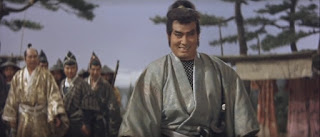


Meanwhile, meanwhile, Sonate, who parted ways with Ikazuki to continue her own quest, has an unfortunate run-in with Zenbei’s goon squad, who think she’s discovered their secret plans. And it is only through the timely arrival of Zenbei himself that prevents her from being killed. Sending the others on to kill Ikazuki, Zenbei sticks with Sonate, hoping to help find her missing dad, because she reminds him of his long lost love, killed as a reluctant spy in a far away land at the insistent behest of her belligerent father. They soon run into Ikazuki and the boy, who isn’t doing so hot after their latest run in with Zenbei’s assassins (-- now numbering about three --) while trying to ford a river. Zenbei is shocked to find out Ikazuki is the boy Sonate’s been mooning over the whole time they’ve been together. He’s also sniffed out who her father is, kidnaps her, leaving our hero to deal with a bunch of killer door panels (-- again, not making that up), and takes her to Orochimaru, who, turns out, as a surprise to probably no one by now, is her father.


Seeing this as a golden opportunity, Orochimaru tries to turn Sonate to the Dark Side, commanding his traumatized daughter to go back to Ikazuki and poison him. After a substantial browbeating, she reluctantly agrees to honor his wishes but cannot go through with it in the end -- almost, but not quite. Also of note, having seen this tragic scenario played out before with his own lost lover, Zenbei also has a change of heart and takes out “Plan B," his last assassin, currently hiding outside the window of their current refuge. Together, then, they hatch a plan that requires Zenbei to lure Orochimaru to their hideout and away from the castle so Ikazuki can take out Yuki-daijo without his interfering. And do this they all do, quite spectacularly, as our hero interrupts the evil lord’s latest round of drunken debauchery by siccing a giant, fire-breathing horny toad on him (-- right before he *ahem* “deflowers the farmer’s daughter), which destroys most of the citadel as it chases all of Yuki-daijo’s men into the sea. But for the man himself, the honor of his death belongs to Ikazuki, who avenges his father most righteously.


But suddenly! Orochimaru appears, flying in on a fireball, thanking our hero for clearing the way for him to claim the throne. Seems Zenbei’s last assassin wasn’t as dead as he thought, who spilled the beans about his master and Sonate’s betrayal, which gets Zenbei run through with a sword and Sonate left bound to a post to be dealt with later. Anyhoo, this all leads us to the climax, which means it is time for a KAIJU BIG BATTLE! Summoning his dragon once more, Orochimaru’s magical totem engages in combat with Ikazuki’s giant toad, exchanging blasts of fire and water, before slamming together for an outright slobber-knocker, laying waste to what is left of the castle and grounds. Again, it appears the more seasoned Orochimaru has the upper hand, whose dragon soon has Ikazuki’s toad on the ropes. Fortunately, Sonate, rescued by the farmer’s son, feels it is time to employ the spider talisman her grandmother gave her way back at the beginning of the movie.


Thus, the battle is joined by a giant spider, who goes all larval Mothra and quickly turns the tide against the dragon, which evaporates -- well, detonates, in defeat. This sets up a final, more traditional, samurai showdown between Ikazuki and Orochimaru. Here, is the film’s weakest moment as the running sword fight along the water’s edge is kinda awkwardly staged and ends with Orochimaru having some kind of seizure before collapsing into the sea, where he … transforms into a giant disco ball and explodes? Maybe? Maybe it was his dad? Or the spirits of the men he killed on the boat? Whatever, the bad guy’s dead and Ikazuki didn’t have to kill him, much to the relief of Sonate. Hooray! Then, summoning that giant eagle, Ikazuki and Sonate jump on and fly away, leaving the kingdom and the land to the people, destined to return to the forest where they will live happily ever after together.


I think it is the completely demented fairy tale vibe that has always enamored me to The Magic Serpent. Information and background on the film is fairly scarce and sketchy so I can’t really tell you who was responsible for the stunts, F/X, production design, or who was in charge of the giant monster action. The toad was a man in suit, who belched real fire like Gamera. The dragon was an impressive combination of a monster suit and a glorified marionette. Sure, they kind of pale when stacked up against the work of Tsuburaya, and you can barely NOT see the wires used to animate them, but, again, it is this kind of low-tech effort that I find the most endearing about the whole movie. Also, one should note, this might be a conscious choice to look that way, especially when you take into account they bothered to have an air-bladder in the giant toad so his throat pouch would work.

A lot of the F/X were done in camera, with double-exposures and the use of matting in most instances, with still images of our characters flying around on painted in fireballs. Again, I’m sure this was all done with cost-savings in mind, but it resulted in a crazy, live-action manga aesthetic that really draws you in. And most importantly of all, this approach also requires a leap of imagination and a willingness to engage from the audience, to believe in what you are seeing, suspension of disbelief be damned, with any and all cynicism curb-stomped for about 90 odd-minutes, instead of the sensory overload we get today in sci-fi and fantasy films, which is why I picked The Magic Serpent for this particular “For the Kids” roundtable for the Celluloid Zeroes as the perfect entry point for any young and burgeoning genre fans as an introduction to the gonzo world of Japanese tokusatsu.
Now, I’m kinda ashamed to admit when I bought Retromedia’s double-feature DVD of Return of the Giant Monsters (Gamera vs. Gaos) and The Magic Serpent many moons ago I got it for the Gamera movie and the Gamera movie alone as it wasn’t until many moons later that, on a whim, I gave the second feature a spin because I was too lazy to swap out the DVD. Well, shame on me, and apologies to myself for taking so damned long. And while I do appreciate the DVD the feature was obviously the AIP-TV print, which still looks pretty good considering how old it is, and it is better than nothing, but it is also cropped in a defensive driving course of pan and scan.

There is a dodgy, dubbed widescreen print streaming on YouTube at last check; again, better than nothing, but there are also several widescreen clips floating around both dubbed and subtitled that look ah-mazing that I have thus far been unable to pinpoint a source on and it is driving me bananas. (All the widescreen vidcaps for this review were taken from those clips and the Japanese trailer.) This is a movie screaming to be seen in its original aspect ratio so we may absorb the full impact of all it’s nutty magic. Arrow Video? Vinegar Syndrome? Shout Factory? Someone get on that as soon as possible, please and thank you. Until then, no matter what your age, really, I encourage all of you track down The Magic Serpent as soon as possible if you haven’t seen it yet and rectify yourselves!

This review was just one entry in the Collective Head 'o' Knuckle, known in your dimension as The Celluloid Zeroes, latest roundtable efforts. Please follow the linkage to my similarly addicted B-Movie Brethen, won't you? Thank you! Checkpoint: Telstar :: Time Bandits // Web of the Big Damned Spider :: 5000 Fingers of Dr. T // Cinemasochist Apocalypse :: TBD // Psychoplasmics :: The Gate // The Terrible Claw Reviews :: Gamera vs. Viras // Seeker of Schlock :: Spider-Man.
The Magic Serpent (1966) Toei Company :: American-International Television (AIP-TV) / P: Shigeru Okada / D: Tetsuya Yamanouchi / W: Masaru Igami, Mokuami Kawatake (play) / C: Motoya Washio / M: Toshiaki Tsushima / S: Hiroki Matsukata, Tomoko Ogawa, Ryûtarô Ôtomo, Bin Amatsu, Nobuo Kaneko, Kensaku Hara