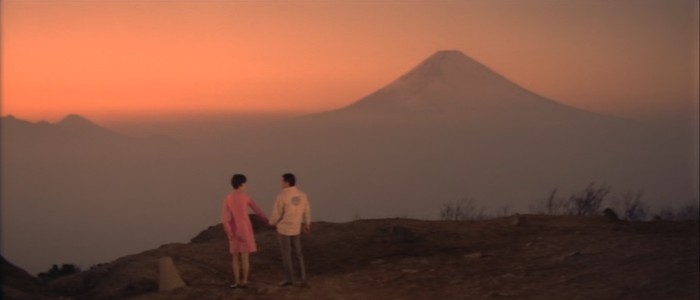
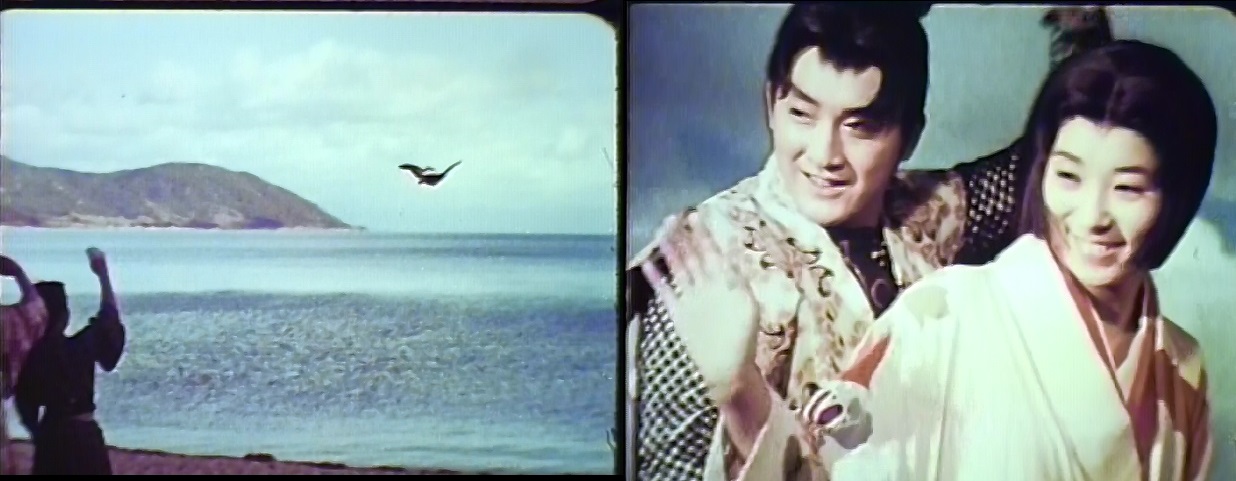
With the arrival of some fissionable material, the latest rocket from the Fuji Astro-Flight Center (FAFC) is all fueled up and will now achieve its flight window to Mars. However, as Dr. Kato (Okada) and Dr. Berman (Bruber) reminds the latest crew of astronauts, each of the past six attempts to land on the Red Planet have ended in dubious disaster as every expedition first reported encountering some kind of UFO before all communications ceased, meaning they were most probably destroyed by the alien craft and all lives lost to the cold blackness of space. And though they mention no new safety precautions to hopefully prevent this from happening a seventh time, the crew -- Commander Sano (Wazaki), Medical Officer Dr. Kiowata (Sonoi), Communications Officer (and comedy relief) Miyamoto (Yanangisawa), and Chief Xenobiologist Dr. Lisa Somethingorother (Neal), all put on a brave face, focusing on the mission at hand and the assumption this won’t be another one way trip.


With that, the AAB-Gamma successfully launches, but once clear of Earth’s gravity there is a sudden spike in radiation, which they trace to the equally sudden appearance of the dastardly UFO -- that by all rights doesn’t look mechanical in origin at all, but more of a sentient and hostile Hostess Fruit Pie. Anyhoo, this spike in radiation also explains the abrupt lack of communications with the other lost flights as the discharge knocks out the AAB’s radio. With that, Commander Sano turns tail and floors it before they meet the same fate as the others, limping back to the FAFC’s moon-base for repairs.


Here, our movie makes one of many abrupt left turns as the apparent urgency of the situation is put on hold. (Hell, they don’t even bother to file a report!) Seems the AAB crew made it back in time for Happy Hour, and so, decked out in their hippest attire, they knock a few back at the base’s martini lounge, where we also run smack into a romantic triangle subplot between Sano, Lisa, and Michiko (Harada), one of the moon-base’s operatives. And if I’m reading my signals right, Lisa is openly pining for Sano, Sano is really secretly pining for Machiko, and Machiko is extremely jealous of Lisa’s proximity to Sano, and therefore, won’t give Sano the time of day. Or Lisa might have the hots for Michiko, too, as far as I can tell. *shrugs* Got all that? Good. Now, moving on...


Once the AAB is repaired, a Dr. Stein (Daneen) is promoted to flight duty (under protest) to replace Kiowata, who came down with a bad case of “space sickness” after being exposed to that mystery radiation. And so, he is buttoned up with the rest of the crew, who launch without incident -- unless you count Stein’s bitching about EVERYTHING all, the, way, to, Mars. But like with everything else, this is also cut short by another attack from the UFO, who, despite Sano’s best efforts at evasive maneuvers, manages to breach their hull this time with some enticed meteorites. And during the explosive decompression, a panicked Stein pushes Sano out of the way and ignites the boosters. And while this successfully allows them to escape the UFO before it can deliver a death blow, Stein’s actions burns up all their fuel, leaving them powerless and drifting toward deep space.


Stuck and thus, while Miyamoto tries to get the radio working again before the batteries die, too, Sano and Lisa go for a space walk to investigate something strange glommed onto the outside fuselage -- in the exact same spot the UFO bounced off of them, one should note, when they made their desperate escape. (I won’t tell them it looks like a splotch of semen if you all won’t.) Anyhoo, Lisa declares it to be some kind of alien spore and they take one of the glowing spheroids nestled in it for later analysis. And once back inside, with the lingering traces of the UFO either scraped off or sealed inside a shielded container, the radio crackles back to life and the FAFC is ecstatic to find them alive and sends a rescue mission, in which Machiko delivers another fuel cell and the AAB triumphantly returns to Earth without ever getting within sniffing distance of Mars. Hooray!


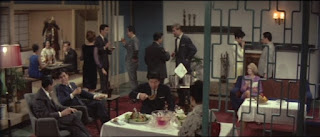
And after a cursory examination of the spore, sticking with proper protocols, apparently, Dr. Kato gives everyone the night off so they can come to his house for a celebratory booze-can. But the party is interrupted mid-cocktail with word from the lab saying there’s been an accident, the specimen has been destroyed, and it looks like something smashed through the floor. Well, upon further review it looks like something melted through the floor. And closer examination of the remnants of the spoor sure resembles broken egg shells to me. They also find what appears to be the footprint of a giant chicken seared into the floor.


And as the base suffers an inexplicable power failure, are you all thinking what I’m thinking and that something monstrous hatched out of that egg, is feeding off the base’s energy grid, and escaped. If so, you guessed better than our group of heroes, who can only shrug and then head off in search of more booze (-- and I am so not making that up); but when they arrive in town, the nearby valley erupts with a cacophony of fiery explosions, announcing the arrival of the world’s most adorable kaiju-eiga of ever, who’s hopped up on electricity and ready to go on a rampage...

Since it’s founding in 1920, making it one of the oldest film production companies in Japan, Shochiku Studios had always been innovative. It was the first to abandon the use of female impersonators and hired actresses, as well as adapting many Hollywood principals to filmmaking, including the use of sound stages, resulting in the release of Japan’s very first “talkie.” After World War II most of the studio’s product centered around melodrama aimed primarily at female audiences, with the likes of Hiroshi Shimizu's Children of the Beehive (1948), Yasujirō Ozu’s truly wonderful Tokyo Story (1953), and Hideo Oba’s What’s Your Name (1953).

But by the 1960s, Shochiku’s films started to be criticized as being too old fashioned, and so, they adapted and helped usher in the Japanese New Wave to compete with rival Nikkatsu Studio’s Taiyo-zoku youth-orientated movies, with Nagisa Oshima’s Cruel Story of Youth (1960) and Night and Fog in Japan (1960). But as the decade wore on and Japanese cinemas were destroyed by television, and studios like Shintoho and Daiei went bankrupt, while Nikkatsu and Toei turned to gangster movies, Pinky Violence and Roman Porno, Shochiku changed course again and focused on family-oriented features, which meant it was time to finally take the plunge and make their own giant monster movie.

It only takes about ten minutes into The X from Outer Space (1967/1968) to realize first time director Kazui Nihonmatsu was in over his head. From all appearances, Shochiku threw quite a bit of money at this picture as the production design is actually kind of nifty as the Fisher Price spaceships zip around and the crew occupies extensive control rooms, command decks, or lounges around in some super-swanky party pad. And then that monster shows up, and the feature gets really ridiculous and at ludicrous speed. And this is where Nihonmatsu’s inexperience really shows, making one truly appreciate the skills of Tsuburaya and company over at Toho.


Yes, the monster, Guilala, looks patently asinine, whose origins appear to be a prop rubber chicken with bulging thighs, wobbly antenna, and the inexplicable aero-dynamic noggin; but the real problem lies not in his appearance but in his execution as the director fails to shoot him at a higher speed so it will play back looking slow and ponderous as it accumulates all that extensive property damage. Nihonmatsu also stubbornly refused to hardly ever shoot the monster from any other angle except straight on, giving Guilala no real sense of scale. The miniatures the giant alien gets to demolish, courtesy of Hiroshi Ikeda, are quite effective but, again, due to a lack of technique the tanks, the knock-off masers (-- which prove equally ineffective), and the jets it fights will never be mistaken for anything other than the toys and models they really were. (Some stock military footage might’ve helped here.)


The whole middle-third of the movie is dedicated to Guilala’s reign of terror as he trashes a good chunk of Japan, drawing a bead on Tokyo, as kaiju are often wont to do, belching up gobs of devastating plasma as he goes, absorbing all the energy of any power source encountered. It’s pure bedlam, and entertaining enough on a visceral, rubber-suited mayhem level, but there is no real weight to it, just chaos on top of havoc as the military is unable to halt the rampage, leaving it up to those who brought the infernal thing here to find a way to stop it.


Luckily, Lisa is able to pull a solution completely out of her ass -- well, not quite, but close, as she examines the discarded shell fragments and deduces the material, dubbed Guilalanium, can contain the monster by blocking its ability to absorb energy and, from there, she concludes it will revert back to its original form. But to synthesize more of it, she’ll need the vacuum of space; and so, the AAB-Gamma crew load up and head back to the moon, where, for once, their mission is a complete success.


However, on the way back to Earth, their ship is attacked by that damnable UFO again, whose origin and true motivation is never really explained aside from the assumption that it laid its eggs on the ship. (Is this the Martian way to say, “Stay the hell off my planet, Earth Scum?”) To make matters worse, the synthesized an improperly stored Guilalanium does its job too well, disrupting the AAB’s instruments, leaving it powerless once more to orbit the Earth indefinitely unless someone can come up with an idea. This time it’s Machiko who gets the bright idea of moving the unstable material into the reactor room, whose radiation shielding should suffice -- if it doesn’t destroy the atomic pile first, ‘natch.


But this strategy proves sound and the AAB makes it back to the FAFC ASAP, where the Guilalaniumumimunumum is loaded into the warheads of multiple missiles, which are then loaded onto several fighter jets. And this all happens just in the nick of time, too, as Guilalalalala, drawn to its multiple atomic power sources, is making a beeline for the FAFC, which appears to be S.O.L. And as it lays waste to most of the base, Sano and Miyamoto are able to use some of the leftover Guilalaniumumimunumumnumnum to lure the monster far enough away to save their friends and give the planes enough time to arm up and go on the attack, pasting Guilala with salvo after salvo, coating him with what appears to be a thick layer of shaving cream.
Soon reduced to one large shambling mass of goo, the monster quickly shrinks back down to its original spore-size. A spore that is quickly put into a rocket and sent back to where it came from, leaving Sano with only one more problem to solve: Lisa or Machiko? You know, Sano, as the old bull once said to the young bull...
Back in 1967 Hollywood was also feeling the pinch of television, even way down the ladder at American International Pictures, who briefly followed the old axiom: if you can’t beat them join them, opening a new subsidiary, American International Television. Originally, there was talk of turning the Beach Party and Dr. Goldfoot franchises into TV series but nothing really came of that, and the only original programming produced for this new division was a half-dozen WTF-MFTV feature remakes helmed by Larry Buchanan down in Texas: Attack of the Eye Creatures (1965), Zontar the Thing from Venus (1966), In the Year 2889 (1967) etc.

And so, most of AIP-TV’s contribution came from repackaging foreign imports for television: Mexican fairy tales, Italian sword and sandal epics, and sci-fi and monster movies and TV series from Japan, including Johnny Sokko and His Flying Robot (1967–1968), Godzilla vs. Monster Zero (1965), Son of Godzilla (1967) and, you guessed it, The X From Outer Space, which never had a theatrical release in the States and debuted on the small screen, dubbed over by the familiar voices of Titra Studios.
I’ve never seen the original Uchû daikaijû Girara version of this film, so I don’t know how much was changed in tone or content for the AIP-TV cut, so maybe some of the messier elements aren’t all on Nihonmatsu -- or maybe not, like, say, the wonky soundtrack because, unless Taku Izumi was a huge fan of Herb Alpert and the Tijuana Brass, I’m thinking the two main themes for this flick were patched on later by someone trying real hard to be Les Baxter.


Also, there’s a moment in The X From Outer Space right after Guilala first appears, where we cut to a conference room where Dr. Kato is informed Tokyo has been lost -- and lost completely off-screen; and for one brief, scary moment the audience fears we’re gonna get screwed out of seeing what brought us all here in the first freaking place. These fears prove unfounded, as Guilala’s rampage, though incompetently directed, is one for the ages, but with Nihonmatsu’s penchant for shifting focus away from the action and zeroing in on the search for booze or the trite love-triangle instead, can you blame us all for worrying? I mean, just look at the monster? How can that NOT be the focus of your movie?!

What is Hubrisween? This is Hubrisween. And now, Boils and Ghouls, be sure to follow this linkage to keep track of the whole conglomeration of reviews for Hubrisween right here. Or you can always follow we collective head of knuckle on Letterboxd. What's this? 24 reviews down? With only two TWO! left to go?! How can this be? *gasp*
The X From Outer Space (1968) Shôchiku Eiga :: American-International Television (AIP-TV) / P: Wataru Nakajima / D: Kazui Nihonmatsu / W: Moriyoshi Ishida, Eibi Motomochi, Kazui Nihonmatsu / C: Shizuo Hirase, Chitora Ôkoshi / E: Yoshi Sugihara / M: Taku Izumi / S: Eiji Okada, Peggy Neal, Toshinari Kazusaki, Itoko Harada, Franz Gruber, Mike Daneen, Shin'ichi Yanagisawa, Keisuke Sonoi,
We open in the thick of it as a bloody revolt erupts in and around the castle of Lord Ogata (Hayashi); the benevolent ruler of the feudal Japanese kingdom of Oumi. Well, at least he was until his top general, Yuki-daijo (Amatsu), reveals himself to be a traitor and the instigator of this violent uprising. who then puts a sword through his former master, killing him. And as Ogata's wife tries to escape, she is also killed by Orochimaru (Otomo); the ruthless leader of a band of mercenary ninjas, whom the corrupt Yuki-daijo hired as muscle to back this hostile takeover. Apparently a success, Orochimaru reports all other loyalists to Ogata have been liquidated, leaving only one loose end to wrap-up and snuff-out before Yuki-daijo officially takes over: Ogata’s young son and rightful heir, Ikazuki.


Luckily, a few of Ogata’s men managed to escape the slaughter and the castle with the toddler prince in tow. But while they try to flee in a small boat, Orochimaru proves to also be a master of magic as he transmogrifies himself into a nifty, kaiju-sized dragon, which promptly swamps the boat and shreds all of the men trying to protect Ikazuki. And those it doesn’t eat, the dragon drowns. And just as he’s about to turn the boy into a tasty morsel, salvation comes from the heavens when a large eagle swoops in and maims the dragon, taking out an eye, complete with some righteous arterial spray. And before the dragon can recover, the bird swings around and snags the child and flies him away to safety, leaving an enraged Orochimaru behind. *whew*


But this is only the beginning of our tale, as we jump ahead several years and find a now much older Ikazuki (Matsukata) training hard in the art of ninjutsu and magics under the tutelage of a wizened old hermit named Dojin-Kiki (Kaneko), who had sent the eagle to save him. And after successfully completing the latest battery of hazardous tests and surviving the obstacle course from hell, Ikazuki is informed his training is now complete and it’s time to return to the outside world and embrace his destiny to do good for all of mankind, unlike Dojin-Kiki’s last pupil.


But the revelation of who that was and what his destiny will be will have to wait until after dinner. Sent out to find some suitable veggies for the pot, Ikazuki is attacked by a pack of wily, preternatural ninjas. And while it appears this fight doesn’t go well for our hero, what with him getting decapitated and all, turns out losing his head put his opponents right where Ikazuki wanted them. (No, I am not making this up.) Soon vanquished, the last remaining ninja suicides-out before revealing who sent them.


Once he gets his head back on, Ikazuki also flushes out Sonate (Ogawa), thinking the young maiden is another attacker (-- well, at least he did until accidentally cupping a feel and realizing she's a girl after tackling her and going for a downhill roll in the weeds). Turns out she was just lost in the woods, searching for her equally long lost father since her mother recently died. Thinking his master may be able to help find him, since she claims her father came to this area to study with a wizard, a smitten Ikazuki convinces the girl to come with him. Meanwhile, Orochimaru drops in on Dojin-Kiki. (Obviously those ninja assassins were his, out and about trying to find and kill the missing prince.) Turns out there’s a long and sordid history between these two. And, yep, Orochimaru was the former (and now disgraced) pupil of the old wizard, who stole several magic scrolls, including the one with the instructions on how to morph into a dragon. Seems Orochimaru finally realized it must have been his old master who saved Ikazuki; the delay was due to his thinking the old wizard was long dead, since the villain thought he had killed him while stealing those scrolls.


A fight soon erupts, but through magical treachery most foul, Dojin-Kiki is poisoned by a deadly snake -- an illusion he mistakes for the recovered dragon scroll. However, the tough old bird manages to stay alive long enough to reveal Ikazuki’s true heritage and beseeches our hero to take back the throne of his father and kill both Yuki-daijo and Orochimaru. He also recognizes Sonate, but expires before he can reveal the identity of her father, which, believe you me, is a rather an important cog in the tale to come -- and, it is someone we’ve already met...


You know, it’s not very often in a film where your hero gets his own head lopped off but still manages to win the fight against a horde of killer ninjas anyway. Ladies and Gentlemen, Boils and Ghouls, welcome to the pure bonkers-bedlam of Tetsuya Yamauchi’s The Magic Serpent (1966). Gleaned from Japanese folklore, the film was based on the legend of Jiraiya (-- later changed to Ikazuchi-Maru), a master ninja who controls “giant toad magic," where he rides around on some over-sized amphibians, fighting evil, and can even turn into a kaiju-croaker whenever the situation calls for it. And in his serialized adventures he falls in love with Sonate, a beautiful maiden, who is a master of “slug magic," and has a running fight with his dreaded arch-enemy, Orochimaru, a former pupil who controls “giant serpent magic." The first recordings of these stories can be dated back to 1806. From there it was expanded to 43 installments between 1839 and 1868, with the first ten chapters adapted by Mokuami Kawatake into stage production, Jiraiya Gōketsu Monogatari [“The Tale of the Gallant Jiraiya”] around 1852.

And it was Kawatake’s version producer Shigeru Okada and Toei Studios adapted into Kairyū Daikessen [“The Mystic Dragons’ Decisive Battle”] nearly a century later. Founded in 1938, Toei most notably dealt with product for television aimed at children; and whether it be animated (Mazinger Z, Voltron, Dragon Ball Z and Sailor Moon) or live action (Johnny Sokko and His Flying Robot, Kamen Rider, the completely demented Supaidāman, and then there’s the Power Rangers and their assorted knock-offs, Big Bad Beetleborgs and Masked Rider), one cannot underestimate the cultural impact their product had on both sides of the Pacific. Hell, globally. Essentially, if it had a kid and a giant robot, or a bunch of kids forming a giant robot, beating the snot out of a horde of goofy-assed monsters, it probably had Toei’s fingerprints on it.

Thus, Toei wasn’t averse to making tokusatsu [“special filming”], a catch-all Japanese term for anything featuring live-action and the considerable use of special effects -- even on the big screen. It began when they cobbled together several episodes of their Planet Prince series into a feature, which was then exported to the States as Prince of Space in 1962. This was followed up by Invasion of the Neptune Men (1961), and another Sonny Chiba vehicle directed by Kinji Fukasaku, The Terror Beneath the Sea (1966), a wild mash-up of spy-shenanigans and mad science. Fukasaku would also helm The Green Slime (1968), which Toei co-produced with MGM, that I really need to get around to reviewing one of these days because it is that awesome and then some; and let us not forget Toei’s Star Wars cash-in, Message From Space (1978), which, sticking with the theme, is totally nucking futz that I go into much more detail here for those who want to get their hands on their very own magical space walnut.

Anyways, circling back to The Magic Serpent, it, too, was imported to the States by American International Pictures but it didn’t get a theatrical release. Instead, it was packaged-off as part of AIP’s syndicated TV line-up with other Japanese imports like Toho’s Dogora (1964), The X From Outer Space (1967), Yongary (1967) and Daiei’s Daimajin trilogy and nearly all of their Gamera films. Here, the film was given a new and extremely nonsensical title, was extensively re-cut, re-scored, and dubbed over by the always commendable Titan Studios, who also dubbed Speed Racer and Ultraman among many other imports ranging from Gamera to Gamma-3. Even the monsters were dubbed, with the familiar roars of Godzilla (the dragon), Rodan (the toad), and Mothra (the eagle) all subbing in for an assortment of creatures. But even with all that tinkering, nothing can or ever will quash the pure and unadulterated fun The Magic Serpent brings from start to finish.


Even as it settles into a melodramatic groove, chock full of budding romance, double-crosses, damsels in distress, and a staggering amount of mayhem, death and destruction, The Magic Serpent has a certain indelible charm, and it is wonderful to behold and a pleasure to endure as the insanity slowly escalates from scene to scene and showdown to showdown as Yuki-daijo and Orochimaru switch tactics, no longer hunting for Ikazuki, but will wait for the young hero to come to them on his quest for vengeance. Seems Orochimaru has a (somewhat convoluted) plan involving Zenbei (Hara) and his seven specially trained super-assassins to take out Ikazuki so he can pretend to be Ikazuki so he can take over the kingdom. (Why he doesn’t just kill his boss and takeover and be done with it? Well, ya got me there.)


Meanwhile, Yuki-daijo leads a contingent of troops to the local market where Ikazuki has been spotted helping a crusty old farmer and his two children. A wild brawl erupts, where Ikazuki uses his magic to summon the ghost of his father to put the fear into his enemies, then flies around, shoots lasers, rides lighting, causes several detonations, and then uses and eldritch lasso to trounce the bad guys. But before he can take out Yuki-daijo, Orochimaru arrives and evens the field. And when the dust settles, the farmer is dead, his daughter is captured, destined to be added to the brothel back at the castle, and Ikazuki barely escapes with the son.
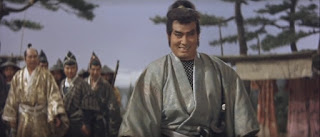


Meanwhile, meanwhile, Sonate, who parted ways with Ikazuki to continue her own quest, has an unfortunate run-in with Zenbei’s goon squad, who think she’s discovered their secret plans. And it is only through the timely arrival of Zenbei himself that prevents her from being killed. Sending the others on to kill Ikazuki, Zenbei sticks with Sonate, hoping to help find her missing dad, because she reminds him of his long lost love, killed as a reluctant spy in a far away land at the insistent behest of her belligerent father. They soon run into Ikazuki and the boy, who isn’t doing so hot after their latest run in with Zenbei’s assassins (-- now numbering about three --) while trying to ford a river. Zenbei is shocked to find out Ikazuki is the boy Sonate’s been mooning over the whole time they’ve been together. He’s also sniffed out who her father is, kidnaps her, leaving our hero to deal with a bunch of killer door panels (-- again, not making that up), and takes her to Orochimaru, who, turns out, as a surprise to probably no one by now, is her father.


Seeing this as a golden opportunity, Orochimaru tries to turn Sonate to the Dark Side, commanding his traumatized daughter to go back to Ikazuki and poison him. After a substantial browbeating, she reluctantly agrees to honor his wishes but cannot go through with it in the end -- almost, but not quite. Also of note, having seen this tragic scenario played out before with his own lost lover, Zenbei also has a change of heart and takes out “Plan B," his last assassin, currently hiding outside the window of their current refuge. Together, then, they hatch a plan that requires Zenbei to lure Orochimaru to their hideout and away from the castle so Ikazuki can take out Yuki-daijo without his interfering. And do this they all do, quite spectacularly, as our hero interrupts the evil lord’s latest round of drunken debauchery by siccing a giant, fire-breathing horny toad on him (-- right before he *ahem* “deflowers the farmer’s daughter), which destroys most of the citadel as it chases all of Yuki-daijo’s men into the sea. But for the man himself, the honor of his death belongs to Ikazuki, who avenges his father most righteously.


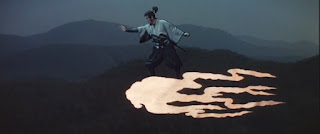
But suddenly! Orochimaru appears, flying in on a fireball, thanking our hero for clearing the way for him to claim the throne. Seems Zenbei’s last assassin wasn’t as dead as he thought, who spilled the beans about his master and Sonate’s betrayal, which gets Zenbei run through with a sword and Sonate left bound to a post to be dealt with later. Anyhoo, this all leads us to the climax, which means it is time for a KAIJU BIG BATTLE! Summoning his dragon once more, Orochimaru’s magical totem engages in combat with Ikazuki’s giant toad, exchanging blasts of fire and water, before slamming together for an outright slobber-knocker, laying waste to what is left of the castle and grounds. Again, it appears the more seasoned Orochimaru has the upper hand, whose dragon soon has Ikazuki’s toad on the ropes. Fortunately, Sonate, rescued by the farmer’s son, feels it is time to employ the spider talisman her grandmother gave her way back at the beginning of the movie.


Thus, the battle is joined by a giant spider, who goes all larval Mothra and quickly turns the tide against the dragon, which evaporates -- well, detonates, in defeat. This sets up a final, more traditional, samurai showdown between Ikazuki and Orochimaru. Here, is the film’s weakest moment as the running sword fight along the water’s edge is kinda awkwardly staged and ends with Orochimaru having some kind of seizure before collapsing into the sea, where he … transforms into a giant disco ball and explodes? Maybe? Maybe it was his dad? Or the spirits of the men he killed on the boat? Whatever, the bad guy’s dead and Ikazuki didn’t have to kill him, much to the relief of Sonate. Hooray! Then, summoning that giant eagle, Ikazuki and Sonate jump on and fly away, leaving the kingdom and the land to the people, destined to return to the forest where they will live happily ever after together.


I think it is the completely demented fairy tale vibe that has always enamored me to The Magic Serpent. Information and background on the film is fairly scarce and sketchy so I can’t really tell you who was responsible for the stunts, F/X, production design, or who was in charge of the giant monster action. The toad was a man in suit, who belched real fire like Gamera. The dragon was an impressive combination of a monster suit and a glorified marionette. Sure, they kind of pale when stacked up against the work of Tsuburaya, and you can barely NOT see the wires used to animate them, but, again, it is this kind of low-tech effort that I find the most endearing about the whole movie. Also, one should note, this might be a conscious choice to look that way, especially when you take into account they bothered to have an air-bladder in the giant toad so his throat pouch would work.

A lot of the F/X were done in camera, with double-exposures and the use of matting in most instances, with still images of our characters flying around on painted in fireballs. Again, I’m sure this was all done with cost-savings in mind, but it resulted in a crazy, live-action manga aesthetic that really draws you in. And most importantly of all, this approach also requires a leap of imagination and a willingness to engage from the audience, to believe in what you are seeing, suspension of disbelief be damned, with any and all cynicism curb-stomped for about 90 odd-minutes, instead of the sensory overload we get today in sci-fi and fantasy films, which is why I picked The Magic Serpent for this particular “For the Kids” roundtable for the Celluloid Zeroes as the perfect entry point for any young and burgeoning genre fans as an introduction to the gonzo world of Japanese tokusatsu.
Now, I’m kinda ashamed to admit when I bought Retromedia’s double-feature DVD of Return of the Giant Monsters (Gamera vs. Gaos) and The Magic Serpent many moons ago I got it for the Gamera movie and the Gamera movie alone as it wasn’t until many moons later that, on a whim, I gave the second feature a spin because I was too lazy to swap out the DVD. Well, shame on me, and apologies to myself for taking so damned long. And while I do appreciate the DVD the feature was obviously the AIP-TV print, which still looks pretty good considering how old it is, and it is better than nothing, but it is also cropped in a defensive driving course of pan and scan.

There is a dodgy, dubbed widescreen print streaming on YouTube at last check; again, better than nothing, but there are also several widescreen clips floating around both dubbed and subtitled that look ah-mazing that I have thus far been unable to pinpoint a source on and it is driving me bananas. (All the widescreen vidcaps for this review were taken from those clips and the Japanese trailer.) This is a movie screaming to be seen in its original aspect ratio so we may absorb the full impact of all it’s nutty magic. Arrow Video? Vinegar Syndrome? Shout Factory? Someone get on that as soon as possible, please and thank you. Until then, no matter what your age, really, I encourage all of you track down The Magic Serpent as soon as possible if you haven’t seen it yet and rectify yourselves!

This review was just one entry in the Collective Head 'o' Knuckle, known in your dimension as The Celluloid Zeroes, latest roundtable efforts. Please follow the linkage to my similarly addicted B-Movie Brethen, won't you? Thank you! Checkpoint: Telstar :: Time Bandits // Web of the Big Damned Spider :: 5000 Fingers of Dr. T // Cinemasochist Apocalypse :: TBD // Psychoplasmics :: The Gate // The Terrible Claw Reviews :: Gamera vs. Viras // Seeker of Schlock :: Spider-Man.
The Magic Serpent (1966) Toei Company :: American-International Television (AIP-TV) / P: Shigeru Okada / D: Tetsuya Yamanouchi / W: Masaru Igami, Mokuami Kawatake (play) / C: Motoya Washio / M: Toshiaki Tsushima / S: Hiroki Matsukata, Tomoko Ogawa, Ryûtarô Ôtomo, Bin Amatsu, Nobuo Kaneko, Kensaku Hara