Thursday, August 11, 2016

Blogathon Alert :: Whaddaya Call It When You Play Multiple Roles and then Kill Yourselves Onscreen Multiple Times? Well, We're Gonna Find Out!


There's an apocryphal story told by actor Dick Miller about the time Roger Corman hired him as an extra for Apache Woman (1955), where they filmed a scene where he played an Indian fleeing from some pursuing cowboys, and once that shot was completed, Corman told Miller to ditch the wig, wipe off the warpaint, change costumes, and put on a hat for the next shot of the pursuing cowboys, so, essentially, Miller was chasing himself in the same edited scene. Over the years since this story has been embellished on occasions, where Miller also wound up shooting himself as well. Now, this kind of frugal improvising and maximizing resources (and time-space paradoxes) were a trademark of any Corman production, but I don't think he ever improvised more or maximized anyone else as hilariously as he did with Beach Dickerson, another one of his stock-players, in his prehistoric "epic", Teenage Caveman (1958).


Thus and so, have I got a tale of multiple deaths, multiple resurrections, costume changes, and a dubious incident involving a bear costume for you, Boils and Ghouls, when Christiana Wenher and Silver Screenings launch the Dual Roles Blogathon due to hit in late September. So, stay tuned! 


I'm participating. Are you?

Monday, August 8, 2016

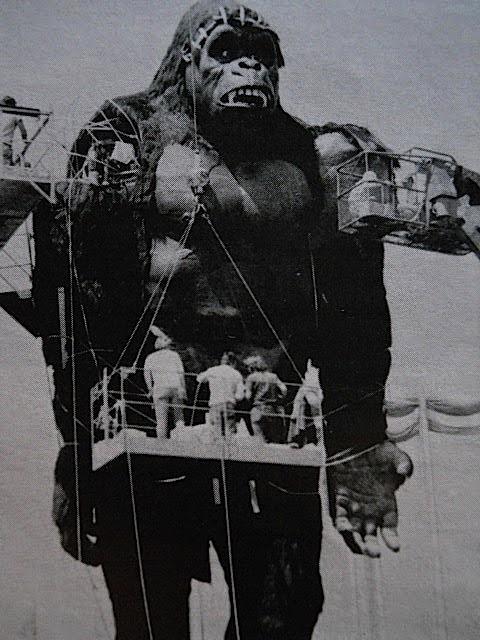
Favorites :: Behind the Scenes :: Nobody Cry When the Giant Robot Monkey Die: Damage Control and the Aftermath of King Kong '76.


As much grief as Dino De Laurentiis and Carlo Rambaldi got for the colossal failure of the much ballyhooed giant mechanical gorilla for the 1976 version of King Kong, the execution of those giant animatronic gorilla hands was actually quite good. A bona fide miracle, perhaps, for, as the legend goes, due to an accelerated production schedule (-- the reasons for which would take a whole ‘nother post to explain), the hydraulics to run them were so complicated, they weren't really finished when filming began. And when they finally got them kinda sorta working, the crew wanted to show them off to their producer. And when De Laurentiis walked into the studio, the giant arm extended toward him and flipped him the bird. And while De Laurentiss broke up over this, so did the arm. It seized up and the obscene gesture remained as is for almost a week.


But as erratic as the hands were, the full-sized mock-up proved even more temperamental than Bruce the mechano-shark did in JAWS (1975). In theory and design, it was an ambitious, technical marvel. In the execution, well...


Now, the arms and robot were designed by Rambaldi but were engineered and built under the supervision of Glen Robinson. Originally, De Laurentiss tried to commission some aerospace engineers to manufacture the robot but they required nearly a year and a half to complete it. Thus, it was up to Robinson, who had it built in less than five months. Built? Yes. Working? No. Well, not quite. When finished the contraption weighed in at nearly six tons, filled with some 3,100 feet of hydraulic hoses and 4,500 feet of electrical wire ensconced inside an aluminum skeleton, covered with an additional two tons of molded rubber and imported Argentinian horsehair, styled and stitched in by famed wig maker, Michael Dino.


In theory, the prop could walk, turn at the waist and move those attached arms (built separately) into sixteen unique positions as piloted by a half-dozen technicians manning twice that many levers each -- all of them Italians, who needed all instructions translated, which caused even more delays. And when it made its debut, in front of an anxious crowd at Shea Stadium, including several execs from Paramount, and they engaged those levers, Kong’s eyes started to move, then his mouth opened in a silent roar and the crowd went nuts. But this was soon followed by several screams and a lot of fingers pointing to one of the legs. (Other reports said it was toward the crotch.) Seems several hydraulic hoses had burst and Robo-Kong was hemorrhaging out gallons upon gallons of crimson-tinted fluid. Things never really improved from there, which explains why the contraption wound up with so little screen-time in the finished film – and most of that were just static long-shots. All told, a mere 25 seconds.


The animatronic hands fared a little better. They were six-feet across and weighed nearly a ton each. Again, the giant body was built to accommodate them but with all the added doodads and gizmos to run them, the main structure could barely support the weight -- so much so the technicians quickly nixed a series of  publicity photos of Robo-Kong holding Jessica Lange because of the stress factor of that much added weight and jostling on the tenuous joints.


In fact, after weathering that accelerated production schedule, including the widely circulated rumor that no one realized they had built two right hands until they were almost finished, causing even more delays while one of these was back-engineered into a southpaw (-- this apocryphal tale is sort of confirmed in Charles Grodin’s auto-biography), there were several close calls that could’ve led to a catastrophic injury.


Once the hands were unstuck and in nominal working order they decided to do another trial run. And so stuntwoman Sunny Woods crawled into the hand and braced herself while the contraption was engaged and the fingers slowly closed around her, and then started to lift her up into the air. But it had barely gotten more than 10 feet off the ground when the hand snapped at the wrist and several lines blew, causing the hand to lose pressure and to contract even further. Luckily, the safety bolts in the finger joints worked as designed and prevented the hand from crushing the girl, but left her dangling in mid-air. Thus the movie became a trial by fire for all involved, especially for Lange and Woods, who were essentially at the mercy of two pilot-less forklifts covered in foam rubber and horsehair for retake after retake for nearly 10 months of shooting. Lange would suffer much bruising and a pinched nerve in her heck when one of the fingers missed its mark and clobbered her in the head.


In the end, this glorified paper weight cost the studio nearly $2 million. To salvage the film they had to spend another half-million on the gorilla suit worn by Rick Baker for the majority of the picture. And then another $300,000 was spent on the giant Styrofoam corpse used for the final shots of the movie.


It’s really too bad this crew didn’t have more time to tinker and perfect the over-sized gizmos they’d made. Some of what they accomplished onscreen with those cumbersome appendages was really quite admirable. And who knows what they could’ve done with that year and half instead of the five months they got. As is, the film still won an Academy Award for Rambaldi, Robinson and Frank Van der Veer (opticals) for their efforts but even this didn’t happen without controversy when several Academy F/X board members resigned in protest (-- including Jim Danforth, who reportedly hated the film).


One of the biggest sins of King Kong ‘76, aside from the lack of dinosaurs on Skull Island, is that at no moment while watching do you, for a second, despite a valiant effort by Baker, believe that you are watching a real gorilla and not someone in a monkey-suit. Baker implored them for a better design and to allow him to walk on all fours like a real gorilla but these were all nixed to match their more anthropomorphic prop, which they were still harboring delusions of using for the majority of the picture during pre-production. As yet another legend goes, when they realized the robot might not work out and started advertising for a gorilla man in the trades, Baker said he was “the only one stupid enough to do it."


Again, you cannot blame Rambaldi, Robinson, or their crews, or Baker, for the perceived failure to light up the box-office. The film actually made a tidy profit but failed to generate ticket sales the way JAWS had the year before, sending its producer on a slightly embarrassing quest to try and top it -- ranging from Orca (1977) to The White Buffalo (1977), where he failed again and again. But you gotta admire De Laurentiis’ enthusiasm and chutzpah. Sure, his mouth wrote a check his butt couldn’t cash, but even in this failure he succeeded. For in a brash display of ballsy hucksterism that would’ve made P.T. Barnum proud, the producer promised audiences that he would deliver a giant robot Kong onscreen and he did just that. Barely.


And as I wrote this piece up, inspired by that picture way up at the top, I got to wondering as to whatever happened to the giant robot once filming was completed. I do know that when things wrapped in New York City, the thousands of gathered extras pretty much destroyed the Styrofoam replica in a wild souvenir hunt. As for the robot, well, that’s where things get a little sketchy. There are tales of it appearing at several premieres around the world. And after that, it allegedly spent some time in a circus, where it was part of an elaborate stunt-show. 


There is also solid documentation that the robot went on a barnstorming tour of South America, where it would spend weeks in a traveling circus tent, where a master of ceremonies would command it to move to a stunned audience before a blackout. But as the hydraulics kept breaking down and interest waned, the sideshow angle was abandoned and the automaton was moved one last time to stand a silent vigil in the city square of Mar del Plata, Argentina, where it apparently stood for several years.


Exposed to the elements, stripped of its hydraulic and electronic guts, as the hair and latex started to rot away, rumors spread that the prop was essentially written off and hauled to some anonymous Argentinian landfill. However, this myth is dispelled by an article that appeared in the April 29, 1985, issue of the Henderson Times-News, which stated what was left of the robot was recovered and brought home to Wilmington, North Carolina, where De Laurentiis had opened a studio (De Laurentiis Entertainment Group (DEG)), perhaps all in an effort to stir-up some publicity for his proposed sequel, King Kong Lives (1986), that was currently in pre-production and due to be released one year later.


Is it still there now some thirty years later? Well, the Magic 8-Ball says the answer is once more unclear. Apparently parts of it, the head and one of the arms, were prominently on display at the studio but have since disappeared under dubious circumstances when DEG went bankrupt a mere three years later after a few high profile flops and was taken over by Carolco Pictures before they in-turn sold the lot off to Screen Gems in 1996. So, odds are the Kong robot wound up in landfill, only in a North Carolina landfill. A sad ignominious end, really, to something so notorious that could’ve been something really great.

Sunday, July 31, 2016

Recommendations :: Vengeance Thy Name is Sasori: Arrow Video's Female Prisoner Scorpion: The Complete Series Collection (1972-1973)


Despite an escalation of violence and explicit nudity, Japanese cinema, like their American counterparts, was still losing the battle to television and losing badly at the dawn of the 1970s. And while fabled studios like Nikkatsu abandoned any pretensions and went full softcore Roman Porno (Romance Porn) rival studio Toei fought on and found a modicum of success by amping up the violence and nudity even more but also by abandoning traditional Japanese themes of honor and tradition and proper gender roles for the more brutal approach of Kinji Fukasaku’s epic treatise Battles Without Honor and Humanity (1973-1979) and Shunya Itō’s Female Prisoner Scorpion series (1972-1973).


Seems when Nikkatsu switched gears to skin-flicks it also saw an exodus of talent, one of those being rising star Meiko Kaji, who had lit up the box-office with Blind Woman’s Curse (1970) and the delinquent-bad-girl-centric Stray Cat Rock series (1970-1971), which the studio hoped would continue by plugging Meiko into a proposed adaptation of Tōru Shinohara’s popular women-in-prison manga, Sasori (Scorpion). However, things got off to a very rocky start as the assigned novice director Itō wasn't all that impressed with Meiko as an actress and felt she was completely wrong for the part. Their first pre-production meeting was a complete disaster but luckily for film fans everywhere, despite the initial rancor behind the scenes, things eventually worked themselves out onscreen as the director and actress delivered a deliriously awesome cocktail of sex, violence, empowerment and social commentary wrapped in bun of surrealistic artistry and striking visuals with Female Prisoner #701: Scorpion (1972).


Not quite "Pinky Violence" and not quite "Roman Porno", the inaugural entry sets the tone to come with a distinct authority seldom seen from a first time director. And while Female Prisoner #701: Scorpion definitely has the salacious, exploitative sheen of a women-in-prison flick on the surface, you don't have to dig too deep into the nudity, cat-fights and lesbian interludes to see there is a lot more going on as the film rails against entrenched corruption and the abuse of power. Of course, all of that is wrapped around the tale of a prisoner, Nami “Matsu” Matsushima (Meiko), who was set-up by Sugimi (Isao Natsuyagi), a crooked detective, as bait in a drug-bust to eliminate his competitors gone sideways -- so sideways an enraged Nami tries to kill him after. 


Inside the prison walls, for trying to kill a police officer, our heroine is subject to all kinds of torture and abuse from the guards and the sadistic warden, Goda (Yayoi Watanabe), but also her fellow inmates and trustees when her many escape attempts result in punishment for all. And as Matsu’s few friends are stripped away, along with her humanity, she slowly transforms into the Scorpion. And when one of Goda’s group punishments backfires, resulting in a riot and a prolonged stand-off, Matsu manages one more escape and systematically takes out Sugimi’s narcotics ring, leading to a final fatal showdown with the man who betrayed her, who also happens to be the man she loves.


With her transformation from naïve waif to hardcore killing machine, with such minimal dialogue, watching Meiko Kaji act is just incredible and a privilege as she constantly turns the tables on her tormentors, stepping stones all on the road to her ultimate revenge. I’m telling ya, her silent death glare could vaporize glacial ice. As the series progressed and things smoothed over, Itō would freely admit he was mistaken about Meiko. The director put her through all kinds of hell during filming, which the actress never backed away from, earning his deep respect. And the mesmerizing results on film are just brutal, visceral, and visually stunning as Ito's influences range from German silent expressionism; to the avant-garde weirdness of Luis Buñuel (-- I love how Matsu draws a blade across her eyes, with tears for blood, signaling that vengeance is coming, like the hand swipe that turns the Daimajin from stone golem to vengeful demon); the anything goes nuttery of Seijun Suzuki; the hard shell candy colors of Michael Powell and Emeric Pressburger; to the wild camera angles of William Dozier's TV version of Batman (1966-1968).


When the film was finished, Toei executives weren’t thrilled with the end result and were on the verge of just shelving Female Prisoner #701: Scorpion indefinitely, but a wild raid and sit-in at a hotel occupied by the brass led by Itō turned things around. Originally intended as a B-picture, the film proved such a big hit it was quickly moved to the top of the bill to cash-in. Thus, the film that almost didn’t happen -- or not as we’ve come to know it, left audiences clamoring for more. Toei was quick to answer, reuniting Itō and Meiko for the follow up feature, Female Prisoner Scorpion: Jailhouse 41 (1972), which hit theaters a mere four months after the premiere of its predecessor.


The second feature picks up a year after the bloody conclusion of the first. Now, Matsu has spent that entire year trussed up in the deep, dark and dank recesses of solitary confinement but now her old pal and resident sadist, Goda (Watanabe again), has decided to let her see the sun for one last time before he transfers out via a promotion. (I love how these two are essentially the bane of each other’s existence.) This, does not go well at all. And so, as usual, Goda orders a Sisyphusian group punishment for all prisoners at a local rock quarry, where he has a skeevy surprise planned for our protagonist, as well, to make her an even more abject lesson to the other convicts. However, sticking with the theme, this also backfires when Matsu and six other prisoners engineer an escape and spend the rest of the film on the run with Goda and his goons and their own past sins hot on their heels. Again, this does not end well.


Now, I had heard good things about this series but, great googily-moogily, two films in and this is patently ridiculous how great these’ve been. I talked about the international influences of Itô on the first film but we can add traditional Japanese theater, Masaki Kobayashi’s Kwaidan (1964), and I swear to god, the musicals of Stanley Donen and Gene Kelly as several phantasmagorical dream sequences just scream “man, this really reminds me of the “Gotta Dance!” sequence from Singing in the Rain (1960)."


But those explosions of color are rare this go ‘round, with a more subdued palette as this one kinda sorta comes off as a ghost story. The scenes where the fugitives hide in the ruins of a village, abandoned due to an apparent volcanic eruption, providing a surreal moonscape, are hypnotic -- though the bit with the stray dog was a tad disturbing. 


As are later scenes with the discovery of a body in a river and the waterfall suddenly disgorging blood and where our heroine is lost in a mountain range landfill that quietly tells you all you need to know about what the director is trying to say. (There’s also an early scene where he shows the passage of time by showing Matsu grind a spoon into a shiv using only her teeth.) Thus, no matter how many influences you cite, Itô combines them all into one unique, demented, and brain-boggling experience.


Meiko also delivers again as our silent assassin, though I think she only says three words in the whole movie. Never fear, Kayoko Shiraishi says plenty as fellow prisoner, Oba, in a performance for the ages in this primal scream and raised middle finger at the entrenched corruption of the powers that be in post-war Japan and its oppressive patriarchal system, which once again had audiences hoping for another sequel. Again, Toei didn’t hesitate and Female Prisoner Scorpion: Beast Stable (1973) was soon in production.


This third entry begins rather gruesomely as our fugitive heroine is still on the loose after the successful bloody conclusion of the last chapter, narrowly escaping the long-arm of the law when new arch-nemesis, Detective Kondo (Mikio Narita), tries to nab her on a subway train, only to literally lose an arm. Seems he managed to cuff himself to Matsu, so she just chopped off the tethered appendage to make her escape. (The scene as she flees the subway and into the light, leading to a near total white-out, is another win to notch on the innovative director's belt.) Hiding out in a cemetery, Matsu is taken in by a prostitute, who cares for and has a disturbing mutually beneficial incestuous relationship with her hapless, sex-addicted and brain-damaged brother. Recognizing her from all the wanted for murder posters, a miserable Yuki (Yayoi Watanabe) is now pregnant and hoping Matsu will help out and just put her brother out of his/her misery.


Meanwhile, Yuki is also having problems with a local brothel -- more specifically, Madam Katsu (Reisen Lee) and her goon squad, who don't take kindly to independent sex-workers horning onto their turf. Having once served time with the Scorpion, Katsu recognizes Matsu and knows she has the fugitive over a barrel. With plans to add Matsu to her stable, this unwilling recruit is drugged and left in a giant birdcage (-- just roll with this, trust me), where Matsu watches one of the other prostitutes, forced into having a botched back-alley abortion, bleed out and die. And this once again lights a fire of raging vengeance in Matsu, for it is bad enough when men exploit women like this but it’s even worse when women do it to themselves. And after hemorrhaging out all of her henchmen, Katsu actually turns herself in and willingly goes to prison, hoping this will somehow save her from the Scorpion.


But nowhere is safe from the deadly eyes and blade slinging Matsu. And after a not-so brief interlude where she's trapped in a sewer maze by a psychotically determined Kondo -- determined to see her dead, that is, which he thinks he has accomplished with some induced help from Yuki, a thousand gallons of gas, and a match. Thus, with Matsu presumed dead and cremated, that leaves her free to get thrown in prison anonymously on a frivolous charge -- the same prison where Katsu is hiding out. Well, make that was hiding out as Matsu's machinations soon has all of her enemy threads tied up and knotted off in a neat little (and very dead) bow.


By now Itō and Meiko were fairly comfortable with each other; and having felt they'd played out the prison angle the majority of Beast Stable takes place on the outside looking in with Itō's usual brazen visual flare and camera tricks and wears its anti-establishment message on its sleeve – well, actually a clenched fist hidden in the sleeve. Mention should also be made of the fantastic score provided by Shunsuke Kikuchi and the mournful ballads that serve as sort of an ersatz Greek chorus throughout the whole series -- and it should be noted that this balladeer was Meiko Kaji, herself, who sings her “Song of Vengeance” just as well as she kicks ass.


Apparently Toei had envisioned at least a ten film run for the Scorpion series. Alas, even though the films had lost no momentum at the box-office, and a guarantee that he could do anything he wanted, Itō felt he had told all the "fiction within a fiction" tales he cared to tell. However, the studio was able to convince Meiko to come back for at least one more go with Female Prisoner Scorpion: #701’s Grudge Song, where Meiko was reunited with one of her old Stray Cat Rock directors, Yasuharu Hasebe.


Sadly, one can easily sense Itō’s absence in this last installment. It’s good, but not near as good as the others as we once more open with Matsu on the run from yet another new arch-nemesis, Inspector Hirose (Hiroshi Tsukata). Beaten and bloodied, she manages to elude capture and takes refuge in strip-club, where she’s nursed back to health by Kudo (Masakazu Tamura), a former student radical who is also well aware of police brutality, having been crippled, scarred and beaten into betraying his faction by the very same Hirose. And together, these two lost souls go on the lam and slowly *ahem* stoke the fires and rekindle their lost humanity (-- a theme that actually began in the last installment for Matsu). 


Things are complicated when an attempt to ambush Hirose goes awry when his pregnant wife, whom they were holding hostage, is accidentally killed while trying to escape (-- she might’ve even committed suicide by flinging herself off a balcony. Hard to read that scene, honestly.) When Kudo is captured he once more caves, giving up Matsu to the police; and as she is once more incarcerated and awaits her execution, constantly tormented by Hirose the whole time, whatever trace of humanity that had resurfaced is completely destroyed, meaning Matsu is no more and now there is only the Scorpion, who has no intention of walking the gallows steps and will not stop until she’s had her revenge again.


It isn’t until the grand finale and final showdown that #701’s Grudge Song finally reaches the nightmarish delirium of the first three films. If Hasebe had spread that out a bit, then we really might’ve had something here. As is parts just didn’t jive, like how Matsu makes several long speeches after barely uttering ten words in the last three films combined. Still, they were trying to show that Matsu was subverting the Scorpion so I guess that kinda works. However, one cannot help but sense this was a film about Kudo that grafted Matsu onto it, a doomed couple on the run that owes more to Bonnie and Clyde (1967) and The Getaway (1972) than its predecessors. Thus, #701’s Grudge Song falls into that nebulous category of being a pretty good movie but also a pretty terrible sequel. Not a catastrophe by any means – you got Meiko being Meiko after all, but there is a whiff of disappointment that I won’t deny.


Okay, then, when most people try to sell you on female empowerment that’s wrapped-up in this kind of violence, sexually abusive brutality and sadistically exploitative packaging, they are usually full of shit; but I’m telling ya the Female Prisoner Scorpion series are the real deal. And you’re only getting half the picture here as no plot synopsis on Earth can do justice to the work Meiko and Itō pull-off onscreen. And if you need further proof, that can now be easily rectified thanks to the fine folks at Arrow Video and the brand new Female Prisoner Scorpion: The Complete Collection boxset.


All four films are included, all digitally restored, and are jammed packed with extras. No commentaries this time, which is a tad disappointing because I wanted to know more. However, Arrow compensates for this with plenty of featurettes, including several new interviews with Itō and one vintage interview with Hasebe. But the real highlight are a couple of visual essays by Tom Mes; one on the film career of Meiko Kaji and the other an in depth analysis of the evolution of the Scorpion series. The boxset also includes a booklet with more critical analysis, an interview with Toru Shinohara, the creator of the Scorpion manga and reprint of a rare vintage interview with star Meiko Kaji.


Again, I was aware of this series but aside from a much later Chinese co-production / failed reboot in the aughts (that wasn't very good) this was my first official foray into the Scorpion series and I cannot stress enough how much the originals knocked me on my ass. As I type this up, I am already scrambling for some kind of creative financing that will allow me to pick up the similar Stray Cat Rock boxset from Arrow, and I’ve already got Lady Snowblood (1973) added to my Hulu queue to satiate my new insatiable Meiko Kaji fix. But its gonna be hard to top what I just watched. Seriously, Boils and Ghouls, the Female Prisoner Scorpion boxset is due to street the first week of August. And when it does, go and snatch one up. And then watch these as soon as possible. Trust me.


Related Posts Plugin for WordPress, Blogger...