Showing posts with label Allied Artists. Show all posts

Tuesday, June 18, 2019

The (Red) Apes Have Taken Over :: A Beer-Gut Reaction to Edward and Mildred Dein's Shack Out on 101 (1955)


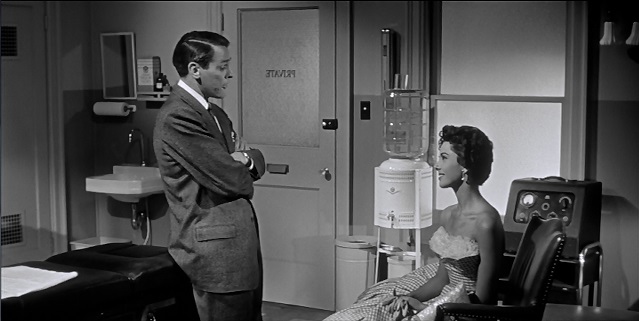
At a small ocean-side greasy-spoon well off the beaten path, the owner of this eatery barely ekes out a living. Minimally staffed by a world-weary waitress and a cantankerous short-order cook, what few customers George (Wynn) does get consists of an occasional long haul trucker and the staff of a government research center nestled somewhere up the road a piece. Well, wherever they come from, all these customers agree on two things: one, they'd all like a fling with the saucy Kotty (Moore), and two, Slob's cooking is awful.


But the thick-headed Slob (Marvin) couldn't care less what others think, and Kotty turns them all down flat. See, she's currently attached and swapping spit with one of those research scientists; a Professor Sam Baniston (Lovejoy), who's also trying to help her ditch this dead-end occupation and shepherd her into a cushier government job through the Civil Service exam.


And as we meet a few more kooky denizens of this diner, including a daffy salesmen named Eddie (Bissell) and a shifty-eyed fishermen (Lesser), things seem normal enough on the surface, but underneath something far more sinister is happening once the sun goes down and the kitchen closes for the night.


Seems several of those government researchers have up and disappeared without a trace, and they were all last seen eating at this very establishment. And not only that, but there are other transactions going on at the diner. Transactions that are off the menu and take place strictly under the table. And what are these clandestine transactions all about? Secrets. Secrets bought and sold that could bring about the end of the world as we know it...


In August of 1950, after the FBI ferreted out their spy ring, a Federal grand jury indicted Julius and Ethel Rosenberg on 11 counts of conspiracy and espionage for allegedly passing on the secrets of the A-Bomb to the Russians. Later convicted on these charges in March of 1951, despite the couple's protests of innocence, the Rosenberg's, admitted Communists, were sentenced to death for this act of treason; a sentence that was eventually carried out in June, 1953. But this was not the end of it. No. Far from it.


History would show this notorious incident only added fuel to Senator Joe McCarthy's Stomp-A-Commie-Crusade; and Hollywood, already stinging from the whipping it took from the House Un-American Activities hearings in 1947, which resulted in the Black List, where countless artists and craftsmen suddenly became persona non grata to the studios, were eager to make nice with a series of Anti-Communist films --  I Married a Communist /The Woman on Pier 13 (1949), I Was a Communist for the FBI (1951), Big Jim McClain (1952), and assorted shorts -- What is Communism? (1952), Red Nightmare (1957), to bolster the perception of Tinsel Town's unwavering patriotism to avert anymore governmental grievances. Even second tier studios like Allied Artists got in on the act; and Shack Out on 101 (1955) is a prime example of this type of output.


An Atomic-Paranoia-Sleaze-Noir, the separate ingredients of Patriotism and Red Scares in Shack out on 101 are clearly definable to your viewing palate as the film digests, but these morsels are essentially overwhelmed by a few more spicier ingredients thrown in with the best of intentions to make it all go down a little easier. For, not only did the married screen-writing tandem of Edward and Mildred Dein throw the kitchen sink into this seamy little potboiler (-- Edward also directed), but added the stove, the fridge, the cupboards, and all the above's contents into the mix as they tried to subvert this central theme under several layers of steamy romantic intrigue, oddball characters, and laugh-out-loud comedy.


Strangely, each element on its own works fairly well but kinda curdles when baked together. Sticking with the culinary metaphor, then, admittedly, the end results tastes kinda funny. Not bad, mind you. Just funny -- a bit off, maybe -- with each bite either too salty or too sweet or too bland that never reaches any sort of satisfying equilibrium. (Note to self: You are so talking out of your "You Don't Even like to Cook" ass right now.) Anyways...


Yeah, the soapy melodrama just never jives properly with the cloak and dagger stuff. The comedic elements work best, especially a few throwaway bits with George and Slob working out, and the resulting pissing contest over whose legs are in better shape -- a contest Kotty eventually has the last word on, and George and Eddie (Whit Bissell in a rare comedy relief stint) swapping tales and testing out some new fishing equipment.


Frankly, the whole plot feels like a hyper-condensed season of your garden variety soap opera, where said soap latches onto the latest headlines or hot-topic and folds it into one of its many subplots, with the viewer plopped down right into the middle of it, beginning with Slob's initial molestation of Kotty on the beach, whose tired reaction says this kinda crap happens all the time, and who only gets indignant when the grab-fanny cook spoils her latest batch of laundry.


Now, with a soap, you would have months and months to work this storyline -- hell, in some cases, years; here, we barely have an hour as a frustrated Kotty moves from man to man, looking and longing for love or some kind of stability, eventually sniffing out the nefarious truth behind Bastion and Slob's secret sea-shell swapping sessions down by the sea shore but doesn't quite grasp the stakes until it is far too late. For, unlike the Rosenbergs, here, not only are those Commie bastards stealing classified information from the research center through several stooges, they're actually kidnapping scientists and engineers and smuggling them out of the country through Mexico, destination Moscow, to unlock more Atomic secrets for Uncle Nikita.


Discovering her beau (and ticket out of this shack) is one of these stoolies, in perhaps not the wisest of moves, knowing they've killed several people already, Kotty's self-righteous snit-fueled tirade nearly gets everyone else killed as the mysterious Mr. Gregory, the man behind this nest of vipers, finally reveals himself, who decides it's time to cut bait on this operation and leave all the witnesses at the bottom of the Pacific.


Now, since everything that brought us to this point, and the climax itself, to the pat happy ending, is all carried out six and half miles somewhere above “over the top” an argument could be made that Shack Out on 101 should be considered a farce, which kinda makes sense, making it a nice subversive foil for this particular genre that was already fizzling out. And despite all these complaints and snarky observations, I'm happy to report the cast overachieves and makes all of these disjointed plot elements work.


As the Tomato, whom everyone wants to *ahem* sample, Terry Moore is a million miles away from her big screen break as the young ingénue in Mighty Joe Young (1949). She brings a solid “been there, done that, screw the lousy t-shirt” weariness to Kotty, who once more sees a way out of this funk only to have the door seemingly slammed in her face. The constantly blustering Keenan Wynn is great, too, as always, and plays well off the bumbling Bissell. But Lee Marvin steals the movie as the slovenly Slob, who isn't as slovenly and thick-headed as he lets on.


It also helps the film itself looks fantastic. Credit to cinematographer Floyd Crosby, who used the limited sets brilliantly, keeping things nice and dingy and sleazy, and who used the cramped and limited space in the diner to his advantage by having the camera ridiculously close to the action at all times, resulting in a seedy documentary feel that's about [--this--] close to crossing the threshold of cinéma vérité. Seriously. You can almost smell some Pine Sol wafting from the toilets and hear the grease popping on the griddle.


This would be one of Crosby's last stops before he hooked up with Roger Corman and the boys from American International Pictures, starting with Fast and the Furious (1954), and whose skills are kinda underappreciated in the success of both. One also cannot discount the efforts of editor George White, who also stitched together the similar docu-noir, The Phenix City Story (1955), and the noir to end all noir, The Postman Always Rings Twice (1946). And then there’s the music of Paul Dunlop, whose horn-heavy spazz-jazz riffs only amp up the proceedings even more.


After finishing Shack Out on 101, the Deins latched onto the wrong bandwagon with Calypso Joe (1957) -- yup, there was a time when most people predicted calypso music would have more staying power than rock ‘n’ roll, but then the couple were roped in by Universal and scripted the strangest, but surprisingly effective entry in that studio's resurgent monster movie movement with Curse of the Undead (1959), which throws a vampire into a western, making him an indestructible hired gun set loose on a range war. You wouldn't think that would work but, believe me, it does.


Thus, despite its haphazard structure and kitchen-sink narrative, Shack Out on 101 will surprise you when it's over and done. It shouldn't work either, but it does. Apparently, the film's original title was Shack Up on 101 but some muckety-muck at the studio didn't like the euphemistic connotation of "shack up" (-- some sources claim the objection came from Moore), and so producer Mort Millman made the change. Whatever the title, more folks probably need to see this gritty and dirty and highly idiosyncratic film.


Shack Out on 101 (1955) Allied Artists / EP: William F. Broidy / P Mort Millman / D: Edward Dein / W: Edward Dein, Mildred Dein / C: Floyd Crosby / E: George White / M: Paul Dunlap / S: Terry Moore, Frank Lovejoy, Keenan Wynn, Lee Marvin, Whit Bissell, Len Lesser, Frank De Kova

Tuesday, November 8, 2016

The Celluloid Zeroes Proudly Present: The Political-Science Fiction Roundtable :: Who Do You Trust in Don Siegel's Invasion of the Body Snatchers (1956)


Cutting short his stay at a medical conference, Dr. Miles Bennell (McCarthy) heads back to the sleepy southern California town of Santa Mira, where his practice has been so suddenly inundated with insistently frantic patients his nurse, Sally Withers (Wiles), was forced to call him home early. But when Bennell checks in he’s told almost all of those patients have since cancelled their appointments. This sacrifice wasn’t a total loss, however, when one of those appointments that bothers to show up turns out to be Becky Driscoll (Wynter), Bennell’s old high school sweetheart. And as the flickering flame of romance quickly rekindles between these two, Becky reveals she’s come for some advice about her cousin, Wilma (Christine). Seems she’s become convinced their Uncle Ira, isn’t really her uncle any more.


Now, this man, this Ira, may look like Ira, he may sound like Ira, and he sure does act like Ira, but Wilma cannot be convinced otherwise: there’s just something off about him, she insists; and so, whoever that is it definitely is NOT her uncle. And since this is out of his bailiwick, all Bennell can do is refer Wilma on to see a psychiatrist friend of his, a Dr. Dan Kauffman (Gates). And that would seem to be the end of that, except Bennell’s next patient is a hysterical young boy, who is also convinced his mother isn’t his real mom anymore and fears he’s going to be “gotten” and replaced, too. But replaced by what? That, the child cannot answer but his fear is palpable.


Brought in by his concerned grandmother, and thinking he’s got a burgeoning case of mass-psychosis on his hands, Bennell consults with Kauffman, who confirms he has been swamped with similar cases as Santa Mira has been seemingly overrun with paranoid folks claiming someone close to them has been replaced with an insidious doppelganger. Convinced by Kauffman this delusional neurosis is nothing to worry about and will eventually play itself out, Bennell suggests the boy spend the night with the grandmother. And if the hysterics continue, they will contact his parents and look into it further tomorrow.


As for that night, Dr. Bennell has got himself a date with Becky. Both are surprised to find the most popular nightclub in town nearly empty, the owner saying business has gotten so bad lately he’s had to let the house band go. But they only get as far as ordering drinks before Bennell gets a message from his answering service, relaying that another close friend needs an urgent house call. And so, the couple head to the home of Jack and Theodora “Teddy” Belichick (Donovan, Jones), where they are led into the basement and presented with a startling sight: a dead body laid out on the pool table.


Well, at least it appears to be a body as on closer examination the corpse is more like a featureless template of a man -- it even lacks fingerprints. However, it being a small town and all and full of free-flowing gossip, they’re all fully aware of the epidemic of alleged duplicates, which is why Teddy is convinced by the general build this “thing” was meant to replace her husband.


So now they have definitive proof that something screwy is going on, and Bennell concludes this unsettling interlude by telling the Belicheck’s to keep an eye on the body while he takes Becky home with a promise to bring the authorities back in the morning. But things get even more sinister long before the sun rises as the frantic Belichek's rush into Bennell's house, saying the blank changed while they were asleep and is now a perfect duplicate of him -- right down to the sustained cut on his hand, suffered AFTER they had initially discovered the body! (Love that bit when its eyes open.) And then something hits Bennell right in the gut. Something Becky had said when he dropped her off, how her father hadn’t been himself lately either.


And so, he hustles over to the Driscoll house and checks the cellar, where her father has been spending odd hours doing secretive things, and sure enough, he finds a near exact duplicate of Becky! But by the time they call in the authorities, including Dr. Kauffman, both bodies have mysteriously disappeared. And with no concrete evidence, the police quickly write them off and Dr. Kauffman once more calmly and coolly and logically convinces them they’re all suffering from some kind of mass hysteria or auto-suggestion; there were no bodies, he says, they only imagined it; and this notion that the entire town is being invaded, replicated and repopulated by a horde of cold and emotionless automatons just isn’t possible. Only they aren’t imagining it, the town really is being invaded and replaced by duplicates, with no way out, with no way of knowing who to trust, and with no way to tell who’s been converted to the other side and who hasn’t...


When film critics and historians talk about the allegorical Red Scares and the Horrors of Communism of 1950s era science fiction films, Don Siegel’s Invasion of the Body Snatchers (1956) is usually Exhibit A. Based on a story by Jack Finney that first saw print as a three part serial in Collier’s Magazine, which ran from November through December in 1954 as The Body Snatchers, producer Walter Wanger was so impressed he began negotiations for the movie rights after only reading part one.


And while the film itself can be interpreted or dissected on many allegorical levels, with some calling the vegetative assimilation plot acutely anti-Communist, while others see it as a not so thinly veiled poke in the eye at Red-baiting McCarthyism in general -- hell, there’s even an argument to be made the film is pro-McCarthy as their really was something under the bed in the cellar all along, making the resulting hysteria and finger-pointing of our protagonists justified, this was apparently not the intention of the original author, the film’s producer, the director, or the adapting screenwriter, who all intended it as a pure thriller and nothing else. And though I find that hard to buy, let us sift through the evidence.


Alien invaders who assimilate and infiltrate was nothing new in the 1950s. In It Came from Outer Space (1953) the xenomorphs were just hiding in plain sight; in Invaders from Mars (1953) the Martians were infiltrating their way to world conquest; but as written Invasion of the Body Snatchers was less about insidious motives and more about happenstance and collateral damage as the Earth fell victim to the natural order of an alien spore’s life-cycle, which blew from planet to planet on cosmic winds, assimilating planetary ecosystems until they were dry (a five year cycle) and then the plant-people seed-out and die, leaving both a dead world behind and their expunged spore to find the next host world to latch onto.


Here, these parasitic vegetables mimic their human hosts while they sleep, absorbing memories and character traits. Once the cycle is complete, the host body disintegrates, leaving the duplicate to take over without the need for emotions or individuality. And I think that’s one of the main points Finney tries to get across: humankind’s penchant for callously using up resources, wiping out indigenous populations and destroying the planet with nary a second thought. We are them, and they are us.


There’s also plenty of non-political metaphors at work like the obvious fight to hold onto one’s humanity. And as the 1950s progressed, before Rock ‘n' Roll knocked it on its ass, America was drinking the Kool-Aid of push-button technology and cultural homogenization, with everything pre-fab and cookie-cutter neat, resulting in a definite loss of self -- or as the psychologist says in the film when he makes his pitch to let go, give in, and "abdicate from human responsibility in an increasingly complex and confusing modern world."


At least that’s what director Siegel claims he latched onto, saying, “People are pods. Many of my associates are certainly pods. They have no feelings. They exist, breathe, sleep … It just happens to leave you in a very dull world but that, by the way, is the world that most of us live in. It's the same as people who welcome going into the army or prison. There's regimentation, a lack of having to make up your mind, face decisions. People are becoming vegetables. I don't know what the answer is except an awareness of it. That's what makes a picture like Invasion of the Body Snatchers important."


Siegel also stated the political inferences to Senator McCarthy’s witch-hunt and totalitarianism were inescapable but he tried not to emphasize this, not wanting to get too preachy. In fact, the director had intentionally added a lot of humor to help defuse some of the film’s heavier elements and scares. “I felt that pods growing into a likeness of a person would strike the characters as preposterous,” Siegel said. “I wanted to play it that way, with the characters not taking the threat seriously."


However, the brass at Allied Artists were not amused, laying down an edict that there was no room for humor in a horror film and axed all the comedy bits out. (Though I do find the pod props themselves rather comical -- that is until they start to hatch.) I do find it interesting that the last two surviving humans in Santa Mira are the two recent divorcees, whose previous marriages were both train-wrecks, and what little humor remains in the film is their all too brief courtship, punctuated by their passionate kisses that would come into play again during the harrowing climax.


From the beginning of the film, the viewer gets a sense something’s not quite right in Santa Mira with plenty of hints and clues that said the invasion wasn’t coming but already here and, in a sense, the war was already lost. And as all of those who insisted someone had been replaced keep happily recanting, Bennell can’t seem to quite put it all together -- at least in time to do anything about it.


For as a cookout with him, Becky, Jack, and Teddy is ruined by the gruesome discovery of four half-gestated pods hatching out in a nearby greenhouse, all attempts to contact the authorities outside the city limits are thwarted by the Snatchers, whatever they may be. And after disposing of the duplicates with a pitchfork, Bennell and Becky stay behind as bait, hoping to give their friends the distraction they need to flee Santa Mira and bring back help.


But the Belichick's never make it and are turned, leaving only Bennell and Becky. (The scene where he checks in on nurse Sally, only to see she’s turned and is putting a pod in her toddler’s playpen, saying there will be no more tears, will send chills up your spine.) Then, through pluck and some luck, the couple manage to make out of the city limits and take refuge in an abandoned mine, where they must hide until the pursuing army of pod people move on. 


At this point, Dexedrine boosters or not, the lack of sleep is definitely catching up with our two heroes. And when they hear some music, thinking there might be someone else left, Miles leaves Becky behind to investigate. He traces the music to an arriving truck at a massive greenhouse that is surrounded by even more trucks -- trucks ready to transport more pods to the surrounding communities. And when the driver disappears, so does the music.


Knowing their only chance to stop this invasion is to make it to the main highway on foot and then Los Angeles, Miles heads back to the mine to collect an exhausted Becky, who appears to be on the verge of falling asleep. Working quickly, Miles grabs her and tries to bring her around with the kiss heard round the world, which proves Becky wasn’t about to fall asleep but new Becky was just waking up.


All alone, a frantic and distraught Miles once more evades capture and makes it to the highway, where he bounces from car to car like a lunatic, desperately trying to warn the other passing motorists of what is happening and who will be next to seemingly deaf ears!


In Finney’s novel the invading aliens are beaten back, with Bennell and friends leading the charge, burning greenhouses full of pods, which convince the Snatchers to bug-out early and look for less resistant and belligerent hosts elsewhere. In the original cut of the film, Siegel ended it right there on the highway, with Bennell seeing several trucks full of pods heading to parts unknown, with his desperate, maniacal pleas for help ignored completely until he breaks down the fourth wall and impeaches the audience, saying we will be the next to go. Here, the studio stepped in again after a couple of disastrous early screenings and demanded a new wraparound segment to lighten things up a bit, where Bennell is able to convince the authorities of what is happening, who make moves to stop the invasion. No guarantee of victory, mind you, but a little more optimistic.


Siegel and screenwriter Daniel Mainwaring were more satisfied by the pessimistic ending and felt the film was nearly ruined by all of Allied Artists’ dickering. Wanger was also very much against the changes, but in order to protect the film he managed to convince both men to write and shoot the new prologue and epilogue -- because if they didn’t do it, the studio probably would have found someone else who would.


With the shooting title of The Body Snatchers the film was shot in-and-around Sierra Madre, California, over the course of 23 days with a budget of $350,000. Not wanting any confusion between their film and the old Val Lewton thriller, The Body Snatcher (1945), the studio tried They Came from Another World but that didn’t stick. Siegel suggested they change the title to Sleep No More or Better Off Dead but the studio finally went with the more exploitable Invasion of the Body Snatchers


Originally, Wanger wanted more bankable stars, too, eyeballing the likes of Dick Powell, Joseph Cotten, Donna Reed and Vera Miles for the romantic leads but a last minute budget cut meant the roles went to two relative newcomers, Kevin McCarthy and Dana Wynter, who kind of come off as Rob and Lora Petrie, adding even more frisson to my eyes. (Sharp eyes will also spot future director Sam Peckinpah as a meter-reader.)


And while the story itself holds up remarkably well, it’s the work of Siegel and cinematographer Ellsworth Fredericks that really gives this film its lasting legs. Shot with a solid noir flare and a claustrophobic mentality, with stark lighting, crazy quilt shadows and a constant sense of eternal blackness invading the screen, this movie hits the ground at a sprint and never really slows down, giving it a clipped, documentary type feel -- especially when you add Bennell’s constant narration, which makes the film come off as one of those anti-Communist docudramas of the same era. (The constantly sounding sirens and the meeting in town square to organize the spread of pods is right out of Red Nightmare.) And all the while they impend the dread and ratchet-up the paranoia and tension, with startling bursts of creepy, eerie, and the brazenly bizarre. (The scene where the prongs of the pitchfork hovers and lingers over the newborn pods is just downright disturbing.) And with no humorous reprieve or outlet, having been axed out, there is no room to catch a breath.


As Michael Dodd of The Missing Slate put it so beautifully: “[The film is] one of the most multifaceted horror films ever made … simultaneously exploiting the contemporary fear of infiltration by undesirable elements as well as a burgeoning concern over homeland totalitarianism in the wake of Senator Joseph McCarthy's notorious Communist witch hunt, it may be the clearest window into the American psyche that horror cinema has ever provided.” 


You never really know how precious your humanity is until you have to fight to keep it, says this movie. And 2016 marks the 60th anniversary of Invasion of the Body Snatchers and lo these many decades later the film still resonates and the main reason why is because those damnable pods and the resulting dehumanization are so open to drawing infinite parallels and multiple interpretations, be it political, zealot or heathen, making it timeless and ever relevant. I mean, just sub in Libtard or Republikant for Commies and Commie-Baiters and there ya go and here we are. 


That’s right, We were next all along.


This post is part of The Celluloid Zeroes' Political-Science Fiction Roundtable, where you, me, all of us try to survive the crucible of this dastardly election day. So please feel free to check out these other entries, please and thank you: Checkpoint Telstar takes a look at The Paralax View ::  Web of the Big Damned Spider gives A Report on the Party and Guests :: The Terrible Claw Reviews drops a bomb on Shin Godzilla :: Psychoplasmics gets caught up in The Mist.


Invasion of the Body Snatchers (1956) Walter Wanger Productions :: Allied Artists / P: Walter Mirisch, Walter Wanger / D: Don Siegel / W: Daniel Mainwaring, Jack Finney (novel) / C: Ellsworth Fredericks / E: Robert S. Eisen / M: Carmen Dragon / S: Kevin McCarthy, Dana Wynter, Larry Gates, King Donovan, Carolyn Jones, Jean Willes
Related Posts Plugin for WordPress, Blogger...