

If you ask Roger Corman, he’ll tell you, quite adamantly, that he never made a movie called Teenage Caveman (1958). However, he will freely admit to making a film called Prehistoric World back in '58, where a small group of stone-age cave dwellers live in a blighted pocket of land between a forbidden river and the deserts of the Burning Plain. Here, they eke out a barely sustainable existence because according to tribal law to even think of wandering beyond those boundaries would break one of several ingrained taboos. And though no one can really remember why these boundaries or rules were drawn up in the first place, to even question them, let alone break them, is punishable by tribal ostracizing on the first offense, and then with two strikes you're posthumously thrown out.

Enter our prehistoric teenage rebel (Vaughn), who is currently on a cliff overlooking the Great River, which gives a nice panoramic view of the valley beyond it that is teeming with life (-- pilfered from 1940s' 1,000,000 B.C. and 1951s' Mysterious Island). With all that food eagerly waiting just a stone’s throw away, the Boy doesn’t understand why his people are forced to settle for the bare pickings of the rock quarry they call home. He’s even threatened to cross the river on several occasions in open defiance of tribal law, whose catch-22 logic only infuriates him even more. The law must be obeyed, says his father (Bradley), right or wrong -- no matter how asinine, because it simply is the Law. And besides, there are worse things lurking beyond the river than the great beasts and sinking earth. When asked how he would know such things, Pops admits that when he was younger, he, too, crossed the Great River, but didn't tarry long for fear of running into the legendary Beast that Gives Death with its Touch.


Our junior malcontent then turns his attention on a trio of tribal elders who serve as Keepers of the Three Great Gifts of Man: the first tends a small fire, the second spins a stone wheel, while the third constantly stacks up a pile of rocks only to knock them over to illustrate man's ability to create and destroy, as I'm sure their fathers and grandfathers did before them. All of this, of course, seems rather pointless to the Boy, but when he begins to question all of this he draws the unwanted attention of a certain surly caveman, let's call him Crank (DeKova), who on one hand cajoles the Boy into breaking the Law by crossing the river, and on the other, gives everybody else an earful for these blasphemes, saying our hero’s lack of faith in the Law will certainly bring sickness and death to all the clan.

All of this comes to a head after the next hunt, where Pops falls victim to an unfortunate looking bear attack (-- and more on this Ursus Minor in a bit). Critically mauled, the other hunters bring Pops back to the caves where, as wife (Jocelyn) and son watch, the tribal elder does his best to stitch him back together. Alas, with Pops laid up and unable to rein him in, Crank seizes this golden opportunity to goad the Boy into exploring across the river. The Boy, in turn, entices several other youths to accompany him, thanks to some stone-age fueled peer pressure. But once they cross the river, enter the surrounding jungle, and run right into a familiar looking monitor lizard and dorsal-finned crocodile, locked once more in their eternal cinematic combat, these wayward explorers are probably thinking at this point perhaps those old foolish taboos aren't so foolish after all.


Now, if you’d like to find out what happens next as our errant party beats a hasty retreat back toward friendlier environs, I encourage you all to check out my exhaustive review of Teenage Caveman over at 3B Theater. Because here, we’re going to narrow our focus a bit, specifically on the guy bringing up the rear of this failed expedition, who veers off course and falls victim to the dastardly sinking earth.


And while the character’s name is never known, the actor’s name who played him was Beach Dickerson; and he’d already died in the film once -- sort of, now twice -- sort of, and his director still wasn’t finished killing him yet!

Born in Glenville, Georgia, Charles Beach Dickerson fell in love with the movies when he was a kid, staying after matinees to sweep out the theater for a free pass to see the next feature. At the age of 18 he moved out to Hollywood to try and break into pictures, signing up for drama classes and joining the Player’s Ring Theater, where he met Beverly Garland. Dickerson's first official onscreen appearance was an uncredited bit part as a bellboy, playing a brief scene with Jerry Lewis in Frank Tashlin’s screwball Martin and Lewis musical, Hollywood or Bust (1956).

Dickerson then landed a part in the theater production of Calder Willingham’s End of Man, which was headlined by Robert Vaughn. In the audience was Garland, who happened to be dating Roger Corman at the time, who took a liking to Dickerson and hired him for another small role as one of the ill-fated sailors in Attack of the Crab Monsters (1957).


Here, Dickerson would learn firsthand that Corman’s frugal reputation was well-warranted as he soon found himself pressed into double-duty as one of the operators of the title creature along with fellow actor, Ed Nelson.


“No one knew how the crab was supposed to work,” said Dickerson. “We got some piano wire to help move the claws. [And] someone’s got to get inside the @#%*ing thing and lift it up. Ed and I figured out that if we got inside, bumped asses, and locked arms at the elbows, I could pull him north, he could pull me south, I could pull him east, he could pull me west."

Corman followed that up with Rock All Night (1957) for American International Pictures, where a couple of criminals on the lam hole-up in a bar, holding the patrons hostage as the police dragnet closes in. Here, Dickerson played the role of ‘The Kid’, a promising young boxer according to his manager, and whose girl just wants him to get out of the dirty business before any permanent damage is done, who winds up getting slapped around by the Professor from Gilligan's Island. This would prove to be Dickerson’s largest film role for Corman or any other production, which was followed up by a few more uncredited parts in Sorority Girl (1957) and War of the Satellites (1958), making him officially part of Corman’s stock company, where he would also serve as an actor, production assistant, sound-man, gaffer, set construction, special-effects, stunts, monster maker, and production designer before graduating to an assistant director and producer on future product.


Still, I think Dickerson’s biggest claim to fame is his unheralded performance in Teenage Caveman. Well, make that performances as he literally steals the movie once you notice him. Now, we first spot Beach hanging around the caves, cheering when the hunters successfully return with meat for the fire. But when that runs out, they must go out for more -- only this time the hunting party runs right into a bear! And three guesses as to who that is stuck inside that bear costume? Odds are you’re only gonna need one.

This scene was filmed at the Iverson Ranch, and while everyone waited for the bear wrangler to show up, someone stepped up to Dickerson with a bear suit, which he was soon bundled up in, sweating like a hog, and left on top of a hill. “I asked Beach to double as a bear that stalks the tribe,” said Corman in his autobiography, How I Made a Hundred Movies in Hollywood and Never Lost a Dime. “I had him come down a steep path, stop, look over the valley below, then continue down. That's all I told him. How much direction or rehearsal can you give a bear?”

"Rahr! I'm a bear. Fear me!"
On the first take, Dickerson, unable to see, came down the hill backwards. They quickly rigged up a rope for him to follow on the second take, and we’ll let Corman take it from there: “So Beach came padding down to his spot, stopped, lifted his paw to his forehead, and shielded his eyes with it as he scanned the valley. I yelled 'Cut! Beach, a bear doesn't pick up his front paw and hold it over his eyes against the sun!"


And here’s Dickerson’s account of what happened next: "So after a couple of these takes where I come down the hill with my head hanging between my legs, it's 150 degrees inside this @#%*ing bear suit, and I'm dying. I get down the hill, he yells, 'BEAR. STAND UP!' I stand up. 'BEAR, GROWL!' So I growl. He goes, "MEAN, BEAR, MEAN!" I growl louder, scratch the air violently with my deadly paws. 'MEANER, BEAR, I WANT YOU MEANER!' he yells. I'm dying inside this suit, growling and flailing, and then he yells to the rest of the extras, 'Okay, tribesman, KILL THAT @#%*ING BEAR!' and thirty guys jump on me, take me down, and beat the shit out of me."


So that’s the first time Dickerson officially died in Teenage Caveman, but not the last. (Truth told, at full speed, the fake bear attack is actually quite effective. Startlingly so.) Next, we find him as part of a trio of fellow cave-teens, including another Corman regular, Jonathan Haze, whom star Robert Vaughn talks into crossing the Great River with him. Again, this ends in disaster. This not so great river was actually a duck pond in The Arboretum in downtown Hollywood, which served as a jungle locale for many a movie, including several Tarzan movies for MGM. The water at the location was also notorious for being stagnant and crusted over with a thick layer of duck feces. Told to fall off a log into the brackish water and pretend to drown, Dickerson held his breath, dived in, and started flailing and kicking. Corman was unconvinced, refused to cut, and ordered his actor to make him believe he was actually drowning. Swallowing several gulps of putrid water already, which were about to come back up, Dickerson went berserk and then sank beneath the waves before popping back up as a corpse. Here, Corman’s cheapness worked in his favor as there was no time or money for a second take.


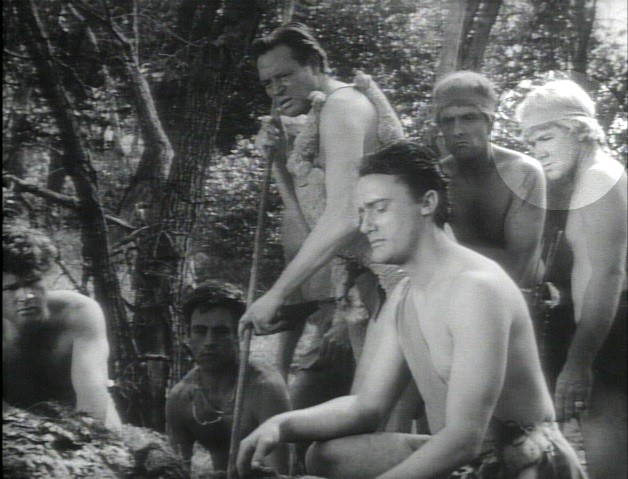
Later, when the shoot moved to Bronson Canyon, Corman found Dickerson hanging around the wardrobe truck and ordered him to get into costume for the next crowd scene. When told he couldn’t because his character was dead, the director told him not to worry because no one would ever notice. Well, actually, it’s kinda hard not to:


And then came one of the most pivotal scenes in the movie, when the rider from the Burning Plain appears, where the Law says nothing can live. Again, Dickerson was a last minute casting decision, here.

Dressed in a bearskin rug, a fright wig, and a big bushy paste-on beard, Dickerson was thrown on a horse and then started looking for a soft spot to land. There wasn’t any. See, the scene called for him to ride in and be stoned to death by the frightened tribesmen. “I’m not a stuntman,” he told Corman. “You’re just as capable of falling off a horse as anyone,” encouraged his director. “And save you fifty bucks,” replied the actor.


Now, if you take a closer look during this sequence as we cut back and forth between rider and the knot of frightened and belligerent cavemen, you can also spot Dickerson lingering in the crowd. And most hilariously of all, guess who threw the fatal spear that causes the rider to fall off the horse?


That’s right, now Dickerson has officially killed himself onscreen. And this time there had to be a second take of the horse stunt because on the first attempt cameraman Floyd Crosby caught a glimpse of Dickerson’s tightie-whities as he went ass over tea-kettle that ruined the shot.


Dickerson is next spotted whacking a tom-tom at the memorial service for the fallen rider as the winds of change start wafting over the tribe. And to make these changes permanent, Vaughn heads back across the river, determined to bring back the head of the notorious Beast that Gives Death with its Touch, a prop that would serve double-duty in Corman’s Night of the Blood Beast (1958), which, as far as I know, was not played by Dickerson.

And that’s because he’s part of a trailing party of zealots, led by Crank, who is determined to kill the Boy and maintain the status quo. Yeah, don’t let that crappy wig fool you. That’s our boy, Beach, alright. And it seems only fitting that when the dust settles, with Crank dead, the most adorable pack of feral dogs ever beaten back, and The Beast vanquished and unmasked, Dickerson and his wig are still standing at the end to help defuse that final plot twist.


1958 was a big year for Corman. After ram-rodding almost ten features that ranged from Hawaiian intrigue in Naked Paradise (1957) to Scandinavian hi-jinx with the marquee busting The Saga of the Viking Women and their Voyage to the Waters of the Great Sea Serpent (1957) the year before, Corman’s next feature was a slight change of pace; a bio-pic on the notorious gangster, George Kelly, better known as Machine Gun Kelly (1958). And with the help of a strong script and stand out performances by Charles Bronson as the cowardly Kelly and Susan Cabot as his deadly muse, the production earned some favorable reviews, especially the European critics, who praised the low-budget auteur for his themes and overall aesthetic. And while Machine Gun Kelly was finding its legs, Corman's next feature, The Wasp Woman (1958), was the first film financed and distributed independently through his new company, The Filmgroup. And all of this set the stage for his next feature; a strange mash-up of Kelly's psychological themes and subtext mixed with the gonzoidal schlock of The Wasp Woman, where Corman apparently believed in his new press-clippings a bit too much, I think, as he pretentiously went all Bergman on a caveman movie and pounded the resulting film within an inch of its life with the giant clown-hammer of significance!

Now, one would like to give Teenage Caveman some credit for beating the post-apocalyptic revelation of Planet of the Apes (1968) to the punch by almost a decade, but this was kinda stolen wholesale from Stephen Vincent Benét’s short story, By the Waters of Babylon, which was kind of raided and plundered mercilessly by Corman and screenwriter, R. Wright Campbell, who left nothing in the pantry, then wrapped it up in loincloths and furs and stock-footage lizards and hoped nobody would notice. Their resulting film barely breaks over an hour, and so, with its heavy allegorical themes it might have been better suited as an episode of The Outer Limits, where I think it would fit right in somewhere between The Zanti Misfits and The Controlled Experiment. Don't get me wrong, I like the movie quite a bit and have always admired Corman's chutzpah of wheedling and weaving his progressive and anti-establishment views into his films; here, expressing his thoughts on the horrors of teen angst, the generation gap, and sticking it to the man and his archaic dogma.

It was the brass at American International who renamed the film, hoping to cash in on Herman Cohen's wildly successful I Was a Teenage Werewolf (1957) -- it was even packaged with Cohen's third Teenage monster-fueled sequel, How to Make a Monster (1958). Regardless of whichever title you see it under, Corman's prehistoric/post-apocalyptic tale is by no means a bad film, a bit pretentious maybe -- hell, definitely, but I still dig it. But from what I've read, like with a lot of Corman’s films, what winds up on screen doesn't prove nearly half as entertaining as the story behind the actual making of it. Just ask Beach Dickerson.

Sources: How I Made a Hundred Movies in Hollywood and Never Lost a Dime, Roger Corman and Jim Jerome; Fast and Furious: The Story of American International Pictures, Mark Thomas McGee; Roger Corman: An Unauthorized Life, Beverly Grey;
Other Points of Interest:

This post is only a small part of Christiana Wenher and Silver Screenings' three day extravaganza of multiple mash-ups of many familiar faces in The Dual Roles Blogathon! Thanks to our hosts for throwing out such a wide net for participants. Now follow the linkage and check out all the other entries, please and thank you!

Teenage Caveman (1958) Malibu Productions :: American International Pictures / EP: James H. Nicholson, Samuel Z. Arkoff / P: Roger Corman / D: Roger Corman / W: R. Wright Campbell / C: Floyd Crosby / E: Irene Morra / M: Albert Glasser / S: Robert Vaughn, Darah Marshall, Frank DeKova, Leslie Bradley, June Jocelyn, Jonathan Haze, Beach Dickerson


