On Friday, December 29, 1972, Eastern Air Lines Flight 401 departed JFK Airport around 10:20pm, with the Lockheed TriStar destined to land at Miami International Airport two-hours and twenty minutes later. History shows they did not make it. On board this red-eye shuttle flight were 163 passengers as well as 10 flight attendants and the flight crew; Captain Robert Loft, co-pilot Albert Stockstill, and the flight engineer, Don Repo. By all reports the flight was routine until they reached Miami and prepared for landing, when the indicator light signaling that the front landing gear was down and locked failed to light-up. After several more attempts failed to get the proper signal, and assuming it was due to a burnt-out bulb, Flight 401 contacted the airport, aborted the landing, and requested a holding pattern, wanting to circle around until they could visually confirm the landing gear was properly engaged. Told to head west over the Everglades and to circle at 2000 feet, Flight 401 complied.


From there, a series of small but accumulating missteps would end in disaster, beginning with Repo leaving the cockpit via the “hell-hole” into the avionics bay directly below to check on the landing gear. Meanwhile, both pilots began to tinker and disassemble the landing gear-panel to try and trace the source of the malfunctioning light, thinking the plane was on autopilot. Well, it was but it wasn’t set right. Seems the autopilot could either be set and locked to a certain constant altitude or set to hold at whatever altitude the pilot last left the stick at. And so, at some point, the toggle was accidentally switched to the wrong setting. And as the fatigued and frustrated pilots fought with the stubborn panel, any amount of forward pressure on the controls caused an imperceptible loss in altitude as the autopilot kept readjusting.


And as the seconds ticked away and the plane unwittingly got lower and lower, an altitude warning chime went off at the engineer's station, which went unheard because the engineer wasn’t there to hear it. And when the pilots finally realized how low they actually were it was already too late and Flight 401, in the middle of a scheduled turned, clipped into some trees and crashed, the left wing impacting first and then subsequently torn off, burrowing into the swamp at 227mph, breaking up completely as it went.

There were two eye-witnesses to this crash: Robert “Bud” Marquis and Ray Dickinsin, who were out gigging frogs in an air-boat. They rushed to the scene, lit by burning fuel, and started pulling survivors from the wreckage -- Marquis receiving severe burns over most of his body as a result, but he pressed on with his heroic efforts, shuttling the injured to drier and more solid ground.


In the end the fault of the crash was determined to be pilot error as "the failure of the flight crew to monitor the instruments during the final four minutes of flight, and to detect an unexpected descent soon enough to prevent impact with the ground. Preoccupation with a malfunction of the nose landing gear position indicating system distracted the crew's attention and allowed the descent to go unnoticed." In response to this tragedy, many airlines established new protocols for their pilots and crews when confronted with faulty equipment, requiring at least one pilot to be monitoring the other instruments at all times, to prevent this from ever happening again.

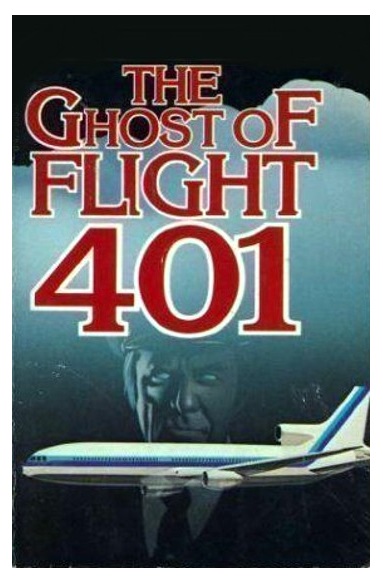
This tragic tale would eventually be translated into two books. The second, Rob and Sarah Elder’s Crash (1977), which inspired a made-for-TV movie, Barry Shear’s The Crash of Flight 401 (1978) for ABC, focused solely on the crash itself and the investigation by the NTSB; and while the film dramatized the crash it was mostly concerned with the man in charge of the dogged investigation (William Shatner) as he fights for the truth and resists a possible cover-up by the airline and the plane’s manufacturer. However, the tale told by the first published book, John G. Fuller’s The Ghost of Flight 401 (1975), which also inspired another telefilm for NBC, doesn’t end with the crash or even the resulting investigation. No, according to Fuller that was only beginning of the story as the crash of Flight 401 also spawned a ghostly urban legend that haunted Eastern Air Lines and her flight crews and passengers for years after that fateful night.

John Grant Fuller Jr. was a New England based journalist who wrote a column for the Saturday Review magazine. He was also notorious for writing articles about the UFO phenomenon, metaphysics and other supernatural shenanigans, which soon turned into an obsession with several books written to cash in. First up was Incident at Exeter (1966), which established the author’s modus operandi of heavy research and exhaustive interviews with alleged eye-witnesses of a rash of UFO sightings in New Hampshire. Fuller followed that up with An Interrupted Journey (1966), which focused on Betty and Barney Hill, a bi-racial married couple who claimed to have been abducted by aliens and experimented on. And in 1974, Fuller published We Almost Lost Detroit; an exposé on a near-miss Chernobyl level incident that railed against the dangers of atomic energy. Now, Fuller’s wife, Elizabeth, was a former flight attendant for NorthWest and perhaps she’s the one who clued him into the ghost sightings that were haunting a rival airline. However they got on the trail, the two collaborated and carried out several interviews with wary airline personnel, which netted them some compelling testimony and a best-seller.


Steven Hilliard Stern’s adaptation of the book, The Ghost of Flight 401 (1978), begins with ominous portent, personified by a wife’s (Rossen) unheeded pleas that her husband, a flight engineer, call in sick and skip his next scheduled flight. But despite his wife’s unease and feelings of impending dread, Dom Cimoli (Borgnine) never called in sick a day in his life. And so, he kisses his wife goodbye and heads to the airport. From there, the film follows fairly closely to the truth as we meet the rest of the passengers and crew in short order, including the two pilots (Johnson, Hessemen), and Prissy Fraiser (Basinger), one of the stewardesses, as the plane takes off from Florida without incident, makes it to JFK, and then starts back on its return trip to Miami but doesn’t make it for the same reasons described above.


And after a few harrowing scenes of the downed airplane and pulling survivors from the half-submerged wreckage, including Prissy and Cimoli, who was in the nose of the plane checking on the landing gear when 401 crashed, and like his real life counterpart, later died in the hospital, the film essentially glosses over the investigation, quickly chalking it up to pilot error and moving on. For, both Fuller’s book and the movie inspired by it were less interested in what happened before the crash and more interested in what happened after, especially the salvageable parts of Flight 401 once they were released by the NTSB as pieces of the downed airliner were cannibalized and recycled as spare parts, while even larger sections were used and incorporated in the construction of brand new TriStars by Lockheed; and not necessarily interested in those parts themselves, either, but what managed to latch onto them -- ectoplasmically speaking.


Seems at some point after the crash, there were numerous sightings by multiple witnesses of the ghost of both Loft and Repo, mostly on other flights by both passengers and crew; some who knew and recognized them while others were complete strangers as they seemed to keep a silent vigil over the airplanes. In one instance a flight's captain and two flight attendants claimed to have seen and spoken to Loft before take-off, watched him vanish, and were so shaken by this they cancelled the flight. Another incident found an Eastern Air Lines executive having a one-sided conversation with whom he assumed was the captain of a flight only to realize it was Loft he was talking to. On another flight, a hysterical passenger called for a stewardess because she was concerned for an unresponsive man in uniform who looked pale and ill sitting next to her who subsequently vanished into thin air. The passenger would later identify Repo as the man she’d seen.


Witnesses didn’t always get the silent treatment either, especially the ghost of Repo, who would materialize during pre-flight inspections and offer to help or just pitch in, having been spotted several times in a plane’s galley, tinkering with an oven door. He was also spotted in a hell-hole once when the command crew heard knocking from below. But the most notorious incident happened on a flight to Mexico City, where Repo was once more spotted in the galley by a flight attendant, who reported it to the captain, who sent the engineer to check it out, who recognized his old friend as he intoned a warning from the beyond to “Watch out for fire on this airplane.” And sure enough, one of the engines caught fire but the plane managed to land safely when the fire just as mysteriously put itself out. During a later encounter, Repo promised "There will never be another crash. We will not let it happen."


At least twenty some ghostly encounters were reported and at some point someone put it together that these paranormal activities were only happening on planes with recycled parts from Flight 401. For their part, Eastern Air Lines vehemently denied or downplayed these incidents. Former Apollo astronaut and current Eastern CEO Frank Borman called Fuller’s collected ghost stories a load of garbage. Borman even considered suing the author for libel, based on his assertions of a cover-up by the airline, but nixed it, not wanting to give Fuller any free publicity. The family of Captain Loft did file a lawsuit against Fuller for invasion of privacy but the case was thrown out.

Perhaps this lawsuit was the reason the telefilm focused solely on the ghost of the flight engineer, with Cimoli subbing in for Repo, which recreated many of the incidents described above. Ernest Borgnine does excellent work as always, humanizing a character in a plot full of ciphers who are only there to string several events together. (The chemistry between he and Rossen is brief but palpable.) Beyond that you got Gary Lockwood, a novice Kim Basinger, and a ton of familiar TV faces who bring a sense of true camaraderie and sell the hell out of these incidents -- and sharp ears will easily identify veteran voice-man Paul Frees as the narrator, who also pops up constantly as several other voices either on the radio or the intercom.


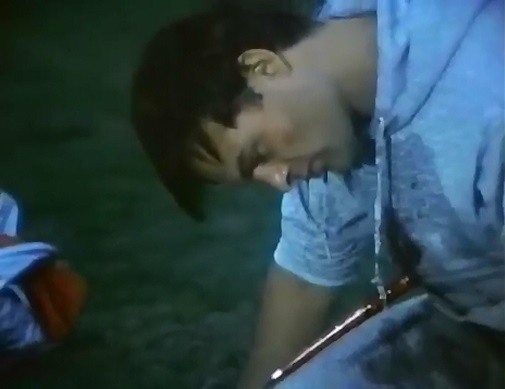
Essentially a journeyman episodic TV director with a few feature films under his belt [The Devil and Max Deviln (1981)], Stern did carve himself out quite the niche directing made for TV movies, most notably Mazes and Monsters (1982) and Hostage Flight (1985). Here, Stern does an admirable job of mixing the straight with the supernatural by making the right decision not to sensationalize anything as the whole film comes off very sober -- almost procedural. Stern and cinematographer Howard Schwartz’s use of a free-floating subjective camera gives the viewer a sense of something ethereal moving throughout several scenes post-crash and I love the subtle use of camera movements in the slow-pans over an empty seat only to look back a second later and see something that definitely wasn’t there before, which then just as quickly disappears. And even on the brutally washed out print I watched on YouTube the creepiness of the aftermath of the crash, with bodies moving and floundering in the muddy water amongst the dead and the wreckage are harrowing and startlingly effective and, again, makes you wish someone would give these old telefilms a digital upgrade.


Screenwriter Robert Young also had a prolific career on the small screen, penning several other telefilms, including Diary of a Teenage Hitchhiker (1979) and Starflight: The Plane That Couldn't Land (1983). And while the film is enjoyable enough as is, it might’ve been better served to flesh-out the middle a bit between the crash and the first sighting as we get forty minutes of a disaster movie followed up by an hour long crypto-doc that gets kind of stuck in a cycle of sighting, denial, sighting, denial, sighting, denial etc. as a tight-knit group of pilots, engineers and flight attendants try to unravel the mystery of why the spirit of their friend hasn’t moved on while also trying to hang onto their jobs when they try to report the truth of what they’ve encountered to the higher-ups; namely some weasley pencil-pusher named Evanhower (Lockwood), who serves as our doubting Thomas until Cimoli’s voice appears on an inflight recording.


And so, with concrete proof, this same group seeks out the help of a couple of mediums (Roche, Oppenheimer), who explain the psychometry of what happened and then perform some kind of ritual seance that encourages the spirit of their departed friend to let go of his guilt and cross over into the light. Couple this spiritual cleansing with the airline finally caving and removing all those recycled parts of Flight 401 from their fleet, allowing Cimoli to finally rest in peace, these multiple hauntings and sightings (and the movie and this review) suddenly came to an abrupt end.

What is Hubrisween? This is Hubrisween. And now, Boils and Ghouls, be sure to follow this linkage to keep track of the whole conglomeration of reviews for Hubrisween right here. Or you can always follow we collective head of knuckle on Letterboxd. That's seven down with 19 to go!

The Ghost of Flight 401 (1978) Paramount Television :: National Broadcasting Company (NBC) / P: Emmet G. Lavery Jr. / D: Steven Hilliard Stern / W: Robert M. Young, John G. Fuller / C: Howard Schwartz / E: Harry Keller / M: David Raksin / S: Ernest Borgnine, Carol Eve Rossen, Gary Lockwood, Tina Chen, Kim Basinger, Howard Hesseman, Russell Johnson, Robert F. Lyons, Alan Oppenheimer, Eugene Roche, Paul Frees