Saturday, December 22, 2018

Boob-Tube'n :: F-Troop :: For the Hero Who Sneezed: Lieutenant O'Rourke, Front and Center (1966).


It’s just another quiet day at Fort Courage (-- well, at least the watchtower hasn’t been blown up or collapsed yet, so we’ll call that a win), when a Major Duncan arrives carrying a whole saddlebag full of trouble. 

Seems the brass back at territorial headquarters haven’t been too impressed with the last few batches of graduates from Officer Candidate School; and so, Duncan (Gregory) has been charged to visit all army posts within his jurisdiction to seek out those of sterner officer material, conduct a battery of exercises to evaluate all enlisted personnel, and then award a few field commissions to those who pass muster.
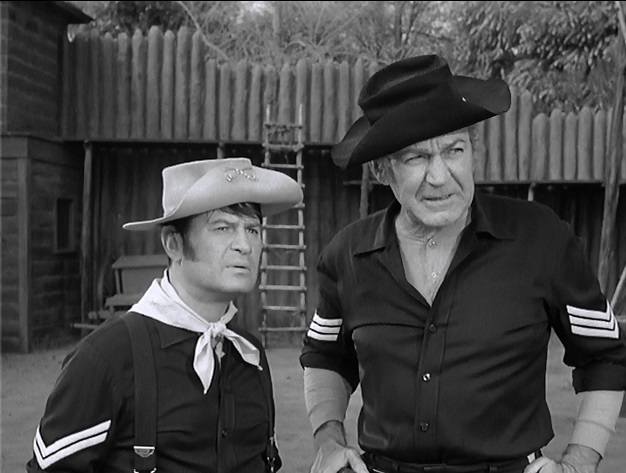


Thinking this is a swell idea, the fort’s commanding officer, Captain Wilton Parmenter (Berry), reminds Duncan how he, himself, was awarded just such a battlefield commission toward the end of the Civil War (-- backed up by the TV show’s opening theme song). 

Well aware of the disastrous chain of events that led to the “legend” of the Scourge of the West, Duncan rim-shots they were well aware of this down at headquarters, but decided to go through with these tests anyway.


Thus, the screening will begin with a test of physical fitness; namely an imposing obstacle course, which is to be completed under simulated battlefield conditions with Duncan and Parmenter firing arrows over the men’s heads. 

And after Sergeant Morgan O’Rourke (Tucker) goes over how the course is to be traversed, a line quickly forms on the left, wanting no part of this, starting with Dobbs (Hampton), who complains of dizzy spells from blowing his bugle too hard; trooper Duffy (Steele) cites an old leg wound he picked up at the Alamo fighting alongside Davy Crockett that's flaring up again AGAIN; the company's blind-as-a-bat lookout, trooper Vanderbilt (Brooks), can’t decide which elbow he threw-out pitching horseshoes; and Hoffenmueller (Mitchum), the fort’s Indian interpreter, who can speak Cheyenne, Apache, Hekawi, and Shug, but not a word of English, expresses how sein knöchel ist gebrochen in his native German.


Soon, the whole lot is protesting; and just when things appear to be getting completely out of hand, order is restored thanks to O’Rourke and Corporal Randolph Agarn (Storch) and the judicious use of his hat to beat the rabble back into some sense of order. 

And then, after a few last words of encouragement from their Captain, the exercise commences. And what happens next, well, why tell you when I can just show you:


Thus and so, when this exercise grinds itself to a complete halt, Duncan calls off the test over Parmenter’s protests, feeling his men weren’t given a fair shake -- even as Duncan stresses the U.S. Cavalry hasn’t suffered such a brutal and ignominious defeat like this since the Battle of Bull Run. 

And while Parmenter fears this means his men will miss out on a promotion, Duncan says not so fast. Seems he feels there is one man in this forsaken outfit worthy to lead and asks for a soon to be newly minted Lieutenant O’Rourke to step forward and accept his bars, which, believe me, is the last thing the scheming O’Rourke wants to do...


When William T. Orr was put in charge of Warner Bros.’ fledgling television division in 1958, one of the first things he did was to move the whole department from New York to Los Angeles. 

Now, before being placed in charge, Orr had forged a steady working relationship with the American Broadcasting Company (ABC), which had been languishing in third place in the ratings against the other big two (NBC, CBS) since they first found a place on the TV dial, with a series of highly successful westerns, starting with Cheyenne (1955-1962), which reinvented the genre for TV with its hour-long format, higher cinematic production values, and adult themes, which inspired the follow-ups, Colt .45 (1957-1960), Sugarfoot (1957-1961), and the wildly popular James Garner vehicle, Maverick (1957-1962).


After the move to California, Orr followed up with a few more westerns, Lawman (1958-1962), and Bronco (1958-1962), before branching out with a series of detective shows. And just like with his westerns, these series all belonged in the same “shared universe” beginning with 77 Sunset Strip (1958-1963), then Bourbon Street Beat (1959-1960), Hawaiian Eye (1959-1963), and Surfside 6 (1960-1962). And during the height of his run, Orr had no fewer than 9 prime-time programs on the air at one time. 

But by 1963, Orr had had his fill with the cheapness of his parent studio, which had cost them plenty of star-wattage over contract disputes and their staunch refusal to switch to color over cost concerns, which would come back to bite Warner’s in the ass when it came to later syndication packages for these storied programs. And with that, Orr left the company to join Frank Sinatra’s Essex Productions.

F-Troop (1965-1966) would be one of the last TV-series Orr would greenlight for producer Hy Averback. The brainchild of Richard Bluel, Seaman Jacobs, Ed James and Jim Barnett, this show would be a broad spoof and satire of westerns, relying on slapstick, sight-gags, and physical humor for most of its yuks, drawing inspiration from shows ranging from The Phil Silvers Show (Sgt. Bilko) (1955-1959), Mchale’s Navy (1962-1966), Get Smart (1965-1970), and even Gilligan’s Island (1964-1967).

The series would revolve around two main characters, Sgt. O’Rourke and Cpl. Agarn, and their schemes to bilk as much money from the U.S. government as possible, drawing pay and rations for non-existent troopers, and then funnel that into O’Rourke Enterprises, which includes business dealings with the local Indian tribe, the Hekawis, led by their wily Chief, Wild Eagle, played by a constantly scene stealing Frank DeKova, who mass produce wild west trinkets and artifacts to be sold to tenderfoots back east. And when the bumbling Parmenter was assigned as their commander at Fort Courage, he was the perfect pigeon to dupe and distract to keep this cash-cow rolling along, leading to much wackiness per episode.


Of course, any kind of promotion would lead to a reassignment for O’Rourke, which would bring all of this profiteering to a screeching halt once he becomes an 'officer and a gentleman.' And that phrase, thinks O’Rourke, holds the key to his immediate demotion and soon hatches a scheme with Agarn, who finds Major Duncan in Captain Parmenter’s quarters. 

Duncan had just missed “Wrangler” Jane Thrift (Patterson), a resident of the nearby town, who dotes on Parmenter something fierce, including nocturnal visits to the post for a little petting, which is against regulations. And Parmenter is such a stickler for these regulations, and rodent control, a flabbergasted Duncan is about to seek lodging somewhere else when Agarn blunders in to say Sgt. O’Rourke has gone A.W.O.L. but won’t say where, opting to show Duncan instead, for it must be seen to be believed, leaving the fussbudget Parmenter behind to deal with his cheese and traps.


And when we do eventually see what Agarn was alluding to, I’m still not sure I believe it as he leads Duncan past the rock that looks like a bear and then turns left at the bear that looks like a rock to the Hekawi camp that’s been transformed into … Wait for it … The Playbrave Club, complete with Playbrave Squirrels, The Tomahawk Trio house band, and a go-go dancing floor-show:


Once their horses are turned over to the valet, they are greeted by the Maître D', Crazy Cat (Diamond), who took over for Roaring Chicken (Edward Everett Horton) as Wild Eagle’s second in command. 

And as Duncan soaks this all in, he comments how he’d like to help these “little squirrels” gather acorns for the winter. Hi-YO!


But Agarn pushes him on, staying on mission, to arrest Sgt. O’Rourke, whom they find in the company of Wild Eagle, who claims his good friend is a card carrying member of the Playbrave Club and has attended their soiree every night since they opened.

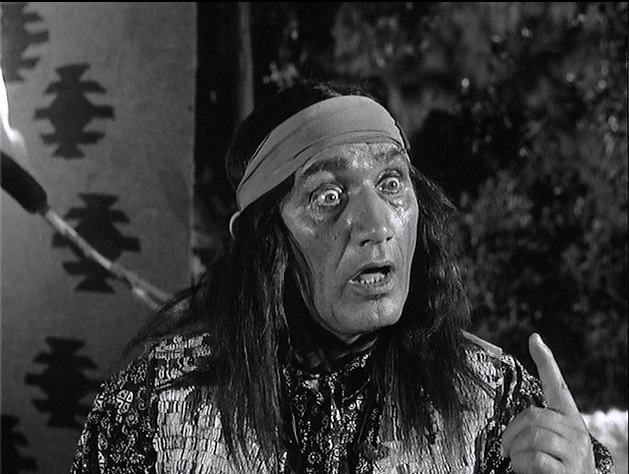


And as Agarn reads off the litany of charges against O’Rourke, who stands to take his punishment for conduct unbecoming of an officer to be, Duncan smiles, waves it all off, saying any man who can lead him to a place like this is just the kind of leadership he’s looking for. The army is looking for men like O’Rourke, not glorified housekeepers like Parmenter, you see.


The following morning, as Lt. O’Rourke and the newly minted Sgt. Agarn inspect the troops, including a promoted Cpl. Dobbs, who is holding auditions to replace him as bugler, O’Rourke bemoans he has less than 24-hours before he takes a 70% cut in pay -- unless he can convince Parmenter to let him remain at Fort Courage. 

But as they wait outside Parmenter's quarters, they overhear an argument between Duncan and their Captain. Seems Duncan has lost all patience with the fuddy Parmenter and plans to bunk with Lt. O’Rourke, who definitely won’t be greeting him in his nightcap and feather duster.


Thus, with salvation at hand, O’Rourke acts the part of Parmenter, rather deftly I might add, and runs Duncan off with those Lt. bars in tow, leaving us with the final coda, where Agarn, Dobbs and Hoffenmeuller are all relieved of their promotions, once again bringing the denizens of Fort Courage right back to where we started.

When F-Troop premiered on September 14, 1965, it was given a brutal time-slot on Tuesday nights opposite CBS’ nigh invincible, The Red Skelton Show (1951-1971). But positive critical response and a rapidly developed and loyal fanbase soon found the show cracking the Top 10 in the Nielsen ratings. 


As usual, Warners wouldn’t OK the show unless it was shot in black and white to save money. (The fort was built on the Warner Bros. backlot in Burbank, adjacent to one of its two western town streets.) And yet, despite this monochrome treatment, for the first three months of that inaugural TV-season, F-Troop was ABC's biggest new hit. 

But just when it seemed to be finding it’s comical legs and really breakout, the show would be quickly overshadowed by a mid-season replacement when the Adam West version of Batman (1966-1968) debuted on ABC in January of 1966 and Bat-Mania swept the country.


Still, F-Troop had solid ratings and was granted both a second season and an upgrade to color. And the show continued to hold its own through its sophomore run despite the loss of many of its writers and a third season appeared to be in the can. 

Unfortunately, the show was deemed too expensive for its allotted running time by the Warner execs, which was compounded by a merger with Seven Arts, who had no interest in continuing the show whatsoever, which officially shuttered-up Fort Courage for good after two seasons and 65 total episodes.


Like with Gilligan’s Island, once you embrace the absurdity of the premise the show is kind of brilliant -- and hysterical. The same goes for F-Troop as far as I’m concerned. It’s also strangely subversive, with a rousing soundtrack by William Lava, and is pretty damned funny in my book. 

I mean, think about it. The tower keeps falling over, sure, but you have to remember who it was who kept putting it back up, explaining why it always collapsed so easily and on such a regular basis. Think about it, won’t you? Thank you.


For the hero who sneezed...
Ken Berry
(1913-2018)


F-Troop (1965-1967) Warner Bros. Television :: American Broadcasting Company (ABC)/ EP: William T. Orr / P: Hy Averback, Herman S. Saunders, Richard M. Bluel / AP: Phil Rawlins / D: David Alexander / W: Arthur Julian / C: Robert Hoffman / E: James T. Heckert / M: William Lave / S: Forrest Tucker, Larry Storch, Ken Berry, Melody Patterson, Frank DeKova, James Hampton, Bob Steele, Don Diamond, Joe Brooks, John Mitchum, James Gregory

Wednesday, December 5, 2018

Good Reads :: No Assembly Required.


I’ve been reading The Avengers for a long time now. I was there for the Kree-Skrull War, and the "War" with the Defenders. 


I was there when they fought the Serpent Crown and the Squadron Supreme, barely survived the Korvac saga, government dictated line-ups, and outlasted innumerable extinction-level schemes from Ultron.


I’ve encountered celestial beings, mad Titans, and even saw an android marry my favorite mutant. I’m well versed in several encounters with the Masters of Evil, especially the time they took over the Mansion and nearly destroyed the team. (No. Seriously. I thought the bad guys had ‘em that time.)


I was there for Onslaught, Rebirth, and Reborn. I remember when Kang actually conquered the world, and then watched as the team rallied and took it back from that tin-pot tyrant from the future one issue at a time.


I’ve seen them disassembled, reassembled, fragmented, and franchised. (Great Lakes Avengers represent!) Watched as they went through a Civil War, a Secret Invasion, a holy war with the Phoenix-possessed X-Men, and cheered when they rallied the Universe and stopped the cosmic Builders cold on the Galactic Frontier. Not to mention seeing them through not one, or two, but three Secret Wars.


I’ve seen them get bigger, smaller, younger, older, and even darker, and seen characters and line-ups, writers and artists, both good and bad, come and go. But I don’t think I’ve ever read anything quite like the first trade of Jason Aaron’s current run on Earth’s Mightiest Heroes.


If you’re a fan of the franchise, this belongs in the conversation as one of the greatest Avengers stories ever told. My mind be boggled. And I cannot wait to see what happens next. Go. Read this. NOW! 

Monday, November 26, 2018

War is Hellaciously Gruesome :: A Beer-Gut Reaction to Richard Raaphorst's Diesel-Punk Masterpiece, Frankenstein's Army (2013)


As the German lines collapse on all fronts as World War II breeches its bloody climax, a famed Soviet long range reconnaissance patrol led by Lt. Novikov (Gwilym) mops up what little resistance is left as the enemy retreats from the Red Army’s wrath and its inexorable push toward Berlin. Tagging along on this mission is Dimitri (Mercury), a political officer, sent to document these heroes of the Great Patriotic War on film for propaganda purposes, which lets us meet the rest of the squad as the cameraman interviews them after each victory: starting with second in command, Sergei (Sasse); team sniper, Alexei (Stevenson); the brutish Ivan (Tang); the hot-headed Vassili (Zayats); and the youngest of them, Sacha (Newberry), who serves as both the radio operator and has the privilege of schlepping around Dimitri's equipment and film stock.


Thus, it’s Sacha who first hears the distress call from another Soviet patrol, who claim to be pinned down and trapped in a nearby village. And it soon becomes apparent those trapped can only transmit and not receive when they do not respond to any reply. Well, turns out the problem might be on Sacha’s end as he can’t raise anyone else on the radio either, meaning their transmissions are in all likelihood being jammed by the Germans. Still, the distress call keeps repeating, and the caller relays their coordinates, where no patrol should be. Regardless, despite no orders or permission, Novikov decides to push on in to enemy held territory and come to their comrades’ aid.


But as the patrol gets closer to their destination, the sights along the way go from strange to downright disturbing -- even in this age of Nazi atrocities and Uncle Joe’s scorched earth tactics. Most of the buildings have been razed, there’s odd bits of machinery scattered all around, and most of the corpses they come across -- combatant and noncombatant alike, appear not to have been shot or blown up but torn asunder; almost as if they were shredded; anomalies Dimitri films studiously. They then come upon the smoldering ruins of a convent, and then find the former occupants, also smoldering, all piled up nearby, victims of some obscene massacre. One of the butchered and burned nuns is still alive but is in so much pain, Vassili quickly puts her out of her misery before Dimitri can get any answers from her as to what happened here.


Then, when they finally reach the village where the lost patrol should be, they find the area completely deserted -- except for a lone sentry found inside a warehouse, blindly groping around, strung up like some obscene marionette, whose appearance is human but not quite; and whose appendage, of what appears to be a jackhammer attached to the elbow instead of an arm, might explain what happened to all those dead soldiers and nuns. Something so hellishly unnatural, half human, half machine, all murder, that quickly lashes out and kills Novikov and proves very hard to put down. And worse yet, turns out it’s not alone...


So, I finally caught Overlord (2018) a few days ago and thoroughly enjoyed this elseworlds saga of the remnant survivors of a parachute squad of Screaming Eagles, who must knock out a German radio-jamming tower before the D-Day landings commence at dawn, only to find something much worse instead: a secret Nazi lab, where a mad scientist is experimenting on the local French villagers as he tries to perfect a serum which can not only reanimate fallen soldiers of the Wehrmacht but grant them enhanced strength, speed, and durability to serve the thousand year Reich indefinitely.


But! This process has not been perfected yet, resulting in several ghoulish guinea pigs lurking around to be discovered by our paratroopers as the clock keeps ticking and the deadline of the landings at Normandy ever looms as they try to stay alive and undetected to complete their mission and rescue the younger brother of a French woman, who had helped them along the way and pitches in during the final assault.


I think it’s the ticking clock element that really helps keep Overlord moving, as all the zombie-fu is secondary to the main objective, making it a pretty good war movie for such a monster mash. And for a monster mash, it’s a pretty good war movie. It’s also anchored by a couple of great performances by Mathilde Ollivier, as the resistance fighter, and Wyatt Russell, who comes off pretty well as the grizzled and hardened corporal even though he was channeling his father pretty hard in spots -- but he hasn’t quite got the old man’s delivery on his punctuating quips down just yet; but I think he’ll get there.


But as the film played out I kept getting distracted by one single thought as we moved deeper and deeper into this mad scientist’s lair and discover what obscenities these Nazis have cooked up. For while I enjoyed the movie quite a bit, it all came off a little tame after being exposed to Richard Raaphorst similar World War II based body-horror film, Frankenstein’s Army (2013). Then again, if you’ve seen Frankenstein’s Army, like I had, what wouldn’t be tame compared to that? And after leaving the screening of Overlord, I had the itch to watch it again.


Seems back in the early 2000s, Raaphorst was one of the first filmmakers to try and crowdfund a film via the internet. And what he had envisioned was a practical special-effects driven dark comedy called Worst Case Scenario, which would center around a cadre of undead Nazi-cyborgs surfacing from the sea and laying siege on some beach resort. Pre-production on the film began in 2004, and in 2006 two teaser trailers were released. (Teaser one. Teaser two.) But the film never went much further than that and was officially abandoned in 2009. But, Raaphorst folded a lot of the monster designs for the project into his next idea, Frankenstein’s Army, which was cooked up by him and Miguel Tejada-Flores.


An what they concocted is an inexplicably effective first-person shooter / found footage / torture porn / World War II period piece that regrets nothing while it does a naked cannonball into the splatterpunk pool. The plot about a Russian patrol being lured into a trap is fairly irrelevant because once the дерьмо hits the вентилятор, they're nothing but fodder for the FX to buzzsaw thru as Sergei takes charge after Novikov is killed despite Vasili's challenge. They then stumble upon a cache of caged animals and ambush their caretaker, capturing him. But while Dimitri interrogates the old man, trying to find out what that thing was, and who was behind it, he claims to know nothing and only cares for the animals. Here, Vassili loses his temper and tortures the prisoner, cutting several fingers off, until the old man relents and agrees to take them to the man in charge, who will answer all their questions.


But as the prisoner leads them deeper into the catacombs below the warehouse, turns out he was leading them into a trap all along as several more “zombots” -- zombies with huge metal implants, including one with giant metal pincers for hands, one on stilts that looks like a demented mosquito, and yet another whose head has been replaced by an engine and prop from some downed aircraft that makes like a giant weed-whacker with the expected gory results -- and we're barely scratching the surface here. And with each harrowing escape, Sergei’s command gets whittled down a little more in the resulting carnage, including a trio of Nazi-sympathizers, who were trying to escape from “the Doctor,” who has gone mad, they say, and failed.


And during one of these brief respites, Sergei discovers Dmitri has betrayed them. Seems he was the one who orchestrated the fake distress call to bring them all here under orders from the Kremlin to seek out Dr. Victor Frankenstein, the man responsible for these horrible aberrations, and recruit him to their side. And if he refuses, Dmitri has orders to capture him alive at all costs and take him back by force. But despite the threat of political reprisals on their families, the others refuse to obey his orders and abandon Dmitri in this abominable meat-locker of the damned with his camera.


Alone, Dmitri presses further into this phantasmagorical madhouse and stumbles into Frankenstein’s study, where he makes the most bizarre discovery yet: the decapitated head of a woman, still alive, stitched onto the body of a teddy bear. (Production notes would show this woman was Frankenstein’s mother. Overlord tried to pull off a similar gag, and while disturbing it wasn’t quite as disturbing as this.) Moving on, he finds a repository where all the dead (and not quite dead) bodies are hung from the ceiling, waiting for their upgrades and reanimation. Here, Dmitri is discovered by several more outlandish zombots and is captured. He comes to in the galley, where the animal caretaker force feeds him some soup. Turns out this was Victor Frankenstein (Roden) all along; descendant of the original Baron Frankenstein and all that.


Anyhoo, seems the Kremlin had heard Frankenstein had gone rogue and turned against Hitler. But he isn’t all that interested in Dimitri’s sales pitch. Instead, he wants to show the cameraman how his process works, where we see almost everyone we've met thus far has since been "converted," culminating with his latest experiment, which he claims will end the war. And this experiment is to fuse together two half brains; one from a captured Nazi officer, the other from a captured Sergei, who will also play host to this hybrid. Sergei begs for help, but Dmitri refuses and stays on mission. But, once that operation is done, the doctor decides to operate on Dmitri next and film it using his own camera. But this is thwarted by a fail-safe aerial bombardment.


Before Frankenstein can flee, he is shot and killed by Sacha, who refuses to free Dmitri, swipes his camera and his rucksack full of spent film, and vacates. Meantime, Sergei has awoken, breaks free, and has his revenge on Dimitri before the whole lab is obliterated from above. Meantime, the final coda shows Sacha as the conquering hero of the people, who is personally decorated by Stalin himself for his actions.


At times, Frankenstein’s Army almost feels like a demo reel of sorts as the whole thing is in service to the FX and creature creations. All of the FX and gore are practical and done in camera. The zombots are also practical and are some true steampunk inspired wonders -- though given the time-frame, make that diesel-punk. And the only real beef I had with the movie is don't tease me with 'The Sherman Tank that Walks on Two Legs' and then don't do anything with it. And as the expendable meat is herded around from one monster and atrocity to the next it also kinda feels like you’ve stumbled into the world’s greatest Jaycees Haunted House of ever!


Others have already addressed the anachronistic camera Dmitri uses that employs color film stock, a widescreen lens, and captures sync-sound, which I don’t think had been invented for a hand-held camera yet back in 1945. But if you can’t suspend your disbelief for that, you probably won’t for the zombot with a propeller prop for a head either. Such is life in direct to video horror films.


On first viewing, I found Frankenstein’s Army to be both top-notch, production design wise, and a lot of ferocious fun -- if not a tad overwhelming as things piled up in the third act. And it nearly lost me, but the ending and final coda had me giggling like an idiot. And judging by the trailers, I half-expected Overlord to reach those same gorenagraphic heights but, nope. And that’s OK. It didn’t need them, and was shooting for something else. Frankenstein’s Army, meanwhile, scored a direct hit for what it was shooting for, which proved slightly more coherent on second viewing. And those inspired nightmare fuel creatures it unleashed are worth the watch alone. And in action, they are decadently gross and gooey, violent, surreal, and definitely not for the squeamish. But for those inclined to such things the film is absolutely ah-mazing and one helluva thing to see. (And if you hurry, you still might catch Overlord playing in theaters, too.)


Frankenstein's Army (2013) MPI Media Group :: Dark Sky Films :: Pellicola :: XYZ Films :: Sirena Film :: Ministry of Culture of the Czech Republic :: The Czech Film Industry Support Programme / EP: Badie Ali, Hamza Ali, Malik B. Ali, Nate Bolotin, Nick Spicer, Aram Tertzakian / P: Richard Raaphorst, Todd Brown, Nick Jongerius, Daniel Koefoed, Greg Newman / LP: Kristina Hejduková,Pavel Muller / D: Richard Raaphorst / W: Richard Raaphorst, Miguel Tejada-Flores, Chris W. Mitcheli, Mary Shelley (novel) / C: Bart Beekman / E: Aaron Crozier, Jasper Verhorevoort / M: Reyn Ouwehand / S: Robert Gwilym, Hon Ping Tang, Alexander Mercury, Luke Newberry, Joshua Sasse, Mark Stevenson, Andrei Zayats, Karel Roden

Wednesday, November 7, 2018

DANGER :: The Atomic Weight of Cheese Podcast :: Episode 23 :: Because Renny Harlin.


We’ve been doing this podcast for a year and in this extra super special episode we reveal the secret origins behind why we call our podcast The Atomic Weight of Cheese. It has to do, strangely enough, with the 2004 Renny Harlin thriller, “Mind Hunters” (two words), being punchy on a road trip and making fun of something using a terrible Austrian accent. I’d like to tell you it will all make sense but after a year, you know what’s coming at you.


Our podcast can be found on Feedburner, iTunes and we're also now available on Stitcher. You can keep up with the podcast at The Atomic Weight of Cheese. Also, please Like and Follow us on Facebook, Twitter, and Tumblr, where we'll be posting our latest episode updates, episode specific visual aides, and other oddities, nonsense and general mayhem. Also, if it ain't too much trouble, write us a review to let us know how much you like us or how much we suck. So come join us and listen in, won't you? And, sincerely, we want to thank you for going on this journey with us. It’s been challenging, but a blast from top to bottom and we hope you’ll hang out with us as we enter year 2!

Related Posts Plugin for WordPress, Blogger...