Showing posts with label Cinema Sagebrush. Show all posts

Saturday, March 30, 2013

Genre Mash-Up :: A 13 Vid-Cap Look at Henry Hathaway's Sagebrush Slasher, 5 Card Stud (1968)

___  ___  ___  ___  ___  ___  ___  ___  ___  ___  ___  ___
 
"You've preached a lot of funerals around here 
lately. You got something new for this one?"
___  ___  ___  ___  ___  ___  ___  ___  ___  ___  ___  ___ 

5 Card Stud opens quick and dirty with a tin-horn cowpoke getting caught cheating at cards, which is then compounded when the other players overreact, especially the no-account son of the local land baron (McDowall), leading to some swift frontier justice at the end of a rope over the vehement protests of our hero (Martin). Realizing they went too far too late, all involved, seven otherwise outstanding citizens in total, clam up and make a pact to carry the secret of their dirty deed to the grave. This, of course, sets up our bloody tale as several months later someone starts picking off these conspirators, one by one; and whoever is doing it is making a deliberate point as each victim dies most gruesomely by some form of strangulation -- just like the tin-horn. They can't go to the law without implicating themselves, and therefore can only watch helplessly as shoot-first-and-ask-later vigilante mobs run rampant looking for the elusive killer, waiting and wondering who will be next. But who is doing the killing? One of them? Trying to scare the others into silence? Or maybe to make sure the others stay silent forever. Or is someone else out to knock them off? And if so, for what purpose? Revenge, most likely; an eye for an eye, as the good Reverend Rudd (Mitchum) would proselytize -- and to reap what you sow...


When a person digs back into the fossil records looking for films that helped inspire or establish the ground rules for the Stalk-n-Slash boom of the early 1980's the last thing you'd expect to find is a western. And if I told you that same western was also a starring vehicle for Rat Pack booze crooner Dean Martin, you'd probably think I just took a long walk off a very short credulity pier. But let's look at the evidence: 


Now, a person seeking revenge on those who killed his family is nothing new for this genre. Hell, a lonesome quest to put these kinds of killers in the ground is usually championed and one of the rocks on which the western is built. But here, with the focus on the lynch mob, the line between that old trope and a bloody body-count movie is muddied up pretty good. Look, I am in no way saying or implying that Dean Martin is some kind of ersatz Final Girl, but from the set-up, to the kills, to the killer's modus operandi, 5 Card Stud holds almost all the other earmarks of a later day slasher: a sinister secret that links the victims and triggers the whole thing, a familial need for vengeance on the killer's part, signature slayings, layers of conspiracy, mounting paranoia, and a long suspect list that is whittled down with each body found until the real killer is finally revealed. (It's also kind of like Hang 'Em High in reverse.)


Granted, this sagebrush whodunit works best during the mayhem, so, fair warning, it does tend to clunk along when the film shifts focus to the love triangle between our lothario gambler Martin and parlor madame Stevens and good girl Justice. But, we do get to see Mitchum behind the pulpit again, bringing the fire and the brimstone and the lead to the unrepentant. 


Directed with a steady hand by Henry Hathaway with an adapted screenplay assist by Marguerite Roberts (based on a novel by Ray Gaulden), the film gets extra bonus points from me for a nasty, unflinching mean-streak that is sustained throughout the film. (The very next year Hathaway and Roberts would team again with John Wayne for the original True Grit.) Add it all up and this offbeat genre mash-up definitely rates a look even for those who seldom venture out west, cinematically speaking.

Other Points of Interest:


x
Five Card Stud (1968) Paramount Pictures  / EP: Hal B. Wallis / P: Joseph H. Hazen, Paul Nathan / D: Henry Hathaway / W: Marguerite Roberts / C: Daniel L. Fapp / M: Maurice Jarre  / S: Dean Martin, Robert Mitchum, Roddy McDowall, Yaphet Kotto, Katherine Justice, Inger Stevens

Tuesday, November 27, 2012

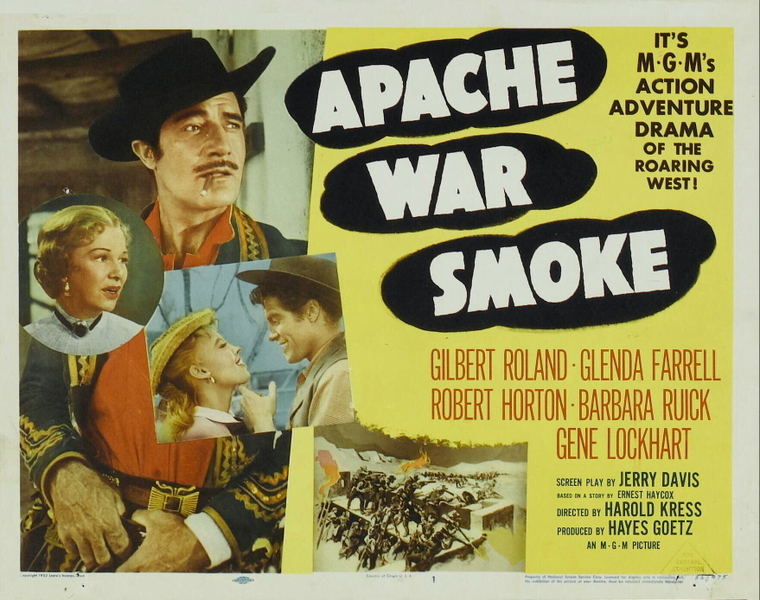
Where the Stageline Ends :: A Beer-Gut Reaction to Harold Kress' Apache War Smoke (1952)


When the latest stage reaches a remote station in the New Mexico territory for a fresh set of horses, the manager (Horton) won't let them leave and asks all the passengers to unload and make themselves comfortable for awhile. Seems the Apaches have been stirred up and all the smoke signals indicate a war party will be attacking soon. To add more fuel to this already highly volatile situation, another traveler shows up seeking refuge; a notorious bandit by the name of Peso Herrera (Roland). But the wary manager, knowing Peso is probably more interested in the army payroll locked up in the stage's strong box, won't let him enter the fortified compound unless he surrenders his guns first.


And we don't have long to meet and greet all of our other trapped players before the Apaches start probing their defenses. Then, another rider barely makes it in, who reveals the Indians are on the prod because some no-goodnik killed several tribal elders and ran off with their prized valuables. (And, hey, didn't Peso just give one of the female passengers an Indian bracelet?) He also says the offended war party have tracked the culprit to this very station and are willing to let the others go if they turn the killer over to them. And as all eyes turn on Peso, circumstantial evidence or not, survival instincts start getting the better of everybody with each renewed attack. And as things fragment further, the manager calls for a vote on whether to kick Peso out, a certain death-sentence, or hold out in hope of promised reinforcements to break the siege. You'd think it would be a landslide but when the hands are counted, its up to our hero to cast the deciding vote...


From the early 1920's to the mid-'50s author Ernest Haycox had a pretty fruitful career writing Two-Fisted Oaters, whether it be a self-contained novel or a serialized novella in the likes of Colliers or The Saturday Evening Post. Eventually, several of those frontier fables were adapted to the big screen, most famously when Haycox's Stage to Lordsburg became John Ford's seminal sagebrush standard, Stagecoach, where a cast of disparate and desperate characters face a tempest without (hostile Indians) and crisis within (class prejudice, which Ford gleefully took the hide off- and exposed the hypocrisy of). That same year, Trouble Shooter begat Cecill B. DeMille's all-star epic Union Pacific; and later, more stories were turned into vehicles for the likes of Randolph Scott (Abilene Town) and Errol Flynn (Montana).


Apache War Smoke was also based on a Haycox story, Stage Station, that had already been adapted once before by Richard Thorpe as Apache Trail ten years prior. Both films cover a lot of similar thematic ground as Stagecoach, only more stationary, but add a familial element to the proceedings. But while Thrope's film centers on two feuding brothers, one the station manager (William Lundigan), the other a notorious outlaw (Llyod Nolan), for Apache War Smoke screenwriter Jerry Davis and director Harold Kress tweak the dynamic a bit, making the station manager, Tom, the estranged, illegitimate son of the Mexican bandito, Peso, who may or may not be the root cause of all that Indian trouble, adding another dynamic element as Tom must decide on what to do next. For Tom really doesn't like his father, and it would've been easy enough to just chuck him over the wall.


This was a rare directorial outing for Kress, who would go on to much acclaim as an Oscar-winning film editor for many a Hollywood epic (How the West Was Won, King of Kings, The Greatest Story Ever Told) and as Irwin Allen's go to guy to patch-up his disaster flicks (The Poseidon Adventure, The Towering Inferno, and The Swarm.) Here, Kress puts in a steady enough effort, a solid B-western, action-wise, that is ably kept afloat by the cast, which is rounded out with many familiar sagebrush stalwarts in supporting roles (Henry Morgan, Hank Warden and Emmett Lynn), and it took me half the movie to realize Luis was played by Robert "Bobbie" Blake.


Apache War Smoke was also Robert Horton's big screen debut, and though he always appeared to have a cob up his ass over something in every role I've seen him in (from this to The Green Slime), to the actor's credit, he pulls this constant obstruction off really, really well and almost makes his asshole-ishness likeable. And Gilbert Roland remains an enigma to me. For only Roland could get away with the swinging-cock(sure) machismo of Peso and make all that swaggering and posturing endearingly roguish when anyone else would have every handy projectile in your house flying at the screen followed by some industrial strength Pine Sol to disinfect your entire entertainment system to remove the oily stench. And I knew my gal Glenda Farrell had to be more than just an old pioneer-marm, who has plenty of saloon hall secrets of her own. As for filling out the corners of the prerequisite love-triangle for our besieged station manager, we have Nancy, a tom-boy army brat with an inferiority complex (Ruick) and Lorainne, an old flame of the prim and proper lady variety (Tiernan), who basically disappears whenever the shit hits the fan only to reappear to drive a wedge between the other two whenever Nancy, the obvious right choice, makes any headway during the lulls.


Again, Kress does better in the aggressive action set-pieces than the passive melodrama. The battle sequences are the true highlights, and the scene where Roland deftly gets the drop on Lynn and Morgan and the silent stare-down/war of nerves that follows as Peso makes his play for the gold shipment is worth the price of a rental alone.


Now, despite its passive/aggressive nature, Apache War Smoke also deserves some props for its forward thinking in some aspects. There easily could've been a derogatory racial element involved, that could've horribly dated the picture, but ethnicity is just a mere coincidence in the territories and Kress wisely ignores it (-- though some could argue that Roland comes off too clownish and stereotypical but I still insist he has the chutzpah to pull it off). No one raises a stink when young Luis, who is half-Mexican and half-Indian makes known his crush for Nancy. Sure the others rib him over this, but no one is frothingly aghast over it. And I love how all the women, especially Ruick and Farrell, pitch in during the fighting, and how Ruick proves Horton's perfect fit for frontier life and gets both the last word and puts her man in his place when he tries to re-establish proper gender roles once the shooting stops. And, once again, the "bad guy" proves infinitely more charismatic than the hero. (Notions that both Boetticher and Leone would pick up and runaway with a few years later). I also appreciated how the true culprit behind the massacre wasn't any of the usual suspects (-- the bandit or the overly worried about what's in the strong-box stageline manager), and the final reveal may seem a bit of a cheat but it makes perfect sense if you take a step back and think about it again. One of the many reasons why Apache War Smoke is well worth your time.


Apache War Smoke (1952) Metro-Goldwyn-Mayer (MGM) / P: Hayes Goetz / D: Harold Kress / W: Jerry Davis, Ernest Haycox / C: John Alton / E: Newell P. Kimlin / M: Alberto Colombo / S: Gilbert Roland, Glenda Farrell, Robert Horton, Barbara Ruick, Patricia Tiernan, Harry Morgan, Robert Blake

Monday, January 23, 2012

Moments of Pure Cinema Fusion :: The Major Rides Alone in William Wyler's The Big Country (1958)

By definition, nuclear fusion is the process by which multiple like-charged atomic particles join together to form a heavier nucleus -- usually accompanied by the release of a massive amount of energy, depending on the elements involved. Applying that theory to film, there are certain moments in certain movies when the direction, cinematography, acting, editing, and soundtrack collide and merge into something I like to call Moments of Pure Cinema Fusion.


As the old joke goes, The Big Country proves just that since William Wyler was bound and determined to show us every. damned. square. inch. of it. Don't get me wrong, I love the movie. I love how Burl Ives steals it. I love how Chuck Connors almost steals it. I love Carrol Bakker and Jean Simmons natural beauty against that wide-open backdrop. And Jerome Moross' score ... well, that's just gravy. A kind of gravy that would make you consume your own head if it was covered in it. Case in point, here, as we barrel toward the climax in Blanco Canyon, with the feud between the Terrils and the Hannassey's about to explode in a hail of lead, after a sufficient lead in where reason is chucked clean out the window, things start to percolate around the 1:45 minute mark, and then reach a boil at about 2:45, with total fusion achieved at 3:07:


Video courtesy of le0pard13.

I swear, that look between Heston and Bickford could have vaporized glacial ice. Like I said. Love this movie!

Credit where credit is due: Directed by William Wyler; story by James R. Webb, Sy Bartlett, Robert Wilder; cinematography by Franz Planer; editing by Robert Belcher, John Faure; music by Jerome Moross; starring Charlton Heston, Charles Bickford.

Friday, December 30, 2011

Fractured Flickers :: Bob Hope Tosses the Perfect Strike in The Paleface (1948).


As with most Bob Hope comedies, the premise of The Paleface is a little -- okay, a whole lot -- convoluted; but, eh, who the hell cares as long as Hope gets to run amok and do his thing, no matter what the character, consequence or setting. And to get to this particular favorite cinematic scene is gonna require some set up first. Here, Hope teams up with Jane Russell in a crackling wild west tale of mistaken identity, gun-fights, and Indian attacks. 


Here, Russell plays Calamity Jane, who, in an effort to get pardon from the governor for past crimes, agrees to help infiltrate a gang of no-goodniks who are smuggling guns and dynamite to a tribe of hostile Indians. But when her partner is killed, needing someone to take his place as "her husband" Jane tabs "Painless" Peter Potter, a frontier dentist and a cowardly doof of the highest order, as her dupe. But as the film progresses, thanks to Jane's clandestine sharp-shooting skills, Painless soon garners himself quite the reputation as a gunslinger, bringing them both into contact with the gunrunners. However, when their duplicity is discovered, the couple is captured and turned over to those Indians for disposal -- just when the blossoming romance between Painless and Jane finally reached full bloom.


And so, Painless faces a horrible death, with each leg strapped to a different sapling -- think of two catapults, sharing the same load, only firing in opposite directions.


But thanks to a loose boot, something goes wrong with the launch, and instead of getting wish-boned, Painless (or a reasonable facsimile thereof) flies off into the wild blue yonder...


Where, luckily, he lands in a tree.


But Painless best get down quick and act fast with a rescue, or his true love will meet a similarly gruesome fate -- of the permanent hot-foot variety.


Working fast, once out of that tree, Painless bumps into the disgraced Medicine Man, banned from the tribe for botching a certain paleface's execution. Unaware of that fact, and needing a disguise to sneak back into the camp undetected to save Jane, Painless commences with the fool-proof plan to make 'em trade, duds for duds.


But a fool and his plan are soon parted, for the kooky savage wants no part of it and heads for the hills, leading to what I think is the best scene in a whole movie full of great ones, where Hope gives chase, takes up a rock, draws a bead on his fleeing prey, and lets it fly...


*bonk*


"WOHOO!"


Bob Feller would have been proud!
That scene just cracks me up. Every. Damn. Time!


Ah, but even with his perfect/imperfect disguise gained, will Painless be able to save his lady fare? Sorry. For that you'll have to track down and tune into the hilarious and somewhat "explosive" conclusion of The Paleface for yourself -- because there's no way the written word, or any amount of vid-caps, could do it justice. Trust me.


The Paleface (1948) Paramount Pictures / P: Robert L. Welch / D: Norman Z. McLeod / W: Edmund Hartmann, Frank Tashlin / C: Ray Rennahan / E: Ellsworth Hoagland / M: Victor Young / S: Bob Hope, Jane Russell, Robert Armstrong, Iris Adrian, Jackie Searl, Chief Yowlachie
Related Posts Plugin for WordPress, Blogger...