

With his ranch ravaged and in near ruin thanks to a plague of rabbits, Cole Hilman (Calhoun) contacts Elgin Clark (Kelley), the president of the local university, of which Hilman is a huge financial booster, looking for help that’s a little more eco-friendly than saturating his land with poison. Clark offers up Professor Roy Bennet (Whitman) and his wife, Gerry (Leigh), who helped Hilman once before with his coyote problem, which, one should point out, indirectly caused the rabbit explosion. (Circle of life and all that.)

Settling on a screwfly solution, Bennet starts injecting several captured rabbits with a series of hormones, hoping to disrupt the breeding cycle but all this does is stimulate rapid growth. And things are soon desperate enough he’s even willing to try and experimental elixir that hasn’t been properly vetted yet. Then, things start to unravel when the Bennet’s daughter (Fullerton) ‘rescues’ one of the test subjects when no one is looking, and then the plot really hits the fan when the infected rabbit escapes into the desert, where it rapidly breeds a mutant strain of highly aggressive and extremely voracious rabbits – rabbits the size of a Volkswagen! (Volkswagen, get it? Get it? No? … … … Never mind.)

Once they are discovered after the authorities follow a trail of dismembered bodies to a mine, efforts are made to contain and kill these monsters. Alas, this effort basically boils down to sealing them underground by dynamiting all the entrances to their warren. (Yeah. I know.) So, it isn’t long before the mutant killer rabbits dig their way out, and their bloody rampage begins anew...

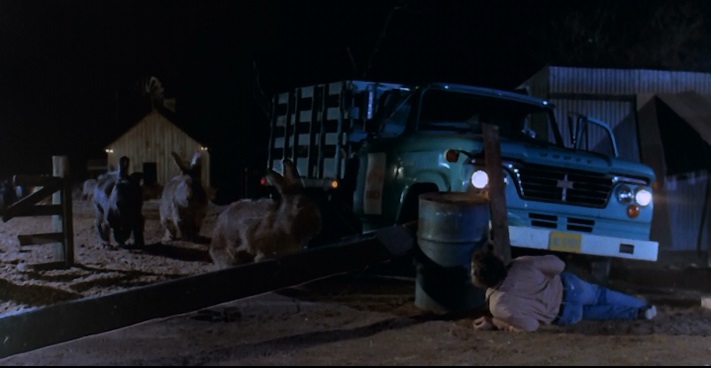

Back in 1859, when a property owner released a mere 24 rabbits into the wild in Victoria, Australia, the ecological and economic impact of this action, basically done as a lark by a hunting enthusiast, is still being felt to this very day. With no natural predator and ideal weather that allowed them to breed year round, the invasive species had essentially overrun Austraila, Tasmania and New Zealand before the turn of the century. Things got so bad, when all other efforts to curb the population had failed, a biological approach was approved in the 1950s with the introduction of the Myxoma virus, which seemed to work wonderfully, destroying over 75% of all infected colonies. (Estimates say it went from over eight million rabbits to less than one million.) But this only worked to a point as the rabbits who survived kept on breeding and soon developed an immunity, creating a need for an even deadlier and more toxic solution.

This seemingly futile war against the rabbits served as inspiration for Russell Braddon's farcical novel, The Year of the Angry Rabbit (1964), which used the backdrop of man vs. nature to frame a scathing indictment on the folly of war and the dangers of nationalism and capitalism gone amok. In the book, a wealthy landowner cashes in a few political favors with the Prime Minister that nets him a batch of Supermyx (Myxoma on steroids) to rid his property of the rabbit pestilence once and for all. But this contagion backfires when it doesn't kill the rabbits but turns them rabid with a lethal bite. They also serve as carriers of the super-virus, which proves fatal to humans. Undaunted, the Prime Minister nukes the property to sterilize the outbreak, but he then weaponizes the virus, which allows Australia to conquer the world in less than three years. This, in turn, leads to total nuclear disarmament, an end to conventional warfare, and peace on Earth appears to be at hand -- except for one problem. The only thing nuking the Supermyx colony did was mutate them into something larger and more dangerous, which breaks out and overruns the continent.

In 1972, a near moribund MGM decided to adapt Braddon's novel as Night of the Lepus (1972), tapping A.C. Lyles to produce it, who tagged William Claxton to direct, who signed Gene Kearney and Don Holiday to adapt the novel, who moved the action to Arizona and stripped out all of the satire but left the giant killer rabbits in. Known for a string of westerns on both the big and small screens, Lyles and Claxton seem odd choices to ramrod a science-fiction horror hybrid but it’s not unprecedented. Back in 1966 Carroll Case, William “One-Shot” Beaudine and Carl Hittleman teamed up for the sinister sagebrush double-bill of Billy the Kid vs. Dracula and Jesse James meets Frankenstein’s Daughter. Alas, neither film delivered on those gonzoid titles, basically coming off as tepid Halloween episodes of Bonanza. Lyles and Claxton fared a little better, though not by much story and production wise; but the film hits ludicrous speed when it came to the execution of its rampaging monsters, which leave quite the endearingly awful impression on the viewer.


In all fairness, despite its dubious reputation, the F/X and miniature work in Night of the Lepus really isn’t that bad, especially when compared to the lackluster and downright dull direction of the non-rabbit elements. It's just that the subject matter is so absurd. A typical F/X shot consisted of live rabbits, filmed in slow motion, running through a series of miniature sets with thundering footfalls piped over them. (Did I mention they trill and growl like grizzly bears?) Now, it might’ve been different if they had used some nasty looking jack-rabbits but what we get are strictly of the cute and fuzzy bunny strain. (The film tries to excuse this by offering several domesticated rabbits had escaped when a rabbit farm burned down.) You even start to recognize a few of them, running through the frame more than once, conjuring up images of some poor grip catching bunnies on one end of the table, running around behind the camera, smearing more fake blood all over them, and then releasing the varmints again, prodding them back into the shot.


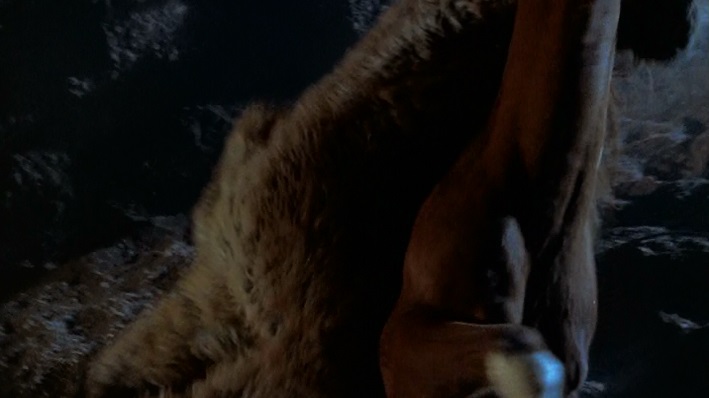


However, where things really breakdown are the (not-frequent-enough IMHO) instances where a stuntman decked in a natty bunny suit leaps into a scene and engages in hand to paw combat with the latest victim – be it human, horse or cow. Keep an eye out for a scene where one of these costumed critters gets conked in the noggin with a rifle butt and then watch the reaction.


When filming was completed MGM took a look and suddenly got cold feet; and they started working on damage control before the film was even released. The title was changed from Rabbits to Night of the Lepus and all promotional materials were redone and had all references to giant killer rabbits redacted. Even the original trailer was cut around them.


Fie and *pfui* on that, I say. These killer rabbits should be celebrated, not mocked. And the film they’re plugged into is actually a nice throwback to the science gone amok, tampering in god’s domain, mutant critters all-out-attack fright flicks of the 1950s. They even bring the army in to deal with monsters, and salvation comes in the form of another electrical arc. In this case, an electrified train track the rabbits are herded onto. In fact, one could argue Night of the Lepus sparked a spurt of other monster movies in the same vein, ranging from Ssssss (1973) to Food of the Gods (1976) to Day of the Animals (1977), adding a little mad-science to the rash of nature’s revenge and eco-disaster flicks of the disco decade.


Again, the FX are the least of the film's problems as the only other thing that sticks with you is Jimmie Haskell's haunting main title theme. Still, any film that contains the line of dialogue “Attention! Attention! Ladies and gentlemen, attention! There is a herd of killer rabbits headed this way and we desperately need your help!” is definitely worth anyone’s time. Also, bunnies! Bunnies! Bunnies! Bunnies! Bunnies! Bunnies! Bunnies! Bunnies! Bunnies! Bunnies! *ahem* Sorry about that. Eh, screw it. Bunnies! Bunnies! Bunnies! Bunnies! Bunnies! Bunnies! Bunnies! Bunnies! Bunnies! Bunnies! Bunnies! Bunnies! Bunnies! Bunnies! Bunnies! Bunnies! Bunnies! Bunnies! Bunnies! Bunnies! Bunnies! Bunnies! Bunnies! Bunnies! Bunnies! Bunnies! Bunnies! Bunnies! Bunnies! Bunnies! Bunnies! Bunnies! Bunnies! Bunnies! Bunnies! Bunnies! Bunnies! Bunnies! Bunnies! Bunnies! Bunnies! Bunnies...

What is Hubrisween? This is Hubrisween. And now, Boils and Ghouls, be sure to follow this linkage to keep track of the whole conglomeration of reviews for Hubrisween right here. Or you can always follow we collective head of knuckle on Letterboxd.

Night of the Lepus (1973) A.C. Lyles Productions :: Metro-Goldwyn-Mayer (MGM) / P: A.C. Lyles / D: William F. Claxton / W: Don Holliday, Gene R. Kearney, Russell Braddon (novel) / C: Ted Voigtlander / E: John McSweeney Jr. / M: Jimmie Haskell / S: Stuart Whitman, Janet Leigh, Rory Calhoun, DeForest Kelley, Paul Fix, Melanie Fullerton


