While exploring the excavated tomb of the young Pharaoh, Tutankhamen, visiting American archeology professor, Douglas McCadden, marvels at what’s left of the ancient burial site that hasn’t been pilfered by graverobbers or museums, when suddenly, a violent earth tremor opens up an undiscovered burial chamber adjacent to King Tut’s tomb that hasn’t been disturbed for nearly 3,000 years. Calling dibs on the entombed sarcophagus he finds inside, McCadden (Murphy) arranges to have it and all of its undisturbed contents shipped back to California with him, where he teaches at the State’s eponymous University of Sciences. And once there, he will officially break the seal and reveal what’s inside to the world.
Now, McCadden’s discovery is a huge coup for the University, explaining the ginormous impending press conference for the sarcophagus’ grande unveiling the following day arranged by the school’s president, Wendell Rossmore (Karen), and his ever present toadie, Bruce Serrano (Chew Jr.) -- who have huge alumni and booster-fed dollar signs spinning in their heads. Meanwhile, McCadden and a group of grad students, including his TA / girlfriend, Susie Miller (Axelrod), begin the slow and methodical process of opening the stone coffin to help preserve and catalogue its contents and the mummified remains of whoever is within. Translating the hieroglyphics on the outer shell, Susie identifies the occupant as Ankh-Venharis, which translates loosely as “noble traveler."


With that, the seals are removed and the sarcophagus is opened revealing a large mummy covered in a strange green dust -- most likely a dormant mold or fungus of some antiquity. And while some samples of that are taken, McCadden quizzes his students on what they see. And what they all agree on is it appears whoever this Ankh-Venharis was, he was obviously buried in a hurry sans the usual mummification process -- therefore, the body should be completely intact. More answers for this puzzle will be found once the body has been x-rayed. Unfortunately, the clumsy x-ray tech, Peter Sharpe (Brophy), fails to check the settings before he starts shooting plates; and thus, accidentally bombards the mummy with multiple massive doses of radiation. This is finally noticed too late by Jack Parker (Random), an engineering professor and a friend of McCadden’s, who at least pulls the plug before the mummy starts glowing in the dark. Sharp offers to start over, but McCadden feels their “patient” has had enough radiation for one day.


Later that night, as he develops the plates, Sharpe notices five jewel like objects near the mummy’s skull. Returning to the darkened lab, he finds the compartment they’re secreted in and assumes these crystalline spheres are diamonds, pockets them, and then covers his tracks with one more x-ray at the highest setting to replace the incriminating original, which he must quickly secret behind some electrical equipment when Parker spots him loitering around. The following morning, Sharpe tries to pawn the jewels but is told they’re worthless. And so, to try and salvage at least something from this criminal boondoggle, he arranges to sell them off to a few of his gullible frat-brothers as gifts for their respective girlfriends, unwittingly putting them all in harm's way for reasons we’ll get to in a sec.


Meantime, at Rossmore’s big press conference, the gathered reporters wait anxiously for the mummy’s unveiling. But things get off to a rocky start when one of McCadden’s students notices a slimy green substances exuding from the seams of the sarcophagus’ lid that wasn’t there before, and then does something really scientific by sticking his finger in it only to find out the viscous substance is extremely caustic. (Well, at least he didn't try to taste it.) And as the screaming student is quickly hustled away, McCadden tries to postpone the unveiling until they can figure out what the gunk is; but the impatient Rossmore won’t hear it. And so, McCadden orders the tomb to be opened -- revealing an empty container! Thus, the press conference is a complete disaster. And while an embarrassed and outraged Rossmore feels this is nothing more than an ill-advised fraternity prank, for which the culprit will pay dearly for running off with his prized mummy, the truth is a little more strange and extremely dangerous. For you see, while those first doses of x-rays managed to reactivate the dormant dust into a lethal flesh-eating fungus, that second blast has apparently awakened something far more worse...


There was an old axiom floating around Roger Corman’s New World Pictures in the 1970s, where the wizened producer would offer these sage words to his underlings whenever they came looking for more money: “Make two successful pictures for me and you’ll never have to work for me again.” To translate this, what he meant was if his filmmakers could make a profitable picture on one of his shoestring budgets, the major studios would soon come knocking. And this they did, causing a bit of a brain-drain at New World as the 1980s got to rolling. Gone were the likes of Ron Howard, Jonathan Demme, Jonathan Kaplan, Joe Dante and Allan Arkush, who were now all making Corman-flavored movies for the majors. Hell, even the second tier talent from Corman’s effects crews were starting to get pilfered as James Cameron went from doing F/X and production designs for Battle Beyond the Stars (1980) to directing The Terminator (1984).

And as the grindhouses and drive-ins dried up and disappeared, Corman also faced a dwindling venue for his first run product, forcing him to shift gears and focus more on making features for the direct to video market. And so, it was during this weird period between 1980 and 1985, when New World was kinda in its death-throes, theatrically speaking, where Corman started looking outside his own studio for product to distribute, which is how he came to be involved in the production of Time Walker (1982); a delightful little creature feature featuring a rampaging mummy with a bit of a sci-fi twist.

The movie began as a story idea concocted by Jason Williams and Todd Friedman. Williams was an actor, whose main claim to fame was starring in a couple of Bill Osco’s demented softcore porn spoofs, Alice in Wonderland (1976) and Flesh Gordon (1974), where Williams played the title hero. I will assume these two met during the production of Flush (1977), a pretty turgid It’s a Mad, Mad, Mad, Mad World (1963) knock-off that Friedman wrote and Williams had a bit-part in. After, the two would concoct a tale about an alien that crash-lands in Egypt three thousand years ago and is severely injured. The radiation the alien admits is also lethal to the touch and wound up killing anyone who tried to help him, including Tutankhamen.


And so, when the alien died, the Egyptians carefully wrapped the body and hastily buried it. Only the alien didn’t die; it just went into some kind of hibernating stasis until it was accidentally revived in the present by those X-rays. And like any stranded alien on Earth, the creature needed to phone home for a ride -- only someone ran off with the energy crystals he needs to power his communication device. And thus, the mummy goes on a campus-wide rampage -- and I do mean rampage as this mummy doesn't shuffle but glides around at a pretty good clip, to retrieve the parts he needs, crushing all in his path or spreading some of that toxic fungus to all of his victims, leaving McCadden, the University’s hospital staff (Stoker, Bower), and the police (Joston) scrambling to unravel what’s really going on and hopefully put a stop to it.


Williams and Friedman then took their idea to Dimitri Villard. Villard was Harvard man, who had served as an editor on the Harvard Lampoon, which would later morph into the National Lampoon. Upon graduation, he started his own record label and co-founded one of the first pay-TV companies in California before selling it off around 1980 to get into the movie production business. And after a brief internship with producer Edward Pressman -- Phantom of the Paradise (1974), Conan the Barbarian (1982), Villard was ready to produce something on his own, cobbling together a quartet of investors, including Corman, who got the U.S. theatrical and home video rights, to bring Time Walker to the big screen, and who would also serve as kind of a ghost producer on the project, offering all kinds of advice to the fledgling filmmaker; like how to skirt around the unions to keep production costs down by shooting the majority of the film on location at Cal-State Northridge, where campus security kept the teamsters at bay. And how when the film was completed, laying down a content-be-damned edict to cut the running time by ten minutes so it would fit in one film can to save money on shipping, explaining away a few jarring edits and leaps in plot logic.


To direct the film, Villard hired Tom Kennedy, a graduate of New York’s School of Visual Arts. From there, Kennedy worked as an editor on Joe (1970) and Silent Night, Deadly Night (1972) before moving to Los Angeles in 1977, where he helped found Kaleidoscope Films, which quickly became one of Hollywood’s goto places for audio-video ad campaigns and theatrical trailers. There, Kennedy supervised the campaigns and trailers for the likes of The Empire Strikes Back (1980) and Return of the Jedi (1983), Indiana Jones and the Temple of Doom (1984), The Terminator, and the Star Trek franchise, running from The Motion Picture through The Voyage Home (1979-1986). And while Time Walker would be Kennedy’s only time in the director’s chair, he does nothing to embarrass himself that couldn’t be rightfully blamed on the film’s low budget, rushed production schedule, and the script’s sketchy material outside the alien mummy rampage.


Still, despite all these hiccups -- like that asinine frat-party interlude, and Rossmore's blundering attempts to frame McCadden for this cock-up, Time Walker still qualifies as one of my most favorite mummy movies of all time because I love the ancient alien angle and the flesh-eating fungus wild card, which is actually exacerbated by all attempts to stop it only making it worse. And the unknown components of the fungus is just one of many clues that McCadden eventually pieces together to reach the improbable conclusion that Ankh-Venharis is not of this Earth. And after the noble traveler, who's actually kind of a dick, manages to retrieve all of the crystals, leaving several dead bodies in its wake, we get one helluva whackadoodle climax, where the mummy makes the call home and reveals his true form before his intergalactic-Uber driver arrives. And the fact that he winds up taking someone with him, leaves the film open for a possible sequel that, alas, had nowhere to go, which explains why we never, ever got one.


Like a lot of folks, I was personally introduced to Time Walker through Mystery Science Theater 3000, when they savaged it under the alternate title, Being from Another Planet. And it’s a fairly under-appreciated episode in my book. I just loved it when the ‘Bots freaked-out whenever the screen turned green to represent Ankh-Venharis' perspective, an ersatz “Mummy-Vision” if you will -- especially the extended stalk ‘n’ chase sequence, where Ankh-Venharis runs Susie in, around, and off a building, and the constant chants of “the fungus is among us.” And I enjoyed the episode so much I tracked down the film on VHS, watched it unadulterated, and still enjoyed the hell out of it.

Today, Time Walker is currently available on a stupidly expensive Bluray from Shout! Factory but is also available at a much more reasonable price on the Vampires, Mummies And Monsters 4-Pack Collection as part of the same company’s Roger Corman’s Cult Classics line. The MST3k version is also available to buy in the Volume XXXV boxset but last check it’s streaming on YouTube on a couple channels. Either way, the film comes highly recommended from me, Boils and Ghouls, as it seems to strike just the right balance between sincere earnestness and monumental stupidity to wind up just plain bonkers.

Time Walker (1982) Byzantine Productions :: Wescom Productions :: New World Pictures / EP: Robert A. Shaheen / P: Dimitri Villard, Jason Williams / D: Tom Kennedy / W: Jason Williams, Tom Friedman, Karen Levitt / C: Robbie Greenberg / E: Maria DiGiovanni, Lucile Jones / M: Richard Band / S: Ben Murphy, Nina Axelrod, Kevin Brophy, Robert Random, James Karen, Sam Chew Jr., Austin Stoker, Antoinette Bower, Shari Belafonte
As a daring daylight robbery of a Melrose Avenue jewelry store is perpetrated by two brutish masked thugs, a silent alarm alerts the LAPD, who converge on the scene, including a couple of oil and water detectives; the straight-laced Roger Mortis (Williams), and his puerile partner, Doug Bigelow (Piscopo), who think the call might be linked to a case they’re currently investigating -- six violent robberies over the past three weeks, all occurring within a nine block radius, same M.O., but different suspect descriptions, which the local press have dubbed the Cash and Dash Gang. And when the robbers emerge and find themselves surrounded by almost a hundred armed cops, instead of surrendering, they pull a Butch and Sundance, determined to shoot their way out.


And as the firefight quickly gets out of hand and devolves into a massacre, the scene starts to eerily resemble the real life Battle of North Hollywood, where two heavily armed and armored bank robbers shot it out with the LAPD on February 28, 1997, for 44 minutes, expending nearly 2,000 rounds of ammunition. Here, though, the robbers are taking on an inordinate amount of hit damage -- without the benefit of body armor, mind you, as they keep blasting away and are blasted to bits but stubbornly refuse to fall. But thanks to some quick thinking, and a borrowed superior’s car, Mortis and Bigelow finally take out the criminals with a misplaced hand grenade for one and pancaking the other between two cars; one moving, the other not.


Later, after the pair gets reamed by their commander over their accumulated flagrant misbehavior and dangerous actions, and barely avoiding termination for the same insubordination, Mortis gets a call from the coroner, Dr. Rebecca Smythers (Kirkconnell), who's found something rather peculiar about those two dead jewel thieves. Seems Rebecca recognized the two men because she’d already performed autopsies on the both of them about a month ago. And while that sounds crazy there is physical evidence to back this up, including photos and, most importantly, the large y-incisions on each perp’s chest that still sport the crude stitches used to close the cavity back up after the internal organs had been removed, measured, bagged up, and stuffed back inside. And so, impossible as it may sound, these two men were already dead when they robbed the jewelry store.


Meanwhile, Rebecca’s superior, chief coroner Dr. Ernest McNab (McGavin), doesn’t buy any of this, insisting his eager protege is simply misidentifying these men -- otherwise, they got up and left the morgue of their own volition. And that’s just crazy, says McNab. But Mortis isn’t so sure, having witnessed all the damage the two shooters took before finally going down. It should also probably be mentioned at this point that Mortis and Rebecca have a damaged romantic history together. Still, there appears to be some spark left as he decides to pursue a lead, when told the only other anomaly with the bodies, aside from them not being dead, is large traces of the chemical sulfathiazole; a long outdated substance previously used to fight bacterial infections. And there’s only one place in town that still uses it: Dante Pharmaceuticals.

Given a tour of the facilities by Randi James (Frost), PR director for the company, and the daughter of the late owner, Arthur P. Loudermilk, she’s definitely evasive but answers all questions deftly, confirming or denying nothing, and purposefully avoids the restricted areas of the building. And so, a suspicious Bigelow flimflams his way out of the tour, pretending to look for the john. And once the coast is clear, he breaks into the restricted lab for a looksee and gets an immediate eyeful: a giant mutant biker from hell, who sports a familiar Y-incision on his chest, and whose face appears to be separating and slowly sloughing off his skull, lying on an illuminated slab directly underneath some kind of massive electronic contraption -- who suddenly springs to life and attacks him! And as the mammoth man-monster beats the hell out of him, Bigelow does get a couple of shots off, alerting his partner to his predicament. But when Mortis joins this melee, he’s knocked into a decompression chamber used to euthanize test animals. And as unseen hands work the controls and seal him inside, Bigelow finally manages to subdue the monster but is unable to open the door, and thus, he watches helplessly as his partner slowly and painfully asphyxiates to death.


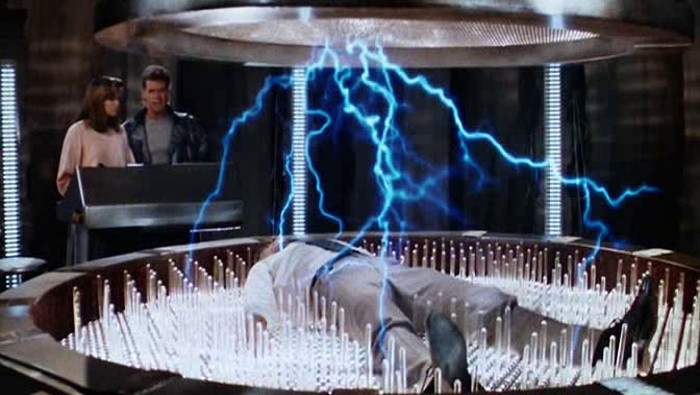
Later, as a forensics team works the scene, the coroner arrives and a distraught Bigelow must break the news to Rebecca about Mortis. Told everything that happened, and after examining the mutant biker, a heartbroken Rebecca hacks into the system controlling the electric gizmo where Bigelow found that unholy thing and determines it’s some kind of ‘resurrection machine’. Dense Bigelow can’t get his head around the implication and doesn’t buy this at first. And perhaps partly due to grief or partly to prove herself right, Rebecca conspires with Bigelow to steal Mortis’ corpse from the morgue, take him to Dante’s secret lab, and then place him on the slab. And after Rebecca finishes prepping the body as instructed by the user friendly computer readouts and prompts for the right command codes, the Frankensteinian machine fires up, sending several thousand electrical jolts into the body. And once the sequence finishes and things quiet down, what once was dead suddenly lives again...


Have you all seen the nifty film noir D.O.A. (1949)? If not, it was directed by Rudolph Maté and stars Edmond O’Brien as small-town accountant, Frank Bigelow, who walks into a police station to report a murder: his own. From there, we flashback to several days prior, when Bigelow arrived in San Francisco for a week-long blowout before settling down and getting married to his fiance. But after a wild first night on the town, where a mystery figure did something to his drink, Bigelow wakes up with something far worse than a hangover. And when the doctors tell him he’s been deliberately poisoned by a “luminous toxin” that one, has no cure, and two, only gives him a few days to live, the walking dead man embarks on a frantic journey to find out who killed him and why before he expires.

And when Mark Goldblatt’s Dead Heat (1988) finally gets to cooking with Mortis’ death and resurrection, it really brought that old film to mind. Now, I don’t know for sure if that’s what Goldblatt and screenwriter Terry Black had in mind, but that’s the impression I got. And judging by one of his character’s names being a callback and what I believe was a brief insert from the film in question on a TV screen (-- I’m at about 88% sure), I do believe my suspicions have been confirmed. Also of note, Terry Black is the brother of Shane Black, one of the best and one of my favorite screenwriters -- The Monster Squad (1987) and Lethal Weapon (1987), and filmmakers -- Kiss Kiss Bang Bang (2005), The Nice Guys (2016), of all time. And while Terry didn’t quite reach the cinematic heights of his brother, he did have a solid career writing for episodic TV.

And so, Dead Heat would be the younger Black’s one and only feature film. And here, Black kinda one-upped D.O.A. in that the protagonist actually died before he went on his quest to find out who killed him. Still, there is a ticking clock element to this scenario; for either Rebecca didn’t know exactly what she was doing, and was that desperate, or the resurrection process hasn’t been perfected quite yet according to what she finds on the computers and manuals. And so, Roger Mortis -- wait. Roger Mortis? Rigor Mortis? Ah, I see what you did there. Anyhoo, the undead Mortis, once he’s convinced he really is dead, has less than 12-hours before his body, already starting to decay, will be reduced to a puddle of protoplasmic sludge. And while Rebecca would like him to stay in the lab for more tests, hoping to prolong his resurrection, Mortis, who feels fine, honest, declines so he and Bigelow can track down who killed him the first time.


And their first stop is to nab Randi James before she can skip town. Check that, the first thing they do is stop at a drugstore so Mortis can get some makeup to try and hide his ghastly pallor. This they do, and they do catch Randi, too, but they’re ambushed by a couple of undead hitmen sent to silence her before she can reveal anything. And it’s at this point where Dead Heat starts to get really absurd as Mortis realizes how much punishment he can take since he’s already dead, staying underwater indefinitely, getting stabbed repeatedly, and taking several direct bursts of automatic gunfire, allowing him to provide cover for his friends with his body before they dispatch the zombie attackers by electrocuting them in the backyard pool. After, as a reluctant Randi starts to open up, she leads them down a twisted path of clues to unlock this post-mortem conspiracy.


Like Black, Dead Heat was a rare directing opportunity for Mark Goldblatt, whose only other directing credit was the Dolph Lundgren version of The Punisher (1989). But Goldblatt was no stranger to filmmaking, having made his bones as an editor, starting with his days at New World, where he cut Piranha (1978) and Humanoids from the Deep (1980). From there he would continue to edit films for the likes of Joe Dante's The Howling (1981), Jim Cameron's The Terminator (1984), Terminator 2: Judgement Day (1992), True Lies (1994)), and Paul Verhoeven's Starship Troopers (1997), as well as many action standards of the 1980s: Enter the Ninja (1981), Rambo: First Blood Part II (1985) and Commando (1985), which is probably why producer Michael Meltzer gave him a chance. The previous year, Meltzer had produced another offbeat oddity, The Hidden (1987), where an LA detective (Michael Nouri) teams up with an alien cop (Kyle MacLachlan) to bring in a body-hopping parasite from outer space, which proved to be a surprise sleeper hit.

And as you watch Dead Heat play out it’s easy to see Goldblatt learned a lot about what you did and didn’t need to make this kind of film work from his editor’s chair. And what a comedy-horror mash-up like this film really needs is momentum, and Goldblatt delivers that in spades as things are amped up to ridiculous levels, from the stunts, to the squibs, to the ludicrous realizations of the living dead, to keep this thing rocketing forward. And then things really get nuts when Randi leads Mortis and Bigelow to a Chinatown butcher shop, which is a front for a notorious gangster named Thule (Luke), who confirms he’s in on this conspiracy when he activates a mini-version of the resurrection machine, which reanimates the multitude of dressed out animals in the shop, chicken, duck, pork, and fish, who attack our protagonists en masse in a scene that is positively David Lynchian in its comical grotesqueness, which culminates in a one-sided battle with a dismembered side of beef.


Thus, with the conclusion of that whackadoodle scene, it’s probably safe to say that FX supervisor Steve Johnson is the real star of this film. To me, it’s always fun to watch these throwback, pre-CGI, practical-effect blowouts from the 1980s. Apparently, Johnson, a protege of Rob Bottin and Rick Baker, was left to his own devices while developing the props and prosthesis to fill this film up with grotesques, gore and goo. (In fact, things got a little too out of hand and several cuts had to be made to avoid an X-Rating.) Mention should also be made of the massive amount of blood squibs expended in this movie, which are so much more visceral and impactful than the current bane of digital blood spatter. And while the scene in the butcher shop was pretty wild, the most effective -- and startling, scene in the whole movie is when Randi finally fesses up to what’s going on.

Yeah, after she and Mortis return from exploring Loudermilk’s tomb to prove whether or not her father is alive, dead, or undead -- the answer, inconclusive, they find Bigelow has been murdered by another zombie hit squad while they were gone. Seeing things are now officially out of control, Randi admits she wasn’t the daughter of Loudermilk after all but a terminal cancer patient who volunteered to be the first test subject for the resurrection machine. Seems these conspirators were also responsible for resurrecting folks to commit the Cash and Dash robberies to help finance research into the resurrection machine, which is apparently >this close< to being perfected and will grant eternal life. Alas, 'close enough' only counts in horseshoes and hand grenades; and before Randi can reveal who was really behind it all she starts to rapidly decompose before Mortis’ (and the audiences’) horrified eyes as she devolves into a withered old hag first, then everything starts sloughing of her bones before she crumples into several pieces as she continues to apologize for lying until there is nothing left to apologize with. *bleaurgh*


From there, through several dubious clues, Mortis deduces Loudermilk was in cahoots with McNab, who was the mastermind behind the whole thing. And with only about an hour left before he meets the same gruesome fate as Randi, Mortis heads to the morgue to confront the chief coroner.
Alas, McNab was waiting in ambush and captures Mortis, locking him in an ambulance outside the morgue, where, turns out, he’s also hiding the body of Rebecca, who apparently got too nosy and was rubbed out. Here, McNab assumes Mortis will sit until he dissolves while he heads to the secret lab at Dante Pharmaceuticals, where Laudermilk (Price) is currently making a sales pitch to a bunch of rich old fudds, promising them all eternal life -- for a price.


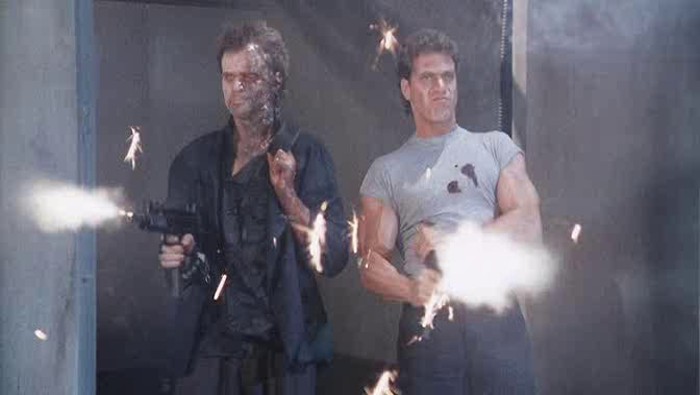
Meanwhile, Mortis engineers himself quite the escape from the ambulance, sending it down a steep hill, through heavy traffic, until it crashes and burns at the bottom. And even though half his body has been burned beyond recognition, and he’s still smoldering from the fire, he still has his badge and manages to commandeer a patrolman’s motorcycle, and then literally crashes the party at the lab, leading to one of thee most comical shoot-outs in screen history, where two zombies, one good, one bad, standing about five feet apart, blast each other with uzis, blowing each other to bits, and the scene keeps going and going and going as neither falls and keeps on shooting for yet another brilliant piece of absurdity courtesy of Goldblatt and co.
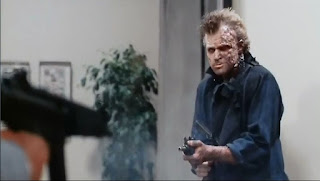


Then, at last, Mortis reaches the lab just as McNab was about to give a practical demonstration of the resurrection machine for the unbelieving crowd, who scatter for the exits when the zombie cop blasts his way inside, where, turns out, that body McNab was about to revive was Bigelow; and while Mortis mops up the rest of his guards, and Laudermilk cowers in a corner, the switch is flipped and Bigelow comes back to life, too -- only he was dead too long, making him a mindless automaton like the others, who obeys McNab’s orders to kill his old partner. But! Mortis manages to tap into the one part of Bigelow’s brain McNab could never scrub clean -- the raunchy juvenile part. And when both undead cops turn on him, McNab takes the coward’s way, blowing his own brains out.

Never fear, these two will not be robbed of justice and just throw the body onto the resurrection machine and bring him back -- just so they could fire it up for a second round, overloading the machine, which causes zombie McNab to detonate rather messily. And as the resurrection machine burns, and Laudermilk begs them to save it, promising them both eternal life, Mortis and Bigelow ignore him and leave the burning building, pondering what the afterlife will be like or the possibility of reincarnation -- and if so, Bigelow would like come back as a girl's bicycle seat. And with that, as the screen fades to white, Mortis says to his partner, "You know, this could be the end of a beautiful friendship."


OK. So. After revisiting Dead Heat for the first time in over thirty years -- which wasn’t easy, as Amazon kept sending me the wrong 2002 version of Dead Heat, I found it to be fairly entertaining and kind of wonderful -- and definitely not the disposable zombie riff on the 80s Buddy Cop formula that I had remembered it to be; epitomized by a moment at the end, when the two main bad guys, played by Vincent Price and Darren McGavin, when their scheme finally goes up in smoke, and Price is ranting and McGavin is doing all the heavy lifting to stop the good guys, and McGavin pauses long enough to yell, "Shut up, you old fart!" I hit the floor laughing. Hard. It was such fun to see those two working together and having a ball. And also a big hand for Keye Luke, who performed his own stunt when another one of those massive and multiple blood squibs went off on his chest during the climactic shoot-out.

And I'm still baffled that Always a Treat Williams didn't have a bigger career than he did. He started with Milos Forman and Hair (1979), then Spielberg’s 1941 (1979), then Sidney Lumet with Prince of the City (1981), then Sergio Leone’s Once Upon a Time in America (1984), and then, well, Dead Heat. I don’t know, I’ve always just liked the guy. He seemed genuine and was all-in no matter what part he played. And here, he was REALLY all-in for the number of stunts and full body make-up he endured.


And it really shows in his character as Mortis adjust to and finally accepts his fate -- even enjoying his new found indestructibility to a certain extent. As for his partner, Joe Piscopo, who seems to be the root cause of most negative reactions I’ve seen leveled against this film, well, he was only terrible when he was trying to be funny. I know, I know, he was essentially the comedy relief. At least he was, until Williams’s character "died" and their roles got reversed and Piscopo became the straight man to a decomposing walking corpse, which improved things considerably.

Also, for a comedy, even a black comedy, this thing comes off kinda cold, ruthless, and a little detached at times -- especially the snap reveals of both Bigelow and Rebecca's fate, both killed off-screen, which only adds to how strange and oddly downbeat the whole thing is. (This might’ve had something to do with the film’s restricted budget, as New World Pictures was teetering on bankruptcy during the production. And while five million dollars sounds like a lot of money it really wasn’t for a film this stunt heavy and FX laden.) I mean, the good guys still win in the end, but everyone’s dead. And strangely enough, when Terry Black was approached by New World to write a sequel to Dead Heat, he told them it would be almost impossible to do because all the main characters were either killed off or dissolved in the first film. To which the studio responded, "You've got a resurrection machine ... You figure it out." Alas, the proposed sequel never got much further than that.


Again, Dead Heat was a pleasant surprise and a lot better than I remembered it being. And it’s a prime example of late 1980s cinematic action and kitchen-sink excess on every element involved. And if anything, it feels like a nice introduction for the kind of gonzo gore films the likes of Peter Jackson would push to the limits a few years later with Dead Alive (1992). And while the adolescent antics of Piscopo may be too big a hurdle for some, I think Goldblatt, Black, Johnson, Williams, Frost, Luke, McGavin and Price easily overcompensate for this, making this one a real treat. No trick. Honest.
What is Hubrisween? This is Hubrisween. And now, Boils and Ghouls, be sure to follow this linkage to keep track of the whole conglomeration of reviews for Hubrisween right here. Or you can always follow we collective head of knuckle on Letterboxd. That's four down with 22 to go! Up next: Not so Famous Monsters of Amateur Filmland.
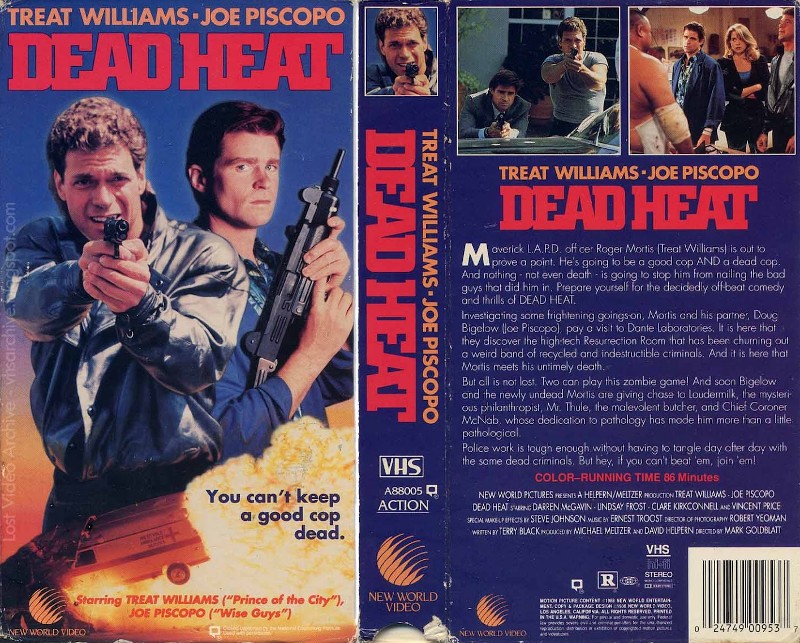
Dead Heat (1988) Helpern / Meltzer :: New World Pictures / P: David Helpern, Michael L. Meltzer / AP: Allen Alsobrook / D: Mark Goldblatt / W: Terry Black / C: Robert D. Yeoman / E: Harvey Rosenstock / M: Ernest Troost / S: Treat Williams, Joe Piscopo, Lindsay Frost, Clare Kirkconnell, Darren McGavin, Vincent Price, Keye Luke