A wild mash-up of The Magnificent Seven (1960) and The Dirty Dozen with a significant feminine twist, Hired to Kill (1990) finds a wet-work specialist named Ryan (Brian Thompson) hired by a shady organization that operates outside the CIA’s purview to rescue an imprisoned revolutionary in some banana republic when the puppet government they set up proves even more corrupt than the one they helped overthrow in the first place. And the only way to do this and fool Fakeastan’s chief of security (Oliver Reed and what’s left of his liver) is to send Ryan into this island nation undercover as a fashion designer with a half-dozen sexy female “models” he rounds up out of several prisons and asylums, former operatives gone bad, an ex-Mossad assassin, and an ex-partner among them, for a staged photo-shoot. And after he whips these new recruits into shape via several training montages, Hired to Kill then spends the middle portion of the film gawking at all that eye-candy before things go completely bonkers when Ryan and his howling commandos finally raid the prison and all hell breaks loose – and breaks loose quite spectacularly.


When I reviewed Nightmare at Noon (1988) awhile back, I went into the history of Nico Mastorakis and his Omega Entertainment and lamented over how you just don’t see these kinds of high octane independent actioneers anymore. Oh sure, they try to but no amount of digital blood splatter and lame stunts can hold a candle to what you used to find in the action aisle at the old Video Kingdom. Apparently, Mastorakis was only supposed to be the writer and producer on Hired to Kill but the initial director, Peter Rader, got *ahem* distracted by one of the starlets and was soon shown the door when the production started to lag. The stone-faced Thompson does fine in a rare good-guy role (-- and there's once scene with Reed where he must maintain his cover that is worth the price of the disc alone), but the film really works due to the overcompensating efforts of Michelle Moffett, Barbara Niven, Jordana Capra, Kendall Conrad, Kim Lonsdale, Jude Mussetter, and Penelope Reed as our kick‘n’ass strike-team; all part of a tight and snappy, no-nonsense package that knows what the audience wants to see – blood, boobs, and things going boom, and knows when to get out after 90 or so minutes.


Arrow Video’s new release of Hired to Kill looks fantastic. It also includes a moderated audio commentary with the film’s editor, Barry Zetlin, which covers most of his career where he worked with the likes of Charles Band, Roger Corman, and the Go-Go Boys at Cannon Films. There’s also two interviews, one with Mastorakis and another with star Thompson, who talk about making the film, the nepotism that got Thompson the role in the first place, and both confirm that Reed was bombed out of his skull for the whole shoot; and each address the tragic helicopter accident that claimed the life of stuntman, Clint Carpenter, during filming. Also included is a digital copy of the shooting script, plus liner notes by critic James Oliver. Again, a great package for a highly entertaining slice of 1990s action pie that I heartily recommend.

At the urging of his homesick wife, Akira Saito (Sho Kosugi) moves his family to America to open a new restaurant. Unfortunately for the Saitos, they are kinda sold a false bill of goods by a doddering old fart who (over)sells them on some property in a seedy neighborhood. And turns out this previous owner is so oblivious he has no idea his derelict property is also being used as a dropsite between some mobsters and a couple of corrupt detectives who were supposed to leave a stolen necklace there but decided to pull a double-cross. And so, when the chief goon goes to retrieve the jewels, a sadistic creep by the name of Limehouse (James Booth, who also wrote the script), but can't find them, of course they think the new owners must be the ones who stole them and are determined to get them back no matter who gets hurt. They start by kidnapping the youngest son and don't believe Saito's claims of not knowing what they're talking about. (Both kids were played by Kosugi’s real children.) The cops, of course, prove worthless, but what these crooks don’t realize is their intended victim just also happens to be a deadly ninja – who apparently learned all his lethal skills from Sam from Quincy (Robert Ito), who has no qualms about taking the law into his own hands when he's finally pushed to far.


Now, to say the plot of Pray for Death (1985) is kinda convoluted would probably be the understatement of the year. Actually, the plot is pretty simple; it’s the execution where things went staggeringly awry. (Though I will
say that Maurice Binder, 007-esque knock-off opening sequence was truly
amazing. As was the bait and switch ninja TV show that opens the film.) The 1980s saw an inexplicable dry-fart explosion of ninja movies and you couldn’t see one of these things without tripping over Sho Kosugi, who first appeared as the bad guy in Enter the Ninja (1981), then the good guy in Revenge of the Ninja (1983), and then the one-eyed sort of good guy in the nigh inexplicable Ninja III: The Domination (1984), all for Cannon Films. And one would almost swear, what with the cast, the loopy leaps of plot logic, and that the all too familiar plot is essentially Death Wish II (1983) with ninjas that Pray for Death was another Go-Go Boys turd-burger but you’d be wrong. No, Pray for Death along with Rage of Honor (1987) were two films featuring Kosugi and directed by Gordon Hessler for Trans World Entertainment. Most of the problems with this film can be laid at the feet of the script. There is some juice toward the end with a running fight through a mannequin factory (-- why a mannequin factory? Basically because why not...), and a final confrontation that involves a chainsaw but this might prove too little too late for some viewers.


Again, Arrow Video spared nothing when it comes to bonus features on the special edition Bluray of Pray for Death. Here, you’ve got the option of watching the theatrical cut or the unrated version. (I thought I clicked on the unrated version but what I saw was relatively clean and bloodless so that’s me shrugging right now.) There’s also two interviews with Kosugi, a recent conversation and a vintage archive interview with a ninjitsu demonstration from the film’s premiere back in 1985. Personally, I think watching Kosugi work, a true martial artist, is always worth the time and find most ninja movies to be a total hoot. The action that follows in Pray for Death is plentiful, sure, but the execution is exceedingly sloppy with characters that are required to be “that” stupid to make the plot work. Thus, as an action film Pray for Death fails rather miserably; but as an unintended comedy there’s plenty to enjoy. And just how in the hell many henchman did the bad guy have anyway?!
We open in the darkened desert near the sleepy town of Canyonland, Utah, where two black vans emitting a strange, electronic hum pulls off the highway and park near a river. Inside one of them, a scientist -- check that, an evil scientist, wait -- double check that, an evil albino scientist known as, wait for it, The Evil Albino Scientist, or just The Albino (James) for short, finishes off one last diagnostic check with some electronic equipment that looks like it was purchased from a FLAG yard sale after K.I.T.T.’s last upgrade.


Determining the luminescent Green Goo he is obsessing over is ready for a field test, he loads a vial of it into a WHAM-O Air-Blaster and prepares to shoot it into the water, but is interrupted by some friendly bumpkin who putters up in his old beater truck, thinking they’re night fishing. But then, with a wave of a finger, The Albino’s armed escort opens fire on the old coot, killing him and reducing his vehicle to a hunk of swiss cheese, before pushing it and the corpse into the river. And with that response, one might begin to question the validity of the logo on that black van, claiming to be part of something called The Agency for Protecting the Environment, or A.P.E., again, if you’re one for brevity, as The Albino completes his task, firing a cartridge of green goo into the river. Mission accomplished, they clear off to implement the rest of their dastardly plan, whatever that may be -- he typed ominously.


Cut to two days later, same highway, different vehicle, a Winnebago, with different people inside, namely an L.A. entertainment attorney named Ken Griffiths (Hauser) and his wife, Cheri (Beck), out on a week-long roughing-it trip that, for all appearances, seems to be failing miserably at unwinding the tightly wound Ken. Anyhoo, after a brief bit or marital pitter-patter that would sober up the cast of Who’s Afraid of Virginia Woolf, the couple stop and pick up a hitchhiker named Reilly Reilly. (No. Seriously. First and last. Just ask him. He’ll tell you.)


Now, just taking one look at Reilly (Hopkins), with the boots, jeans, leather bomber jacket, the lazy toothpick, and aviator shades, we can easily classify him as a 1980s era badass, subspecies ex-military, probably a former cop, who was fired after he killed a child-rapist he brought down, who was let go when the system failed, leaving him to clean up the mess with a lead outbreak, and now, he wanders alone, no ties, a survivalist, destined to wander the backwaters of America, looking for movie plots like this one to bump into and then reluctantly right some wrongs with extreme prejudice and a few bad puns.


But before we get to that, first, Ken gets tired of Reilly not so subtly hitting on his wife (and his wife not so subtly shoving her breasts in this stranger’s face) and pulls into a diner in Canyonland for some non-microwaveable grub. And though it seems a little early in the morning, Ken matches Reilly’s order of a beer for their breakfast beverage, which the friendly waitress delivers toot sweet. Meanwhile, another bumpkin enters and saddles up to the counter, grinning from ear to ear, and sporting a slightly maniacal look in his eye -- not to mention the oddly green pallor of his face and hands.


Apparently a regular, the waitress calls Charley (Wheeler) by name, flashes a smile and tries to take his order only to have her hand seized and then pinned to the counter with a steak knife, much to the perpetrator’s delight. As she screams in pain at this skewering, Ken tries to intervene only to have the cackling aggressor turn on him, too, and start using him as an impromptu floor mop. And though he seems content to stay out of this fray, at Cheri’s goading, Riley steps in with a few good punches, which have no effect, and soon finds himself flying through the cafe’s front plate-glass window.


And then things turn really ugly with the arrival of Deputy Julia Hanks (Ross), who manages to lose her sidearm when she joins this melee (a recurrent theme as the film progresses, bless her incompetent heart), which a now enraged Charley takes up and aims at her. Then, a shot rings out but it’s Charley who collapses, capped in the leg, confirming Reilly has been packing all along. With that, Charley is temporarily subdued, cuffed and tossed into the back of Julia’s cruiser, where he continues to seethe. Julia then confiscates Reilly’s gun, saying it’s evidence, and they will all need to come to the station and give a statement on whatever the hell just happened. But, upset that his wife talked him into picking up an armed hitchhiker, Ken says to hell with that, pulls Cheri into the Winnebago, and motors toward the city limits.


Cut to a high vantage point in the bluffs overlooking the town, where the Albino initiates phase two of his operation, blocking or jamming all communication and transmissions coming in and out of Canyonland and activating some kind of EMP devices on all the roads leading out of town, which promptly fry all the electronics of the Griffiths’ RV, leaving them to hoof it back into town. With Canyonland now essentially and unwittingly quarantined, the Albino adjusts his fancy binoculars back on the diner, where Sheriff Hanks (Kennedy) has just arrived, who is none to happy about this violent disruption of his otherwise quiet small town. But things are about to get a lot worse when Reilly points out the wound on Charley’s leg, which is oozing some kind of green goo [/sound the Plot Point! klaxon/] instead of blood; and Charley has now turned completely green when he flares up again and improbably breaks out of the cruiser, snaps his cuffs, and steals the vehicle while the others look on dumbstruck.


But Charley isn’t looking to escape; no, he’s looking for more people to gleefully hurt, smashing the cruiser into a parked station wagon, crushing the old-lady driver in-between them. He then gets his hands on a shotgun and declares open season on several more cars and his son, the Sheriff’s only other deputy, before Hanks puts him down permanently, noting it took three more bullets to do it. And while Hanks and the others believe this is an isolated incident, more and more townsfolk are starting to get a little green around the gills and behaving rather anti-socially, and it is only a matter of time before all kinds of hell breaks loose...


While looking over the film career of Nico Mastorakis, one cannot help but notice and admire the parallels between him and Golan and Globus as his Omega Entertainment is kind of a poor man’s Greek version of the Go-Go Boys’ Cannon Films. When first trying to break into the business, Mastorakis wanted to make a big splash with a horror film more depraved than The Texas Chain Saw Massacre (1975). And while Island of Death (1976) failed to meet those lofty notions, it was a weird little bugaboo of a movie; kind of a cross-pollination between Michael Haneke’s Funny Games (1997) and Constantine Gochis’ deplorable The Reedemer a/k/a Class Reunion Massacre (1978), where a sociopathic British couple murder their way through a bunch of locals on a small Greek island mostly ‘just cuz’ or they didn’t agree with a lifestyle choice.

Taking the money he made from that, Mastorakis produced several more pictures in Greece, bouncing from genre to genre to match whatever was popular at the time until the theatrical market for these kinds of films dried up. Thus and so, the producer, director and writer shifted gears, focusing Omega Entertainment on the direct to video boom in the United States, starting with The Wind (1987), a thriller still set in Greece but with a cast of B and C-list celebrities, including a bit of type-casting with Wings Hauser as a psycho-killer, who stalks Meg Foster in and around an old dark mansion. And after this production wrapped, Mastorakis made a move to California, teaming up with screenwriter (and future Emmy winner) Kirk Ellis for Terminal Exposure (1987) and Nightmare at Noon (1988).

And while Terminal Exposure has some intrigue as two beach-bums turn detective to find a murderess, the fact the incriminating tattoo is located on her rear-end says it all as to whose pants the film’s mind is trying to get into but is of such piss-poor quality it will have you pining for the subtle wit and charms of Andy Sidaris. Nightmare at Noon, meanwhile, is kind of an unofficial remake of Bud Cardos’ Mutant (1984), which also starred Hauser and Hopkins, where a couple of strangers wander into a seemingly deserted small town and stumble upon a zombie outbreak due to toxic waste exposure. Here, we technically don’t have any zombies but something more akin to the violent rabies outbreak in I Drink Your Blood (1970), or better yet, the resulting homicidal whackjobs who overrun the small town after their water supply is contaminated by a weaponized virus in The Crazies (1973).


In George Romero’s film this contamination was just an accident that got out of hand and then compounded by the efforts to help resolve it, making things infinitely worse; here, obviously, The Albino is up to no good, contaminating and cutting off the unwilling townsfolk for some nefarious scientific control test on the effects of this kind of destabilizing agent (-- for whose government this was for is kinda left up in the air, and even our own isn’t ruled out), turning each victim into a cackling, greenish, roided-out rage-monster. And it is here where Nightmare at Noon excels, during the chaos, as Cheri is probably regretting not joining the boys for that beer during breakfast. And as she hulks out like all the others, at least this allows Hanks to figure out what the source of the contamination is: the town's water supply.


From there, efforts are made to keep those uninfected safe from those that are, barricading them off inside the hospital, leaving Hanks, who may or may not be infected, Julia, and his two newest sworn in (under protest) deputies, Ken and Reilly, to try and curb this ever-escalating outbreak of murder and mayhem on the streets and keep the death toll to a minimum, surviving long enough to engage with The Albino’s shock troops when he’s seen enough and sends them in to eliminate all the surviving witnesses.


Director Mastorakis had nothing but high praise for Bo Hopkins and Brion James during the production, though James is kind of wasted in a role that has him standing around a lot and tinkering with doodads and smirking and that’s about it. He also only had one line of dialogue throughout the whole movie, “Whoa!”, and we’ll be addressing why he said that in a moment. But the director would come to regret casting Wings Hauser, calling it a mistake, due to the actor’s ongoing battle with drugs and alcohol. I’ve always been a fan of Hauser and his manic intensity ever since I saw him as the degenerate pimp, Ramrod, in Vice Squad (1982). On screen his performance is actually pretty good as the put upon and in over his head Ken, but off screen his problems kept mounting, culminating with an incident at a hotel where a fight broke out during an attempted intervention that found the actor putting someone’s head through a wall, resulting in his arrest, forcing Mastorakis to bail him out.


“The nature of the business today is ‘this’ is what is selling,” said actor, George Kennedy, while discussing his involvement in Nightmare at Noon and other genre films. “Any performer, if he’s got any brains in his head at all, wants to be part of what the viewing public wants to see.” Mastorakis referred to Kennedy as the perfect gentlemen, who never complained and was always game, and who was also just coming off of major knee surgery to shoot Nightmare at Noon, one of just six films he would participate in that calendar year alone, so you’ll kind of forgive him as he slowly putters around. Kennedy is another favorite, whose presence always elevates anything and everything he gets involved in, be it classics like Charade (1964) or Cool Hand Luke (1967), disaster movies like the cop in Earthquake (1974) or as my man Petroni in the Airport ('70, '75, '77 and '79) franchise, exploitation classics along the lines of tick...tick...tick... (1970) and Thunderbolt and Lightfoot (1974) or delightful trash such as Death Ship (198) or Savage Dawn (1985). And with all that awesome to choose from, the reason I chose to write-up Nightmare at Noon for this celebration is a certain scene that blows my brain with glee every single time I watch it:


It begins as night falls and our rag-tag bunch of heroes track the A.P.E. troops to the Drive-In theater. And after they spread out to surround them and then open fire, in a scene shot and edited so badly, with obvious stand-ins, leaving one to boggle as to who the hell we’re supposed to be looking at until Sheriff Hanks finally succumbs to the Green Goo he has denied ingesting all day and the chaos suddenly comes into a sharp focus.
For, as he starts to hulk-out, he charges the bad guys, guns a'blazing...
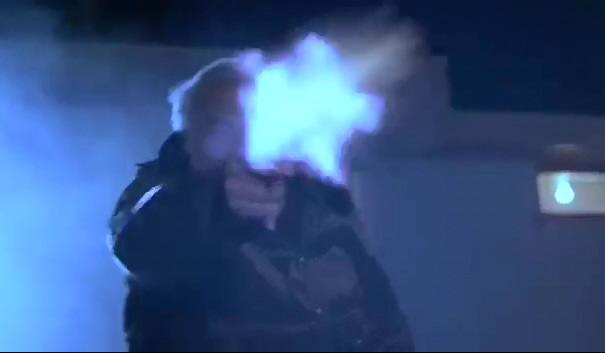
Who in turn aim their sterilizing flame-throwers at him, engulfing Hanks in flames.
But like a rogue bull-elephant, Hanks keeps on charging and shooting.
And not only does he manage to plug not one, not two, but three, enemy soldiers, he presses on past them and does a banzai belly-flop into the A.P.E. van, which promptly causes it to explode.
Hell yeah! Let's see Olivier pull that shit off. But, as ah-mazing as that death scene was, alas, that was not to be the climax of Nightmare at Noon. Hell, the film’s barely half over as the plot whiplashes itself and suddenly decided to turn into a western for a spell, as our surviving trio pursue The Albino and his goon squad into the surrounding desert on horseback as he tries to get out of range of the EMP blast for an extraction. Shot in Moab, Utah, the scenic vistas may look familiar to you as the same iconic buttes and rock formations can be seen in westerns like Warlock (1959), The Comancheros (1961), and Rio Conchos (1964).
And after a lengthy chase and gunfire exchange, with the good guys wounded and whittled away, and the bad guys eliminated by the boss himself, it’s soon down to just The Albino and Reilly for the final showdown, which is then hijacked by Mastorakis, again, who throws the audience yet another curveball, again.


See, not content with just a sci-fi, horror, and western hybrid, Nightmare at Noon will now devolve into an episode of Airwolf (1984-1986) because of … well, reasons. Now, I admit, the scene where the bad guy’s ride rises up from behind The Albino, who smirks, and it looks like he’s going to get away, until we then cut to Reilly, who also smirks as his own helicopter most improbably pops up from out of nowhere, as if conjured from the ether, is a well-played and an indelibly cool moment, and brought a bark of laughter with the incredulous look on The Albino’s reacting face, matching my own, but, seriously, movie, WHAT THE HELL? WHAT IN THE GOOD GOD HELL?! WHERE DID THAT OTHER CHOPPER COME FROM?!? Howbut? Yeahbut? Nobut. Ah, forget it, and just roll with it.


And the interminable helicopter chase that follows -- neither of which bothered to pick up their passengers, I’ll point out -- goes down a lot easier than it prolly should thanks to some amazing stunt-flying that runs the gambit of sheer-recklessness to outright suicidal -- and for defying the astronomical odds of each stray missile launched hitting some abandoned vehicle in the middle of the desert so it would have something to blow up. Eventually, though, the bad chopper is shot down, Hooray!, and Reilly dispatches The Albino with ironic relish, Double-Hooray!, and then returns to town, where everyone regroups, Cheri magically recovers, Reilly blows off Julia’s romantic overtures because he rolls alone, baby, and then everyone rides off into the sunset, bringing us to the ever lovin’ end. *whew*


As I re-watched Nightmare at Noon for this review, I was kind of surprised over the overwhelming sense of loss and lament over the extinction of this kind of regional, independent, gonzo action flick and the practical stunts and F/X that populated them. (And has me cursing at the wind over the invention of digital pyrotechnics and blood-spatter.) And what really sets this one apart, aside from that mind-blowing cast of genre veterans, anchored by Kennedy, who salvage a schizophrenic script that is off its meds and can’t seem to get a hold of itself, is the eye-popping and (not exaggerating) death-defying action set-pieces. Kudos to aerial coordinator David Jones for the cat and mouse chopper chase in around the nooks and crannies of those canyons, and to lead F/X-man Kevin McCarthy for all those in-camera squibs and explosions.


And I wanna give a special shout-out to stunt-coordinator, John Stewart, whose work left my jaw on the floor on multiple occasions, especially that bit with the motorcycle wreck -- a stunt which went staggeringly awry but still wound up in the film, turns out, which netted Stewart a fractured leg when he overshot the pad. All of the crashes and wrecks are almost lyrical in their gravity defiance and slow-mo dance of destruction, and the work of cinematographer Cliff Ralke to capture these so well, with only one chance, and being in the direct line of fire is just incredible. The fight choreography is equally amazing, with a bare-knuckle, brutal tinge, and un-aided by the Cuisinart editing machines of today's fight scenes, with the camera being a willing participant and in the middle of all the action. A little more digging also found Stewart was the director and coordinator for the near impossible to find and completely whackadoodle independent actioneer, Action U.S.A. (1989). There used to a VHS rip on YouTube but it has since disappeared. I'm telling ya, there's some high-octane stunts pulled off in that flick that would make Hal Needham wet his pants, which means it really, really, really deserves a legitimate digital release on some level as soon as possible.

Mastorakis and Ellis would team up again for The Naked Truth (1992) and Hired to Kill (1990) before parting ways but they failed to recapture the adrenal zeitgeist of Nightmare at Noon, which, if I could sum up not-so-succinctly, is like everything you’ve seen before in this kind of flick and yet unlike anything you’ve ever encountered. It’s not really a movie, but a re-enactment you’d see the following day during recess by a bunch of over-caffeinated and sugar-addled second-graders of something they saw on TV the night before; lots of pew pews, and bang bangs, and big booms, held together by a scatterbrained plot best described as AND THEN! AND THEN! AND THEN! AND THEN! as it unfolds. We will never see this type of film or filmmaking again, and that, Boils and Ghouls, is a damnable shame.

This post is part of The Celluloid Zeroes' tribute to honor the passing of George Kennedy. And I encourage you to follow the linkage to check out the other entries. Checkpoint: Telstar :: The Human Factor // Web of the Big Damned Spider :: Straightjacket // Cinemasochist Apocalypse :: Uninvited // Psychoplasmics :: Delta Force // The Terrible Claw Reviews :: TBD
Nightmare at Noon (1988) Omega Entertainment :: Republic Pictures Home Video / P: Nico Mastorakis, Isabelle Mastorakis / AP: Bob Manning / D: Nico Mastorakis / W: Nico Mastorakis, Kirk Ellis / C: Cliff Ralke / E: Nico Mastorakis, George Rosenberg / M: Stanley Myers, Hans Zimmer / S: George Kennedy, Bo Hopkins, Wings Hauser, Kimberly Beck, Kimberly Ross, Brion James