Showing posts with label Pulps. Show all posts

Tuesday, July 19, 2016

Good Reads :: The Unreality of Reality: When Cyber-Punk Went Noir in Kim Newman's The Night Mayor (1989)


When Christopher Nolan’s Inception (2010) came to a theater near you, it brought to mind a fantastic novel I’d read many moons ago that mined the same, lucid shared dream vein called The Night Mayor (1989); and so I tracked it down and gave it another read. And then I gave that copy away to spread the love. Cut to a few days ago, when the latest trip to the local broken spine yielded up another copy, which I snagged for a more permanent residence, as I thumbed through it, looking for favorite parts, I wound up just re-reading the whole thing again and quickly concluded that you all should probably read this, too.


OK, so tune-in and plug into this: In the not to distant future, since movies and TV are a thing of the past, people look to virtual reality, where a person can be projected into their own movie inside their own head, for their entertainment. Things go a bit awry when master criminal Truro Daine tries to make this unreality a reality, with himself in control of everything, and its up to two cyber-sleuths, Susan Bishopric and Tom Tunney, to tune-in to his wavelength and put the kibosh on his nefarious schemes.


Author Kim Newman is a huge film buff and has written several reference books on said subject matter. The Night Mayor was his fictional debut and it’s a real treat for his fellow film fanatics. See, Newman’s master-criminal bases his cyber-kingdom on the shadowy, rain-soaked streets and neon-lights of vintage hard-boiled Hollywood noir movies of the 1940s, and it’s populated with several familiar characters, scenarios, actors and femme fatales of the same era -- Bogart, Powell, Robinson, Bennett and Tierney -- one of them being Daine in disguise. Which is why the authorities bring in Tunney, an outside expert on the genre (-- a surrogate for Newman, perhaps?), to help the lead cyber-detective Bishopric smoke him out.


And with this all being based in a Matrix-style virtual reality anything goes, right? And when our heroes start tweaking things a bit, movie-genres start to get cross-pollinated -- and if you think Lon Chaney Jr. showing up and sprouting whiskers in the middle of all this is wild, just wait until you see what comes stomping out of the harbor. Of course knowledge of vintage films will help your enjoyment of this book but even a cursory film fan will recognize most of the cameos, winks and nods in Newman’s book. The science part of the equation takes a bit to slog through but it’s well worth it to get the fiction. Highly recommended.

Thursday, February 11, 2016

Good Reads :: Knock! Knock! Finding All Kinds of Things about the Origin and Influence of John W. Campbell's "Who Goes There?"


John W. Campbell’s seminal science fiction novella, "Who Goes There?", first saw the ink of print in the August, 1938, issue of Astounding Science-Fiction magazine under the veil of Don A. Stuart, one of his many pseudonyms, and a favorite when writing something this morbid and gruesome. And over the multiple decades since publication this tale of an Antarctic expedition uncovering a deadly shape-shifting alien in the glacial ice, which thaws and starts assimilating its way to world conquest has been adapted to the big and small screens on numerous occasions both officially and unofficially.


From Howard Hawks' The Thing from Another World (1951) to John Carpenter's The Thing (1982), and from Doctor Who ("Seeds of Doom") to The X-Files ("Ice"), and from Invasion of the Body Snatchers (1956, 1978) to The Stepford Wives (1975), all owe a debt to Campbell’s masterpiece of mounting paranoia and nebulous, nigh-undetectable monster. 


If you haven’t had the pleasure of reading the story yet, you can rectify that here, and then you’ll really get a true sense of what I’m talking about. But its influence goes well beyond the moving pictures. I dug out this fabulous, though extremely truncated, British radio adaption put on by the BBC in 2002 while trying to extricate myself from one of them there YouTube holes.


Further digging found a four-color adaptation published in 1976 in the debut issue Starstream, by Arnold Drake with art by Jack Abel. And you can check that out here.


Turns out Campbell’s alien, referred to from the very beginning as The Thing, is also featured in Barlowe’s Guide to Extraterrestrials.


And in 2010, author Peter Watts published an interesting twist on this macabre sci-fi tale, spinning it around and telling the story from the alien’s point of view in "The Things", though to be fair, it is told more from Carpenter’s film version point of view instead of Campbell's novella. You can read Watt's version here, or there’s an audio version of it here.


But the most interesting nugget I found on this latest cannonball into The Thing gene pool, is how it influenced another author, whose work would prove just as, if not more, influential than Campbell’s novella. Apparently, A.E. van Vogt had given up on science fiction and was making his living writing sudsy “true confession” melodramas when he passed a newsstand and, by chance, started thumbing through a certain copy of Astounding Science-Fiction. "I read half of it standing there at the news-stand before I bought the issue and finished it,” said van Vogt. “That brought me back into the fold with a vengeance. I still regard 'Who Goes There?' as the best story Campbell ever wrote, and the best horror tale in science fiction."


After this chance encounter, van Vogt wrote his own story about a shape-shifting alien and submitted it to Campbell, who was also serving as senior editor at Astounding Science Fiction at the time, but he rejected “Vault of the Beast”. However, he did see enough there that he encouraged the author to take another run at it, which netted us all "The Black Destroyer", and whose success spawned "Discord in Scarlet" and several other salty sci-fi tales, later collected under one banner as The Voyage of the Space Beagle (also as Mission: Interplanetary), whose influence, Nexialism, monsters, and cosmic whiz-bangery, can be seen in the DNA of everything from Star Trek to Alien. So, in a sense, two of the greatest sci-fi monsters, The Thing and the Xenomorph (which is directly inspired by both vanVogt’s Coeurl and the Ixtl) and two of the scariest horror films ever made, The Thing (1982) and Alien (1979) can be traced directly to one story. Because this...


Plus this...


Definitely equals this in my book:


Sadly, "Who Goes There?" would essentially be the last thing Campbell would write, focusing instead on his editorial duties and screening potential authors, giving the green-light not only to van Vogt, but to the likes of Lester del Rey, Robert Heinlein, and Theodore Sturgeon to name but a few. And even though he was no longer writing, his influence was far from over. "Write me a creature that thinks as well as a man, or better than a man, but not like a man", said Campbell as he started his sci-fi revolution. As to what that revolution consisted of, I think fellow author and friend Isaac Asimov summed up Campbell's impact best:


"By his own example and by his instruction and by his undeviating and persisting insistence, he forced first Astounding and then all science fiction into his mold," said Asimov. "He abandoned the earlier orientation of the field. He demolished the stock characters who had filled it; eradicated the penny-dreadful plots; extirpated the Sunday-supplement science. In a phrase, he blotted out the purple of pulp. Instead, he demanded that science-fiction writers understand science and understand people, a hard requirement that many of the established writers of the 1930s could not meet. Campbell did not compromise because of that: those who could not meet his requirements could not sell to him, and the carnage was as great as it had been in Hollywood a decade before, while silent movies had given way to the talkies."


Even as his influence dwindled in the 1960s with the coming of the New Wave, Campbell continued to work as an editor until his death in 1971. And even though he made his Golden Age of Science Fiction more about the science than the fiction (-- a stickling for detail that got him into trouble with the FBI when the editor commissioned one of his authors to write about the construction of an atomic bomb in 1944), Campbell wasn't above asking for a story that would match a cover painting he'd already bought. A bona fide genius to some, an irascible right-wing contrarian to others, and a complete cuckoo-bird to the rest, the answer is John W. Campbell was all of the above and I contend that no one did more for the legitimization of the genre than he and him.

Tuesday, June 3, 2014

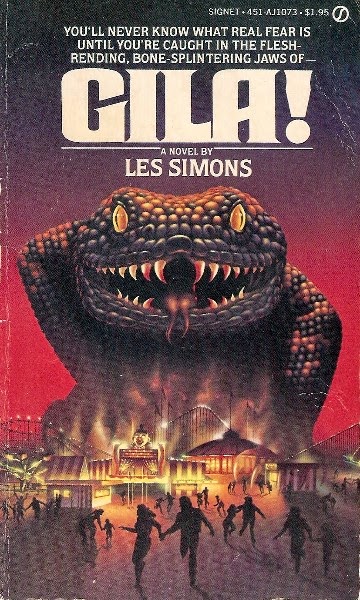
Good Reads :: You'll Never Know What Real Fear is Until You're Caught in the Flesh-Rending, Bone-Splintering Jaws of this Book!


Dr. Kate Dwyer, lead herpetologist at the University of Albuquerque, has no idea why she's been summoned to a clandestine meeting with the governor of New Mexico. But Dwyer gets an explanation quick enough when she's shown the charred remnants of what appears to be a lizard's tail; most likely from a gila monster. 

But why all the hush-hush hubub? Well, this dismembered appendage makes no sense, biologically speaking, due to its abnormal size. For, if you extrapolate from what's left, the rest of the critter would be some fifteen to twenty feet long. Which is impossible, right? Wrong. Dead wrong.

For even though Dr. Dwyer doesn't know what's really going on as she plunges into this nigh inexplicable mystery, the reader sure does. Do we ever! See, some thirty years after all those nuclear bomb tests over in Nevada, all that released radiation seeped across the border and spawned something both ridiculously deadly and deadly ridiculous: a strain of giant Gila monster. 

And not just one, but a whole herd (knot? gaggle?) of these deadly beasts that are currently laying waste to a good chunk of southern New Mexico, leaving no survivors at a wrecked diner and a mysterious bus accident (-- from which the tail was pulled), just carnage and half-eaten body parts, which only deepens the mystery. 

Thus, will Dr. Dwyer discover the truth and formulate a plan to stop these rampaging lizards before it's too late? Well, that all kinda depends on whether or not she can stop having sex with an old flame long enough to be bothered with finding a solution. No. Really.

Born in Omaha, Nebraska, but raised in Albuquerque, Gila! was author Kathryn Ptacek's first novel -- published under the pseudonym of Les Simons, and it really and truly is amazing. Ludicrously so. 

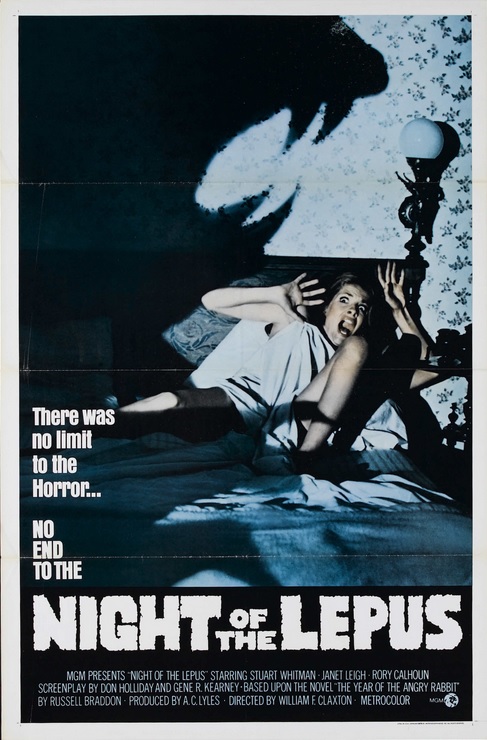
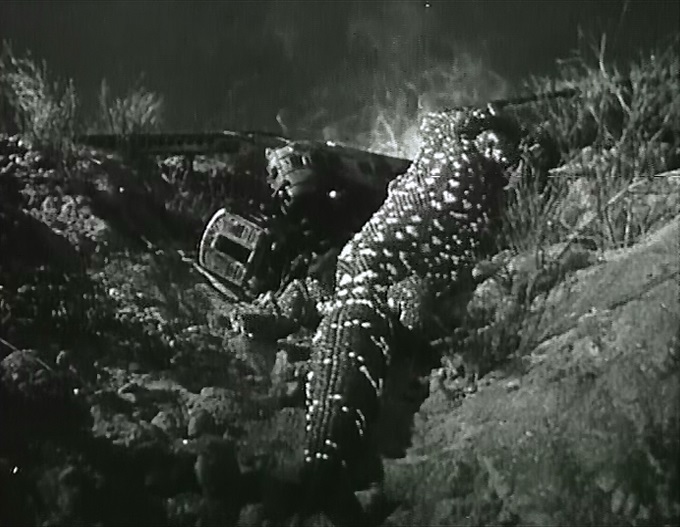
Honestly less The Giant Gila Monster (1959) and more THEM! (1953) or Night of the Lepus (1972), this tale is nothing more than a good old fashioned Monster Movie; and taken on those terms, this thing is an absolute riot. To me, the author just has an uncanny knack for sketching out disposable characters, with just enough flesh on them, only to tear each and every one of them asunder as they're ground-up and dismembered by the rampaging Gila's' powerful jaws, shredded by their poisonous fangs, or just flattened underneath their feet and massive tails. 

I'm telling ya, Ptacek gleefully paints the mayhem and it's aftermath with all the restraint of a Mars Attacks trading card. And I, for one, relished each descriptive paragraph of people being relentlessly and methodically masticated to mulch. 

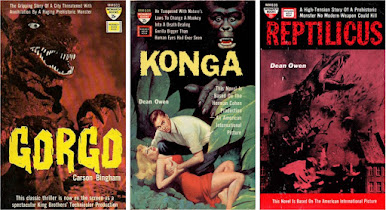
Unfortunately, in between lizard attacks, the author stumbles and trips over a fairly asinine concurrent plot to stop them that isn't helped by the "Dear Playgirl Magazine, I didn't think this could ever happen to me, but, I was a lonely herpetology professor at a small New Mexico college" subplot of Dwyer hooking up with old flame Chato, a native American. I shit you not, this thing was bluer than those old Monarch adaptions of Konga (1961), Gorgo (1961) and Reptillicus (1961). 

Seriously. There'd be a lizard attack somewhere; they'd get there too late; they'd survey the carnage; they'd go back to the hotel; they'd say, Wow, that was really terrible; shrug; and then hop into bed and knock some plaster off the adobe walls. I wish I was exaggerating. But not even a little, am I, as this scenario is then repeated almost verbatim again. And again. And again. Aaaaaaand again -- with each encounter more absurdly inappropriate than the last. (I kept envisioning Ken Tobey sucking on Mara Corday's nipples during these scenes. This, did not compute.)
Thankfully, the incongruity between the carnage and the carnal only adds another layer of a delirium to the whole thing. And honestly, it pales when stacked up against the mounting stupidity of the conspiracy surrounding the governor's slow reaction to this crisis. And like with The Giant Claw (1957), the author gets kinda stuck on one solitary metaphor to announce the Gila monster's impending attack: a leaking tire. (Though the one time the hissing actually was just a flat was kinda funny.) 

Now, I also have very little patience with phonetic spelling to convey a yokel's accents, with Governor Bubba being the absolute worst offender. Still, my only real beef with the book was due to the fictionalized incompetence of the New Mexico National Guard, which denied me, and you, a battle between a flock of giant Gila monsters and a column of tanks. Fie and Phooey on that, I say! 

Aerial bombings with napalm prove just as ineffective due to the lizards burrowing ability. And after laying waste to the New Mexico State Fair (my favorite part) and flattening an Air Force base, the giant lizards continue their relentless march north, drawing a bead on Albuquerque itself. 

And with conventional weapons failing on all fronts (-- though those tanks should have been given a second chance, and I would've loved to see what a bazooka round would do against the lizard's hide), our heroine comes up with a possible solution -- if anyone is still listening to her. And just like with many B-movies of old, just when you think it's all over, it isn't. 

*thhhhhppppppttthhhhhhh*

Look. All I know is when I got to the last chapter of this book, I didn't want to read it. I simply did not want this insanity to end. Nay. I wanted this rampage to continue on indefinitely. And I sort of got my wish, as the last page is a perfect set-up for a sequel that, alas, hasn't happened yet. 

At a brisk 160 pages, this was a quick read that had me barking out loud with laughter with nearly every page turned. The Simons Signet paperback is long out of print and has gotten terribly expensive since I got mine -- if you can even find a hard copy. The good news is, you can now purchase a digital copy listed under the author's real name. Whichever version you choose, get to reading Gila! as soon as possible for a gruesomely good time. 

Thursday, May 1, 2014

Good Reads :: A 250 Page Mission to Boldly Go Where No Zombie Has Gone Before!

So. Just finished up Kevin David Anderson and Sam Stall's Night of the Living Trekkies, a novel which concerns the staff at a Houston hotel as they brace themselves for the onslaught of a weekend Star Trek convention only to be overrun by something far more sinister -- and hungry. 

Here, our story focuses on a certain bellhop named -- wait for it -- Jim Pike, a former Trekker whose enthusiasm for the fantastic has been scuttled by an IED reality check and two tours in Afghanistan. 

But once the shit hits the fan, this disgruntled vet, along with his Andorian sister, a hired cosplayer decked out as Slave Leia, a Klingon from Atlanta who builds replica sci-fi melee weapons, an overweight computer programmer who still lives with his mom, a keynote speaker on Xenobiology from Harvard, and a Red Shirt named William 'Willie' Makeitt, must fight their way from room to room and floor to floor, trying to escape before they're all assimilated into the zombie horde. Well, technically, they're not really zombies, but more of a Van Vogt-tian space parasite infection.

Anyhoo, filled with about a gabillion inside jokes, several of which had me barking out with laughter, the dual-authors really know their Trek lore; and though their end result is completely disposable once the last page is finished, the novel is well worth a read.

Sure, the plot and characters are all unrepentantly silly, but it's in a 'having fun with the cliches' as opposed to 'making fun of them' if that makes any sense. I mean, What is a Zombie Apocalypse but a total Kobayashi Maru?

Now, the only real disappointment I had with Night of the Living Trekkies was it barely scratched the surface on the whole notion of Gene Roddenberry's optimism butting heads with George Romero's pessimism -- an idea I felt deserved to be explored further. 

But! What we got was good enough and manages to actually exceed its novelty trappings while embracing them at the same time as the novel finally answers the eternal question: What will it take to make a cross-fandom relationship work? Alien Zombiegeddon.

Beyond that? Only 250 pages and a quick read. Track it down and engage as soon as possible, Boils and Ghouls. 

Saturday, March 15, 2014

Favorites :: Pulp Covers :: G.G. Fickling's Honey West Novels (1957-1974)


(1957)
 
"I first thought of Marilyn Monroe, and then I thought of  
Mike Hammer and decided to put the two together..."

xxxxxxxxxxxxxxxxxxxxxxxxxx -- G.G. Flicking


(1958)


(1958)


(1959)


(1959)


(1960)


(1960)


(1961)


(1964)


(1971)


(1974)

Sunday, December 8, 2013

Meme Leech :: My Top Ten Favorite Romps Between the Covers.

 No -- Not THOSE Covers ... Nicked from the chaos of Facebook, the challenge was to list ten books that have left a permanent impression on you. Don't over think the list, and try to avoid revisions. They don't have to be the "right" or "great" works, just the ones that have always stuck with you, good or bad. And so, here's mine in the fairly accurate order in which they were encountered over the last four decades.


Feel free to join in on the fun.
Related Posts Plugin for WordPress, Blogger...