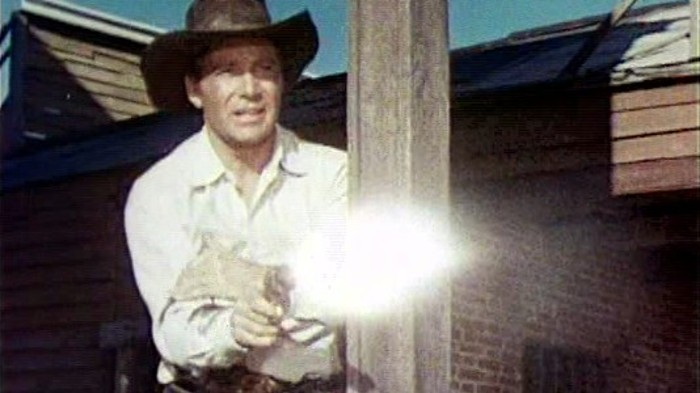
We open in the wild, wild, wild, wild west in the late 1800s. And since Mother Nature is giving all the signs of a harsh winter fast approaching, in the little mining town of Denver, Colorado, the local miner's association is in a state of panic. Seems, somehow, everyone forgot to restock their liquor supplies; and since spending a long cold winter in seclusion, completely sober, is a prospect these prospectors don't want any part of, a decision is made to consult Oracle Jones (Pleasance): famed trail guide, prophet, and clairvoyant -- and complete nut-job, whose prophetic visions get clearer and more accurate the more blitzed he gets! Then, as the desperate miners keep pouring him shots of precious whiskey, the answer comes to him: they should all pitch in for one last big shipment of liquor before the snow starts flying.

With little time to spare, the miners quickly sign a contract with Frank Wellingham (Keith) to shuttle 40 wagons full of liquor and booze over from Kansas. And being "a taxpayer and a good Republican," Wellingham demands an army escort to protect his cargo. This he gets when Colonel Thaddeus Gearhart (Lancaster) sends Captain Slater (Hutton) and a detachment of cavalry to protect said wagon train. Now. This command decision will not only keep the philandering Slater away from Gearhart's daughter, Louise (Tiffin), it will also allow the Colonel to stay behind and protect the fort from the Women's Temperance Movement.

Led by the fiery Cora Massingale (Remick), after learning of the whisky shipment, she uses her feminine wiles, and her portable bathtub, on the hard-drinking Gearhart; and soon enough, with the Colonel in tow, she leads her league of prohibitionist women out onto the prairie to intercept the booze-train and destroy it. Also getting wind of this shipment are several local Indian tribes, who, led by Chief Five Barrels (Wilke) and his main stooge, Walks Stooped-Over (Landau), also make plans to intercept the "crazy water" for themselves. Meanwhile, out on the prairie, the ill-tempered Wellingham is having trouble with the stubborn Irish teamsters he's hired to drive the wagons. And in Denver, with no word from the now long overdue wagon train, the miners form the Free Denver Militia and set out to find their investment and help escort it home or face a long and cold winter with no booze.

So, to sum up, we have the whiskey shipment slowly heading west, stalled by labor negotiations; the miners heading north; the cavalry and the Temperance Movement heading east; and the Indians moving south; all on a direct collision course. And if this all seems confusing, don't worry; the film provides a narrator and a handy map to help keep track of who's where and what's going on. And when these disparate parties inevitably / finally crash into each other, mayhem will most assuredly ensue...

You know what? This is all Stanley Kramer's fault. When the famed director, known mostly for his social dramas and morality plays, decided he wanted to make a comedy, he decided to make the comedy to end all comedies, It's a Mad, Mad, Mad, Mad World (1963). Now, I love that movie, and find it absolutely hilarious, but I'll also admit that it's not a very good movie. Good or bad, the film also ushered in a new type of comedy concept where the misconception that bigger and louder and more spectacular equals more funny. But Kramer got lucky; his film was buoyed by a cast of great comedians that kept the film, despite the constant threat of detonation and derailment, chugging right along. Other productions, however, weren't as lucky.

Originally, The Hallelujah Trail (1965) was supposed to be just another run of the mill western. Adapted from the William Gulick novel, The Hallelujah Train (-- later retitled to cash in on the movie), which, in turn, was loosely based on “actual historical happenings” that can be traced back to an incident in New Mexico, which occurred in the late 1800s; an incident ironically known as “The Battle of White Rock,” or even more ironically as “The Slaughter Pen,” which would have resulted in a huge massacre between settlers and the Native Americans if they had actually managed to find each other instead of just missing one another as the opposing factions kept crisscrossing the valley somewhere along White Rock Creek during the last week of May, 1869.

Now jump ahead one hundred years, and shift over to Hollywood, where all the major studios were doing their dangdest to get people's butts back in the theater seats and away from their TV-sets. And one of these new innovations was the Ultra Panavision 70 process and Cinerama (-- kind of a proto-Imax experience); and with this new format to exploit, the studios made a big push for all-star blockbusters, which is why The Hallelujah Trail was soon tagged for an upgrade by The Mirisch Corporation for United Artists, who assigned the project to director, John Sturges, who, like Kramer, was better known for a different kind of film. In his case, action yarns like The Magnificent Seven (1960) and The Great Escape (1963), or hard-fisted dramas like Bad Day at Black Rock (1955), which all have their funny moments to be sure but definitely are not comedies.

Now. No one could never match up to Kramer's cast, but The Hallelujah Trail's stable of actors are all gamers. Here, Burt Lancaster gets a rare opportunity to show off his comedic side, and has some real and genuine chemistry with Lee Remick onscreen even though the two did not get along at all off of it. Jim Hutton, the only real comedian in the bunch, is solid. As is Brian Keith as the crab-ass wagonmaster; and mention also must be made for the fine troupe of women in the Temperance Movement. And while Martin Landau almost steals the show, that honor rightfully goes to the almost unrecognizable Donald Pleasence as Oracle Jones. (And if you all thought Dr. Loomis was his looniest character? Boils and Ghouls, you ain't watched this film yet.)

Poking fun at a lot of western clichés and stereotypes, this was a wonderful opportunity for a satire but what John Gay’s adapted script all boils down to in the end is nothing but a battle of the sexes wrapped around a lot of property damage. Too bad. There was a lot of potential for a comedy mother-lode here if the script had dug just a little deeper. As is, all the bits with the Indians were hilarious -- albeit tone-deaf when it came to racial stereotyping, but the movie plays it safe, too safe, hoping all the zany antics of its players would be enough.


Well, I don't know about the rest of you, but zany antics, unless we're talking about the Three Stooges, are rarely funny and grow tedious pretty dang quick. (There’s a reason those knuckleheads mostly made shorts.) And at a whopping 165-minutes, The Hallelujah Trail amplifies the zaniness with more action and bigger stunts as it goes barreling for the climax, when all the parties converge at Whiskey Hills, where a freak sandstorm cuts the visibility down to nothing. And in the ensuing confusion, everyone intermingles, shots are fired, and the Battle of Whiskey Hills commences as everyone "circles the wagons" and blindly returns fire. And when the storm ends, the films best gag is revealed as the dust settles: the camps are barely yards apart and miraculously (-- except for a little buckshot in a few select behinds), with all that shooting, no one got hurt.

Then, after an uneasy truce is struck between all parties, despite a little trouble with the Indian interpreter, all the factions have a palaver, officiated by Gearhart. Of course, everyone wants the whiskey: Massingale wants to destroy it; the miners and the Indians want to drink it; Wellingham wants to get paid; and Gearhart just wants to go home.

And while Gearhart ponders on what to do (-- and the romance between he and Massingale is cemented over a shared bottle), the Women's Temperance Movement holds a pow-wow with Five Barrels and gets his entire tribe to sign a sobriety pledge. Meanwhile, Wellingham conspires with Oracle to sneak the whiskey shipment away through the treacherous Quicksand Bottoms. Seems Oracle has staked out a trail through the sinkholes with the shreds of his long johns (-- meaning underneath that buffalo coat, Donald Pleasance is buck-ass naked!)

But the celebration at the Indian camp was all a ruse as Five Barrels takes all the women hostage to hold as ransom for the booze and will only exchange them one at a time: one woman for one whiskey wagon. But since Wellingham could care less about Massingale or her flock, he takes the first few wagons into the swamp. But what he doesn't realize is the ladies were on to his scheme before they were captured, moved Oracle's markers, and Wellingham's wagons soon sink out of sight.


Okay, then. Circling back: there's an apocryphal story that Stanley Kramer was under much stress about the ending of It's a Mad, Mad, Mad, Mad World. With all of that build up, when all those comedians wound-up in that building, chasing down Culpepper and the stolen loot, he honestly had no idea on how to get them back down and feared his movie would end with a resounding thud. Two years later, Sturges was faced with the same conundrum. So how did he end it? The same way Kramer did; with a bunch of outlandish stunts and special-effects as the rest of the whiskey wagons are lined up for the exchange.

Here, Massingale is informed several of the wagons are filled with hot champagne ready to pop at the slightest jolt. And so, during each exchange, when a brave takes a wagon, she gives the horses a jab with a hatpin. And when the horses bolt, the champagne promptly explodes. And then, after the last swap, the cavalry starts chasing down a runaway wagon train of Indians -- who are more interested in drinking the cargo than fighting -- until the chaos ends when the Indians ironically and inadvertently circle the wagons, allowing the soldiers to catch up and attack until Five Barrels runs out of liquor and surrenders.

Thus and so, with all the whiskey destroyed or consumed during the mayhem, after the miners slouch back to Denver, and the Indians ride off their hangovers back to the reservation, there's a double wedding in store for Gearhart and Massingale, and Slater and Louise. As for Wellingham and Oracle Jones? Well, they're patiently waiting around to retrieve whatever Quicksand Bottoms belches up.

It's kind of amazing, really, when great directors who really don't understand comedy -- or at least think they do, try to make one. Both Kramer and Sturges can be funny, and have genuinely hilarious moments in their more serious or action-oriented films, but wind up with monstrous humor-hemorrhages when they set out to make an actual bona fide comedy. And they’re not alone as other directors have fallen into the same fallacy trap and failed in this same spectacular manner. More contemporary examples include Steven Spielberg and George Lucas. They can be funny, too, but their blockbuster comedies, 1941 (1979), Howard the Duck (1986) and Radioland Murders (1994), even though I love 'em, and will defend at least two of them on their own merits, were out of control duds at the box office.

A lot of this can be blamed on thin premises that are stretched well past critical mass. Yeah, if The Hallelujah Trail has one true weakness it definitely is the film’s monumental running time of nearly three hours. For even though the stunts come fast and furious, and are pretty damned spectacular -- Sturges definitely knows his stuff, the comedy is stretched pretty damned thin by the end. Kramer's madcap movie overachieved thanks to a stacked cast of comedy ringers, while Sturges' movie overcompensates with likable characters, spectacular stunts, gorgeous cinematography, and a goofy charm that’s eager to please as it tries to win you over. But in these efforts to overcompensate, one also must note a stuntman, Bill Williams, was accidentally killed during filming when he failed to get clear during one of those many wagon crashes; a scene which remained in the film against the director’s wishes. Hell, it’s in the trailer.

Add all that up and, to me, The Hallelujah Trail still has just enough juice to get you over the hump and to the end -- though it definitely does help if you take full advantage of the film’s built-in intermission. Then, all you gotta do is put it on cruise control (or try to keep up with Oracle Jones on the booze intake), kick back, and become one with the wackiness. Otherwise, it’s gonna be a long, long, long, long movie.

The Hallelujah Trail (1965) The Mirisch Corporation :: United Artists / P: John Sturges / AP: Robert E. Relyea / D: John Sturges / W: John Gay, William Gulick (novel) / C: Robert Surtees / E: Ferris Webster / M: Elmer Bernstein / S: Burt Lancaster, Lee Remick, Jim Hutton, Pamela Tiffin, Donald Pleasence, Brian Keith, John Anderson, Martin Landau, Robert J. Wilke