

Something has gone terribly wrong at the Tower Mountain Research Station and Summit Lab. For above the raging winter storm on the outside, we can hear the nonsensical ravings of the lone occupant trapped inside as we peer into several lighted windows as he stomps around the compound, stressing out, but we don’t really see a whole lot through the glare and frost-encrusted glass. We also hear someone else desperately trying to contact this disturbed man over a two-way radio. But these distress calls are ignored as the incoherent blathering reaches a fever pitch -- he can hear them, but they can’t hear him, followed by the sound of things being smashed and rendered, followed by a few screams of how they wouldn’t listen to him, and now it’s too late, then the sound of breaking glass, followed by a sudden and eerie silence as the radio operator continues to beg for Dr. Vogel to please respond -- a response that will never come.
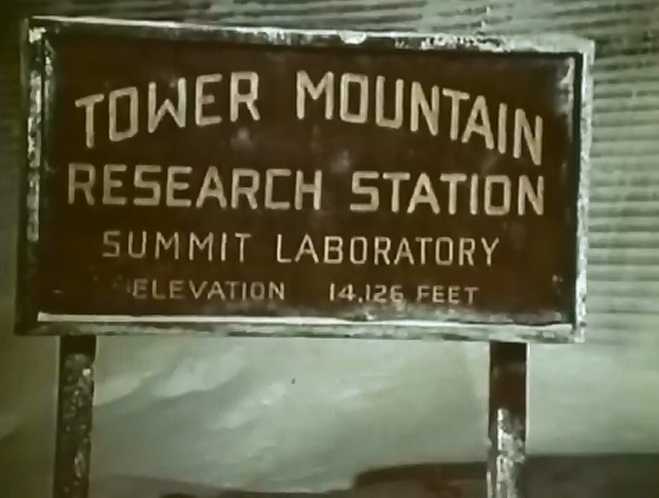

Located near the top of a mountain somewhere near the Arctic Circle, the Summit Lab was established at such a high altitude (over 14,000 feet) and in such harsh surroundings to test the effects of total isolation and extreme environmental changes on a group of chimpanzees to gather data that will hopefully translate into better prepared astronauts for the rigors of extended space travel. Now, several days after the last contact with Dr. Vogel, the two scientists who first envisioned and conceived of this primate research facility, Dr. Frank Enari (Wallach), a primatologist, and Dr. Robert Jones (Culp), a theoretical physicist, have volunteered to travel to the station to find out what exactly happened to Dr. Vogel, of course, but their top priority is to save the animals and salvage the research Vogel had started before he apparently suffered a total nervous breakdown, where he started conversing with the ghosts of Genghis Khan, Alexander the Great, Caesar Augustus, and other historical tyrants according to the radio logs, before breaking off contact completely; and then continue on with these experiments if feasible. If not, it would mean a lot of time, effort, and tax dollars spent all for naught.


When Jones and Enari arrive by helicopter, they find the interior of the station in ruin. It’s also extremely cold as the furnace is not running -- not disabled, but turned off; but all the animals, by some miracle, thanks to the electric lights, are still clinging to life. And while Jones (Culp) struggles to get the heat going, and Enari (Wallach) sees to the animals, the pilot (Gwynne) continues to search the compound, each room in total disarray, until he at last comes to the electronics room and has to force the door before entering, where he finally finds Vogel, dead, frozen solid, clutching the mic of a recorder, with a window to the outside sitting wide open behind him. Let me repeat that so this mystery sinks in properly: the man was sitting alone in the only room with a lock on the door in the whole compound with the window open. And there he sat, until he froze to death. As to how and why he came to be in that condition, well, that will have to wait until the pilot flies the corpse back to civilization and the magnetic tapes Vogel used to record his last report thaw out -- a slow and tedious process to prevent them from shattering, before they start getting any answers.


Meantime, Jones and Enari start cleaning up and putting the lab and living quarters back together and tend to the animals, including a replacement chimp named Geronimo Enari brought along in case one or all the other test animals were lost. And once everything is back in working order it’s time to get back to the real work once they settle on who will be responsible for the menial tasks to keep them and the station functional. Enari has a checklist of duties, but Jones bristles at the very idea of something routine as it soon becomes readily apparent this mismatched odd couple don’t really like each other very much; and maybe the notion of just one scientist assigned to this remote lab doesn’t seem quite so hair-brained as it did not five minutes ago.


See, Jones’ field is in theory and speculation, pondering imponderables, and finding solutions outside the box. Enari, meanwhile, is a firm believer in the scientific method and is a stickler for repetitive tests that will establish definitive results. And that’s why Enari believes Vogel died because, obviously, the cold and the isolation got to him and he suicided out. But Jones isn’t so sure, feeling they’re missing something, and notes how when people freeze to death they tend to look very peaceful, as if they’ve just fallen asleep, but Vogel looked terrified. But they table this disagreement for now as Jones volunteers for outside duty to scoop snow into a large metal tank, where it will melt into their water supply, and maintain the heater and generators, leaving everything else -- the cooking and cleaning and tending the animals, to Enari.


Days pass and things settle into a dreary sludge at the Summit Lab, running the chimps through a rugged battery of stress tests, monitoring their vitals, and collecting blood samples. They receive word that Vogel’s autopsy showed no signs of a brain tumor or a stroke to explain away his erratic behavior, and his official cause of death was exposure to the elements. And while this pretty much backs up Enari’s version of events, Jones refuses to let this locked room mystery go and will wait for Vogel’s tape to finish thawing before passing final judgment -- only this tape proves blank, erased by unseen hands. And so, figuring the unstable Vogel just didn't use the machine properly, the work continues until one night Jones is awakened by the cooped up animals raising hell in their cages -- except for Geronimo, whom Enari gives free run of the compound. But Enari, like someone who lives and sleeps by the train tracks, is conditioned to this kind of racket and slumbers on.


And so Jones checks in on Gengi, Allie, and Augie, who seem extremely upset over something but the cause of which remains elusive. (I mean, aside from being caged up, strapped down, and experimented on.) Moving on, Jones searches the rest of the compound until he comes to the electronics room, where several pieces of equipment have been turned on. Also of note, the window that caused Vogel’s death has once more been jimmied open, allowing in the cold, snow and ice. As Jones closes the stubborn window, the door to the room slowly starts to close behind him, and the man barely has time to catch it before he’s locked in -- just like Vogel. The hallway is empty, betraying no culprit, and when Jones returns to the bedroom after his search turns up nothing, Enari is still sound asleep. Well, at least he wants Jones to think he’s still asleep as the other man crawls back into bed.


The following morning, Jones awakens to the sight of his own breath and Enari’s empty bed. The heat is off, and Jones finds his partner struggling to get the furnace lit. Here, Jones sees their water supply is completely frozen over, too, meaning the heat has been off for several hours and its a race to fix things before the water pipes burst. Once the furnace is rekindled and things start to warm up again, the two men have it out since Enari thinks Jones shut the heat off during his midnight stroll and would like to know why. Jones, meantime, thinks something preternatural might be going on at the station, or they’re not alone, since someone or something lured him into a trap in the electronics room just like Vogel, and then tried to kill them both by turning the heat off, making the two men look like lab rats trapped in a maze of their own design, which leaves us to wonder who is really experimenting on who here...


In his original review for The Chicago Sun-Times, film critic Roger Ebert called Ridley Scott’s Alien (1979) nothing more than an intergalactic haunted house thriller, but at least he gave the film credit for working around this age old conundrum: if your house is haunted by homicidal monsters, then why not just leave the house? Scott, and scriptwriter Dan O’Bannon, of course, trapped all of their characters on a freighter in deep space, where vacating wasn’t really a viable option. In space, no one can hear you scream after all. Of course, author A.E. Van Vogt had already thought of that nearly four decades earlier with his rip-snorting tales of the crew of the Space Beagle in The Black Destroyer and Discord in Scarlet, which introduced the Coeurl and the Ixtll, which would then serve as the unofficial basis for many a cinematic sci-fi horror hybrids to come, including Alien.

Van Vogt was a protege of John W. Campbell, the godfather of modern science fiction, who put the stress on the nuts and bolts of the science instead of the fantasy of the fiction, who also found a workaround on the haunted house conundrum by setting his seminal tale of suspense and paranoia, Who Goes There?, at an isolated Antarctic research station, leaving them trapped with an alien trying to assimilate its way to world conquest, which also inspired several films, including The Thing from Another World (1951) and The Thing (1982), which was a more faithful adaptation of the source material.

And with its claustrophobic arctic setting, mounting paranoia, and an air of otherworldly mystery, Campbell’s story obviously had an influence on Jerrold Freedman’s telefilm, A Cold Night’s Death (1973). Now, there’s another noted sci-fi novel, which also spawned a renown film franchise, that also influenced Christopher Knopf’s script, I’d bet, but we won’t reveal that one quite yet because there’s some pretty massive spoilers coming up and I urge you all, right now, to stop reading if you haven’t seen this movie yet, and go watch it -- it’s available to stream on many YouTube channels, because this thing earned those righteous plot twists, which are a pure joy to watch as they unravel and are all creepy as [expletive deleted].


From the very first scene, where the camera’s eye rapidly glides across the frozen snowpack, as the wind angrily howls and the hostile electronic musical score gives you a sense of some approaching alien menace, A Cold Night's Death rarely misses a beat as it burns through it’s brief 73-minute run time. Both director Freedman and cinematographer, Leonard South, were veterans of the old Night Gallery anthology TV show, which this telefilm would’ve made a great episode of. I love how the camera always seems to be moving as if a third person observer is sneaking around the compound, jockeying for the best angle, or the long tracking shots as the camera whispers down the long hallways, giving one a true sense of how isolated and trapped our two protagonists really are.

Then add in the editing skills of David Berlatsky, who cranks up the creeping unease and the mounting tension with a series of rapid cuts when things go bonkers but also wasn’t afraid to hold a shot. But there was one cut that’s so subtle you barely even register it as Jones, after another sleepless night of investigating phantom noises, finally settles into to bed only to immediately wake up again, hears more noises, and then finds Enari putting Geronimo through his paces on a treadmill as if nothing is wrong. But something seems off, and when you finally put your finger on it and realize both men look like they haven’t shaved in weeks, or even a month, you get a shivering sense of how much time has elapsed and how much this regimented routine has worn these men down and frayed their last nerve. And don’t discount the effort and effect of the sound designs of Herman Lewis and Edward Rossi, who make sure the ever present wind is constantly heard, and the eerie, nerve-ratcheting, almost avant garde score of Gil Melle, which helps keeps those bearings lost.


And all of that in service to a crackerjack teleplay by Knopf, who mostly wrote scripts for TV westerns, TV movies, and TV anthology shows, with his only other sci-fi credit being the adaptation of the Ray Harryhausen vehicle, 20 Million Miles to Earth (1957). The same year this telefilm was originally broadcast Knopf wrote the screenplay for Robert Aldrich’s Emperor of the North (1973) -- another fantastic dual actor showcase for Lee Marvin and Ernest Borgnine. For A Cold Night’s Death, we get Robert Culp and Eli Wallach, whom we’ll be addressing in a second. For them, Knopf weaves one hell of an engaging mystery as their characters become highly distrustful of each other. Are they both going crazy? Is there something supernatural -- or extraterrestrial, going on here? And to Knopf’s credit, the answer to this riddle, and what really happened to Vogel, have been kinda hiding in plain sight since the very beginning; only these two estranged men are no longer thinking clearly and can’t see them, and won't see them, until it’s far too late.


Seems Enari is convinced Jones has cracked up just like Vogel did and is now out to get him, while Jones cannot convince the other man some outside influence is pushing their buttons and pushing them both over the edge. Things come to a head when they wake up one morning and find the mess hall and most of their food stores destroyed. After that, blaming each other, the two men no longer speak and sleep in separate rooms -- but neither sleep all that much as the power and heat keep fluctuating, lights are lit in empty rooms, and equipment seems to turn itself on. And all the while, Jones keeps mentally running through Vogel's last contact before cracking up for good, sure that will hold the key. And he’s still trying to work this out when he once more heads into the bitter cold to replenish the reservoir with more snow. Something Vogel had said. Those phantoms he had talked to ... The names of the chimps ... And when it all finally snaps into place, Jones abandons his shovel and tries to go back in to warn Enari -- only someone has bolted the door, leaving him to freeze to death outside. And it wasn’t Enari.


But Jones rallies himself, fights off the hypoxia induced delirium, instant frostbite, and hypothermia, and manages to crawl through the opening where he scooped the snow and plunges into the ice cold water tank, which was partially frozen over, meaning the heat is off again AGAIN. And once he manages to extract himself from that, nearly frozen stiff, he seeks out Enari, who has armed himself with the pistol designated for putting any rogue chimps down, for protection, once he found the body of Geronimo, whom Jones always complained about, figuring he killed the favored chimp to get at him -- and he's next. Thus, Enari warns Jones to stay away once he finds him in the rec hall. The half dead Jones, his eyes nearly frozen shut, begs Enari to listen as he pleads his case, which proves so rational an explanation the implication is terrifying -- too terrifying for Enari, who will not accept what really happened to Vogel, which has been repeated against them, forcing the two scientists to endure the harsh elements, causing them stress, denying them food -- do these “tests” sound familiar? They should.


But Enari is in full blown denial and accidentally shoots Jones dead when the half-frozen man is overcome with hysterics when Enari refuses to believe, thinking he was attacking him. Then, Enari heads to the electronics room, drawn by a recording he'd made earlier. Someone has turned the recorder on. But when he gets there, he finds the room empty and that same damned window is open, and broken to the point it will not shut. Then, he hears the door slam, and then the deadbolt engaged from the outside. Then, his frozen fate sealed, Enari hears something moving around in the hall, and then the man sees one of the test chimps through the door’s narrow meshed window, staring back at him, solving this mystery once and for all.


Now, I know how I’ve related this story before: how when I was a littler kid back in the early 1970s, and how my family of goons wound up at one of those Go Ape! Marathons 20th Century Fox unleashed to showcase all five of their Planet of the Apes movies -- Planet, Beneath, Escape, Conquest, and Battle (1968-1973). Circumstances that day dictated we had to bail after the fourth film, Conquest of the Planet of the Apes (1972), where the Apes officially took over. And so, in one afternoon, I witnessed the Heston trapped in a madhouse, watched the entire world get nuked out of existence, twice, three brutal ape homicides, and the fall of mankind in one sitting. Thus and so, already a little freaked out, this was then compounded by my inability to know the difference between gorilla fighting and guerilla fighting, which was reported on the news all the time during this turbulent period, meaning, at the time, I was convinced General Ursus was already on the move and the Ape revolution had really and truly begun. Also during this time, many a Made for TV fright flick had sent me to bed with a bad case of the drizzles. And for both of these traumatic reasons, I am sooooooooo glad I didn’t catch A Cold Night’s Death back then, too, under those circumstances, or I probably would’ve never slept again.


Thus, I’m sure the Planet of the Apes franchise had at least some influence on the final outcome of A Cold Night’s Death -- or at least made it seem more plausible at the time. Again, the mystery leading up to that shocking final reveal is outstanding and earned Knopf a deserved Edgar Award nomination for the TV category. And breathing life into this tempest without, crisis within, tale are two rock-solid character actors in Culp and Wallach. With that limited setting the whole thing kind of comes off as an intimate two man play, and it's a genuine pleasure to watch these two work and make their pitch for what Freedman and Knopf were selling. You believe these men are scientists, and the tests they run on their captive chimps are equally disturbing and brutal and perhaps unnecessarily too real in a "no animals were harmed" sense. And to their credit, both Culp and especially Wallach make the massive verbal plot-dumps necessitated by the short running time to get their character's traits, methods, and motivations across by simply flat-out stating them work. But in the end, these weren’t even necessary as all you had to do was watch how each man deals with the mounting stress and sheer exhaustion from working in that kind of cold and thin air. It kinda makes you wish it could’ve been expanded to 90 minutes just to give these characters a little more room to breathe, to just spend more time with them, as things snowball toward that freaky-deeky climax.

A Cold Night’s Death was produced by the two punch combo of Aaron Spelling and Leonard Goldberg, whose Spelling-Goldberg Productions unleashed many a 1970s era TV staple, ranging from Starsky and Hutch to Charlie’s Angels to Dynasty. But they were also responsible for a slew of pure whackadoodle telefilms like A Taste of Evil (1971), Home for the Holidays (1972) Satan’s School for Girls (1973), and Death Cruise (1974). But as gonzo as all of those were, they just can’t compare to A Cold Night’s Death, which premiered on January 30th, 1973, as part of ABC’s Movie of the Week, which was a designated time slot set up specifically for this type of telefilm. Alas, like a lot of its MFTV brethren, A Cold Night’s Death still hasn’t made the legitimate digital leap yet. And that’s too bad as this one is a bona fide chiller that still packs a hefty, disquieting punch.

What is Hubrisween? This is Hubrisween. And now, Boils and Ghouls, be sure to follow this linkage to keep track of the whole conglomeration of reviews for Hubrisween right here. Or you can always follow the collective head of knuckle on Letterboxd. That's one review down with 25 to go! Up Next: We all get shafted.

A Cold Night's Death (1973) 20th Century Fox Television :: ABC Circle Films :: Spelling-Goldberg Productions / EP: Aaron Spelling, Leonard Goldberg / P: Paul Junger Witt / AP: Robert Monroe, Tony Thomas / D: Jerrold Freedman / W: Christopher Knopf / C: Leonard J. South / E: David Berlatsky / M: Gil Melle / S: Robert Culp, Eli Wallach, Michael C. Gwynne, Vic Perrin


