I blame no one but myself for not knowing Sonny Chiba had a werewolf movie on his resume until I went to the mailbox the other day. Sadly, my exposure to Chiba’s oeuvre is kinda sad as off the top of my head I could only come up with Message from Space (1978) -- and he’s barely in that, and Terror Beneath the Sea (1966). Hell, I haven’t even seen The Street Fighter (1974) yet. *sigh*. Thus and so, a Chiba expert I surely am not. And yet, I found myself overly excited to receive Arrow Video’s latest release of Kazuhiko Yamaguchi’s Wolf Guy: Enraged Lycanthrope (1975) and had to sweat out a shift at work before tearing through it.


The action kicks off in full bloom as a terrified and bloodied man flees through rush hour traffic on some neon-glazed Tokyo street. Here, our hero, Akira Inugami (Chiba), a crime reporter (-- I think), enters the picture when he almost runs the man over. Then, after an effort to calm him down fails, the man, claiming a tiger is after him, flees into a darkened alley where he is torn to bloody pieces by some unseen malevolent force. We then crash-cut to the credits, a flashback, where some torch-bearing villagers massacre a clan of lycanthropes, leaving one sole survivor, a boy, who will grow up to be Inugami. And with the blood of the werewolf in his veins, during the cycle of the moon he is granted preternatural powers -- and when the moon is full, he becomes nigh invincible.


Now, I think the cops are aware of his condition as the reporter is interrogated over this gruesome death but the coroner’s report says the victim was mauled by a demon, ruling the Wolf Guy out. Sniffing out an intriguing story, Inugami eventually uncovers that four other men, all members of the same rock band, have all fallen victim to this kind of savage slaying. Further digging leads him to a girl named Miki (Nami Etsuko), who was gang-raped by the band and contracted an STD -- all at the behest of the father of her boyfriend, who had other plans for his son and needed to get her out of the picture. And turns out Miki’s rage over this is so great she is able to psionically project a phantom tiger to take out her revenge.


Things take another dark turn when both Miki and Inugami are captured by some shadowy corporation or government agency (-- again the film is a little vague here --) looking to weaponize the both of them. And while they manage to turn Miki into an untraceable assassin, their werewolf is a little more obstinate despite the copious medical torture sans anesthetic, leading to a Plan B and a blood transfusion to make their own lycanthrope. Luckily, the full moon rises before Inugami can be disposed of and he recombobulates himself, engineers an escape, and has a brief but spectacular fight with his ersatz clone, whose body winds up rejecting the wolf-blood that eats him up from the inside out. And then the film takes another odd turn when Inugami seeks shelter in his old and abandoned village, where he finds true love, avenges his family against the locals, but then must face down a brain-washed Miki as the corporation/agency looks to recapture him and take another crack at breeding a platoon of invincible soldiers...

Never officially released outside of Japan until now, Wolf Guy: Enraged Lycanthrope is pretty nucking futz. The Toei film is an unofficial sequel to Toho’s Horror of the Wolf (1973), which was also based on Kazumasa Hirai’s manga. However, unlike the previous film, Inugami doesn’t actually transform into a wolf at all and just draws strength and invulnerability from the moon. Now, I won’t lie but I found this to be a bit of a disappointment. In one of the supplemental features on the disc, director Yamaguchi explains there simply wasn’t any money to pull off a transformation. Still, there are some startling effective practical gore effects present here. And they are all plugged into a plot that is a little hazy on the details as a lot of things appear to be riding on the assumption the viewer is familiar with the comics it was based on.


Here, plot threads and character motivations spray around like silly string -- or more appropriately for this flick, spray and splatter around like a severed artery as I barely scratched the surface on the story, which takes so many out of the blue twists (-- the reporter’s motives are not altruistic but greed-induced via blackmail --) and turns (-- a psychic killer that shreds her victims --) the viewer winds up inside a pretzel inside of another pretzel. Also of note, I found it oddly distracting that Sonny Chiba's proto-afro and bushy eyebrows in this thing kept bringing Yuri Rozmanovich as interpreted by John Candy to mind. (See below.) That said, we still got Chiba doing his thing, plenty of action, and a story that’s needling toward bonkers, which always equates to a hearty recommendation from me.


Now, unlike Chiba, I am slightly more familiar with the films of Kinji Fukasaku, having crossed off Black Lizard (1968), The Green Slime (1968), Message from Space (1978), Virus (1980) and Battle Royale (2000) off the checklist; but while I’ve seen a lot of his hair-brained sci-fi output Cops vs. Thugs (1975) was my first official foray into his violent, visceral and unflinching tales of cops, crooks and corruption -- epitomized by his storied Battles Without Honor and Humanity series (1973-1976).

First off, as the film begins, one should note that title should be read as Apples vs. Oranges instead of Godzilla vs. Megalon as we won't be witnessing a fight per se but are asked to compare and contrast these two opposing factions in this based on a “real-life incident” but moved to the fictional Kurashima City to protect the not-so-innocent and find there really is no difference at all -- just a matter of both personal taste and interpretation of the facts. And whether these facts can be trusted is a whole 'nother can of worms.


And as we examine those facts as presented, we find two rival yakuza families vying for supremacy while the police try to keep a loose lid on both of them. On one side you have the Kawade clan, who have wheedled their way up the political chain, garnering favor with many city leaders and the police brass, and now appear to be on the verge of going legit by leveraging into a land deal with an oil company. On the other side of the spectrum you have the Ohara clan, who are more street level thugs, running brothels, extortion rackets, drugs and petty theft. They also have a tangential working relationship with the local detective bureau; a sort of ersatz gentlemen’s agreement that lets them get away with quite a bit to keep them satiated so things won’t escalate, which always ends in bloodshed and massive collateral damage, which, and thus, results in an uneasy peace.


At the center of this working relationship is grizzled Detective Kuno (Bunta Sugawara) and Kenji Hirotani (Hiroki Matsukata), temporary chief of the Ohara clan while the big boss finishes off a jail sentence. Kuno and Hirotani’s history dates back several years, beginning when the criminal had tried to turn himself in for the murder of a rival boss but Kuno refused and let him go. (Judging by what we see later, Hirotani was most likely trying to take the fall for someone else.) And while one would think Kuno could use that as leverage to gain an inside man in the mob it goes much deeper than that as the two men connect on some primordial level over a bowl of rice. Kudo also has no love for his superiors or the Kawade clan or the seismic shift in the social structure they represent; and so he uses his influence to help Hirotani short-circuit the land grab, who steals it out from underneath his rivals, and opens “negotiations” with the oil company. And when I say ‘negotiations’ I mean extort a shit-load of money.


Obviously, the Kawade will not sit still for this and, knowing full well Kudo was probably behind it all, use their influence with the police commissioner to start a special task force led by upstart Kaida (Tatsuo Umemiya) to eliminate police corruption, put a stop to the fraternizing with the yakuza, and rein in the Ohara clan. And in short order several cops, including Kudo, quit the force but Kaida’s merciless crackdown backfires, igniting an all out war between the two factions, culminating in a bloody stand-off and siege as Hirotani and his lieutenants hole up in a brothel, refuse to surrender, and, with the press and public watching, will only agree to negotiate with the disgraced Kudo...


You know, the silly-string / arterial spray analogy doesn’t really jive when analyzing Cops vs. Thugs. Here, Fukasaku and scriptwriter Kazuo Kasahara present a spoiled onion that the viewer must first peel away to get to the center only to be called on to slop it back together into one piece to get and truly appreciate the whole picture as they explore the darker side of the criminal underworld and how “civilized” society not only allows it to happen but manipulates it to cash in -- all to a glorious funkified beat on the soundtrack. Fukasaku was never one to shy away from social commentary, and here, in case we didn’t get it, the final coda of the film is a massive punctuating punch to the junk to drive it home for good. There is no good and evil, here, just degrees in between.


Bunta Sugawara was a revelation to me here and I look forward to tracking down more of his films. And I did get a little excited when I saw Reiko Ike’s name in the credits, having fallen in love with her in the righteous Girl Boss series (1971-1973), which could really use its own boxset, Sex and Fury (1973), and Criminal Woman: Killing Melody (1973) and was subsequently shocked by her role, which was essentially being reduced to Hiroki Matsukata’s sex toy and punching bag, later pawned off to Bunta. Now THAT was a bit of an adjustment. As for Fuksaku, Cops vs. Thugs, while a lot to absorb and will leave you with a lot to think about, was nothing short of amazing in its execution and has me anxious to finally, finally, tackle the five daunting installments of Battles Without Honor or Humanity.

As always, Arrow Video’s release of both Wolf Guy: Enraged Lycanthrope and Cops vs Thugs are remastered and look beautiful on screen and are jammed with extras. The first film includes separate interviews with producer Toru Yoshida, director Yamaguchi, and the first part in series of interviews with Sonny Chiba talking about his acting technique. There’s also a limited collector’s booklet featuring essays by Patrick Macias and Jasper Sharp, who chronicles the history of Japanese monster mash-ups. The second film also includes an illustrated essay by Macias. Meanwhile, the disc includes an interview with Fukasaku biographer, Sado Yamane, who sheds some light on the complicated, Japanese-centric themes found in the film. But the true highlight is another outstanding visual essay on the director’s history with cops and criminals by film scholar Tom Mes. And while I enjoyed Cops vs. Thugs more, and it’s definitely worth a purchase, Wolf Guy was a tad disappointing due to the bitch of expectations but is still definitely worth a look -- just don’t expect a lot of hair or fangs.
Wolf Guy: Enraged Lycanthrope (1975) Toei Tokyo / P: Toru Yoshida / D: Kazuhiko Yamaguchi / W: Fumio Kônami, Kazumasa Hirai (manga) / C: Yoshio Nakajima / S: Shin'ichi "Sonny" Chiba, Kyôsuke Machida, Saburô Date, Etsuko Nami
Cops vs. Thugs (1975) Toei Tokyo / D: Kinji Fukasaku / W: Kazuo Kasahara / C: Shigeru Akatsuka / E: Kôzô Horiike / M: Toshiaki Tsushima / S: Bunta Sugawara, Tatsuo Umemiya, Hiroki Matsukata, Reiko Ike
When I first took a position in the composing department at a minor micropolitan newspaper sixteen years ago (-- wait. Sixteen years? Really? Wow ...), I soon struck up a friendship with one of the pressmen; an affable guy, with a thing for dragsters, classic cars, and the latter's restoration -- especially a certain chopped '49 Mercury. (That's him below making with the vroom-vroom.) Our friendship was soon forged and melded over a shared kinship for high-octane and existentially-charged road movies, obsessions over the minutia of classic cartoons and TV shows, and an unwavering fondness for Spielberg's comedic ode to mass-destruction, 1941, which most would call a colossal misfire while we championed it as one of the greatest movies ever made. Explaining why, most nights, as we waited for the last few pages to trickle in from the editorial side, before the presses rolled and belched out the finished paper, we would regale each other with tales of movies seen, venues experienced, and crack each other up with the mere mention of dialogue from the likes of Bob and Doug McKenzie's Strange Brew, It's a Mad, Mad, Mad, Mad World and, again, 1941. Seriously, walk up to him and say, "I don't think your gonna hit him, Ward" or "Check him for stilts" and just see what happens. "Yo."
 Anyways ... on one particularly slow night back in the fall of 2001, my friend Bill (-- or Not Naked Bill, but that's a tale for another day...), while discussing the finer points of the 1970's version of Battlestar Galactica, told me how he and a couple of buddies, all still feeling the addling after-effect of Star Wars, would go and see anything and everything that even remotely smelled of that galaxy far, far away, science-fictionally speaking. Which is why he found himself at the local movieplex for a film he never forgot (-- except for one really important part, that is, and we'll be addressing that in a sec.) A film that was so unfathomably confusing in spots and equally boring in others that the group almost gave up and left, two or three times, until the film would explode in some insane action sequence, buying it a little more time as they settled back into their seats until the next left turn into sheer stoopidity had them threatening to abandon it again.

 When asked for details, his most vivid recollection was a scene described as the Dukes of Hazard in outer-space, where some Rosco P. Coltraine space-cop, complete with a flashing cherry on top of his cruiser, chased a couple of hot-rodders in their souped-up rocket-cars through an asteroid belt, which ended with lawman augering his ship into a meteorite. Intrigued, as I pressed for more details, my friend remembered a trash-can robot that was more Twiki than R2-D2; a pinwheeling space-firefly hunt; a Darth Vader wannabe; lots of explosions; a spaceship that looked like a giant sailboat; and, perhaps strangest of all, something about magic space walnuts that granted magical powers -- or something, and how everyone was fighting to get their hands on one ... Well, don't know about the rest of you, but, he had me sold at Dukes of Hazard in outer-space. And as I listened, occasionally stopping with an incredulous query of Wait. What? for clarification or double-confirmation of these hair-brained details, being the gonzoidal cinema-junkie that I am, was, and ever shall be, had me determined to track this flick down as soon as humanly possible. All I needed was a title. Alas, a title my friend Bill could not remember, no matter how hard we massaged his brain.

 Remember, this was back in 2001. In those yonder days, you still had to dial up the internet that was just beginning to stretch its legs, filled with competing search engines that took you everywhere except where you wanted to go, and streaming video was just an itch in some mpeg's pants. Still, I had to try; and over the next couple of days soon exhausted all of my online sources and a search through my sci-fi film compendiums turned up nothing even close to what my friend had described. But, I kept digging and failing, spurned on each evening when Bill asked if I had found it yet. And just when it appeared that all hope was lost, a sudden idea struck with the sound of a cracking space walnut.
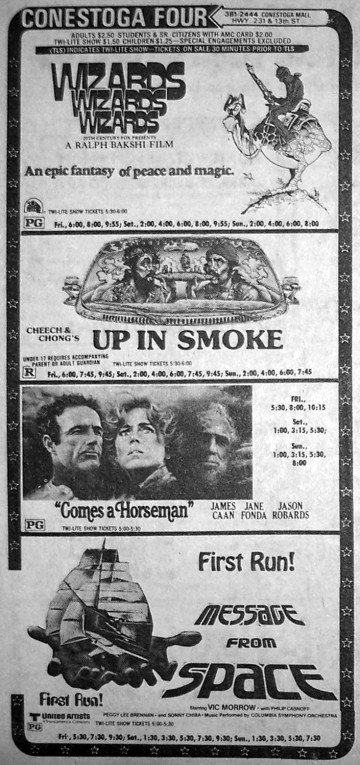
 I honestly think my love of film was cemented in my formative years by perusing the film ads in the local paper my folks subscribed to. Everyday I'd get the paper, check the index, find the ads, and then read the comics. Now, I had already visited my paper's morgue on numerous occasions, giddily immersing myself in all that history. (Alas, wanting to share my finds, it would still be several years later before I had another genius-attack and started taking my digital camera with me, thus birthing Scenes from the Morgue.) With that in mind, I asked Bill when and where did he exactly see this movie. Turns out he had seen at the Conestoga 4, a local theater no longer with us, and after narrowing it down to the winter of his first year in college meant the film played sometime between November of 1978 and February of 1979. With that established, I wagged a finger at my friend and said "Folly me..." Down into the basement we went, then, into the morgue, where I took the bound volume covering '78, Bill took '79, and, before you know it, I unearthed this:
 "Is that it?" said I, pointing at the familiar sounding spaceship. "That's it." confirmed Bill.

 So, we now had a title but the ads really didn't add anything else. Back to the internet, then, where we plugged Message from Space into the fairly new Internet Movie Database, which revealed Japan as the film's country of origin; and a quick check of the credits had me gaping at a cast that included Vic Morrow and Sonny Chiba. Wow. The director, Kinji Fukasaku, sounded familiar, too, and clicking on his link soon had me hooting and hollering and explaining to Bill the plot of The Green Slime, another completely insane space-epic Fukasaku had unleashed on the public almost ten years earlier in 1968.
 Alas, even though we had a title, we still had no way of seeing the film as Message from Space never had a legitimate release on home video. A quick search of eBay and all the other gray-market sources I was aware of proved equally frustrating and fruitless. With a shrug, we both went back to work. But in between pages, I went back to the IMDB to do a little more research and noticed a squared-off text-box that showed Message from Space was due to air in two days on some cable channel called Flix, an offshoot of Showtime. And while I didn't have that channel, maybe Bill did. He didn't, and neither did anybody else we knew. Striking out for seemingly the last time, we took some solace that we had at least found out what the movie was called as the presses rolled and the evening wrapped up. However, that is not the end of this story...
 The next day, see, Bill came into work with the biggest shit-eating grin on his face. As I returned it in kind, asking what's up, he went on to explain how he was talking to another friend about our quest. Turns out this friend's grandmother had a satellite dish with access to every channel known to mankind. And, apparently, this friend's grandma would be more than happy to tape it for us, even though it was airing at, like, 3 in the a.m. And so, three days later, Bill brought the tape to work. And after the paper was put to bed for the night, we retired to my place, popped the tape into my trusty VCR, and I finally got my first, glorious look at the gloriously demented Star Wars knock-off that Message from Space truly is.

 Sure enough, there was a police chase through an asteroid belt, space fireflies, all of it, and then some, as an evil intergalactic overlord in Kabuki makeup invades a peaceful planet of Space-Hippies. But trusting in fate and prophecy, these Space Hippies launch a bunch of glowing Space Walnuts that will find the chosen ones, who are destined to deliver them from this evil despot. Now, these chosen ones include Chiba, Morrow (decked out in the most pimpinest outfit you'll ever see) and Bebe-II, Morrow's Twiki-like robot. The rest are four young rocket-jockeys, who spend most of the movie in a highly agitated state, who rescue the Hippie Princess, who was captured by the Evil Kabuki Overlord after he converted the entire Hippie Planet into a rocket ship! And once they reach Earth's orbit, the bad guys blow up the moon to show they mean business. Luckily, and eventually -- and I mean eventually, the Princess rounds up the chosen ones, and they eventually fight, and then eventually destroy the Evil Kabuki Overlord by taking out the entire hi-jacked planet with some well placed torpedoes at the end of a very familiar looking slit-trench. Then, all the good guys board that space boat and sail off on the solar winds to parts unknown.
 Sounds great, am I right? And luckily for you all, if you'd like to see this tale of eye-popping space battles, fantastic miniature work, and general Japanese cinematic carnage and mayhem, you don't need to rely on one of your best friend's best friend's grandmother's satellite dish because Netflix has a gorgeous widescreen print ready to stream just a few clicks away. I know I haven't been the same since I saw it.
 And as great as this internet age is, I honestly miss the thrill of this kind of hunt to find these obscure and offbeat films. And if you will allow me to continue this not-so-brief coda, after going through all of that, from vague description, to a title, to a dubbed copy in less than a week, two short months later I attended my first B-Fest. And, sure enough, I about crapped my pants when they announced a schedule that included Message from Space. And even though my love for the movie knows no bounds, apparently, I was in the minority as it played out on the big screen, as the audience began to riot due to its meandering pace and wackadoodle characters. I guess they had no faith in intergalactic Space Walnuts. Feh ... heathens.
 Message from Space (1978) Toei Company :: Tohokashinsha Film Company Ltd. :: United Artists / P: Tôru Hirayama, Akira Ito, Yûsuke Okada, Naoyuki Sugimoto, Tan Takaiwa, Simon Tse, Banjiro Uemura, Yoshinori Watanabe / D: Kinji Fukasaku / W: Hirô Matsuda / C: Tôru Nakajima / M: Ken-Ichiro Morioka / S: Sonny Chiba, Vic Morrow, Philip Casnoff, Etsuko Shihomi,Peggy Lee Brennan, Tetsurô Tanba, Hiroyuki Sanada