Showing posts with label The Losers. Show all posts

Wednesday, December 31, 2014

In With the Old :: My Top Ten List of Favorite Film Discoveries for 2014.

Well, it's been a pretty great year of film discoveries. Between playing Criterion roulette on Hulu, having blind faith in Netflix recommendations, or just following my nose down several YouTube holes led to many a fulfilling film-watching experience in 2014. Finally polished of the Hanzo the Razor trilogy with Whose Got the Gold, and also managed to find a long coveted copy of Ghost Catchers, Ole and Johnson's follow up to their wild and woolly and whackadoodle Hellzapoppin'. Yeah, I had a ball with Silent Night, Bloody Night, Citizen's Band, Hobson's Choice, Confidentially Yours, Blue Ruin, Absentia, Curse of the Undead, The Killing of Jacob Marr, Sitting Target, Twisted Nerve, and Hot Summer Week. (On the other hand, I wanted to punch Goodbye World, Texas Chainsaw, Virus, and Movie House Massacre right in the face.) Hell, I even caught a couple of classics on the big screen as they were intended with Fort Apache and A Hard Day's Night


Saw some great documentaries this year, too: Harvard Beats Yale 29-29, Milius, Drew: The Man Behind the Posters, Dear Mr. Watterson, The Green Girl, Life Itself, and File 037's untitled doc on Johnny Quest, but I think my fave was Dana Brown's Step Into Liquid (2003), where he follows in his father's Endless Summer footsteps by highlighting surf culture around the globe, which only reinforced the long nurtured notion that I am a spiritual surfer trapped in a land-locked and gelatinous hayseed's body ... Anyhoo ... As great as all of those flicks already mentioned were, they didn't leave as big as impression as those listed below. And so, here are my personal Top Ten film discoveries for 2014 in no particular order.


I've already gushed about the distinct visual flare of Messiah of Evil (1973) but only focused on the two outstanding murder set-pieces. Well, guess what? The whole film is that visually trippy from beginning to end. A wonderful relic that's just itching to be gorged upon from a time when horror films were more about experimentation than plugging plot points into a rigor'd formula.


Ever have one of those days where it feels like you're ready to fight the good fight only to wind up tripping over your own intestines before expiring? If so, Have I got a movie for you! Super Ninjas (1982), which began life as Five Element Ninja, hits you right upside the head with a whole loaf of Shaw Brothers kung-fu whackadoodlery. Try to get your head around this: a Chinese sensei's martial artists beat a rival Japanese warlord's samurai. Samurai sends word to his brother, leader of an elite cadre of ninja, who possess the power of the elements (earth, wood, wind, water, and fire), before committing hari kari. Super Ninja and his brood wipe out the sensei and his men quite spectacularly, leaving one lone survivor to learn the skills he needs to be a Super-Dooper Ninja to exact his revenge, which he does, even more spectacularly. Now, I'm not the biggest fan of HK films, finding them to be a tad exhausting in the lather, rinse, repeat of their interchangeable plots, but this one is just so nucking futz. Staggeringly so. This display of eye-popping action, hilarious dubbing, grue, dismemberment, wire-fu, fists 'o' fury, and mad ninja gopher skills, had me Ctrl-Alt-Deleting my brain too many times to count. Truly amazing.


Finally took the plunge on Arrow this year, too, which soon found me crushing on Emily Bett Rickards and obsessing over Caity Lotz, which led me to The Pact (2012), where, after their abusive mother dies, two estranged sisters reluctantly agree to meet at the old homestead to settle the family estate. But when the younger sister (Lotz) arrives, the older sister seems to have vanished into thin air. And as more people inexplicable disappear inside the house, things take a supernatural twist when some seemingly malignant ectoplasm tries to force the surviving sister into a certain room. Now, I don't want to spoil some twists this film righteously earned, but, as our heroine digs into the mystery of the house and shakes a few skeletons out of her family tree, turns out that ghost isn't what it first appears to be. And then, Johnny Rico showed up. This was a great, no-budget thriller that I couldn't outguess and really surprised me. I love it when that happens.


Not to be confused with Universal's earlier 1934 version, which first paired Karloff and Lugosi, this incarnation of The Black Cat (1941) is a morbidly comic affair with Lugosi as a creepy groundskeeper (complete with Elmer Fudd outfit) constantly lurking around the mansion of an elderly crackpot and cat-enthusiast who dies under mysterious circumstances. Of course, this brings the heirs a running (Basil Rathbone and Alan Ladd among them), looking for their share of inheritance, which leads to the usual codicils, secret passages, and bumping-offs to increase the profit shares, leaving it up to a bumbling estate agent (Broderick Crawford!) to get to the bottom of things before anymore bodies turn up. Wow. This thing was just great. Wotta cast! One of the better whodunits I've come across in this genre, too; and, oh, if only Hugh Hubert provided the comedy relief in all of these classic creakers.


Hot-Rodding Beachniks, a roving gang of motorcycle hooligans, a jealousy-fueled love-triangle, goofy adults on the periphery played by famous and well-seasoned players, a goofy hang-out run by an even goofier owner, rumbles, riots, and, oh yeah, inexplicable musical interludes. For heavens sake even the action in the poster matches the action going on onscreen. Oh, holy crap. But I do believe that Dragstrip Riot (1958) is the Rosetta Stone when searching to unlock the cinematic fossil record, revealing the exact point when American International's morality-driven teenage-angst pictures switched gears into what would eventually become their Beach Party franchise.


When three disillusioned-with-life cogs (Robert Carradine, Melanie Griffith and Desi Arnaz Jr.) break from the wheel and head to the last frontier of Alaska, pursuing the last vestiges of the American dream of doing their own thing, alas, things do not go as planned in Joyride (1977). Soon robbed, fleeced, and facing a higher cost of living than expected, the only work to be found is on the pipeline via a crooked union steward who has the hots for Griffith. To make matters worse, when they do the right thing and disrupt the boss's embezzling racket, they're all fired and soon subsisting on dog food and, I kid you not, pissing contests to survive, trying to raise enough money to return to the lower 48. Things get so desperate they hatch a plan to rob the pipeline payroll, which eventually morphs into a kidnap and ransom caper that isn't quite as convoluted as it sounds. Pretty good slice of 1970s malaise and disillusionment, all told, even though the film felt like it lasted about half hour longer than it should have once the caper is pulled off, leaving everyone kinda flailing around. Still, I dug this movie a lot. The big surprise was Arnaz Jr.; he was really good. A lot better than I expected from Automan's second banana. Highly recommended.


Never, ever, not in a million years, would I have guessed this film would be that genuinely funny with that much emotional heft (-- especially with Nic Cage and Ryan Reynolds in the lead). After my first viewing of The Croods (2013), my sides were killing me and there was something in my eye. Love the production design, love the off-kilter nature, and the oddball flora and fauna of this fully-realized universe. So much so I immediately watched it again. And again. Aaaaaand again. RELEASE THE BABY!!!


I walked into Rituals (1977) expecting one thing and got something completely different when five doctors go on a hunting trip deep in the Canadian wilderness. Days from anywhere, they draw the wrath of someone lurking in the woods, who picks them off at leisure while these civilized men slowly devolve in front of our eyes into something that just might be able to survive these attacks as they're run ragged and survival instincts kick in. (I know I'll never look at Hal Holbrook the same way again.) Released in the States as The Creeper, I'm hesitant to call this a Deliverance knock-off because I don't want to poison the well, but, it is what it is. It's also really, really quite good and very disturbing on a primal level as far as these Canuxploitation cash-ins go. Just watch it. Trust me.


When an American diplomat is captured by the Viet Cong and taken into Laos for his eventual transfer to China(?), the CIA recruits The Devil's Advocates -- a quintet of surly Hell's Angels rejects, to get him back because of ... because of ... hrrrrmmmmm ... well, because of reasons. Apparently, most of these bikers are ex-servicemen, and after fleshing out their characters a bit, they Megaforce-ize their scooters and, soon enough, all hell breaks loose as this *ahem* 'clandestine mission' has all the sneaky subtlety of the Macy's Thanksgiving Day parade. But! Things go south when they try to bust the prisoner out of the camp. Turns out the diplomat doesn't want to be rescued due to more of these 'reasons' as the film gets even dumber when we switch gears from gung-ho Fillipinosploitation action flick and director Jack Starrett brings out the clown-hammer of morality and mercilessly beats his production senseless until it's an anti-war screed. Again, The Losers (1970) is dumber than a bag of hammers; the mission and motivations make no sense whatsoever, but the sheer audacity of it, coupled with a fantastic cast (William Smith, Adam Roarke, Paul Koslo), and some incredible action set-pieces, makes this an exceptionally good time.


Toshio Masuda's The Perfect Game (Kanzenna yƻgi 1958) is an extremely well-executed morality play about five young turks who concoct an elaborate scheme to defraud a bookie by rigging the results of a race. And while this set-up takes up almost half the movie, and you expect their perfect plan to fall apart, you realize we haven't gotten to the meat of the story yet when the plan goes off without a hitch. The problem: the bookie doesn't have enough money to cover the bet, which leads to a brutal second half where the bookie's sister is kidnapped as collateral until he makes good. Things, do not go well from here. And to say much more would spoil too much. Another outstanding Nikkatsu noir that I cannot recommend enough. Wow.


Up next, I even managed to catch enough new films in 2014 to do Top Ten list for that as well. Stay tuned, Boils and Ghouls.

Wednesday, March 19, 2014

Recommendations :: A Baker's Dozen of What I've Been Watching that You Should Watch, Too, or Avoid at Your Own Peril.


Set against the carnage and chaos of the amphibious landings at Salerno, Italy, Lewis Milestone's World War II mini-epic, A Walk in the Sun (1945), follows an infantry platoon that takes the initiative to complete their mission after all of their officers have been killed. More of a character study and a crackerjack lesson in acting chemistry, each member of the outfit gets their own, well, moment in the sun -- with special shout-outs to Norman Lloyd (as the platoon's cynical prophet), Herbert Rudley (as the lead non-com who cracks), and Dana Andrews (who keeps them moving forward no matter what the cost). Also agitating the gravel are John Ireland, Lloyd Bridges, and the three-punch combo of Richard Conte, George Tyne and Steve Brodie as the machine-gun squad, who burn through Harry Brown and Robert Rossen's screenplay that just crackles with nearly Hawksian levels of camaraderie and banter as the action constantly escalates and deflates with each objective passed until the day is won.


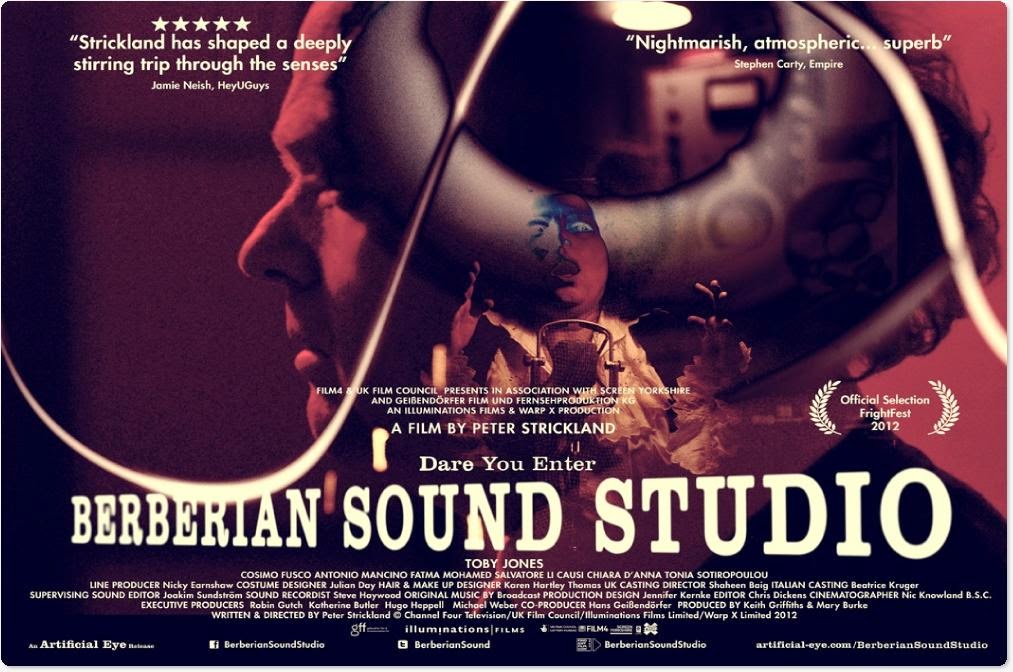
In Berberian Sound Studio (2012), Toby Jones plays a nebbish sound engineer who is hired to supervise the foley work and sound-mixing for an Italian horror movie (-- and judging by the wardrobe and equipment, I'd say this takes place sometime between 1968 and 1975). Coming from the world of English travelogues and nature documentaries, our hero is quite unprepared for the violent and explicit Argento-esque witch-burner he must finish nor the clash of culture with his new bosses and co-workers. Fair warning, this is one of those 'is it real or is this just a manifestation of our protagonist's decent into madness' kinda things. The end result of which is a mind-blowing build up of such staggering proportions the ending can't help but generate some frustrations and consternation. Regardless, Jones is a pleasure to watch and the plot he is plugged into is a fascinating behind the scenes look at the sleight-of-hand sound-booth end of the movie-making process.


When people ask why Robert Ryan is my favorite actor, I usually just tell them to watch The Set-Up (1949) as the answer. I guarantee those who follow through on this challenge will watch riveted as a crooked manager takes a payoff from a local hood to throw a bout; but he makes the mistake of not telling his (not over the hill but we can see it from here) boxer about the fix to keep more of the dough (only the trainer is in on it with him.) Stoker (Ryan), the boxer in question, is keenley aware the end of his career is coming with nothing to show for it and is terrified by his future prospects where punching and getting punched is the only thing he knows how to do. He's also in the middle of a marital implosion with his wife (Totter), who can no longer sit around and watch her husband's brains be scrambled even further when he refuses to quit. What happens next is fairly predictable, but, oh, children, the execution by director Robert Wise and everyone else involved is simply amaze-balls.


Ever have one of those days where it feels like you're ready to fight the good fight only to wind up tripping over your own intestines before expiring? If so, have I got a movie for you! Super Ninjas (1982), which began life as Five Element Ninja, hits you right upside the head with a whole loaf of Shaw Brothers kung-fu whackadoodlery. Try to get your head around this: A Chinese sensei's martial artists beat a rival Japanese warlord's samurai. Samurai sends word to his brother, leader of an elite cadre of ninja, who possess the power of the elements (earth, wood, wind, water, and fire), before committing hari kari. Super Ninja and his brood wipe out the sensei and his men quite spectacularly, leaving one lone survivor to learn the skills he needs to be a Super-Dooper Ninja to exact his revenge, which he does, even more spectacularly. Now, I'm not the biggest fan of HK films, finding them to be a tad exhausting in the lather, rinse, repeat of their interchangeable plots, but this one is just so nucking futz. Staggeringly so. This display of eye-popping action, hilarious dubbing, grue, dismemberment, wire-fu, fists 'o' fury, and mad ninja gopher skills, had me Ctrl-Alt-Deleting my brain too many times to count. Truly amazing.


On the closing night of a theatrical production of 'Murder in the Dark', two escaped prisoners take refuge in the theater, are discovered backstage, and spend the rest of the performance terrorizing the cast, forcing them to finish the show to clear the audience so they can make their escape. Things go awry and, basically, once a character dies onstage, they meet the same fate off. The Last Night (1983) is an obscure, British, direct to video slasher movie -- so rare I am unable to unearth any kind of art for it. (Poster, video box, nada.) Not surprising, because the film kinda stinks, which is too bad because the premise is rather clever and in more capable hands might've really been something. Kind of amazing how this thing presciently predicts Michael Haneke's Funny Games in some aspects, but, again, the whole thing is wasted in the execution, which, somewhat mercifully, doesn't even break an hour of run time.


Now, turns out there's a reason why The Last Night was so short. Apparently, it was part of a direct to video anthology, coupled with director Michael J. Murphy's other short feature, Invitation to Hell (1983), which proves just as bad -- nah, probably a little worse, actually, but just as mercifully short. Here, the worst friend in the world invites her BFF to a Halloween party only to wind up Rosemary's Baby'd. I think. Truthfully, the audio was so hot and distorted on the copy I watched I had no idea what anyone was saying, and so, I got to make up my own plot, which found our trapped heroine moving through a series of beaus, looking for The Children's Rainy Day Book of Ipecacs for the right recipe for the perfect 'Killer Shew' to banish BeelzeDud before she becomes the devil's incubator. Passable gore effects and a kick'n Bride of Frankenstein costume, beyond that -- *bleaugh*.


Until Do You Like Hitchcock?, Cat O' Nine Tails (1971) was probably Dario Argento's most conventional thriller. The title comes from our mismatched trio of sleuths, a reporter (James Franciscus), a blind crossword puzzle-maker with an ear for intrigue (Karl Malden), and the puzzle-maker's young niece (Carolis), who chase around nine elusive leads to solve a string of murders plaguing a genetic research company. Franciscus and Malden are great together and deserved a franchise. And aside from a few traditional Red Herrings, our team faithfully efforts to unravel the clues, seemingly always one step behind the guilty, putting themselves in danger, and unmask the killer -- even though the killer's chromosomal motivation has long been disproved as junk science. Yeah. This round, Argento seemed more focused on the look of the film, which is gorgeous, and some wild editing techniques, giving us the normal feast for the eyes while not making our brains hurt as the plot pretzels itself like it did in Tenebre or Deep Red, proving once again that sometimes less is more.


When an American diplomat is captured by the Viet Cong and taken into Laos for his eventual transfer to China(?), the CIA recruits The Devil's Advocates -- a quintet of surly Hell's Angels rejects, to get him back because of ... because of ... hrrrrmmmmm ... well, because of reasons. Apparently, most of these bikers are ex-servicemen, and after fleshing out their characters a bit, they Megaforce-ize their scooters and, soon enough, all hell breaks loose as this *ahem* 'clandestine mission' has all the sneaky subtlety of Macy's Thanksgiving Day parade. But! Things go south when they try to bust the prisoner out of the camp. Turns out the diplomat doesn't want to be rescued due to more of these 'reasons' as the film gets even dumber when we switch gears from gung-ho Fillipinosploitation action flick and director Jack Starrett brings out the clown-hammer of morality and mercilessly beats his production senseless until it's an anti-war screed. Again, The Losers (1970) is dumber than a bag of hammers; the mission and motivations make no sense whatsoever, but the sheer audacity of it, coupled with a fantastic cast -- William Smith, Adam Roarke, Paul Koslo, and Bernie Williams (the captain from Starsky and Hutch), and some incredible action set-pieces, makes this an exceptionally good time.


Dear Penthouse Magazine, I didn't think this could happen to me. I was a lonely prospector with a dubious treasure map, lost in the deserts of Mexico, with my talking mule, Toby. There I was, desperate, out of water, when suddenly, there appeared an oasis inhabited with six nubile nymphs who cavorted around on some playground equipment cleverly disguised as trees, shrubs and vines. And they were totally starkers! Well, except for their naughty naughty bits. Much sun-bathing, rain dancing and general interpretive hip-shaking ensued. Despite all of this booberific temptation, much to the chagrin of Toby, who, turns out, really has a talent for puns and double entendre, my hunt for the treasure continued in spite of all this bumpin' and grinding. And just when I thought I'd found the buried treasure, turns out I hadn't. Toby swears this was all a mirage, but who can say for sure. Yup, that about sums up Adam and Six Eves (1962) alrighty.


A Tragedy at Midnight (1942) is a fast-paced crackerjack of a mystery, where John Howard and Margaret Lindsay star as Nick and Nora Knockoff who, waitaminute ... That's not right. Oh, yeah, they star as Greg and Beth Sherman, married super-sleuths at large. See, he's the star of a radio program who solves current crimes and makes the police look the fool. But now he's the prime suspect when the body of a woman winds up in their bedroom. Now, the plot to find out who the victim is and whodunit is a little cock-eyed in this due to 15 minutes being excised out the print currently circulating around Amazon and Netflix, which completely omits several important clues; like the bedroom the couple was sleeping in not being their own. (Apparently, it's the TV print Republic chopped up for syndication.) It definitely is The Thin Man lite, but our stars spark the chemistry set and have this thing cooking with gas. Plus, there's an added bonus of Keye Luke as a proto-Kato, who is always around to get our couple out of jam and break out his kung-fu whenever needed.


Here we have Bob Clark's speculative take on what would've happened if Arthur Conan Doyle's master sleuth, Sherlock Holmes, had been pitted against Jack the Ripper. What I appreciated about Murder by Decree (1979) the most is the conspiratorial angle as to why the stymied police refuse to bring Holmes and Watson into the investigation in the first place as the trail of the killer leads to the monarchy. How? Well, I don't want to spoil it, because the onion-peeling is a lot of fun. And Christopher Plummer and James Mason are just great as the two-punch combo of Holmes and Watson. And yet, something was rubbing me wrong. And then it finally hit me: being plugged into this kind of historical tale, especially this one, means our dynamic duo is destined for failure. Basically, if you like your Sherlock Holmes a day late and dollar short, here's your movie.


Based on the Nurse Adams mysteries of Mary Roberts Rinehart, the cinematic adaptation of Miss Pinkerton (1932) results in a bizarre mash-up of an old dark house mystery, a police procedural, and a screwball comedy of errors. When a nurse (Joan Blondell) is loaned out to the police department to keep an eye on the sickly eye-witness to a suspicious death at a secluded mansion, she conspires with the detective in charge (George Brent) to keep her eyes and ears open in a hope someone in the house will slip up and reveal what really happened. Was it suicide? Or was it murder? Or was it a suicide staged to look like a murder as part of an insurance scam? The answer to that is a bit of a slog as the action is a bit too repetitive in spots, with too many auxiliary Red Herrings who almost spoils the soup, and the mystery that unfolds makes no sense whatsoever. But! The film proves highly entertaining anyway thanks to Blondell's gung-ho efforts.


When the U.S. and the Soviet Union unwittingly detonate two of the largest atomic bombs yet simultaneously, the planet's orbit is altered, leaving the Earth circling ever closer to the sun with each passing day. Told through the eyes of a couple of newspaper reporters (Edward Judd and Leo McKern), whose investigations into the strange weather phenomenon, horrific global climate shift, and an unexpected eclipse, uncover a truth no one wants to hear. And once that's sussed out, the only thing left to do is report on the collapse of civilization as we know it while the world withers and melts away and what's left of mankind clings onto the hope of one final, desperate act to correct what they most probably and irrevocably broke. Does it work? Maaaaybeeee ... I think The Day the Earth Caught Fire (1962) is probably Val Guest's most under-appreciated film. Perhaps it's a little too sobering for some but what I always appreciated about it most was not only do you get a crackerjack of a sci-fi doomsday scenario but it's also one of the most accurate portrayals of a newspaper organization covering said crisis that I've seen in film. (18 years insider experience, so there. *thhbbttthh*) Also, Janet Munro goes topless. Great, great stuff. 

Related Posts Plugin for WordPress, Blogger...