Thursday, March 17, 2011

Hey! You Got Your Blackhawk Down in My Independence Day! :: A Beer-Gut Reaction to Battle: Los Angeles (2011)

I'll be honest. I only wanted two things out of Battle: Los Angeles. One, that it took place in L.A. (-- not a deal-breaker, but, eh), and second, that there be, you know, a battle. Seems like a no-brainer of a request, but we've all been to the movies before, right? Right. Well, I'm happy to report that Battle: Los Angeles delivers on both those demands. It's also chock-full of (or, if your so inclined, choking) on an innumerable amount of clichés be it character -- from the weary, ready to hang up his boots Sergeant who once more proves his salt, to the green Lieutenant who first fails under fire but later redeems himself, to a Private with an axe to grind with his superiors -- or familiar situations as disaster mounts, lives are lost, and the alien invaders invariably sturm and drang their way to total victory, with mankind's only hope resting on the shoulders of Colonel Deus, Major Ex and Captain Machina. But I'm here to tell you, I didn't care one damn bit about all of that and enjoyed the hell out of every Alien-Ass-Kicking-Marine minute of this movie.

Now
to be fair, despite the Ex's Deus, there really was a Battle for L.A. A battle battle, and not just some one-sided token attack overwhelmed by the hostile E.T.'s advanced technology. Well, there was, and then things kind of escalate from there. So what we got is a running firefight that lasts for about 3/4ths of the movie. Seriously, I haven't seen an alien invasion flick that gave the Terrestrials this kind of a fighting chance since Tobe Hooper's much maligned remake of Invaders from Mars. And, damn, but if I didn't find that refreshing. And just like in that movie, the Marines have no qualms about killing Martians here, either -- tough though that may be but they and their machines can be brought down. And it's not some kind of miraculous or Divinely compatible computer virus or daring fighter pilots that brings those invading assholes down but the grunts on the ground, paying for each foot of shattered real estate with blood, sweat and steel and a well placed artillery barrage.


Yeah, about as subtle as an old Edward Dmytryk or John Wayne Buy War Bond's propaganda programmer, in the end, Battle: Los Angeles is exactly what its title would imply and doesn't try to be anything else, and how you react to that will probably depend on what you bring into it. Hawkish, Patriotic, clichéd, stoopid, or a shameless two-hour commercial for the Marine Corps -- or Dramamine for those not immune to the old combat shaky-cam (... I really don't even notice that thing anymore, but I'll assure you all at no point did I not know what was going on on screen), whatever you prefer. Me? I'll take it at face value. A kick-ass popcorn thriller that I'd like to see again on the big screen. In fact, I enjoyed it so much I found myself applauding our heroes' valiant efforts not once, or twice, but three times -- the last with an accompanying whoop of "Hell yeah!"


Battle: Los Angeles (2011) Original Film-Columbia / D: Jonathan Liebesman / W: Chris Bertolini / C: Lukas Ettlin / E: Christian Wagner / P: Jeffrey Chernov, Samuel Dickerman, David Greenblatt, Ori Marmur, Neal H. Moritz, Lisa Rodgers / S: Aaron Eckhart, Michelle Rodriguez, Cory Hardrict, Adetokumboh M'Cormack, Bridget Moynahan

Saturday, March 12, 2011

Tributes :: Kroger Babb, Mom and Dad, and the Beginning of the End of Mr. Hayes' Code of Cinematic Conduct.


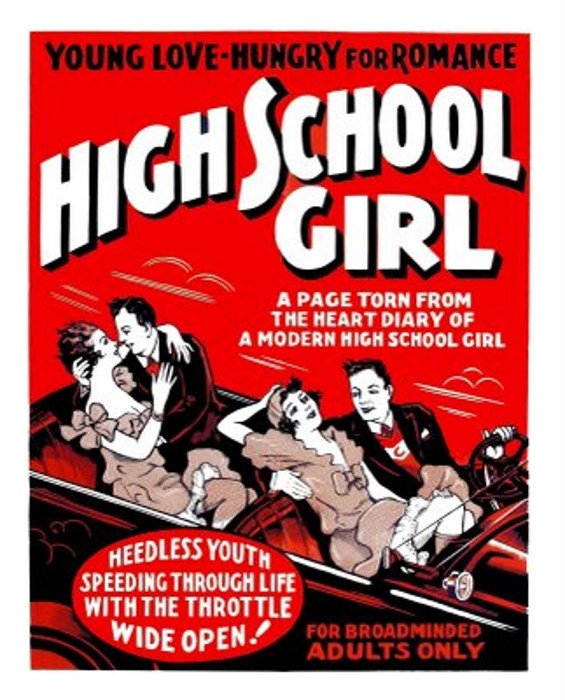
Born in 1906 in Lees Creek, Ohio, Howard W. "Kroger" Babb seemed destined for entertainment immortality -- of the oddball variety, that is. Before he was even twenty, Babb found himself in the "Believe it or Not" bible of Robert L. Ripley for his refereeing skills. And after a brief career as a sportswriter, Babb landed a job as a promoter and publicity director for a string of theaters in his native Ohio, where he honed his skills at cooking-up stunts and promotions to get more people into theaters for some of the less than stellar product on screen. Here, he hooked up with two more Howards, Cox and Underwood, a couple of old-school roadshow entrepreneurs, who were touring a moldy-oldy safe-sex screed, High School Girl (1934), punching it up with a new title, Dust to Dust, and inserting a reel featuring a live birthing sequence, and then capping it off with a lecture by a ringer on the pros of proper hygiene and the evils of sexual intolerance.


It was while heading one of these roadshow troupes that Babb first got the notion of making his own feature to exploit. Using his theater connections, Babb then raised $65000 for the project and arranged to have it shot at Monogram Studios. He even managed to get some clout behind the camera with William "One-Shot" Beaudine in the director's chair and Marcel Picard behind the camera. One week later, a sordid tale of a knocked-up high-school girl and her under-fire sex-ed teacher, complete with his graphic sex-ed inserts, was ready to roll. But first, Babb fine-tuned Mom and Dad (1945) to maximize attendance and minimize any trouble with the local censors and city fathers by pushing the standard moral boundaries of the era to the very precipice without toppling into the crevices of degeneracy below. Barely.


It seems back in those days you could get away with just about anything as long as it was presented as being educational -- and scored extra-points by railing against the ills of society, allowing the promoter to lay those ills bare for all to see as an end-run around the censors. And to get the ball rolling, like an old traveling snake-oil medicine show, Babb would send in an agent first to four-wall the town with promotional materials, handbills, and paid advertisements. Once total market saturation was achieved, the presenter moved in with the film and a bunch of other goodies in tow. See, to heighten things even further, Babb would include a lecture by the noted sexual hygiene commentator, Eliot Forbes, and would have nurses on hand to handle any emergencies if someone became overwhelmed by what they heard or saw on screen -- but what they were really there for was to make a sales pitch for the ancillary sex-ed pamphlets -- complete with diagrams and photos of several victims of varied venereal diseases, available at the concession stand:


___  ___  ___  ___  ___  ___  ___  ___  ___  ___  ___  ___  ___

"They cannot be obtained on newsstands or at booksellers, or anywhere else. No, these books are offered exclusively to the patrons of this presentation at a slight charge over the actual costs of printing and distribution. That price -- on dollar ... Now think of it: for less than the cost of a carton of cigarettes, you can have a set of the vitally important books to be read in the privacy of your won home, and I believe with all my heart that a set of these books belongs on the bedside table of every home in this great land..."

 xxxxxxxxxxxxxxxxxxxxxxx -- Eliot Forbes
___  ___  ___  ___  ___  ___  ___  ___  ___  ___  ___  ___  ___  


If you bought that load of crap, then you bought yourselves a copy of The Digest of Hygiene for Mother and Daughter or The Manual of Hygiene for Father and Son (-- penned by Babb's wife, and Mom and Dad co-screen-writer, Mildred Horn). Now, I have no idea if those editions were segregated like the audiences were (-- anybody else remember the day in High School Health class when the girls had to go watch a film in the library while the boys had to go and watch one in the cafeteria?). Either way, most of the information in these pamphlets was outdated before they were even printed, and the fact that Babb had 25 different touring companies roaming the country at the same time, each with their very own Eliot Forbes to stump for safe sex never discouraged sales all that much.


But even with the education angle, it's been estimated Babb was sued nearly 400 times over Mom and Dad, with no clear record on how he came out on those. However, after nearly a decade in circulation, Mom and Dad had grossed Babb and his Hygiene Productions an estimated $54 million -- and that's just in ticket sales, so I guess you could call that a definite win. Of course, with that kind of money to be made, several imitators soon followed and the whole Kinsey-addled country was soon inundated with sex-ed films. And, unable to compete with the allure of these features with their current product, those behind the burlesque films and stag loops started pushing the limits on what they could get away with, slowly evolving into the Nudies, then the Roughies, to, eventually, mainstream nudity and sexual content, leaving the battered remnants of the Hayes Code in their wake. All thanks to Kroger Babb, Mom and Dad, and all those Elliot Forbeses.

___  ___  ___  ___  ___  ___  ___  ___  ___  ___  ___  ___  ___

"Nothing's hopeless if it's advertised right."

xxxxxxxxxxxxxxxxxxxxxxxxxxxx -- Kroger Babb
___  ___  ___  ___  ___  ___  ___  ___  ___  ___  ___  ___  ___


Lightning never did strike again for Babb after Mom and Dad, though. His more famous follow ups include trying to cash in on actress Lila Leeds' drug bust (-- along with fellow actor, Robert Mitchum,) with She Shoulda Said No (1949); Karamojia (1954) -- kind of a proto-mondo movie about a blood-drinking tribe of Africans; The Prince of Peace, a truly atrocious religious film out of Oklahoma with the promise of a new Bible for every paying customer; he also chopped-up Ingmar Bergman's Summer with Monkia (1953) and re-packaged as the nudie-flick The Story of a Bad Girl; and last, and least, a badly dubbed Italian version of Uncle Tom's Cabin (1965).


Yeah, that was our boy's last hurrah as declining health and constant tax-troubles over the undeclared money made on all those pamphlets and Bibles caused Babb to bow out of the business, which he turned over to his protege (and one of those many Elliot Forbeses), David Friedmen, who was about to team up with Hershel Gordon Lewis and blaze his own trail of exploitation infamy. Babb's health continued to deteriorate over the next decade, and he eventually passed away in early 1980. As for Mom and Dad, when the old entrepreneur finally kicked the bucket, it was still making the rounds on the drive-in circuit, which I find both beautiful and fitting.


Other Points of interest: 


Mom and Dad (1945) Hygienic Films :: Hallmark Productions EP: Barney A. Sarecky / P: Kroger Babb, J.S. Jossey / AP: Lewis G. Dow / D: William Beaudine / W: Kroger Babb, Mildred Horn / C: Marcel Le Picard / E: Richard C. Currier, Lloyd Friedgen / M: Dave Torbett / S: June Carlson, Hardie Albright, George Eldredge, Lois Austin

Thursday, March 10, 2011

Ten Films That Left an Impression or I'm Grateful to Have Finally Seen in 2010.


A taut, low-key flick with a small cast of great characters, a smart production aesthetic, and creepy as all hell, Pontypool can be read, allegorically speaking, on a lot of levels. But I think Bruce McDonald's faux zombie-fest saves it's true message for shock-jock Grant Mazzie's final rant. A defiant cry for the whole world, despite what you hear (or are forced-fed) on the news, to take a breath and just calm the *@%* down before we all kill each other.


A brilliant, but brutal non-linear on the lam / road movie that's triggered by a seasoned prostitute rescuing one of her newest recruits from a sadistic pedophile, which ends in an accidental death. Too bad for them the asshole in question was the head of the local mob, and whose son will stop at nothing to track them down and make them pay for what they did to dear old dad. I had a pretty good idea how it was destined to end, but -- SPOILERS AHOY! -- the film pulled a fast one on me. And though some may find it contrived, and even a bit of a cheat, I found it to be refreshingly uplifting after all the human depravity and carnage we've just sat through.


Let's see ... It stars Ida Lupino, Robert Ryan and Ward Bond ... It was directed by Nicholas Ray ... A tight, twisty script from Albert Bezzerides ... Has some brilliant cinematography from the always reliable Georgie Diskant -- making it quite possibly the only frozen noir ever committed to film ... Yeah ... I have no idea why it took so long to track this one down, either.


Ginger Roger's stock absolutely went through the roof in my classic film portfolio thanks to TCM's Star of the Month treatment in early 2010, making it hard to narrow it down to one choice, here. But this team-up treat with Cary Grant, under the steady hand of Leo McCarey, won out. A fabulous screwball comedy / propaganda piece with some unsuspected gravitas when our crusading couple wind up prisoners of the Gestapo without proper identification and soon find themselves a hair's breathe away from a one-way ticket to a concentration camp.


I reviewed this one awhile back, so I'll just reiterate how this obscurity is Charles B. Pierce's perfect film. So if you're a fan of The Town that Dreaded Sundown and The Legend of Boggy Creek, don't wait as long as I did to track this one down.


Always good to cross another William Wellman flick off the need to see list. And if this movie taught me anything, aside from reinforcing how much I love Wellman's cinematic, keyhole eye, is that I needs to see me some more Robert Taylor movies as soon as possible.


Shane Black really, really, really needs to make more movies.


Simply delightful, a treat for the eyes, ears and the soul. And it's mind-boggling when I think that the two best romantic comedies of the past decade have involved some animated rats (Flushed Away) and a couple of like-minded brethren in a benevolently mad-genius and his weather-nerd crush. Now who's ready for a second helping? This guy!


Two Tickets : $45

Round-trip to Omaha to see it on the Big Screen : 250 Miles

Misting up with your Momma when the Big E tears
through An American Triology : Priceless


Bat-shit insane Japanese espionage flick that proves what every super-spy needs is a crack battalion of suicidal leather-clad vixens, who can make weapons out of anything (-- a favorite being a barrage of LP records), to bail his sorry ass out of trouble whenever he gets in over his head. Which he does. A lot. Don't think, just roll with it, and you'll love this movie as much as I do.


Coming soon: My Top Ten films of 2010.

Tuesday, March 8, 2011

ATTENTION :: Blogathon Alert!


Attention all you Primitive Screw-Heads, Darkmen, and slightly Radio-Active Do-Gooders ... The fine proprietor (--that'd be Bryce Wilson) over at the equally fine Things That Don't Suck blog is ramrodding a tribute to the undisputed King of the Crash-Edit, Sam Raimi, the last week of March and bleeding into April. Full details can be found here. I'm participating. Are you?

Saturday, March 5, 2011

Favorites :: Ensemble Casts :: Defying Death in a Patent Leather Jumpsuit Never Looked So Good!


Red Buttons


Dabney Coleman


Cameron Mitchell


Marjoe Gortner


Albert Salmi


Leslie Nielsen


Lauren Hutton


Gene Kelly


and Evel Knievel

And, together, they made this whole six-pack of the awesome...


What he said.

See this. See it Now!


Wednesday, March 2, 2011

Netflix'd :: Clearing Out the Instant Que :: Budd Boetticher's The Killer is Loose (1956)

___  ___  ___  ___  ___  ___  ___  ___  ___  ___  ___  ___
 
"Some day, Wagner, I'm gonna settle with you for it."
___  ___  ___  ___  ___  ___  ___  ___  ___  ___  ___  ___

Right before Budd Boetticher teamed up with Randolph Scott for Seven Men from Now, setting them on a seven film odyssey that helped define and redefine both of their careers, the director with a history of throwing nosy studio execs off of his sets by the scruff of their necks and the back of their belts ramrodded a crackerjack crime programmer for producer Robert Jacks and Crown Productions called The Killer is Loose.


Boetticher broke into the industry as a technical adviser for Tyrone Power, teaching him how to be a matador, something he'd mastered while living in Mexico, for the film, Blood and Sand. Paying attention to what went on behind the camera and in the editing room, Boetticher soon found himself in the director's chair, where he developed a deceptively simple style that was brutish, bleak and always to the point. His big break came when John Wayne asked him to direct The Bullfighter and the Lady for the famed actor's Batjac Productions -- where, according to legend, on the first day of filming the novice director had the balls to kick the Duke of the set for interfering with his set-ups. (However, Wayne would have the last word when the film was drastically re-edited before release.) And after a less than friendly run at Universal, where he helped cement Glenn Ford's career, but held no patience for the rigid studio system, Boetticher was soon out of a job. Enter Robert Jacks...


Story wise, The Killer is Loose is probably nothing you haven't seen before as the plot is fairly simple: When Leon Poole (Corey), a twitchy bank-teller, turns out to be the inside man in a robbery, he holes up in his apartment and refuses to surrender to the police. In the resulting shoot-out, his wife is accidentally killed in the crossfire before he's apprehended -- with Poole surrendering quietly as he attends to her body in a truly skin-crawling scene. After being convicted and sentenced, Poole swears that some day he'll get even with Detective Sam Wagner (Cotten), who pulled the trigger. Sure enough, several years later, the convict engineers his escape and, with a promise to keep, Poole heads back to his old stomping grounds. But his goal is not to kill Wagner. No. His goal is to make him suffer as he has suffered -- by murdering Wagner's wife!


Sure, there's also a standard subplot about Wagner's wife, Lila (Fleming), not wanting to be detective's widow, begging him to quit his job before something like this happens. And, of course, his efforts to protect her backfire and, actually, leaves her more vulnerable to this violent sociopath. But, that's just background noise and will do nothing to distract you from the main action. Wendell Corey is absolutely mesmerizing as Poole, playing him as a slow, deliberate, and stone-faced cipher that makes his sudden eruptions of violence both more startling and, somehow, more believable. As for our main couple, Boetticher once more butted heads with his star, Rhonda Fleming, to tone down the glamour -- she was playing a cop's wife, after all. She reluctantly agreed, and would later thank him for his efforts and allowing her to act beyond her usual trappings. Cotten is as solid as ever, and it won't take sharp eyes to recognize B-movie stalwarts Alan Hale Jr., Michael Pate and William Hudson as part of Wagner's goon squad


Scripted by John and Ward Hawkins, the film really feels like an extended episode of one of those gritty TV crime dramas of the late 1950's, which would make sense since the Hawkins brothers wrote for almost all of them. Behind the camera, Lucien Ballard's fluid and voyeuristic lens always seem to be perfectly placed to heighten Boetticher's unflinching intentions. (Ballard, of course, would go on to infamy in a series of westerns with Sam Peckinpah.) And together, in just fifteen shooting days, they all produced a tight little thriller that you all need to see.


The Killer is Loose (1956) Crown Productions :: United Artists / P: Robert L. Jacks / D: Budd Boetticher / W: Harold Medford, John Hawkins, Ward Hawkins  / C: Lucien Ballard / E: George A. Gittens / M: Lionel Newman / S: Joseph Cotten, Rhonda Fleming, Wendell Corey, Alan Hale Jr., Michael Pate, Dee J. Thompson, John Larch
Related Posts Plugin for WordPress, Blogger...