Tuesday, April 1, 2014
Crazy or Not Crazy? That is the Question in a Beer-Gut Reaction to Ted Post's Made for TV Movie, Night Slaves (1970)
Our film opens with a man in crisis preamble: He's just quit his job as a corporate attorney; his marriage is currently breaking up on the rocks of ennui and the resulting infidelity (-- the wife is having an affair with his ex-business partner); and his brakes have just failed, resulting in a catastrophic car accident, whose sustained injuries require part of his fractured skull to be replaced with a steel plate.
While he recovers, the wife, in a noble but perhaps misguided gesture of loyalty and doing the right thing, postpones the inevitable break up, not wanting to pile on any more misery until he is solidly back on his feet. Thus, our film proper picks up several months later, with our fraying couple on the road, looking for a quiet spot to recuperate as per doctor's orders. Finding what appears to be the ideal town, everything is so laid back most of the locals appear to be asleep on their feet. (Odd, since it's well past noon.) Here, our cast is thickened up a bit with the introduction of Henshaw, the town sheriff (Nielsen), Beany, the town idiot (Prine), Fletcher, the restauranteur (Kellogg) and Mrs. Crawford, the dowdy owner of the local B 'n' B (Vincent). It almost seems too bucolic to be true, but things take a sinister turn when our couple crawls into bed for the night.
Waking up with a start from a(n obviously reoccurring) nightmare about the accident, our haunted hero is drawn to the window by some activity outside. Seems the whole town has turned out, like ants fleeing a colony, silently loading up onto the back of several trucks. Puzzled by this, he turns to alert the wife only to discover she's not in bed -- or even in the room. He then spots her outside, waiting to get onto one of those trucks. Taking to the streets, he tries to stop her but the other somnambulant townsfolk prevent this, knocking him aside.
Once the trucks leave, the distraught husband does a quick search around town, looking for help but finding everyone gone -- save for one girl, who giggles constantly at his plight and escalating agitation. Luring him back to his room, this tormentor disappears and the overwhelmed man collapses on the bed and passes out. Come the dawn, he wakes up with his wife sleeping soundly beside him. Worse yet, when he reveals what he saw the night before, she has no recollection of any of this -- nor will any of the other townsfolk. Told to write it off as a bad dream, despite the mounting circumstantial evidence backing him up, the man begins to question his sanity in the face of all this denial -- until night falls and, crazy or not, this mass exodus happens again...
Jerry Sohl was a passable science fiction novelist (The Transcendent Man, The Odious Ones), who transitioned to a middling Hollywood screen-writer, staying in the same genre, by penning scripts for The Outer Limits (Counterweight, The Invisible Enemy), Alfred Hitchcock Presents (Dead Weight, A Secret Life), and, most notably, Star Trek (Whom Gods Destroy, This Side of Paradise, The Corbomite Maneuver). He also served as a ghost-writer for Charles Beaumont on a trio of Twilight Zone episodes (Queen of the Nile, Living Doll and The New Exhibit). In between all of that, Sohl published another novel in 1965, Night Slaves.
The tele-film based on the book doesn't stray too far off its source, with the Howards still being on the outs. Marjorie Howard (Grant) is in love with another man but stays with her husband as a sense of duty only while he recovers from that auto accident, which killed the other driver and his passenger. And thus, both physically and emotionally, Clay Howard (Franciscus) is, forgive me, a bit of a wreck. And things only get worse when the couple's getaway vacation is crudely interrupted by some preternatural malfeasance.
Five years after it's publication, producer Everett Chambers tagged Night Slaves for adaptation as a Made for TV movie. I've touched on the history of this genre before but, for those of you just tuning in, the MFTV Movie really cemented itself when Barry Diller set up a specific time slot for them as part of the ABC network's The Movie of the Week in the fall of 1969; and Night Slaves would be part of the second wave of productions to find their way into living rooms. Fellow Outer Limits scribe Robert Specht co-wrote the screenplay with Chambers, which, again, stays fairly faithful to the novel with one notable exception that we won't spoil -- yet.
To translate that script to screen, Chambers brought in veteran TV director, Ted Post. Starting with Armstrong Circle Theater back in 1952, Post was fairly prolific on the small screen over the next three decades, sliding from genre to genre with ease, but was also no stranger to motion pictures. He directed Clint Eastwood in Hang 'Em High (and would do so again in Magnum Force). And Post had just wrapped Beneath the Planet of the Apes, which also starred Franciscus, before tackling Night Slaves. And like it's source novel, this tele-film uses sci-fi trappings as a framing device to show the death throes of a marriage and one man's existential mid-life crisis and mental breakdown prodded along by extraterrestrial forces.
Yeah, after the second morning produces the same vehement denials, and then a third, Night Slaves quickly ventures into It Came from Outer Space territory when Clay finally wises up and plays along the next night, obediently following the others onto the trucks, which take them to a nearby factory where they all unload and set to work on ... something. Poking around further, Clay finally gets to the bottom of it all. Seems a gaggle of shipwrecked E.T.'s are using the people -- as benevolently brain-washed as extra-terrestrially possible -- as forced labor to repair their ship.
Turns out Clay was immune to their 'psycho-kinetic' brainwaves due to that steel plate in his head. But now that he knows the truth, it does little to add credibility to his story. Branded a kook by the locals, the film tries to muddy these familiar plot contrivances by throwing in a couple of missing people, namely Fletcher's wife and daughter. And when the former turns up dead along the road and the ladder turns out to be the giggling girl, who only Clay has seen the past three nights, everyone soon suspects him of a double-homicide.
And if all of that weren't dire enough, things get even a bit more twisted when Clay and the girl (Sterling) fall head over hills in love with each other in perhaps the fastest and stoopidest whirlwind romance ever committed to film. See, the girl has been possessed by a lowly alien technician named Naillil, and they're both ready to tune in and drop out of the rat race and decide to do so together. Alas, insta-soul mates or not, their inter-stellar romance is strictly verboten (-- it'll never work, says I. He's carbon based, she's a non-corporeal blob of neurons). And so, commander Noel (Prine again) orders that Clay be placed in 'protective custody' until the repairs are completed in two more days. Will t'woo wuv win out in the end? Or will a daytime lynch mob derail this romance permanently?
Well, the answer to both questions is yes. Well, sort of. But not really. See, as we barrel toward the climax, Night Slaves the TV film finally ditches Night Slaves the novel. In Sohl's version, Clay Howard truly was insane, and this whole scenario was a paranoid delusion -- all part of his cognitive breakdown over the guilt of killing the other two motorists. And in this delusion, he concocts this plight where he decides to run away with Naillil to outer space. To accomplish this, he commits suicide by slitting his wrists. Again, this was all in his head and he died for nothing.
A lot of the same elements that proved Clay's insanity leaked into the movie. Naillil and Noel are Lillian and Leon spelled backwards, the names of the other victims in the accident. And so, in a sense, novel Clay has fallen in love with the woman he killed to compensate for his guilt, which leads to his self-destruction. I find this weird and a little disconcerting. And when one considers a lot of the other cynical, downbeat, and straight-up mind-f@ck endings the 1970s spawned on the boob-tube (Satan's Triangle and A Cold Night's Death immediately spring to mind), they really could've had another real head walloper here. But, no. We get a happy ending. Sort of. But not really. Sensing a pattern here...
Anyhoo, Clay is saved firstly when that lynch mob waits too long and are diverted back to the factory. (The woman died of a heart attack while in transport and fell of the truck, which, of course, no one remembers.) Left alone in the jail, Naillil lets him out and tells him to meet her in the meadow where the ship will launch the next morning. But Clay thinks they should skip trying to smuggle him on board and just jump in his car and skedaddle. This they try, but the zombified town folk swarm the car, blocking their escape. (The film's most effective scene.) Come the dawn, Clay smiles and nods and gives everyone the answers they want to hear until he's released from jail. Then, he quickly ditches the wife and leads a merry chase to that meadow, where he is reunited with his alien lover. They run off into the weeds together. When the sheriff and Marjorie arrive, they find them sprawled on the ground. Clay is dead -- well, not dead but 'psycho-kinetically' extracted to join Naillil on the ship (-- you'd think that steel plate would have prevented this, too, but, eh, forget it, the movie's almost over), but the girl, Annie Fletcher, is still alive but remembers nothing, leaving those our protagonist left behind to contemplate on what really happened and whether he was crazy or not.
Despite these changes, Sohl was apparently happy with the adaptation. To me, as crazy as I made it out to be, Night Slaves is a little too tepid and way too repetitive in its plot structure. (I was totally with it until it got to the insipid romantic subplot.) It also lacks the true whackadoodlery of George McCowan's The Love War (-- a wild and wacky tale of feuding alien races fighting a clandestine war on earth in the form of Lloyd Bridges and Angie Dickinson, which debuted the same year) and not played straight enough to reach the supernatural contemporaneity alchemy of John Llewellyn Moxey's THE NIGHT STALKER (-- where a vampire stalks the streets of Las Vegas). Post does a workmanlike job behind the camera, but aside from that final attack on the car nothing else really sticks out. We've all seen him be better than this. And weirder. (Go see The Baby. Now!) The incidental music is credited to Bernardo Segall, but one could easily mistake it's hiccuping, clavichord heavy muzak for something Vic Mizzy would cook up. Whoever wrote it, it doesn't really fit the surroundings all that well.
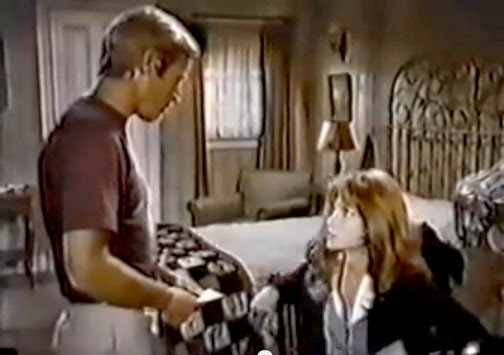
Overcompensating for these deficiencies and lack of deliriousness, we have James Franciscus and Lee Grant adding a lot of gravitas to the proceedings -- and more than it probably deserved. The film just smolders when these two share the screen. Not with hate, but a sense of familiar contempt two people with nothing left to give or say to each other accrue until it finally boils over. The film works so well when these two shred what's left of their marriage, burn the remnants, and salt the ashes. Kudos to Grant especially; it was a genuine pleasure to watch her on such a slow burn, here, when everything else I've seen her in can be easily identified by the teeth marks she left in the majority of the scenery. My Bro'Crush on Franciscus has already been well documented, but, omigod, Tisha Sterling is so adorable I can't even even.
Night Slaves debuted on September 29, 1970. I fist saw it many moons ago on TBS, back when the SuperStations didn't suck. It's good, but not THAT good. It's weird, but not quite weird enough. Is it worth seeing? It barely breaks an hour and there are worse things you could waste an hour on. And despite it's short-comings, Night Slaves definitely proves, once again, that the 1970s truly were a glorious time for network TV. An era of Made for TV movies, with amazing casts plugged into plots you wouldn't believe even if I drew you a picture, that we will sadly never see again.
Night Slaves (1970) Bing Crosby Productions :: American Broadcasting Company (ABC) / P: Everett Chambers / D: Ted Post / W: Everett Chambers, Robert Specht, Jerry Sohl (novel) / C: Robert B. Hauser / E: Michael Kahn / M: Bernardo Segall / S: James Franciscus, Lee Grant, Andrew Prine, Tisha Sterling, Leslie Nielsen, John Kellogg, Virginia Vincent
Saturday, March 29, 2014
Netflix'd :: Clearing Out the Instant Que :: The Only Good Bug Is a Dead Bug in Shinji Aramaki's Starship Troopers: Invasion (2012)
As for what happens next, Would you like to more? Well, Citizen, then do your part and give Starship Troopers: Invasion a spin as soon as possible to find out. Look, I know heeding my highly volatile film enthusiasm is kinda like dealing with an errant puppy when it comes to recommendations, in that malicious intent is never intended, and it could be considered adorable in some circles, but, in the end, I still missed the paper and the carpet is now soiled. However, when dealing with an animated movie from Japan that fetishizes the merging of men and women, rubber, and machine into the ultimate killing machines, with lots of cartoon boobies, mindless violence, dismemberment, animated nookie, giant robot chainsaws, big damn arachnids, and Johnny F@cking Rico -- make that General Johnny F@cking Rico, all compressed into a giant cheeseball of Oo-RAH! awesome stoopidity, then, I say, What's not to love? In other words: C'mon, you apes. You wanna live forever?!?
Starship Troopers: Invasion (2012) Sola Digital Arts :: Stage 6 Films :: Sony Pictures Home Entertainment / EP: Edward Neumeier, Casper Van Dien / P: Joseph Chou / D: Shinji Aramaki / W: Flint Dille, Robert A. Heinlein (novel) / M: Tetsuya Takahashi / S: Luci Christian, David Matranga, Justin Doran, David Wald, Emily Neves
Tuesday, March 25, 2014
Favorites :: Vintage Print Ads :: Violence! Terror! Criminal Assault! :: A Russ Meyer Drive-In Double Feature to Kill! Kill! For! (September, 1966)
Other Points of Interest:
Faster, Pussycat! Kill! Kill! (1965) Eve Productions / P: Russ Meyer, Eve Meyer / AP: George Costello, Fred Owens / D: Russ Meyer / W: Jack Moran, Russ Meyer / C: Walter Schenk / E: Russ Meyer / M: Igo Kantor / S: Tura Satana, Haji, Lori Williams, Susan Bernard, Stuart Lancaster, Paul Trinka, Dennis Busch
Wednesday, March 19, 2014
Recommendations :: A Baker's Dozen of What I've Been Watching that You Should Watch, Too, or Avoid at Your Own Peril.
Set against the carnage and chaos of the amphibious landings at Salerno, Italy, Lewis Milestone's World War II mini-epic, A Walk in the Sun (1945), follows an infantry platoon that takes the initiative to complete their mission after all of their officers have been killed. More of a character study and a crackerjack lesson in acting chemistry, each member of the outfit gets their own, well, moment in the sun -- with special shout-outs to Norman Lloyd (as the platoon's cynical prophet), Herbert Rudley (as the lead non-com who cracks), and Dana Andrews (who keeps them moving forward no matter what the cost). Also agitating the gravel are John Ireland, Lloyd Bridges, and the three-punch combo of Richard Conte, George Tyne and Steve Brodie as the machine-gun squad, who burn through Harry Brown and Robert Rossen's screenplay that just crackles with nearly Hawksian levels of camaraderie and banter as the action constantly escalates and deflates with each objective passed until the day is won.
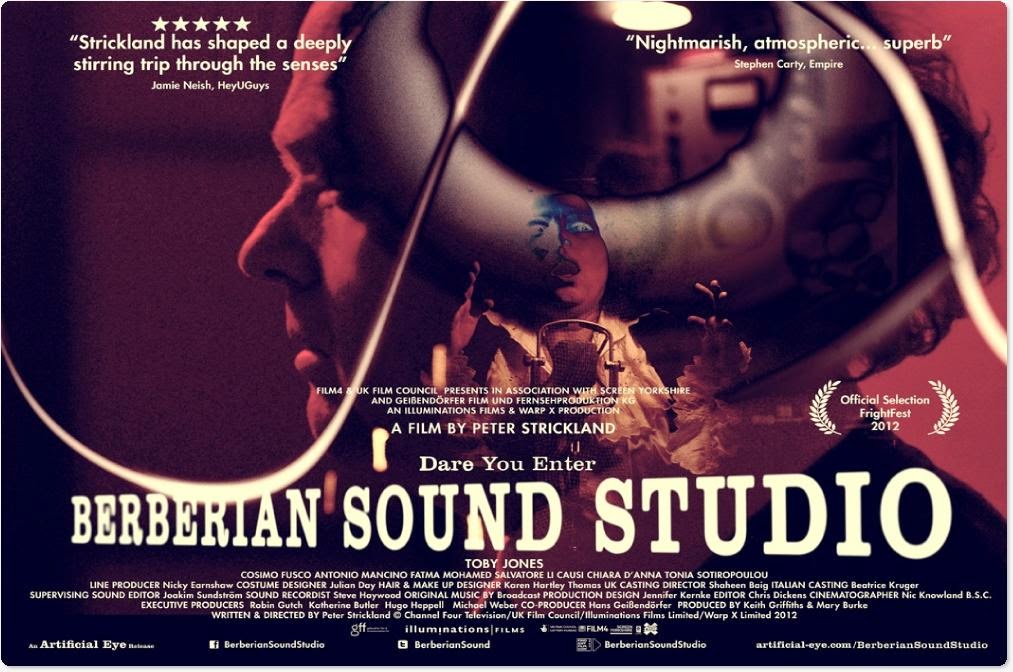
In Berberian Sound Studio (2012), Toby Jones plays a nebbish sound engineer who is hired to supervise the foley work and sound-mixing for an Italian horror movie (-- and judging by the wardrobe and equipment, I'd say this takes place sometime between 1968 and 1975). Coming from the world of English travelogues and nature documentaries, our hero is quite unprepared for the violent and explicit Argento-esque witch-burner he must finish nor the clash of culture with his new bosses and co-workers. Fair warning, this is one of those 'is it real or is this just a manifestation of our protagonist's decent into madness' kinda things. The end result of which is a mind-blowing build up of such staggering proportions the ending can't help but generate some frustrations and consternation. Regardless, Jones is a pleasure to watch and the plot he is plugged into is a fascinating behind the scenes look at the sleight-of-hand sound-booth end of the movie-making process.
When people ask why Robert Ryan is my favorite actor, I usually just tell them to watch The Set-Up (1949) as the answer. I guarantee those who follow through on this challenge will watch riveted as a crooked manager takes a payoff from a local hood to throw a bout; but he makes the mistake of not telling his (not over the hill but we can see it from here) boxer about the fix to keep more of the dough (only the trainer is in on it with him.) Stoker (Ryan), the boxer in question, is keenley aware the end of his career is coming with nothing to show for it and is terrified by his future prospects where punching and getting punched is the only thing he knows how to do. He's also in the middle of a marital implosion with his wife (Totter), who can no longer sit around and watch her husband's brains be scrambled even further when he refuses to quit. What happens next is fairly predictable, but, oh, children, the execution by director Robert Wise and everyone else involved is simply amaze-balls.
Ever have one of those days where it feels like you're ready to fight the good fight only to wind up tripping over your own intestines before expiring? If so, have I got a movie for you! Super Ninjas (1982), which began life as Five Element Ninja, hits you right upside the head with a whole loaf of Shaw Brothers kung-fu whackadoodlery. Try to get your head around this: A Chinese sensei's martial artists beat a rival Japanese warlord's samurai. Samurai sends word to his brother, leader of an elite cadre of ninja, who possess the power of the elements (earth, wood, wind, water, and fire), before committing hari kari. Super Ninja and his brood wipe out the sensei and his men quite spectacularly, leaving one lone survivor to learn the skills he needs to be a Super-Dooper Ninja to exact his revenge, which he does, even more spectacularly. Now, I'm not the biggest fan of HK films, finding them to be a tad exhausting in the lather, rinse, repeat of their interchangeable plots, but this one is just so nucking futz. Staggeringly so. This display of eye-popping action, hilarious dubbing, grue, dismemberment, wire-fu, fists 'o' fury, and mad ninja gopher skills, had me Ctrl-Alt-Deleting my brain too many times to count. Truly amazing.
On the closing night of a theatrical production of 'Murder in the Dark', two escaped prisoners take refuge in the theater, are discovered backstage, and spend the rest of the performance terrorizing the cast, forcing them to finish the show to clear the audience so they can make their escape. Things go awry and, basically, once a character dies onstage, they meet the same fate off. The Last Night (1983) is an obscure, British, direct to video slasher movie -- so rare I am unable to unearth any kind of art for it. (Poster, video box, nada.) Not surprising, because the film kinda stinks, which is too bad because the premise is rather clever and in more capable hands might've really been something. Kind of amazing how this thing presciently predicts Michael Haneke's Funny Games in some aspects, but, again, the whole thing is wasted in the execution, which, somewhat mercifully, doesn't even break an hour of run time.
Now, turns out there's a reason why The Last Night was so short. Apparently, it was part of a direct to video anthology, coupled with director Michael J. Murphy's other short feature, Invitation to Hell (1983), which proves just as bad -- nah, probably a little worse, actually, but just as mercifully short. Here, the worst friend in the world invites her BFF to a Halloween party only to wind up Rosemary's Baby'd. I think. Truthfully, the audio was so hot and distorted on the copy I watched I had no idea what anyone was saying, and so, I got to make up my own plot, which found our trapped heroine moving through a series of beaus, looking for The Children's Rainy Day Book of Ipecacs for the right recipe for the perfect 'Killer Shew' to banish BeelzeDud before she becomes the devil's incubator. Passable gore effects and a kick'n Bride of Frankenstein costume, beyond that -- *bleaugh*.
Until Do You Like Hitchcock?, Cat O' Nine Tails (1971) was probably Dario Argento's most conventional thriller. The title comes from our mismatched trio of sleuths, a reporter (James Franciscus), a blind crossword puzzle-maker with an ear for intrigue (Karl Malden), and the puzzle-maker's young niece (Carolis), who chase around nine elusive leads to solve a string of murders plaguing a genetic research company. Franciscus and Malden are great together and deserved a franchise. And aside from a few traditional Red Herrings, our team faithfully efforts to unravel the clues, seemingly always one step behind the guilty, putting themselves in danger, and unmask the killer -- even though the killer's chromosomal motivation has long been disproved as junk science. Yeah. This round, Argento seemed more focused on the look of the film, which is gorgeous, and some wild editing techniques, giving us the normal feast for the eyes while not making our brains hurt as the plot pretzels itself like it did in Tenebre or Deep Red, proving once again that sometimes less is more.
When an American diplomat is captured by the Viet Cong and taken into Laos for his eventual transfer to China(?), the CIA recruits The Devil's Advocates -- a quintet of surly Hell's Angels rejects, to get him back because of ... because of ... hrrrrmmmmm ... well, because of reasons. Apparently, most of these bikers are ex-servicemen, and after fleshing out their characters a bit, they Megaforce-ize their scooters and, soon enough, all hell breaks loose as this *ahem* 'clandestine mission' has all the sneaky subtlety of Macy's Thanksgiving Day parade. But! Things go south when they try to bust the prisoner out of the camp. Turns out the diplomat doesn't want to be rescued due to more of these 'reasons' as the film gets even dumber when we switch gears from gung-ho Fillipinosploitation action flick and director Jack Starrett brings out the clown-hammer of morality and mercilessly beats his production senseless until it's an anti-war screed. Again, The Losers (1970) is dumber than a bag of hammers; the mission and motivations make no sense whatsoever, but the sheer audacity of it, coupled with a fantastic cast -- William Smith, Adam Roarke, Paul Koslo, and Bernie Williams (the captain from Starsky and Hutch), and some incredible action set-pieces, makes this an exceptionally good time.
Dear Penthouse Magazine, I didn't think this could happen to me. I was a lonely prospector with a dubious treasure map, lost in the deserts of Mexico, with my talking mule, Toby. There I was, desperate, out of water, when suddenly, there appeared an oasis inhabited with six nubile nymphs who cavorted around on some playground equipment cleverly disguised as trees, shrubs and vines. And they were totally starkers! Well, except for their naughty naughty bits. Much sun-bathing, rain dancing and general interpretive hip-shaking ensued. Despite all of this booberific temptation, much to the chagrin of Toby, who, turns out, really has a talent for puns and double entendre, my hunt for the treasure continued in spite of all this bumpin' and grinding. And just when I thought I'd found the buried treasure, turns out I hadn't. Toby swears this was all a mirage, but who can say for sure. Yup, that about sums up Adam and Six Eves (1962) alrighty.
A Tragedy at Midnight (1942) is a fast-paced crackerjack of a mystery, where John Howard and Margaret Lindsay star as Nick and Nora Knockoff who, waitaminute ... That's not right. Oh, yeah, they star as Greg and Beth Sherman, married super-sleuths at large. See, he's the star of a radio program who solves current crimes and makes the police look the fool. But now he's the prime suspect when the body of a woman winds up in their bedroom. Now, the plot to find out who the victim is and whodunit is a little cock-eyed in this due to 15 minutes being excised out the print currently circulating around Amazon and Netflix, which completely omits several important clues; like the bedroom the couple was sleeping in not being their own. (Apparently, it's the TV print Republic chopped up for syndication.) It definitely is The Thin Man lite, but our stars spark the chemistry set and have this thing cooking with gas. Plus, there's an added bonus of Keye Luke as a proto-Kato, who is always around to get our couple out of jam and break out his kung-fu whenever needed.
Here we have Bob Clark's speculative take on what would've happened if Arthur Conan Doyle's master sleuth, Sherlock Holmes, had been pitted against Jack the Ripper. What I appreciated about Murder by Decree (1979) the most is the conspiratorial angle as to why the stymied police refuse to bring Holmes and Watson into the investigation in the first place as the trail of the killer leads to the monarchy. How? Well, I don't want to spoil it, because the onion-peeling is a lot of fun. And Christopher Plummer and James Mason are just great as the two-punch combo of Holmes and Watson. And yet, something was rubbing me wrong. And then it finally hit me: being plugged into this kind of historical tale, especially this one, means our dynamic duo is destined for failure. Basically, if you like your Sherlock Holmes a day late and dollar short, here's your movie.
Based on the Nurse Adams mysteries of Mary Roberts Rinehart, the cinematic adaptation of Miss Pinkerton (1932) results in a bizarre mash-up of an old dark house mystery, a police procedural, and a screwball comedy of errors. When a nurse (Joan Blondell) is loaned out to the police department to keep an eye on the sickly eye-witness to a suspicious death at a secluded mansion, she conspires with the detective in charge (George Brent) to keep her eyes and ears open in a hope someone in the house will slip up and reveal what really happened. Was it suicide? Or was it murder? Or was it a suicide staged to look like a murder as part of an insurance scam? The answer to that is a bit of a slog as the action is a bit too repetitive in spots, with too many auxiliary Red Herrings who almost spoils the soup, and the mystery that unfolds makes no sense whatsoever. But! The film proves highly entertaining anyway thanks to Blondell's gung-ho efforts.
When the U.S. and the Soviet Union unwittingly detonate two of the largest atomic bombs yet simultaneously, the planet's orbit is altered, leaving the Earth circling ever closer to the sun with each passing day. Told through the eyes of a couple of newspaper reporters (Edward Judd and Leo McKern), whose investigations into the strange weather phenomenon, horrific global climate shift, and an unexpected eclipse, uncover a truth no one wants to hear. And once that's sussed out, the only thing left to do is report on the collapse of civilization as we know it while the world withers and melts away and what's left of mankind clings onto the hope of one final, desperate act to correct what they most probably and irrevocably broke. Does it work? Maaaaybeeee ... I think The Day the Earth Caught Fire (1962) is probably Val Guest's most under-appreciated film. Perhaps it's a little too sobering for some but what I always appreciated about it most was not only do you get a crackerjack of a sci-fi doomsday scenario but it's also one of the most accurate portrayals of a newspaper organization covering said crisis that I've seen in film. (18 years insider experience, so there. *thhbbttthh*) Also, Janet Munro goes topless. Great, great stuff.
Subscribe to:
Posts (Atom)