In an effort to get some new and wilder footage to bump up their views, extreme sports-stunt YouTube-channelers Brian and Matt (Osborn, Davis) head into the notorious Big Thicket of east Texas, with an uncle’s abandoned cabin nestled deep in the nigh impenetrable forested area their final destination. Why is it abandoned? We’ll get to that in a sec. For now, keep it under your hat as the two brothers, along with Matt’s girlfriend, Dora (Madison), and their friends Todd and Elizabeth (Edwards, Williamson) are enjoying their time on the road, documenting everything on multiple cameras, checking out the sights, guzzling beer, encountering a near perfect redneck gas station, and shooting bottle-rockets off from inside their moving SUV. But this joy and gaiety eventually wears off as the trip drags on and night falls and the two brothers struggle to remember the exact route to get where they need to go as road conditions get worse and worse the deeper they go into the Thicket.


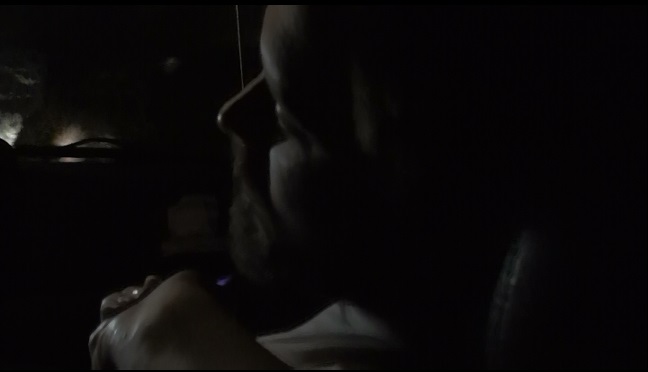
Soon everyone except Matt and Dora are asleep. And instead of watching the road, Matt watches as Dora plays a practical joke on Brian, where she films her efforts to singe his beard off with a lighter. And while distracted, their vehicle strikes some poor animal crossing the road, giving everyone onboard a good jolt. Getting out to investigate, they find a busted headlight, a dented bumper, some blood, a few scraggly hairs, but no other evidence of what they hit. Their flashlights do show something big moving away in the woods, followed by an intense howl of pain, that sends everyone scrambling back into the vehicle to put as much distance between whatever it was and them as fast as humanly possible.


As they drive on and finally find the turnoff leading to the cabin, Brian checks the footage on his camera and comes across Dora’s prank, which also kinda sorta captures a brief glimpse of what they hit through the front windshield. And while none of them can identify exactly what it was due to the speed and lack of light, the trip comes to a sudden halt due to a fallen tree blocking the road, meaning they have to hoof it the rest of the way in. Upon arrival, their guests are a little nonplussed by the deplorable conditions of the cabin, which has apparently been abandoned for years -- and abandoned in a hurry judging by what all was left behind. And when it is discovered the cabin is also harboring some wildlife, the decision is quickly made to spend the inaugural night back in the SUV.


But while everyone else sleeps, Brian keeps going over the footage of what they hit. And when he hears more monstrous howling in the woods, almost mournful, he notices Matt is wide awake and listening, too. When Brian tries to hushedly talk to him about what could be making that noise, his frightened younger brother doesn’t want to hear it, meaning they both know exactly what is making that noise and why their uncle abandoned the cabin and maybe, just maybe, they had some ulterior motives for coming out here with all those cameras.


Letting it got for now, the following morning the group is recharged a bit as they reclaim the cabin and spend the rest of the day using a ramp to launch themselves and their bikes into a nearby creek. Later, as the couples pair off and do what couples do, Brian withdraws and explores the nearby woods, where he finds several impossibly large footprints, eventually stumbling upon Todd and Elizabeth making out. But while the perverted practical joker trains the camera on them, he notices something else moving behind them -- a large black something booking it along the ridge. Letting out an expletive over this, the nearby Todd and Elizabeth are alerted and outraged, rightly thinking the creep was trying to film them having sex. Not interested in what he has to say or what he saw, Todd confiscates the camera’s memory card and pockets Brian’s proof. And once more, Matt stifles Brian’s conjecturing on what it really is out in the woods, even accusing him of hiring someone to come out here and scare them on film for YouTube ratings.


Undaunted, Brian sets-up several GoPro cameras at various points around the cabin and waits for whatever it was to come back. That night, while the others party inside, Brian waits outside, blazing a blunt, and beseeching the creature to show itself. And then suddenly, he hears something moving nearby and freezes; but he's then overwhelmed by a volley of paintballs as Matt and Todd appear and pummel him mercilessly; payback for his earlier attempt at making an unsolicited sex-tape. But then the night air is split by a monstrous roar and the three men quickly retreat to the cabin as the roaring continues, and continues to get closer. Inside, they reunite with the panicked girls as the roaring and howling continue. Outside, Brian’s cameras pick up something large and hairy and on two legs moving up the stairs and onto the porch. Inside, the terrified group listens as something extremely pissed off stalks around the cabin, banging on the walls, probing for a way in. When all this just as suddenly stops, Brian, camera in hand, creeps up to a window and looks outside, only to have his view quickly blocked by a monstrous inhuman face that screams at him before withdrawing, giving them all the proof they need that Bigfoot really does exist...


The Big Thicket is a patch of two to three million acres of rolling forests and marshlands in east Texas nestled between Nacogdoches to the north and Galveston to the south, with the eastern border provided by the Sabine River and the western boundary ending at the Brazos River. One of the most dense and bio-diverse and inhospitable areas in the country, it was no stranger as a source of tall tales and rural legends.
In the 1940s, stories began to surface about ethereal mystery lights seen along the Saratoga Ghost Road, an old dirt trail near an abandoned railroad line, with explanations and theories ranging from long dead conquistadors looking for treasure, Civil War ghosts from both sides looking for payback, a decapitated railroad worker, and a lost hunter damned to an eternity of searching for a way out of the infernal thicket.

Usually associated with the Pacific northwest, but, Bigfoot sightings have actually been reported in nearly every State in the Union. Texas has always had a cryptid problem. The Sasquatch has long held a place in Native American folklore, with the first reported western sighting in the Lone Star state coming in 1837 with tales of the “Wild Woman of the Navidad”: mysterious barefoot tracks were frequently seen in the area, which were linked to the sightings of a creature covered in short brown hair that moved very fast and always eluded capture. Over the decades since the creature has held many names; the Caddo Creature, Old Mossy Back, the Lake Worth Monster, the Bear King of Marble Falls, and the Liberty County Monkey Man until the Patterson-Gimlin footage hit in 1968 and everyone settled on referring to the elusive creature as Bigfoot.

Speaking of the Patterson-Gimlin film, I’m hard-pressed to come up with a better or more appropriate subject-matter for a found footage movie than Bigfoot. Found footage movies existed long before The Blair Witch Project (1999), but Eduardo Sánchez and Daniel Myrick’s mini-movie that could, which also owes a huge debt to one of the most brilliant viral marketing strategies of ever, made the sub-genre a going concern and a relatively cheap cash-cow that’s still being flogged and exploited to this day.

As a child of the 1970s cryptid-mania, Sanchez had always wanted to make a Bigfoot movie, inspired by the Patterson film, the TV series In Search of…, a few legendary episodes of The Six Million Dollar Man and The Bionic Woman, and especially Charles B. Pierce’s The Legend of Boggy Creek (1972). The Blair Witch of its day, Boggy Creek, with its pseudo-documentary style, which inspired dozens of imitators as well, did almost as much if not more to sensationalize and make Bigfoot a household name than any footprint or “real” footage ever found. Ever since Blair Witch hit, Sanchez and screenwriter Jamie Nash kicked the idea around to make the definitive Bigfoot movie, where, unlike a lot of Sasquatch cinema, there would be no external plots or subplots getting in the way and keep the conflict between the players and Bigfoot, not each other. And most importantly of all, Bigfoot would be a creature of this Earth and not some spiritual manifestation, extraterrestrial or inter-dimensional being.


Strangely enough, as conceived, Exists (2014) wasn’t intended to be a found footage movie at first but, drawing inspiration from all those cryptid docs and YouTube sighting videos which proved sometimes less is more, Sanchez compromised, treating it like a feature that just happened to be shot by the people in it. And so, the camera is still rolling the following morning when our campers beat a hasty retreat only to find the creature spent the rest of the night demolishing their ride. Then, back in the cabin, Matt and Brian reveal they stole the keys to the cabin and no one knows where they are. With no cell reception and very few options, Matt volunteers to bike out alone for help.


Several miles later, in a clearing, a few intermittent bars pop up on his cellphone. He tries 911 first but the signal isn’t strong enough. But he does get a hold of his uncle and relays where they are before Bigfoot silently appears in one of the best executed jump scares of ever. And after a brief chase, the creature easily runs Matt down who screams as the camera cuts out. Meanwhile, back at the cabin, the rest of the crew has spent the day barricading the doors and windows, uncovering a cellar where Todd finds a shotgun and a dozen shells. Then all they can do is wait and hope and pray Matt makes it out OK. But they’re prayers are answered when the Bigfoot chucks what’s left of Matt’s bike onto the porch.


That night brings another attack, where Elizabeth is mortally wounded as they all take refuge in the cellar until Todd manages to finally drive the creature off with the gun. The next morning shows signs that Todd hit him, judging by all the blood; and emboldened by the notion that they’ve injured it, maybe even killed it, and knowing the cabin is no longer safe, the three survivors decide to hike out on foot. Listening to Brian, who says he knows a shortcut, they abandon the road and head into the woods, where they find Matt’s backpack and helmet covered in blood but no body. They also find an abandoned camper before hearing Matt screaming in the distance. They trace this to the creature’s den, a narrow series of tunnels, which Brian enters to retrieve Matt; and after several harrowing turns, manages not only pull his injured brother to safety but also manages to put another slug into the Bigfoot.


As dawn breaks, the survivors take refuge in the camper, where Brian’s cellphone rings. It's his uncle, who’s at the cabin, but the signal dies before they can relate where they are. And so, Todd bravely heads outside to shoot off the last of his fireworks as a signal, which he does manage to accomplish before the Bigfoot attacks and Louisville Sluggers him against a tree. The creature then lays siege on the camper, which proves no protection at all. In fact, it becomes a deathtrap as the enraged monster easily pushes it over a cliff into a deep ravine.


Both Matt and Dora are killed on impact but a dazed Brian survives and flees, with the Bigfoot, after making one helluva jump in another outstanding shot and stunt, in hot pursuit until his prey falls into another ravine and knocks himself out. When Brian comes to, he is being dragged by the foot into a burnt out area of the forest and is brought to rest by the gathered bodies of his fallen friends. He panics, but the creature is seemingly gone. His attention is then drawn to a small shallow grave, whose content explains why the constantly reported docile creature was so enraged at them.


Putting it together, Brian realizes it was the creature's juvenile offspring they hit and killed that first night and all of this was grief-fueled payback. The adult Bigfoot returns and forces him closer and closer to the body as he hysterically apologies. Suddenly, a shot rings out and the creature flees. It’s the uncle, who grabs Brian and they quickly flee. They are in sight of his truck when the Bigfoot ambushes them, killing the uncle before turning on Brian, who takes up his uncle’s gun and begs his attacker to stop. Taking in the creature’s injuries, the pain in its eyes, and the grief they’ve caused it, Brian puts the gun down, turns around and drops to his knees, essentially giving himself up, ready to take his punishment. The creature takes all this in, but instead of attacking, it quietly stalks off into the woods, the blood vendetta done, leaving two survivors in the cleansing rain.


With Exists Sanchez solves the two fundamental problems folks had with The Blair Witch Project. (Three if you count the minimal use of shaky-cam.) One, we like these protagonists enough. And two, the threat they face is physical and something we can see and quantify. In fact, one of the best decisions Sanchez made was to redo the opening credit sequence. The original version is included on the DVD, which paints our protagonists as irredeemable douche-bros. But with a little bit of trimming, removing the majority of the dialogue, and adding a mellower soundtrack, they quickly switch from insufferable assholes to a group of people who admittedly aren’t all that interesting but at least you don’t want to see them get killed.


I’ve always felt found footage films had one less layer between the film and the audience, making them active participants. Here, Sanchez kinda breaks the rules he helped write on the sub-genre by hitting the ground running and showing us a full-frontal monster. There’s also a musical score and some impressive sound-design and editing. Again, inspired by the cryptid docs and films of his youth, Sanchez took the less is more JAWS approach with his monster, showing enough but then hiding it or obscuring it. The attack on the cabin is a thinly veiled homage to the siege of the Ford house during the climax of The Legend of Boggy Creek. However, the director then proceeds to put his own personal stamp on Bigfoot cinema with the attack on the trailer, perhaps drawing some inspiration from Bigfoot and Wildboy, which showed a Sasquatch can hop around like the Hulk.


Originally teaming up with WETA, who provided some initial concept sketches, it was Spectral Motion who designed and built the Bigfoot suit for Exists; it looks fantastic and Sanchez utilizes it beautifully as we get to see more and more of the creature as the film progresses. Brian Steel wore the suit and gives an outstanding performance. You can honestly feel the monster’s rage and grief as he goes on this rampage. The film was originally scheduled to be shot in the fall but had to hold off until spring due to some massive wildfires. The production decided to incorporate this into the film, setting the climax in the burnt-out, ashen moonscape. And if you look closely, there is another filled in grave next to the open one, leading to some easy conjecture that the creature lost it's mate in the fire, and has now lost its offspring, making his lashing out even more understandable and his redemption at the end a little more poignant.


Bigfoot cinema has been around almost as long as there have been sightings. There was the seminal Sasquatch vs. Biker flick Big Foot (1970). And then there was that time Bigfoot subbed in for Jason Vorhees in Night of the Demon (1981). There’s even been a mini-resurgence of Sasquatch Cinema lately with Corey Grant’s Bigfoot: The Lost Coast Tapes (2012) and Bobcat Goldthwait’s Willow Creek (2013), both of which also employed the found footage technique. But Exists shows the old master still has a few tricks up his sleeve, resulting in a pretty excellent flick, which easily pushes Exists to the top of my list for this kind of cryptid whackadoodlery.

What is Hubrisween? This is Hubrisween. And now, Boils and Ghouls, be sure to follow this linkage to keep track of the whole conglomeration of reviews for Hubrisween right here. Or you can always follow we collective head of knuckle on Letterboxd. That's five down with 21 to go! And if you're itching for more Sasquatch Cinema, watch this space a couple letters down the road
Exists (2014) Court Five :: Haxan Films :: Miscellaneous Entertainment :: Lionsgate / EP: D. Todd Shepherd, George Waud, Reed Frerichs, Gregg Hale / P: Robin Cowie, Mike Elizalde, Jane Fleming, Andy Jenkins, Mark Ordesky / D: Eduardo Sánchez / W: Jamie Nash / C: John W. Rutland / E: Andrew Eckblad, Andy Jenkins / M: Nima Fakhrara / S: Samuel Davis, Dora Madison, Roger Edwards, Denise Williamson, Samuel Davis, Brian Steele
Our latest feature doubles down from the get go, opening first with a printed disclaimer, saying what we are about to see is true and only the names and locations have been changed; and second, as a chilling wind blows us through a brief tour of a dilapidated farmstead, which eventually gives way to an organ playing a mournful dirge, a newspaper reporter, Tom Sims (Carlson), steps into frame and admits he covered firsthand the human horror story of ghastly proportions that took place here several years back, who then warns how the events of this coming tale will be recreated in graphic detail with nothing left to the imagination. And once those in the audience with weaker constitutions find an exit, Sims begins to relate the tale of Ezra Cobb -- murderer, grave robber, necrophiliac, but he’s probably better known to the general public as the notorious Butcher of Woodside.


As this tale continues, Sims will by popping in and out of the movie at strategic turning points in the life of Cobb (Blossom), elaborating as we go, getting to the bottom of his psychosis by starting at the beginning: at the deathbed of Cobb’s beloved mother (Lee), at the foot of which the devoted son has spent most of his life, waiting on her hand and foot since her debilitating stroke several years prior. And with his father long dead, and not being the sharpest tool in the shed, his mama was all Cobb had and the source of all he knew. Sensing she is about to pass on, Ma Cobb (-- get it? Macabre?) forbids any trip to the hospital, wanting to die in her own bed. She then asserts her virulent influence one last time, warning her son to be wary of the “money stealing bitches” who are only out for his money. All women are full of disease, she rants on, and the wages of sin is gonorrhea, syphilis and death! With that, she falls silent and despite his begging and assurances that she will be just fine, Cobb’s mother passes on, and quite violently, too, with a vomitous eruption of blood and regurgitated stew.

As the months pass after the funeral, we find the Cobb residence is starting to resemble a pigsty; a hoarder’s nightmare of trash, porn magazines and half-full food tins -- all except for the mother’s bedroom, which is in pristine condition, a shrine, complete with her dress laid out on the bed, with her portrait where her head should be with her bible close to (a phantom) hand. At some point Cobb started writing letters to his mama, expressing how much he missed her. He then starts talking to her, as if she were still there. And then, mama started talking back.


Chastised for leaving her all alone in that cold cold grave, what else would a dutiful son do but go dig her up and bring her home. His delusions are shattered a bit in a well executed scene where he opens the coffin and what he thinks he sees doesn’t quite match what he actually finds. It’s been almost a year since Mamma Cobb passed on, and her fragile desiccated corpse is in a state of advanced decomposition and disrepair. Regardless, Cobb brings the body home and starts an errant quest to repair the damage, researching into embalming and taxidermy, using different animal skins to patch things up. It wouldn’t be until a short time later, says Sims, that Cobb would get the notion of using human tissue for his preserving needs.

Working as a hired hand for his neighbor, Harlon Kootz (Warner), Cobb is invited to dinner with the Kootz family, where Harlon sees in the paper that their old Sunday school teacher has died. Unsure of what an obituary is, Cobb is soon intrigued by this ready-made menu and will use it to track down the spare parts he needs. He even admits this between bites, saying he wouldn’t need the whole body, just a few parts, but the collective Kootzes assume ol’ kooky Ezra is just pulling their leg. Only he isn’t, and that night he steals the fresh corpse from the cemetery and takes it home, removing her face, making a mask, which he tries on before stitching it onto his mama, leaving the filleted skull by the bedside to keep her company. More dug up bodies follow and, Sims warns, it will only be a matter of time before Cobb sets his sights and perversions on a living victim...

Edward Theodore Gein was known as a simpleton mama’s boy around his hometown of Plainfield, Wisconsin. A bit eccentric, sure, but pitiable, having never gotten over the death of his mother. At least he was until a local hardware store owner, Bernice Worden, disappeared in November of 1957. When evidence of a receipt showed Gein was her last customer, the authorities followed up on this lead and searched the Gein farm. Needless to say, no one could have been prepared for what they found:

Worden’s decapitated body was discovered hanging upside down in a shed; she’d been gutted and dressed out like a deer. More horrors awaited inside the main house: furniture reupholstered with human skin; bowls made out of skulls; a corset made from a female torso skinned from shoulders to waist; masks made from the skin of human faces; musical instruments and utensils made from human remains; Worden’s head; a belt made from female nipples; four noses; and then there was his “woman suit” that he had been piecing together since his mother died, made so he could literally crawl inside her skin and become his mother in what psychologists described as an "insane transvestite ritual." Interestingly enough, if that’s the right word, this squalor and depravity were confined to only certain areas of the house, while others, which were defined as his mother’s bedroom and parlor, were pristine and untouched.

Obsessed with tales of cannibals and Nazi atrocities and death in general, Gein admitted that most of his macabre paraphernalia came courtesy of his habitual grave-robbing. He also confessed to killing two women; Worden, and Mary Hogan, a local saloon keeper who had disappeared three years earlier, whose head was also found in the house. He was also suspected in the disappearance of several others, including juveniles Evelyn Hartley and Georgia Weckler. His initial confession was tossed out when the county sheriff assaulted the suspect during the interrogation, making it coerced and inadmissible. Despite this, Gein would be found mentally unfit and was confined to a mental institution until he finally stood trial in 1968 for the murder of Bernice Worden. Found guilty but still considered to be insane, Gein would serve no prison time but would remain incarcerated at the Mendota Mental Health Institute until his death in 1984.

Long before the trial even worse rumors about Gein began circulating. Tales of necrophilia and cannibalism started to creep in and embellish the growing urban legend surrounding the case. (Gein always denied having sex with the bodies he exhumed, explaining, "They smelled too bad.") Even as fact and fiction blurred, Gein started to leave his mark on popular culture, too. His case inspired Robert Bloch to write Psycho (1959), which in turn inspired Alfred Hitchcock’s feature film adaptation (1960), with Norman Bates and his mama subbing in for the Geins. Whenever Tobe Hooper’s cousins from Wisconsin visited him in Texas they would regale him with grisly tales of the killer and his trophies, which went a long way in inspiring the clan of rural cannibals in The Texas Chain Saw Massacre (1974).

But while Gein would inspire the villains in many a movie and novels (Silence of the Lambs), there weren’t many filmmakers brave enough to try and tackle the story of Gein himself. Enter rock-promoter Tom Karr, who had put together tours for the likes of Led Zeppelin, Three Dog Night, and Black Sabbath in the early 1970s. Obsessed with the Gein case, Karr had notions of making his story into a feature film. And at some point, he crossed paths with Bob Clark and Alan Ormsby while they were out on a promotional tour for their inaugural feature film, the overly-maligned Children Shouldn’t Play With Dead Things (1972). Clark and Ormsby first met at the University of Miami in the late 1960s; both were theater majors and aspiring playwrights at the time. And when Clark got a wild hair and raised about $20 to make a movie, he turned to his friend for help; and together they co-wrote a script, with Clark handling directing chores while Ormsby took care of the makeup and F/X and also took the lead role of the obnoxious leader of a theater group who inadvertently trigger zombiegeddon.

Karr had hoped Clark would also direct his proposed feature but the aspiring filmmaker, who would go on to do A Christmas Story (1983) and launch the Porky’s franchise (1981-1985), declined, feeling the subject matter was too ghastly. Clark was also knee-deep in his own second feature at the time, too: Dead of Night -- a/k/a Deathdream (1974) an eerily effective spin on The Monkey’s Paw, also scripted by Ormsby, who handled the F/X and makeup again, with the help of his novice assistant, Tom Savini. Clark did agree to produce and edit the film for Karr, and suggested his friend Ormsby for the screenplay and Jeff Gillen, an actor friend who had been in Children and Deathdream, to direct. (Ormsby and Gillen wound up co-directing the film, and Savini would pitch in on the special makeup effects.) Karr agreed, and taking $200,000 of his own money, production began on Necromania when he turned over all of his extensive research and newspaper clippings about the arrest, investigation, and trial of Gein over to Ormsby.

One of the main goals of the production was to show what Hitchcock didn’t (or couldn’t) in his film, namely the grave-robbing, the construction of his flesh suits and knick-knacks, and then get their character inside those skins. And with Ormsby, Savini and Jerome Bergson all pitching in this mission was accomplished to much gruesome effect as the film is actually more graphic than The Texas Chain Saw Massacre (-- it still boggles my brain that Hooper was shooting for a G-rating with that, hoping to find the same general audience like JAWS had.) Several efforts wound up on the cutting room floor when the film was first released, restored later in an uncut version; most famously the scene mentioned above where Cobb not only skins the corpse (-- played by Gillen’s wife) but plucks her eyes out with a spoon, saws off the top of her head, and digs out her brain with an ice cream scoop.


To balance this out, Ormsby added a lot of gallows humor to his screenplay, and then he and Gillen found just the right balance executing it, making the audience laugh one moment and then skeeve them out the next., resulting in a near pitch-perfect delirium of minimalist rural Gothic impressionism bashed into a startlingly distinct nightmare of realism.


And while staying fairly faithful to the facts of the case, the production steered clear of the necrophilia and cannibalism aspects and, at Karr’s insistence, took one major dramatic liberty and added the element of Cobb digging up his mother and bringing her home. (Gein never did this, and kudos to Cosette Lee and her gung-ho performance as her VD rant is one for the ages.) Originally, Karr wanted to film in Wisconsin but when this proved untenable the production was moved across the border into Canada, filming in and around Ontario, taking advantage of several tax breaks. (Clark loved it up there so much he stuck around and shot his next film, Black Christmas, in Canada as well.)

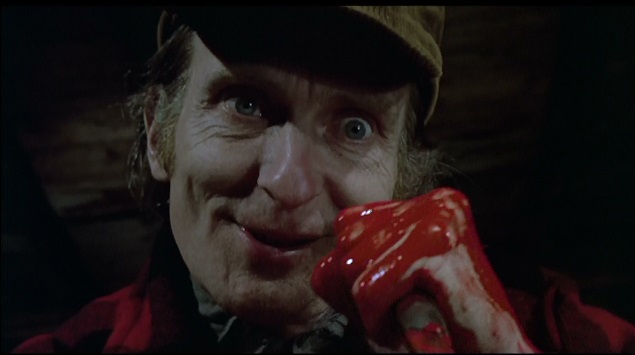
Karr set-up casting calls in New York City, where the likes of Harvey Keitel and Christopher Walken auditioned for the lead role. And while either of them sounds great in theory, that would have denied us the incredible, understated and yet extremely perverted performance by Roberts Blossom as this ghoul with his own internal logic that isn’t hard to decipher but terrifying nonetheless. With his efforts we don’t really feel sorry for or empathize with Ezra but we do understand that he is completely futzed in the head.


We believe in the capability when he’s chopping up bodies, but we also believe it when those around him, innocent bystanders or potential victims, as he hides in plain sight, think he’s just some harmless old kook -- and that might just be the most disturbing point of all when you get right down to it as Carl Zittrer’s haunting and repeating chorus of “The Old Rugged Cross” leads us into the next verse of Cobb’s reign of terror, when he sets his sights on a new kind of victim.


This begins with a slightly daffy interlude when Cobb, at the Kootzes encouragement, starts looking for wife, starting with the only woman his mama trusted, Maureen Shelby (Waldman), a “plump heifer” who can relate to Ezra because she, too, talks to the dead all the time; namely her deceased husband (-- a cameoing Ormsby), who constantly “tells” her to satisfy her carnal needs by any means necessary. And so, she seduces the hapless Cobb by seance into the bedroom. And while he seems initially excited by this process and her ample bosom, Ma Cobb soon asserts herself, bringing the episode to a violent end when Cobb shoots Maureen in the head through a muffling feathered pillow.

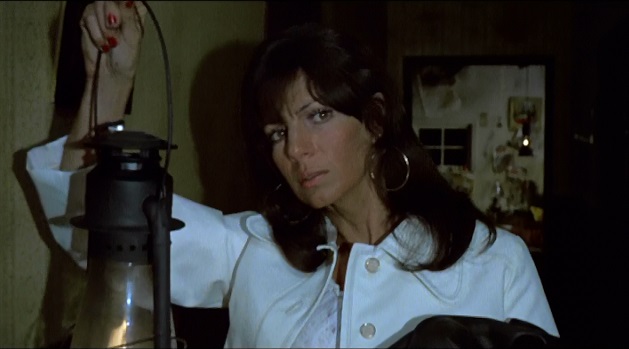
Things get even more ghoulish when Cobb next becomes transfixed with the busty waitress at the local roadhouse. Like everyone else, Mary Ransom (Moore) thinks Cobb is just a harmless barfly, even agreeing to let him give her a ride to the service station when she gets off work and finds her tires slashed -- only Cobb did the slashing and they wind up at his place, where he promises to round up a couple of spare tires for free.
But after an interminable wait with no sign of Cobb, Mary enters the darkened house looking for him, following some bizarre noises into a bedroom, where she discovers a grotesque hen party of seated corpses surrounding Ma Cobb on the bed. And then one of those corpses starts to move! It’s Cobb, dressed in the skin of one of his victims, who runs Ransom down before she can escape.
When she comes to, Mary finds herself locked in a closet, bound, and stripped down to her bra and panties. Cobb eventually lets her out for a dinner party, which looks suspiciously like the one in Hooper’s movie until one realizes this film was released nearly eight months earlier. The juxtaposition of the gathered rotting corpses in the prim and proper setting is phantasmagorical. And for Mary, who holds it together quite admirably under the circumstances, this nightmare ends when a desperate escape attempt ends with an enraged Cobb beating her to death with a femur.


Which brings us to the extended climax of the film, where Cobb tells his disbelieving neighbor that Mary isn’t missing, she’s just up at his place. Then Harlon’s son (Smeagle) arrives and introduces his girl, Sally (Orr), who works as a clerk at the local hardware store. Once again, Cobb is immediately smitten with the girl and starts hanging around the shop, saying he needs some anti-freeze, turning down an invitation by the Kootzes to go hunting so he can remain behind with Sally.
Once alone, he uses one of the store’s display rifles to shoot the incredulous Sally in the head. Tossing the body in the back of his truck, Cobb heads for home; but in his excitement, he neglected to make sure Sally was really dead as the bullet merely grazed her scalp. Fleeing into the forest, this leads to the most disheartening scene as Sally almost gets away only to be waylaid by one of the small game traps set by the unwitting Kootzes.


Meanwhile, the Kootzes return to the original scene of the crime, find Sally gone and blood on the floor, and alert the Sheriff. When he arrives, they find the receipt for Cobb’s anti-freeze, the last sale of the day. And while Harlon feels Cobb would have nothing to do with whatever happened to Sally, his son and the Sheriff (McHeady) decide to head out to the Cobb place anyway, where Cobb is in the process of stringing Sally’s naked body up by her feet and proceeds to “gut the carcass.” Suddenly, he is overwhelmed by his mother’s presence and an unholy flashback of all the atrocities he’s committed these past few months.


When the Sheriff and the Kootzes arrive, they see what’s left of Sally hanging from the rafters in the barn. (A truly haunting scene as the incongruous corpse slowly sways in the breeze.) They then find Cobb in the house, surrounded by his trophies, cackling and disconnected from everything. And as the screen fades to black, Simms returns one last time to say several nights later, a group of local townsfolk gathered at the Cobb house and burned it to the ground, hoping it would help erase the memories of what happened there.

I guess technically Deranged (1974) is to Ed Gein as what The Sadist (1963) is to Charlie Starkweather, in that they were both inspired by the subject matter and whose grim and gritty sheen gives them more juice than their bigger-budgeted brethren. As far as I know only one other film tried to tackle Ed Gein, In the Light of the Moon (2000) -- later released on video as Ed Gein. And while it does contain a fabulous performance by Steve Railsback and sticks closer to the truth I think it pales when stacked up against the ickiness of Deranged, a title Karr hit upon at the last minute when he struck a distribution deal with American International Pictures.

They were fun to make, said Ormsby on making these films, with a kind of communal feeling. Sadly, Ormsby and Gillen would have a bit of a falling out with Clark when he shut them out of the editing room. A rift that would last until they reunited briefly for Popcorn (1991), when Clark was forced to fire his old friend off the picture, ending their friendship and working relationship for good. And their loss was a loss for us as well, as I for one wished those two had kept making movies together -- especially ones as effective and deranged as Deranged.
What is Hubrisween? This is Hubrisween. And now, Boils and Ghouls, be sure to follow this linkage to keep track of the whole conglomeration of reviews for Hubrisween right here. Or you can always follow we collective head of knuckle on Letterboxd. That's three! Three films down! Ah! Ah! Ah! With 23 to go! Oy! Oy! Oy!
Deranged (1974) Karr International Pictures :: American International Pictures / P: Tom Karr, Bob Clark / D: Jeff Gillen, Alan Ormsby / W: Alan Ormsby / C: Jack McGowan / E: Bob Clark / M: Carl Zittrer / S: Roberts Blossom, Cosette Lee, Leslie Carlson, Robert Warner, Brian Smeagle, Robert McHeady, Marian Waldman, Micki Moore, Pat Orr