Showing posts with label Dorothy Malone. Show all posts

Monday, May 14, 2018

Taking It All If You Can Just Pull the Trigger :: A Beer-Gut Reaction to Richard Quine's Pushover (1954)


We open with a brazen and well-orchestrated early morning bank robbery, which progresses smoothly until a guard goes for one of the perpetrator’s guns but winds up shot and killed as the two assailants flee with almost $200,000. Cut to several days later, where we zero in on a young woman, Lona McClane (Novak), as she vacates a movie theater and heads for her car. Only her car won’t start. Luckily, a good Samaritan just happened to be passing by, who offers some assistance. 


Thus, Paul Sheridan (MacMurray) helps the stranded motorist get the vehicle to a mechanic and gives her a ride home. But they stop at a bar for a drink along the way, and then divert to his apartment, leaving it up to the audience as to what happens next when the door closes. But if we were all betting folk, odds are good these two just had sex. So, place your bets now.


The next morning, Sheridan heads to work and, turns out, he’s a police officer. And not only that, but this detective has been assigned to crack that bank robbery case. Also of note; turns out Lona is/was the girlfriend of Harry Wheeler (Richards), one of those robbers identified by several eyewitnesses. (The other, who shot the guard, wore a mask.) And so and so, Sheridan was actually tailing Lona, hoping she would lead him to Wheeler, the money, and the identity of his partner. So, yeah, you’d be right to assume that *ahem* “assignation” at his apartment, which explains why he didn’t want to return to hers, which is under constant surveillance, really wasn’t proper police protocol for such a stakeout.


You see, Sheridan, along with his partner, Rick McAllister (Carey), have been clandestinely watching Lona’s apartment and listening in on her phone calls for quite some time now from an adjacent building. (And when she leaves, one of them has to follow ‘natch. And three guesses as to who ALWAYS volunteers for THAT detail.) They’ve also been saddled with another detective on their shift, Paddy Dolan (Nourse), whose penchant for abusing the bottle is about [-this-] close to blowing his impending retirement pension. 


And so, under direct orders from their hard-nosed Lieutenant, Karl Eckstrom (Marshall), Sheridan and McAllister must not only keep a close tab on Lona they must also effort to keep Dolan sober for just one more week, and they do this by leaving him alone in the car. To watch the street. Parked right next to a bar. Once again, place your bets, folks.


Anyhoo, as this stakeout dragged on, Sheridan soon became infatuated with the drop-dead gorgeous femme fatale -- so much so, they decide to meet up at his place again. Only this time, Sheridan blows his cover by asking too many questions about Wheeler. Despite this betrayal, Lona seems to have genuinely fallen for this old rugged cop and sets her hooks in deep. And so, soon enough, Sheridan’s unhealthy desires soon have him scheming to kill Wheeler and keep Lona and the money all for himself...


Poor Fred MacMurray. He never could fall for the right dame in these old noir films. And I guess one could (fairly easily) draw comparisons between Pushover (1954) and the noir film to end all noir films, Double Indemnity (1944) -- especially the sense that the whole scheme and machinations in both MacMurray-led films -- one a double cross on a bank job, the other a homicidal case of insurance fraud -- felt doomed from the start, making these roads to ruin a distinct inevitability.


Like Double Indemnity, which was based on James M. Cain’s novel, Pushover also began life as a book, The Night Watch, by Thomas Walsh, which also was serialized as The Killer Wore a Badge in The Saturday Evening Post from November through December in 1951. To adapt Cain’s novel into a screenplay, director Billy Wilder looked to Raymond Chandler, one of thee greatest writers of detective fiction of ever (The Big Sleep, Farewell My Lovely, The Long Goodbye). And to adapt Walsh’s novel, director Richard Quine looked to Roy Huggins, who was soon to become equally famous in the world of detective stories -- only in a different medium.


A novelist himself, Huggins career in Hollywood began when Columbia Pictures optioned the rights to his novel, The Double Take, and turned it into I Love Trouble (1948). But before he would sign the contract, Huggins stipulated he be allowed to adapt his own work. After, Huggins stuck with Columbia for a few years, bouncing between them and RKO, writing scripts, adapting more of his own literary output with the terse melodrama Too Late for Tears (1949) -- where another money grab goes horribly wrong, and riding out the Communist witch-hunts of that era. Seems Huggins had actually joined the Communist Party back in 1939 but would renounce them less than a year later when the Soviets became allies with Nazi Germany. Huggins was called to testify before the House UnAmerican Activities Committee, where he proved cooperative, naming 19 other party members but only named names of those who had already been outed.


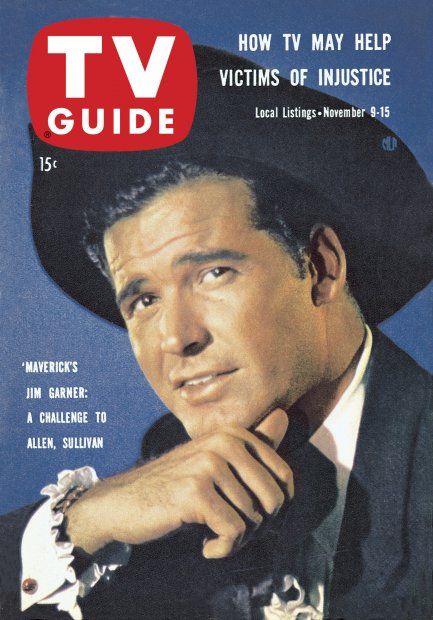
And so, Huggins avoided the dreaded Hollywood Blacklist and continued producing screenplays, most notably a trio of westerns -- Gun Fury (1953), Three Hours to Kill (1954) and the Randolph Scott vehicle, Hangman’s Knot (1952), which also saw Huggins take a rare shot at directing. But by 1955, Huggins shifted gears and mediums, moving to the small screen, taking jobs with Warner Bros. and 20th Century Fox’s TV divisions, where he produced hits like Cheyenne (1955-1963) and Maverick (1957-1962) -- an offbeat western starring James Garner (-- followed by Jack Kelly and Roger Moore), where Huggins guiding principle for his pool of writers went as follows: “In the traditional Western, the situation was always serious but never hopeless. In a Maverick story, the situation is always hopeless but never serious.” Around the same time Huggins also helmed the smash hit detective series 77 Sunset Strip (1958-1964).


Unhappy with how Warners treated him financially during this period, feeling they were constantly cheating him out of owed royalties, Huggins quit and joined Quinn Martin Productions, where he produced his biggest hit yet, The Fugitive (1963-1967), which Huggins always vehemently insisted was not based on the notorious Dr. Samuel Sheppard murder case but was, instead, intended to be a modern-day take on Victor Hugo’s Les Miserable, with David Janssen’s Dr. Richard Kimble as Valjean and Barry Morse’s Lt. Gerard subbing in for Javert, who chases Kimble while he chases down the one-armed man. But by the mid-1960s, Huggins had moved on to Universal, becoming vice-president of the TV division, where he would serve for nearly two decades, launching shows like The Virginian (1962-1971) and The Bold Ones (1969-1972).


And when the 1970s rolled around, after the Butch and Sundance cash-in Alias Smith and Jones (1971), Huggins left the western behind and started telling offbeat detective stories again, with things like Toma (1973) and Barreta (1975-1978), but then reached the absolute zenith of the small screen take on the genre when he teamed up with Stephen J. Cannell for The Rockford Files (1974-1980), once again featuring Garner as a pardoned ex-con turned acerbic and often reluctant detective who knew every scam in the book and could never get into his trailer without getting jumped by a few thugs -- especially if he had just been to the grocery store. Few shows were better. And Cannell, a TV legend himself, who also worked with Huggins again in the 1980s on Hunter (1984-1991), said of the veteran writer/producer, "Roy was in the driver's seat where he belonged. Nobody does it better or with more style...Roy Huggins is my Godfather, my Hero and my Friend. They don't come any better."


Huggins was still producing TV movies based on his properties up until his death in 2002, ending a remarkable career and a ton of hits that ran for nearly four decades. And while his work in film wasn’t quite as indelible, you can still see that Huggins’ “touch” in his screenplays, where ordinary, everyday but very fallible people soon find themselves in something completely over their heads.  


Pushover would be one of the last screenplays Huggins would write, and one of its greatest joys is watching the wheels come off as Sheridan’s solid and near foolproof plan to rub out Wheeler, steal the girl and the loot unravels and goes completely awry while his desperate attempts to salvage it only makes things exponentially worse.


In the beginning, it appears this plan will go off without a hitch. And things are helped out considerably due to Sheridan’s partner becoming equally fascinated with Lona’s next door neighbor, a nurse named Ann Stewart (Malone), who is constantly distracted by her as they keep bumping into each other as McCallister lurks about. But this comes back to bite Sheridan in the ass when Ann, looking to borrow some ice for a party, finds Sheridan in Lona’s apartment when he isn’t supposed to be, making her a dangling loose end that will most likely have to be dealt with, and permanently.


And then there’s Paddy, who isn’t where Sheridan needs him to be for this plan to work but is instead inside that bar knocking a few back -- only to reappear at the most inopportune time. And so, Paddy kind of screws the pooch when Wheeler does show up. And when Sheridan’s attempt to soft-strong arm Paddy into accepting why his fellow cop had to kill Wheeler in a clumsy audible, Paddy, a drunk but no fool, doesn’t buy this cock 'n' bull is all about saving his pension at all. And that’s why Paddy moves the car with the money and the body in it on his own. And so that’s also why Sheridan accidentally kills him later when Paddy refuses to say where it is and threatens to turn him in.


And as the cops swarm in due to the gunshot, Sheridan tries to play this off as a suicide. And this buys him some time -- but not quite enough, as McCallister backs his story, having seen Paddy in the bar drinking. But his story starts to fall apart as the lies and spin mount, and Lt. Eckstrum is starting to smell a rat. And as the evidence starts pointing back toward him, Sheridan is soon on the run with Lona, who found Wheeler’s car and the loot in the interim.


And they might’ve still gotten away clean if Sheridan hadn’t detoured to take care of Ann, kidnapping her, leading to pretty cool game of cat and mouse as they try to get their disposable hostage out of the building and through the surrounding police dragnet -- stress on the might’ve.


Now. One of the other great pleasures of watching Pushover is getting to watch both the lovely Kim Novak and the gorgeous Dorothy Malone as the bad girl / good girl foils do their respective thing. I’m still not convinced that wasn’t Novak as the model used to lure Gaucho into making a movie for Jonathan Shields in The Bad and the Beautiful (1953). Either way, Lona McLane would be her first credited screen role. She would officially break out two years later in Picnic (1955), and would go on to torment Jimmy Stewart (and Alfred Hitchcock) in Vertigo (1958). 


I think I first encountered Malone in Beach Party (1963), where I officially fell in love. She won an Oscar in 1956 for Written on the Wind but I still contend her best performance was in The Last Voyage (1961), one of the best disaster movies you’ve probably never heard of. Again, I cannot express how much these two drop-dead knockouts in those period fashions are worth the price of a rental alone.


Stitching all of this intrigue and eye-candy together was Richard Quine, one of Sam Katzman’s merry brigade of schlockmeisters making hay in Columbia’s B-units. The film was shot in downtown Burbank near the old Magnolia Theater -- featured prominently in the film. Shot mostly at night, with lots of rain and neon reflecting off the puddles, Quine manages to bring the usual noir trappings into this mounting melodrama, and manages to maintain the tension throughout Pushover as the noose finally closes around our hero’s neck and his journey down this ruinous road comes to its fatal end. A familiar journey, sure, but still well worth the time traveled inevitable or not that ending may be.


Pushover (1954) Columbia Pictures Corporation / P: Jules Schermer / AP: Philip A. Waxman / D: Richard Quine / W: Roy Huggins, Thomas Walsh (novel) / C: Lester White / E: Jerome Thoms / M: Arthur Morton / S: Fred MacMurray, Kim Novak, Philip Carey, Dorothy Malone, E.G. Marshall, Allen Nourse, Paul Richards

Wednesday, March 9, 2016

Quite Possibly the Greatest Disaster Movie You've Never Heard Of :: A Beer-Gut Reaction to Andrew and Virginia Stone's The Last Voyage (1960)

 ___  ___  ___  ___  ___  ___  ___  ___  ___  ___  ___  ___  ___  ___

"The SS Claridon, a proud ship, a venerable ship, but as ships go, an old ship. A very old ship. For 38 years she's weathered everything the elements could throw at her. Typhoons, zero-zero fogs, the scorching heat of the tropics. Now she is scheduled for only five more crossings. Then a new ship, a posh, streamlined beauty, will take her place. It is then that the Claridon will pass into oblivion. She has an appointment with the scrapyard. But it's an appointment she'll never keep. For this is her last voyage."
___  ___  ___  ___  ___  ___  ___  ___  ___  ___  ___  ___  ___  ___

The last voyage this narrator so ominously opines begins mid-journey, somewhere in the middle of the Pacific Ocean. And then, barely a minute into the film, disaster strikes when a fire breaks out in the engine room and spreads thru several decks ... Wait. No. Check that. The fire had already broken out, and so, the film actually begins with a note handed to Captain Adams (Sanders), alerting him to this situation. And despite the best efforts of second engineer Walsh (O’Brien), taking over for the chief engineer who died, and his crew, the domino-effect of these fires on the rest of ship’s innards, particularly the engine room, cannot be contained. And as things get exponentially worse, nearly everyone tries to convince the captain that the cascading damage is too much for such and old ship; and it’s only a matter of time before the Claridon could, probably, will, definitely, sink, and perhaps he should alert the passengers of this, send an S.O.S., and begin evacuation procedures but Adams stubbornly refuses to do anything, insisting the ship will be fine.


Meanwhile, the Hendersons, Cliff (Stack), Laurie (Malone) and daughter, Jill (Marihugh), blissfully unaware of the chaos below and the crisis on the bridge, are enjoying the amenities of the ship. Seems Cliff has been transferred to Tokyo on business and decided to make a mini-vacation out of the move. But just as he leaves their cabin to retrieve his wife’s purse, left in the dining area, a now out of control boiler detonates several decks right below them, violently rocking the whole ship. With that, mass panic ensues above as the engine room starts flooding underneath.


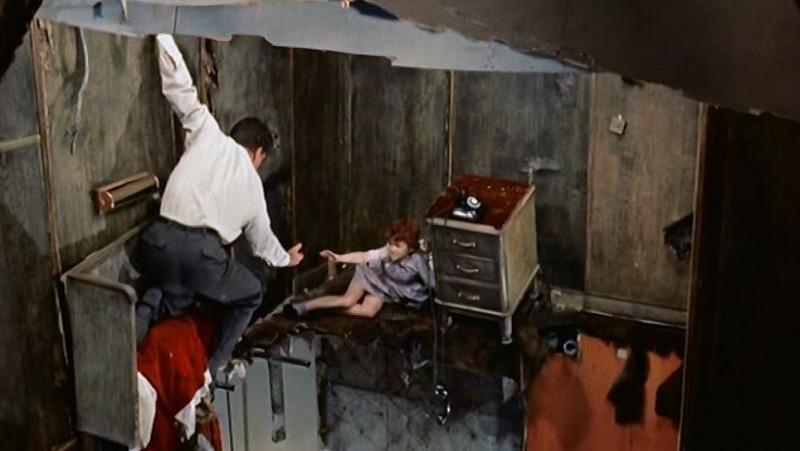
And after fighting his way back to their cabin, Cliff finds Laurie alive but nearly crushed, her legs pinned under a twisted steel beam that he could not even begin to budge; and Jill is stuck on a precarious perch on the other side of a gaping hole where the floor used to be, giving the occupants a first hand view of the sky above and what’s left of the boiler room six decks below. 


And while Cliff manages a harrowing rescue of Jill, Laurie is still irrevocably trapped. And to make this bad situation even more dire, the explosion also tore a hole in the hull big enough that the pumps cannot handle the influx and the bulkheads will not hold. Thus, the Claridon is now officially sinking, and will most probably be completely sunk within the hour...


Essentially shot in real time, for the next 80-some minutes of its taut and unrelenting 91-minute total, The Last Voyage (1960) squeezes every ounce of tension it can as it puts the audience through an emotional wringer, making it probably the greatest, unsung disaster movie you’ve never heard of -- and that’s a damn shame. For, long before Irwin Allen was capsizing ocean liners or torching skyscrapers with all-star casts, and predating that glorious glut of similarly themed airline disaster movies of the 1970s, filmmakers Andrew and Virginia Stone were setting the template for the genre-to-be as far back as the mid-1950s.


Before, unless dealing with recreating some natural disaster [The Hurricane (1937) The Last Days of Pompeii (1959)], or historical recreations [A Night to Remember (1958], these kinds of movies were usually about potential disasters [No Highway in the Sky (1951), Zero Hour! (1954), The High and the Mighty (1954)], where everyone’s gonna die unless through some luck and true grit and, most times, a little divine intervention, these most catastrophic results were averted by the skin of the protagonists’ teeth.


Even the Stones own Julie (1956), a delightful pants-on-fire melodrama, where stewardess Doris Day’s psycho ex-husband (Louis Jourdan) keeps trying to kill her, which climaxes on a airplane, with the pilot dead, the co-pilot mortally wounded, and Day pressed into the captain’s seat to take the stick, ends with her successfully landing the plane, saving the other passengers. They’d done it before with a plane, a bomb, and a blackmail scheme in Cry Terror (1958) that ended happily ever after, too. But with The Last Voyage, before the audience has even settled in, the excrement hits the fan and the clock starts ticking; a bit of reverse engineering as the focus shifts from those who prevent to several overlapping groups trying to survive; a true epoch moment for the genre, where the actual disaster itself moves the plot along.


Andrew Stone had always been innovative as a filmmaker, beginning with Stormy Weather (1943), the first all-colored musical shot for a wide release, but after bouncing around several studios his desire for full creative control found him striking out on his own around 1950 with wife, Virginia, who would serve as co-producer, editor, and production manager on their collaborations. Dubbed "Hollywood's only man-and-wife moviemakers", what followed were a string of low-budget crime thrillers with a very distinctive documentarian look and feel. Verisimilitude was always one of the Stones trademarks. Eschewing sets and studios as much as possible in a dogged pursuit of realism, the Stones shot as much as they could wherever they could on location, be it on a real street, a real office building, on a train, or on an airplane.


Inspired by the wreck of the Andrea Doria, which collided with another ship and sank off Nantucket island in 1956, the Stones decided to up the ante and tackle a maritime disaster of their own and sold the idea to MGM for funds and distribution, leaving the couple to figure out how to pull it off. And then fate stepped in. For, in the strangest of coincidences, one of the first ships to answer the Andrea Doria’s S.O.S. was the Ile de France, a luxury liner, which had cruised the Atlantic between Paris and New York since 1926, and had survived World War II as a troop transport, but by 1959 she was headed for a final reckoning with a Japanese scrap-yard. World famous for its accouterments, amenities and beautiful art deco interiors, this all made the ship ripe for the plucking. And so, before it would meet its final, rendered fate, the Ile de France was given a temporary pardon, destined to set sail one last time and meet a (premature) ignominious end on film.


See, when Stone got wind of the Ile de France’s impending demise, when all other in-service cruise-lines flatly refused to allow him to fake blow-up their ships and film it, he negotiated its lease from the salvage company for his movie. And though the thought of this appalled the original owners, who tried to stop this (but eventually relented with a guarantee that all mention of Il de France be removed from the ship and any publicity materials), and while the new owners were guaranteed that he wouldn’t actually sink it, Stone had his Claridon -- and a free hand to basically do as much damage as he liked to get what he wanted on screen, where, with a combination of massive pyrotechnics and fire-hoses he basically did everything BUT sink the ship, much to the peril of his cast and crew, and much to the eventual chagrin of critics and audience members who easily identified it. “Farcical Finish of A Famous Old Ship” screamed a LIFE magazine article on the film’s production, which eulogized the ÃŽle de France as an “ill-fated victim of movie realism."


Nearly fifty years removed from any of these sentimental attachments, one can only watch what Stone did to both the ship and his actors in The Last Voyage and shake our collective heads, boggle, and then splutter and question the sanity of those involved; but, damn, if it isn’t effective. From the futile efforts to contain the rapidly flooding engine room, to the raging fires, to the multiple explosions, to the collapse of one of the smokestacks, to the actually flooding of the ship to get the proper list and the eventual full submergence of the bow for the climax, Stone’s camera is front and center; and what it captures as the cast valiantly tries to prioritize, sacrifice, and save as many lives as they can really sucks you in and garnered the production an Academy Award nomination for special effects.


Now, for the benefit of those readers who haven’t had the opportunity to watch The Last Voyage yet, Spoilers Ahoy from here on out as Cliff desperately searches for professional help to free his wife when additional muscle proves just as fruitless, finding it initially with Lawson (Strode), one of the engineers, who confirms only a blowtorch will free and save Laurie. For this they’ll need not one cumbersome tank, but two (oxygen and acetylene). And while they manage to get one into the cabin, it takes so long the other is now trapped underwater in the sealed-off engine room. Meantime, Adams has finally come around and the dreaded announcement is finally given: abandon ship.


With that, Laurie convinces Cliff to get Jill to one of the lifeboats. And once they’re gone, with no hope, a distraught Laurie knows the only way Cliff will ever leave the ship without her is if she is already dead. Begging him to kill her, she scares off Lawson with this talk. Alone, she manages to get her hands on a shard of glass and tries to slash her wrists, but the distraught Laurie cannot go through with it. When Lawson reports his wife’s fragile mental state to Cliff, he leaves Jill with him and returns to the cabin, where the rising water has started lapping in under the fractured wall. (The Hendersons cabin was built in the Ill de France’s swimming pool so it could be flooded under *ahem* nominally controlled conditions.) Back on deck, Lawson gets Jill to safety and bellows at the others in the lifeboat to get to the rescue ship and bring back an acetylene tank. If they even heard him, no one can say.


Meanwhile, Adams is starting to feel the wrath of his subordinates for his earlier inaction, and even comes to blows with Walsh, who managed to only save five out of his original crew of 38 from the engine room. A desperate Cliff tracks them both down on the bridge, holding out hope that one of them can provide a miracle. But there are none to be had on the doomed Claridon. All Walsh can do is reaffirm that without a blowtorch, Laurie is destined to drown. And judging by the rising level of water, she only has about another ten minutes. All seems lost for the Hendersons, then, until salvation comes from a most unexpected source.


Honestly, this isn’t one of Edmond O’Brien’s best acting efforts. As Walsh he spits the bit quite frequently, and there’s a lot of scenery with his teeth marks left in them, which presciently predicted another disaster movie staple, I guess. To be fair, the whole cast was put through all kinds of hell during the production. O’Brien even called out his director, saying he was “a psychopath with a death wish.” I particularly love the climax, where the boat is sinking and the last survivors of the Claridon fight their way along the swamped deck as water rushes over the side and O’Brien basically says “screw that” and abandons the scene early. Woody Strode fares better, with a far meatier role than he’s usually saddled with. (He got it when Sidney Poitier turned it down.) The scene where he recoils from Laurie’s assisted suicide request is a thing of beauty. George Sanders actually reins it in a bit as the doomed, if ’n’ buts captain, destined to go down with the ship. Luckily, he was blessed with a very competent crew, who keeps things well-organized and moving properly enough they manage to get all the other passengers off without any additional casualties.


Robert Stack was another late sub for Stuart Whitman. Solid as always, the actor also called out Stone in his autobiography, saying he was lucky to have survived the production. I’m telling ya, the scenes which showcased his efforts to save young Tammy Marihugh, sans stunt performers from what I could see, from her precarious predicament after the initial explosion is just incredible -- and perhaps a little foolhardy and bordering on child endangerment charges. And credit to Marihugh, too, for giving one of the best performances by a child actor that I’ve ever had the pleasure to endure.


And yet despite her essentially thankless role, spending nearly the entire production trapped under the rubble, it is Dorothy Malone who wins the movie with her fraught performance. Her desperate pleas for release, her anguish, her fear, her pain, as her life expectancy ticks away, and later, as the water engulfs her, are mesmerizing. And, oh, holy crap, that look on her face when all those efforts to free her reach fruition and Cliff pulls, and she comes loose, her eyes snap wide, and Laurie realizes she is finally free (a relief the actress probably felt on the set, too, I’m sure) -- it doesn’t get much more real than that, kids, and had me clapping and cheering.


Obviously, I like this film a whole lot but I do have two major problems with it. One, is the constantly intrusive narration of Joe Marston, who also played Ragland, one of the officers whose initial pleas for ‘erring on the side of caution’ fell on deaf ears. It kept popping up at the wrong time, breaking the film’s rhythm, and spent most of the time belaboring the obvious, stating what was exactly happening on screen, making it even more redundant. The second hiccup is at some point, surely, a second solution to Laurie’s predicament should’ve been broached when the blowtorch proved unattainable. And that option, obviously, was an amputation. Surely the ship’s doctor and medical suite would’ve had the equipment and know-how to handle such a crisis, and would prove more accessible than the flooded machine shop. (The film mentions that several other doctors are on board, helping the injured.) And if it came down to drowning or losing a leg (or legs), I’d chose not drowning. Granted, we only really see Laurie from the shoulder blades up once she’s trapped so this might not have been as practical as I think.


Beyond that, I cannot stress enough how enjoyable The Last Voyage is, and how effectively Stone slathers on the tension as situations are aggravated further and things become more hopeless with each spiraling minute and every inch of rising water. You don’t want any of these people to drown, not even Adams. And the hands-on, no-nonsense, no-filler approach of the Stones was a refreshing change of pace that had me riveted until the very end and completely exhausted when it was over.


The Last Voyage (1960) Andrew L. Stone Productions :: MGM / P: Andrew L. Stone, Virginia L. Stone / D: Andrew L. Stone / W: Andrew L. Stone / C: Hal Mohr / E: Virginia L. Stone / M: Andrew L. Stone, Virginia L. Stone, Rudy Schrager / S: Robert Stack, Dorothy Malone, George Sanders, Edmond O'Brien, Woody Strode, Tammy Marihugh
Related Posts Plugin for WordPress, Blogger...