We open with a brazen and well-orchestrated early morning bank robbery, which progresses smoothly until a guard goes for one of the perpetrator’s guns but winds up shot and killed as the two assailants flee with almost $200,000. Cut to several days later, where we zero in on a young woman, Lona McClane (Novak), as she vacates a movie theater and heads for her car. Only her car won’t start. Luckily, a good Samaritan just happened to be passing by, who offers some assistance.
Thus, Paul Sheridan (MacMurray) helps the stranded motorist get the vehicle to a mechanic and gives her a ride home. But they stop at a bar for a drink along the way, and then divert to his apartment, leaving it up to the audience as to what happens next when the door closes. But if we were all betting folk, odds are good these two just had sex. So, place your bets now.


The next morning, Sheridan heads to work and, turns out, he’s a police officer. And not only that, but this detective has been assigned to crack that bank robbery case. Also of note; turns out Lona is/was the girlfriend of Harry Wheeler (Richards), one of those robbers identified by several eyewitnesses. (The other, who shot the guard, wore a mask.) And so and so, Sheridan was actually tailing Lona, hoping she would lead him to Wheeler, the money, and the identity of his partner. So, yeah, you’d be right to assume that *ahem* “assignation” at his apartment, which explains why he didn’t want to return to hers, which is under constant surveillance, really wasn’t proper police protocol for such a stakeout.

You see, Sheridan, along with his partner, Rick McAllister (Carey), have been clandestinely watching Lona’s apartment and listening in on her phone calls for quite some time now from an adjacent building. (And when she leaves, one of them has to follow ‘natch. And three guesses as to who ALWAYS volunteers for THAT detail.) They’ve also been saddled with another detective on their shift, Paddy Dolan (Nourse), whose penchant for abusing the bottle is about [-this-] close to blowing his impending retirement pension.
And so, under direct orders from their hard-nosed Lieutenant, Karl Eckstrom (Marshall), Sheridan and McAllister must not only keep a close tab on Lona they must also effort to keep Dolan sober for just one more week, and they do this by leaving him alone in the car. To watch the street. Parked right next to a bar. Once again, place your bets, folks.
Anyhoo, as this stakeout dragged on, Sheridan soon became infatuated with the drop-dead gorgeous femme fatale -- so much so, they decide to meet up at his place again. Only this time, Sheridan blows his cover by asking too many questions about Wheeler. Despite this betrayal, Lona seems to have genuinely fallen for this old rugged cop and sets her hooks in deep. And so, soon enough, Sheridan’s unhealthy desires soon have him scheming to kill Wheeler and keep Lona and the money all for himself...
Poor Fred MacMurray. He never could fall for the right dame in these old noir films. And I guess one could (fairly easily) draw comparisons between Pushover (1954) and the noir film to end all noir films, Double Indemnity (1944) -- especially the sense that the whole scheme and machinations in both MacMurray-led films -- one a double cross on a bank job, the other a homicidal case of insurance fraud -- felt doomed from the start, making these roads to ruin a distinct inevitability.

Like Double Indemnity, which was based on James M. Cain’s novel, Pushover also began life as a book, The Night Watch, by Thomas Walsh, which also was serialized as The Killer Wore a Badge in The Saturday Evening Post from November through December in 1951. To adapt Cain’s novel into a screenplay, director Billy Wilder looked to Raymond Chandler, one of thee greatest writers of detective fiction of ever (The Big Sleep, Farewell My Lovely, The Long Goodbye). And to adapt Walsh’s novel, director Richard Quine looked to Roy Huggins, who was soon to become equally famous in the world of detective stories -- only in a different medium.

A novelist himself, Huggins career in Hollywood began when Columbia Pictures optioned the rights to his novel, The Double Take, and turned it into I Love Trouble (1948). But before he would sign the contract, Huggins stipulated he be allowed to adapt his own work. After, Huggins stuck with Columbia for a few years, bouncing between them and RKO, writing scripts, adapting more of his own literary output with the terse melodrama Too Late for Tears (1949) -- where another money grab goes horribly wrong, and riding out the Communist witch-hunts of that era. Seems Huggins had actually joined the Communist Party back in 1939 but would renounce them less than a year later when the Soviets became allies with Nazi Germany. Huggins was called to testify before the House UnAmerican Activities Committee, where he proved cooperative, naming 19 other party members but only named names of those who had already been outed.

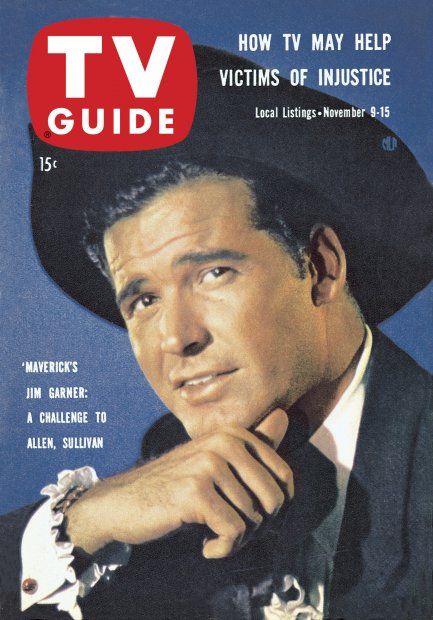
And so, Huggins avoided the dreaded Hollywood Blacklist and continued producing screenplays, most notably a trio of westerns -- Gun Fury (1953), Three Hours to Kill (1954) and the Randolph Scott vehicle, Hangman’s Knot (1952), which also saw Huggins take a rare shot at directing. But by 1955, Huggins shifted gears and mediums, moving to the small screen, taking jobs with Warner Bros. and 20th Century Fox’s TV divisions, where he produced hits like Cheyenne (1955-1963) and Maverick (1957-1962) -- an offbeat western starring James Garner (-- followed by Jack Kelly and Roger Moore), where Huggins guiding principle for his pool of writers went as follows: “In the traditional Western, the situation was always serious but never hopeless. In a Maverick story, the situation is always hopeless but never serious.” Around the same time Huggins also helmed the smash hit detective series 77 Sunset Strip (1958-1964).


Unhappy with how Warners treated him financially during this period, feeling they were constantly cheating him out of owed royalties, Huggins quit and joined Quinn Martin Productions, where he produced his biggest hit yet, The Fugitive (1963-1967), which Huggins always vehemently insisted was not based on the notorious Dr. Samuel Sheppard murder case but was, instead, intended to be a modern-day take on Victor Hugo’s Les Miserable, with David Janssen’s Dr. Richard Kimble as Valjean and Barry Morse’s Lt. Gerard subbing in for Javert, who chases Kimble while he chases down the one-armed man. But by the mid-1960s, Huggins had moved on to Universal, becoming vice-president of the TV division, where he would serve for nearly two decades, launching shows like The Virginian (1962-1971) and The Bold Ones (1969-1972).


And when the 1970s rolled around, after the Butch and Sundance cash-in Alias Smith and Jones (1971), Huggins left the western behind and started telling offbeat detective stories again, with things like Toma (1973) and Barreta (1975-1978), but then reached the absolute zenith of the small screen take on the genre when he teamed up with Stephen J. Cannell for The Rockford Files (1974-1980), once again featuring Garner as a pardoned ex-con turned acerbic and often reluctant detective who knew every scam in the book and could never get into his trailer without getting jumped by a few thugs -- especially if he had just been to the grocery store. Few shows were better. And Cannell, a TV legend himself, who also worked with Huggins again in the 1980s on Hunter (1984-1991), said of the veteran writer/producer, "Roy was in the driver's seat where he belonged. Nobody does it better or with more style...Roy Huggins is my Godfather, my Hero and my Friend. They don't come any better."

Huggins was still producing TV movies based on his properties up until his death in 2002, ending a remarkable career and a ton of hits that ran for nearly four decades. And while his work in film wasn’t quite as indelible, you can still see that Huggins’ “touch” in his screenplays, where ordinary, everyday but very fallible people soon find themselves in something completely over their heads.
Pushover would be one of the last screenplays Huggins would write, and one of its greatest joys is watching the wheels come off as Sheridan’s solid and near foolproof plan to rub out Wheeler, steal the girl and the loot unravels and goes completely awry while his desperate attempts to salvage it only makes things exponentially worse.
In the beginning, it appears this plan will go off without a hitch. And things are helped out considerably due to Sheridan’s partner becoming equally fascinated with Lona’s next door neighbor, a nurse named Ann Stewart (Malone), who is constantly distracted by her as they keep bumping into each other as McCallister lurks about. But this comes back to bite Sheridan in the ass when Ann, looking to borrow some ice for a party, finds Sheridan in Lona’s apartment when he isn’t supposed to be, making her a dangling loose end that will most likely have to be dealt with, and permanently.

And then there’s Paddy, who isn’t where Sheridan needs him to be for this plan to work but is instead inside that bar knocking a few back -- only to reappear at the most inopportune time. And so, Paddy kind of screws the pooch when Wheeler does show up. And when Sheridan’s attempt to soft-strong arm Paddy into accepting why his fellow cop had to kill Wheeler in a clumsy audible, Paddy, a drunk but no fool, doesn’t buy this cock 'n' bull is all about saving his pension at all. And that’s why Paddy moves the car with the money and the body in it on his own. And so that’s also why Sheridan accidentally kills him later when Paddy refuses to say where it is and threatens to turn him in.

And as the cops swarm in due to the gunshot, Sheridan tries to play this off as a suicide. And this buys him some time -- but not quite enough, as McCallister backs his story, having seen Paddy in the bar drinking. But his story starts to fall apart as the lies and spin mount, and Lt. Eckstrum is starting to smell a rat. And as the evidence starts pointing back toward him, Sheridan is soon on the run with Lona, who found Wheeler’s car and the loot in the interim.
And they might’ve still gotten away clean if Sheridan hadn’t detoured to take care of Ann, kidnapping her, leading to pretty cool game of cat and mouse as they try to get their disposable hostage out of the building and through the surrounding police dragnet -- stress on the might’ve.
Now. One of the other great pleasures of watching Pushover is getting to watch both the lovely Kim Novak and the gorgeous Dorothy Malone as the bad girl / good girl foils do their respective thing. I’m still not convinced that wasn’t Novak as the model used to lure Gaucho into making a movie for Jonathan Shields in The Bad and the Beautiful (1953). Either way, Lona McLane would be her first credited screen role. She would officially break out two years later in Picnic (1955), and would go on to torment Jimmy Stewart (and Alfred Hitchcock) in Vertigo (1958).
I think I first encountered Malone in Beach Party (1963), where I officially fell in love. She won an Oscar in 1956 for Written on the Wind but I still contend her best performance was in The Last Voyage (1961), one of the best disaster movies you’ve probably never heard of. Again, I cannot express how much these two drop-dead knockouts in those period fashions are worth the price of a rental alone.

Stitching all of this intrigue and eye-candy together was Richard Quine, one of Sam Katzman’s merry brigade of schlockmeisters making hay in Columbia’s B-units. The film was shot in downtown Burbank near the old Magnolia Theater -- featured prominently in the film. Shot mostly at night, with lots of rain and neon reflecting off the puddles, Quine manages to bring the usual noir trappings into this mounting melodrama, and manages to maintain the tension throughout Pushover as the noose finally closes around our hero’s neck and his journey down this ruinous road comes to its fatal end. A familiar journey, sure, but still well worth the time traveled inevitable or not that ending may be.
Pushover (1954) Columbia Pictures Corporation / P: Jules Schermer / AP: Philip A. Waxman / D: Richard Quine / W: Roy Huggins, Thomas Walsh (novel) / C: Lester White / E: Jerome Thoms / M: Arthur Morton / S: Fred MacMurray, Kim Novak, Philip Carey, Dorothy Malone, E.G. Marshall, Allen Nourse, Paul Richards
The poop has already hit the propeller as our latest feature opens with a ship at stormy sea obviously under duress, punctuated by the emergency beacon that has just been activated. Cut to the shore somewhere along the coast of Florida, where the local Coast Guard unit is scrambling to respond to the very same distress signal -- well, some more scrambling than others as one helicopter remains on the ground, much to the consternation of the pilot, Lt. Commander Pagnolini (Conrad), and those in the control tower, wondering why they haven’t lifted off yet. Turns out the reason for this delay is Pagnolini’s co-pilot, Lt. Haig (McClure), who is running a little slow, nursing another in a long line of hangovers in his eternal chase of the skirt.


Once he’s finally aboard, the chopper takes off and they receive coordinates to where they’re headed, which Haig notes is smack dab in the middle of the Devil’s Triangle, where a lot of strange things happen, including several unexplained disappearances of both boats and planes that are never seen again. And while en route, we learn Pagnolini is a religious man who frowns on his friend’s lustful behavior. Thus, a firm believer in God and the Devil, Pagnolini thinks there might just be something supernatural going on inside the Triangle, while Haig is slightly more pessimistic on such things and scoffs, feeling there is a rational explanation for just about anything, including the icing-up and engine malfunction of the accompanying helicopter despite the otherwise balmy tropical conditions, which is forced to turn back, leaving them to run the rescue mission solo.


They soon spot a flare, and then the ship emitting the distress beacon. It’s still afloat but the large yacht has been beaten up pretty badly by the rough seas -- the sails are shredded and the booms are not secured. Worse yet, closer inspection shows a body hanging upside down from the main mast, and another body is spotted stuck in a shattered hatch as if propelled through it from below.
Then, Haig swears he saw something moving inside the cabin -- and since someone had to have shot the flare off, Pagnolini lowers him to the deck with the chopper’s winch to look for survivors. Maintaining radio contact with the chopper, Haig checks on the two bodies first, confirming they are both dead and notes the one hanging from the mast appears to be a priest. He then heads below deck and makes the strangest discovery yet: another body, only this one appears to be suspended in midair. (And I cannot stress enough how eerie this discovery is.)


Sufficiently creeped out, Haig is about to bail and leave it to the Coast Guard cutter due to arrive in about 8 hours to mop things up, when he hears someone moaning and discovers a woman buried under several boxes of supplies. Her name is Eva (Novak), and she claims to be the only survivor on the vessel -- a vessel she claims is cursed. Reporting all this to Pagnolini, who is barely keeping the helicopter under control in the harsh crosswinds, he lowers the rescue basket to the deck, Haig and Eva strap in, and starts to reel them up. Unfortunately, the cable snaps, sending both into the ocean, but they manage to swim to the boat and get back on board. His fuel expended, Pagnolini radios he must return to the base and finally peels away when assured Haig and the woman will be fine until the cutter arrives the following morning.


Strangely enough, when the chopper leaves, the choppy weather calms down considerably. And after finding some dry clothes, and salvaging what they can from the wet bar, with nothing but time on their hands, Haig tries to coax Eva into explaining what happened to the others. Again, she thinks the boat is cursed by the Devil’s Triangle itself and this was the root cause of all the death and destruction around them. And so, when she call’s it the Devil’s Triangle, she means that quite literally...


As a child of the 1970s, I still bare a plethora of psychological scars from many a Made for TV Movie encounter. And one of the biggest emotional traumas came courtesy of Sutton Roley’s Satan’s Triangle (1975), which I saw when I was five or six. And as I’ve gotten older, and six or seven things seem to be wiped from my memory to make room for one single addition, there are still several images and scenarios from this thing still permanently etched in my brain -- most notably that inexplicably floating body, and then the completely bonkers ending that gave me a bad case of the night-drizzles for at least a week. Don’t worry, we’ll be getting to all that in a sec.

Now, the Made for TV Movie really found its legs when Barry Diller set up a specific time-slot for them in 1969 on ABC as The Movie of the Week. And since the network was getting absolutely pasted in the ratings by their competitors, with nothing to lose, Diller let his producers run wild with less traditional fair, resulting in tales of horror, science fiction and suspense, concerning sentient homicidal earth-moving equipment, ancient spirits of evil hijacking airplanes, were-spiders, alien invaders, vampires in Vegas, and psychic race car driving occult detectives, finding their way into living rooms across the country. And I remember many a night, gathering in the living room with the rest of my family unit, nestling into the shag carpet in that cocoon of wood-paneling and Naugahyde, and tuning in the old Zenith to watch and boggle at these things -- once the set warmed up, ‘natch.

And one thing you could always count on in a major Made for TV Movie event was for them to cash in on a current fad. And in 1975, there was no fad more current than the mysteries of The Bermuda Triangle. I know I was a paranormal freak back then, be it Bigfoot, UFOs, or the Loch Ness Monster -- and I wasn’t alone. The first allegations that something screwy was going on in the waters southeast of Florida first saw print in 1950, when an article by reporter Edward Jones was picked up by the AP, which tied together several maritime disasters to the area. In 1952, Fate Magazine published an article by George Sand, which was the first to note the (now standard) triangular shape of the troubled area, which stretched from the southern tip of Florida, to Puerto Rico, to Bermuda, then back to Florida, and the first to suggest a supernatural element was involved in all these strange disappearances. A decade later, Vincent Gaddis' "The Deadly Bermuda Triangle" saw print in the February, 1964, edition of Argosy, which further expanded on the pattern and causes of these disappearances. And though Gaddis would later publish his theories in a book, Invisible Horizons (1969), The Bermuda Triangle didn't really strike a chord with the masses until Charles Berlitz came along.

As the legend goes, gonzo author Charles Berlitz first became interested in the Triangle phenomenon at a travel agency in the late 1960s, when he became intrigued by several customers who adamantly refused any mode of travel through the dreaded area. Berlitz was already pretty gung-ho on extraterrestrial influences on ancient civilizations, underwater archeology, and the paranormal; more specifically, locating and proving the existence of the lost continent of Atlantis; and now, getting to the bottom of the deadly occurrences inside The Bermuda Triangle. And after compiling all of his research, Berlitz believed "the people and planes and ships that have reportedly disappeared in the Bermuda Triangle have been victims of some sort of electromagnetic disturbances that cause them to disintegrate and fall into the sea." And his speculative exposé on this theory, The Bermuda Triangle (1974), sold more than 14 million copies worldwide, feeding the voracious appetite of the cryptomania-addled public of the 1970s, who had gone completely bonkers over UFOs, Bigfoot, ghosts, and psychic whammies, just like me, and almost single-handedly made the notorious area of water a household name and caused a massive dip in Bermuda's tourist trade.

And so, producers Paul Junger Witt and Tony Thomas, no strangers to telefilms, having already produced MFTV classics like Brian’s Song (1971), A Cold Night’s Death (1973), and Home for the Holidays (1972), decided to use The Bermuda Triangle -- a/k/a The Devil’s Triangle, as a backdrop for their next feature. To direct, they hired Sutton Roley, a prolific director on the small screen, with series credits on Combat!, Mission Impossible, and Mannix, and a spiffy telefilm on the occult, Sweet, Sweet Rachel (1971) and the post-nuke, rats trapped in a maze, think-piece, Chosen Survivors (1974). (I highly recommend both.) The script fell to William Read Woodfield, who apparently worked with Roley before on a couple of those TV series. And together, with cinematographer, Leonard South, coupled with an eerie score by Johnny Pate, they delivered a haunting film with some surprising punch and a lot of teeth that sinks into you and won’t let go -- because just when you think you’ve got this plot locked down, trust me, you do not.

I will assume the title of Satan’s Triangle was chosen to avoid any legal hassles with the recently released documentary on the same subject matter, The Devil’s Triangle (1974). Again, Satan or the Devil, either way, the makers of this film decided to interpret that literally, mixing in another popular trend at the time: demon possession, thanks to The Exorcist (1973). That’s right. According to this movie, the reason all of those people and ships have disappeared was due to Satan himself out to consume unsuspecting souls. Think, “The Devil Went Down to Bermuda”. No. I am not making that up.


See, as the night wears on and Eva, convinced they’re both gonna die on the boat, just like the others, finally opens up about what happened, we discover she’s a high-end escort hired to accompany Hal Bancroft (Davis) on a boat trip this rich businessman had chartered with a guy named Strickland (Lauter). And the reason for this expedition was so Bancroft could land a bigger striped marlin than his brother-in-law, with whom he is apparently having a huge pissing contest with. And apparently, this brother-in-law is supposed to be a bigger asshole than Bancroft, though from what we’ve seen I have trouble buying this.


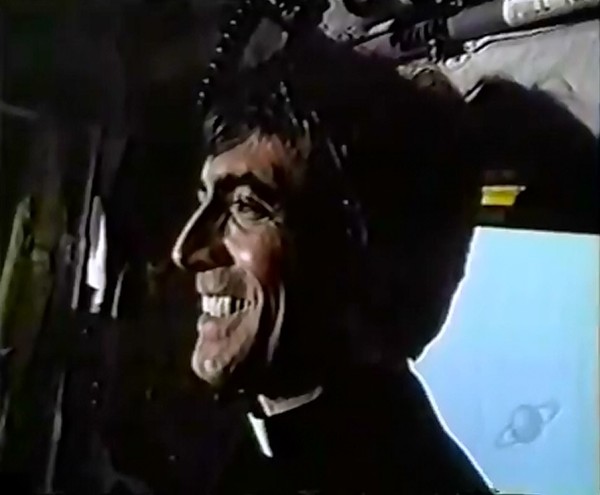
Anyhoo, Bancroft is about to land his prized fish when one of Strickland’s crew spies a man afloat on some wreckage. And over the fisherman's protest, his line is cut so they can execute a rescue. The man they pull from the water is a priest, Father Peter Martin (Rey), who claims to be the sole survivor of a plane crash that was transporting one of his parishioners to Miami for emergency surgery -- a crash he blames on the Devil. Then things start to get a little weird when the majority of Strickland’s crew gets freaked-out by the priest’s arrival and abandon ship, running off with the lifeboat.


And even though there is a massive storm brewing, Bancroft still has a fish to catch. And seeing his fat bonus going up in smoke unless they land one, Strickland and his last remaining crew-member, Salao (Vandis), try to get the boat started to pursue a spotted marlin. And when it refuses to start, they raise the sail. Then, the storm officially breaks wide open, tossing the ship around like a toy. Still, Bancroft manages to catch the marlin, which is then hauled below deck into a special refrigerated compartment. All the while, Eva has become quite infatuated with Father Martin as she listens raptly to his rapturous tales of the evil -- with a capital E, they’re currently surrounded by. And as the weather continues to worsen, Strickland tells Martin to take the wheel, while he and Salao go on deck to get the sails down before the boat capsizes and drowns them all -- but it’s already too late.

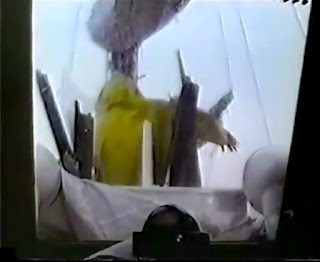

In short order, as the boat is rocked violently by the waves, Strickland is shot out of the front hold like a cannonball through the closed hatch, killing him instantly. And then, in a flash of lightning, Salao disappears off the deck. From below, Bancroft, who had been admiring his catch, starts screaming. And by the time Martin gets the door knocked down, he and Eva find Bancroft dead, his face contorted in pain, free-floating in the air. This is all too much for Eva, who swoons. Never fear, though, for Martin managed to turn on the distress signal. (Wait? How did he know where that was? And how it worked?) Hearing the approaching rescue helicopter, he grabs a flare gun and bolts for the deck, climbs the mast as high as he can, and fires the flare. Alas, the recoil causes him to lose his balance, and as he falls, his feet get tangled up in the ropes, bringing his free-fall to a quick, neck-snapping end, leaving him to swing in the breeze.


Thus and so, that is how Eva wound up being the last survivor of this doomed fishing expedition. And at some point during the night, she and Haig connected -- in a *ahem* ‘biblical sense’, which is why they wind up sleeping together after Haig takes her by the hand and proves what happened to all her shipmates was not due to the malignant supernatural forces of the Triangle, saying Strickland was jettisoned through the hatch due to the crashing waves; and Salao was most probably knocked off the deck by the unsecured boom, which she couldn’t see due to the lightning flash; and poor Father Martin just lost his balance; as for Bancroft’s seemingly preternatural fate, there’s a rational explanation for that, too; seems he got himself harpooned on the beak of the swordfish he caught, which was hung from the ceiling and was blocked from view by the body, and so, it just appeared the body was floating in mid-air.


And once the deed is done and the couple get dressed, Eva suddenly grows very curious about Pagnolini, when Haig mentions a hope he made it back OK. Told he is a righteous and pious man, and the complete polar opposite of Haig, Eva hopes to meet Pagnolini someday. Turns out she’ll get her wish as the Coast Guard has now returned in force, including Pagnolini in the circling chopper. And as an investigative team boards and starts working the scene, Haig and Eva are once again hauled into the waiting helicopter, where Eva suddenly becomes very belligerent, adamantly refusing to don the proper safety equipment. And here, Boils and Ghouls, is where Satan’s Triangle goes completely bonkers in the best way possible. So for those not wanting it spoiled, and want to experience the bonkers for themselves, skip the next couple paragraphs.


OK, then, here we go as the helicopter flies back to the coast, they receive a call from the commanding officer back on the boat. Seems he wants confirmation the body hanging from the mast was a priest. And when Haig confirms this, he’s told that’s not what they found. Cut to the boat as we see them lowering the body, obscured by the tattered sail, until it reveals this was Eva, dead, hanging there all along.
Told they found a woman hanging from the mast, both pilot and co-pilot look back in the hold to see Eva gone, replaced by Father Martin, who, turns out, is the freakin’ Devil! And while Haig tries to compute what he just slept with, the Devil claims he already has Haig’s soul and casts him out of the vehicle, from which he plummets to his death.
The Devil then turns his attention to the more devote Pagnolini, thinking he will make a much more impressive notch on his belt than the horny Haig. The demon then futches with the helicopter, killing the engines, sending it rocketing toward the sea. And all Pagnolini must do to save himself is renounce God and pledge allegiance to the Devil. He refuses, even though the Devil claims after he’s dead he will dopplegang him and take his wife and children. (There’s even an implication that he will rape them all.) He still refuses, saying they will see through his deceptions.


And with that, the Devil proclaims, “Then go to your God, Pagnolini,” and jumps out of the helicopter moments before it crashes. Bobbing to the surface, the Devil spots Haig’s body floating nearby. He also spots a nearby vessel heading toward them, having seen the crash. He then jumps bodies, taking over and reanimating Haig, who gives a smile and a friendly wave to the folks on the approaching ship, who have no idea what’s about to hit them.


Hole. Lee. Shit. And Cheese and Rice. Wow. This is what I’m talking about when I say these old Made for TV Movies tended to screw with your head. I just love how this is all set-up that something supernatural is going on only to have Haig ease Eva and the audience into a sense of relieved comfort. I mean, I know I was expecting some paranormal explanation, be it UFOs, ancient Atlantean Death-Rays, sea-monsters, or some kind of time-vortex, but nope. Rational explanations all around. Yup. At that point, we are fools for buying into this, lulled into what would be a brief and false sense of security only to get walloped over the head with that ending and true explanation! This. This is why I love these telefilms so much. That took some courage and some balls to pull that off. And they pulled it off quite brilliantly, as that climax is genuinely kinda frightening and still packs quite the punch -- especially if you don’t know it’s coming. Don’t look at me! I warned ya!

Helping make all of this work is an outstanding cast. Kim Novak tops the list, here. You know all along there’s something not quite right about her character, seemingly caught in a perpetual trance-like state. And yet, there is something truly evil in those eyes. Doug McClure is pretty solid as the nominal hero, who is played rather badly, always thinking with that bulge in his pants instead of his head. You also buy his fear during the big reveal, and that final shot of him smiling and waving will send shivers down your spine. Jim Davis and Ed Lauter a rock-solid character actors, who do nothing to tarnish that reputation here. And while Alejandro Rey appears to be overdoing things a bit, turns out he was just getting warmed up for the final confrontation, and his tete-a-tete with Michael Conrad, as they both take it to eleven, is just incredible.

What’s always been amazing to me about these old telefilms from the 1970s is how well they age -- even better than most of their same vintage cinematic counterparts I’d argue. With nothing to lose, they went for broke and always struck a raw nerve -- and somehow skirted around the censors. I’ve seen things they could never, ever, get away with today. I know some folks get hung up on the fashions and decor of the time and can’t get past it. That, is too bad. You’re missing some pretty great stuff. And what I know for sure, is it’s over forty years later and we’re still talking about them. And I still wish that someone, anyone, would usher these old telefilms into the digital age instead of having to rely on old and worn out VHS-rips on YouTube.


To be fair, Satan’s Triangle is probably an apex example of the genre I’m talking about. And it’s probably a toss up between this and A Cold Night’s Death as to which one freaked me out the most as a kid when the film premiered as one of those ABC Movies of the Week on January 14, 1975. It’s unique. It’s different. And it’s all kinds of creepy. I know it scared the piss out of me way back when, and honestly, it still kinda freaks me out a bit today.
What is Hubrisween? This is Hubrisween. And now, Boils and Ghouls, be sure to follow this linkage to keep track of the whole conglomeration of reviews for Hubrisween right here. Or you can always follow we collective head of knuckle on Letterboxd. That's 19 down with 7 to go! Only one week left. I totally got this. Up next: Ladies and Gentlemen, welcome to Pinky Violence.
Satan's Triangle (1975) Danny Thomas Productions :: American Broadcasting Company (ABC) / EP: Paul Junger Witt, Tony Thomas / P: James R. Rokos / AP: Judith Craig Marlin, David M. Shapiro / D: Sutton Roley / W: William Read Woodfield / C: Leonard J. South / E: Bud Molin, Dennis Virkler / M: Johnny Pate / S: Kim Novak, Doug McClure, Alejandro Rey, Michael Conrad, Ed Lauter, Jim Davis, Titos Vandis